Gabby Gets It Together (PAWS book 1) by Nathan Fairbairn, illustrated by Michele Assarasakorn

Published by Razorbill

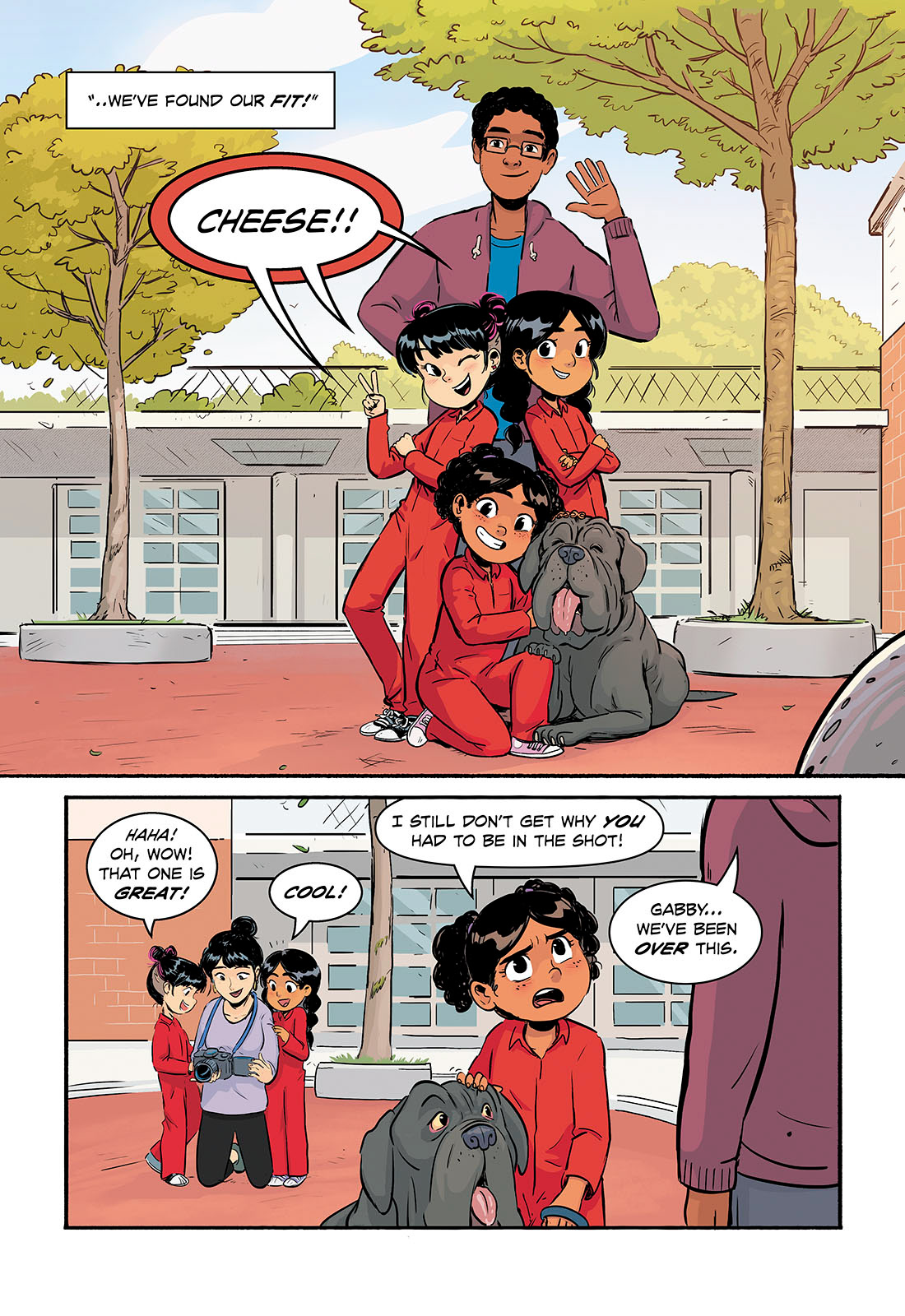
Summary:  The book opens with Gabby struggling to walk five dogs and losing track of four of them.  How did she get into this desperate situation? She explains how she and her friends Mindy and Priya love animals but for one reason or another can’t have pets.  They brainstorm how to get more animals into their lives and come up with PAWS, a dog-walking business.  Right away, they find five clients, but a lack of communication among the three of them leads to a series of misunderstandings that threatens the business.  Which brings us back to the opening scene, when Priya and Mindy have stood Gabby up, and she is trying to walk all five dogs.  Fortunately, all three girls have a change of heart, and Priya and Mindy show up in time to rescue the dogs and the business.  They talk about how to fix their mistakes, and PAWS is back in business and ready for book 2.  176 pages; grades 3-6.

Pros:  This graphic novel is going to be very, very popular in my library with all those kids who love The Baby-Sitters Club and Allergic, with believable tween protagonists, cute dogs, and colorful artwork.

Cons: Mindy and Priya seem to have the upper hand because they’re both a year older than Gabby.
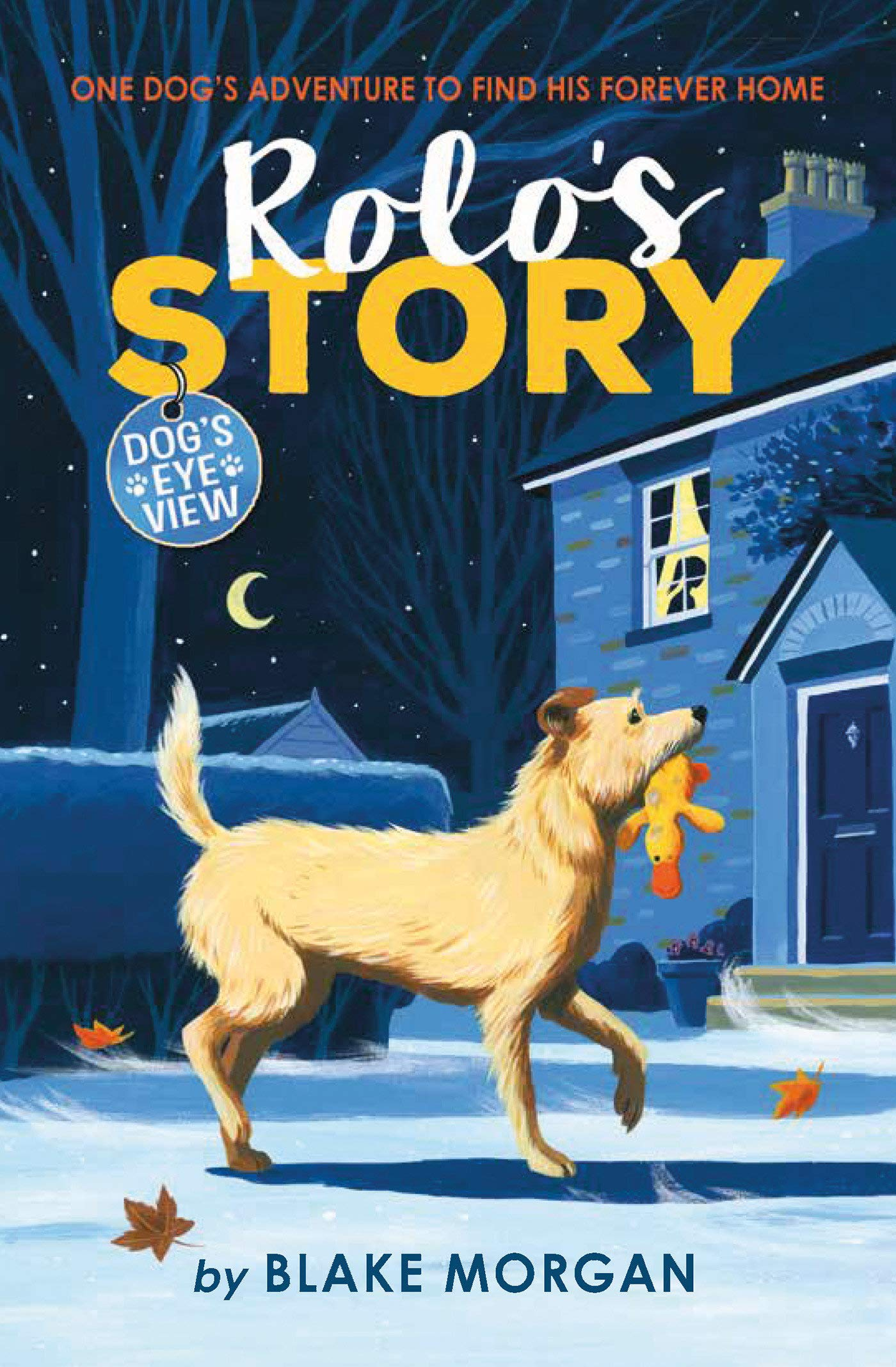
Rolo’s Story (Dog’s Eye View, book 2) by Blake Morgan, illustrated by David Dean

Published by Tiger Tales

Summary:  Rolo starts life with a cruel owner, often tied up in the backyard with a rope and without enough food.  He finally runs away but finds life as a stray to be a precarious existence.  After his friend and mentor Scrap is taken away to the pound, Rolo takes shelter in a shed where he is discovered by a girl named Freya.  Freya lives with her single mother, who is stressed by her many responsibilities and isn’t sure about adding an untrained puppy to the household.  Freya and Rolo’s obvious love for each other finally wins her over, and after a series of mishaps, Rolo finally gets some training.  His presence brings some changes to the household, and Mom finds a career that makes all of them happier.  192 pages; grades 2-5.

Pros:  I always enjoy a good dog-narrated story, and this one is particularly heartwarming, especially for readers who, like Rolo, may not always succeed at carrying out their good intentions.  This is book 2 in a series whose subject matter and relatively low page count is sure to appeal to a wide range of elementary readers.

Cons:  I wish there had been more illustrations besides the same picture of Rolo at the head of each chapter.  Also, Mom’s overnight career switch from accountant to dogwalker seemed a bit fiscally risky.

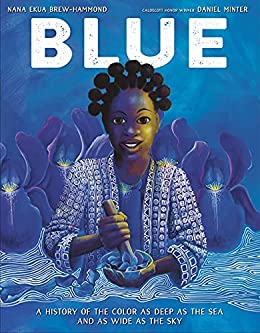
Blue: A History of the Color as Deep as the Sea and as Wide as the Sky by Nana Ekua Brew-Hammond, illustrated by Daniel Minter

Published by Knopf Books for Young Readers

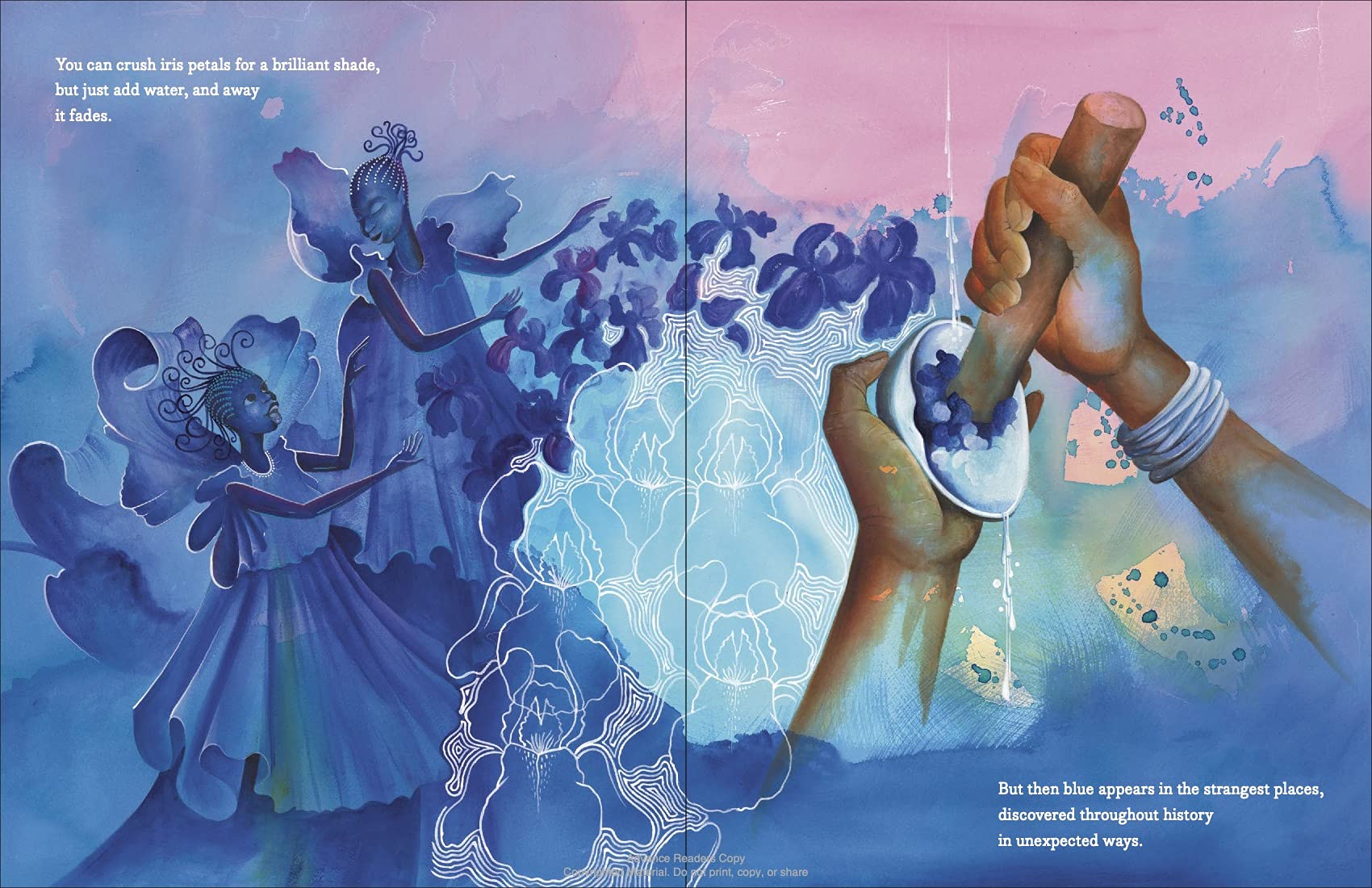
Summary:  Blue may be the color of the sky and the ocean, but for much of human history, it was a difficult color to produce.  Ancient Egyptians crushed the blue stone lapis lazuli to make paint and eye makeup that only the very wealthy could afford.  Later, people discovered shellfish that produced a blue dye, but each organism only produced a drop or two.  Finally, the indigo plant, a native of Asia, Africa, the Caribbean, and the Americas, became more widely known and cultivated.  The value of the plant’s blue dye led to abuses as people were tricked into growing it instead of food and enslaved to help mass produce it.  In 1905, Adolf von Baeyer was awarded a Nobel prize for, among other things, creating a blue chemical dye.  Now everyone can own something that’s blue, but the rarity of blue and the suffering created in its production remind us of expressions like “the blues”, “feeling blue”, and “out of the blue”.  Includes two pages of additional information and a list of selected sources.  40 pages; grades 1-5.

Pros:  Here’s a fascinating history of something I had no idea had a fascinating history: the color blue.  Kids will have a greater appreciation for blue jeans and other commonplace items after reading about the struggles and high value associated with blue.  The gorgeous illustrations feature many different colors but appropriately highlight blue.

Cons:  Some of the claims about the expressions noted above were pretty speculative, and when I looked into them, they don’t appear to have the connections to the color the author writes about.

Nigel and the Moon by Antwan Eady, illustrated by Gracey Zhang

Published by Katherine Tegen Books

Summary:  Nigel has big dreams: he wants to be a dancer, an astronaut, and a superhero.  At night, he tells his dreams to the moon, but during the day it’s harder to share them.  During career week at his school, other kids talk about their plans to become a doctor, an engineer, or a veterinarian, but when it’s Nigel’s turn, he’s afraid to reveal his dreams.  He’s also shy about revealing his parents’ occupations, feeling like they’re not as “fancy” as his classmates’.  On the last day of the week, parents come in to talk about their careers.  Nigel’s parents tell what they enjoy about their jobs as a mail carrier, truck driver, and the best job of all: raising Nigel.  Emboldened, Nigel stands in front of the room between his mom and dad and tells the class exactly what he hopes to become someday.  40 pages; ages 4-8.

Pros:  Nigel’s insecurities are realistically portrayed, as he struggles to find the courage to share his dreams.  The illustrations effectively portray the dreamy night sequences and the brighter daytime scenes.  This would be a great book for introducing community helpers as well as empowering shy kids to share more about themselves.

Cons:  It seemed kind of stereotypical to have Nigel, apparently the only Black kid in the class, also be the only one whose parents had more blue-collar jobs.

The Supernatural Society (book 1) by Rex Ogle

Published by Inkyard Press

Summary:  Will’s struggling with his parents’ recent divorce, his father’s abandonment, and a move from New York City to the small town of East Emerson.  At first he thinks that the monsters he’s seeing in his new town are some overenthusiastic Halloween fans, but before long he realizes that he alone can see the horrors all around him.  Alone, that is, except for his somewhat eccentric neighbor Ivy, who’s in possession of a ring that allows her to see them as well.  Her brilliantly geeky brother Linus doesn’t have the gift and isn’t sure what to believe, but the three of them ultimately form a team to solve the mystery of disappearing pets in town and discover the evil force behind it.  Narrated by Adam Monster, with a voice that evokes A Series of Unfortunate Events, the book ends with a number of unresolved issues, paving the way for book 2 and beyond.  288 pages; grades 4-7.

Pros:  Fans of Lemony Snicket, The Notebook of Doom series, and other books that combine humor and horror will enjoy this series opener that delivers plenty of both.

Cons:  I was sure that Adam Monster’s identity would be revealed in a way that would somehow tie into the rest of the story, but at least in book 1 he seemed to be a somewhat random choice for a narrator.

Bathe the Cat by Alice B. McGinty, illustrated by David Roberts

Published by Chronicle Books

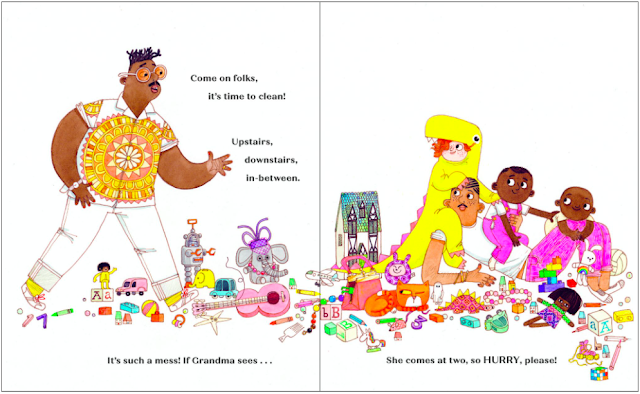
Summary:  Grandma’s coming for a visit, and it’s time to get the house whipped into shape.  The narrator posts a list of chores on the refrigerator with magnetic letters: mop the floor, mow the lawn, feed the fishes, rock the baby, bathe the cat.  Bathe the cat?!  When the cat hears that, he springs into action, making a mess of the letters on the fridge and creating a new chore list.  Family members start vacuuming the lawn and mopping the baby.  But when the cat hears “mow the cat”, it’s time for another letter scramble.  Finally, things are so mixed up, the narrator just tells everyone what to do, and this time it’s the baby who gets bathed and the cat gets rocked.  48 pages; ages 3-7.

Pros:  I could hear the sound of preschool children laughing as I read this zany book with all of its mixed-up chores.  The illustrations add to the high energy with neon pink, yellow, and orange, and lovingly depict a biracial two-dad family. 

Cons:  When Grandma appears on the last page, she looks like she wouldn’t miss a beat coming into a house with an unvacuumed rug, an unmowed lawn, and an unbathed baby, so I don’t know what all the fuss was about
.

Mardi Gras Almost Didn’t Come This Year by Kathy Z. Price, illustrated by Carl Joe Williams

Published by Atheneum Books for Young Readers

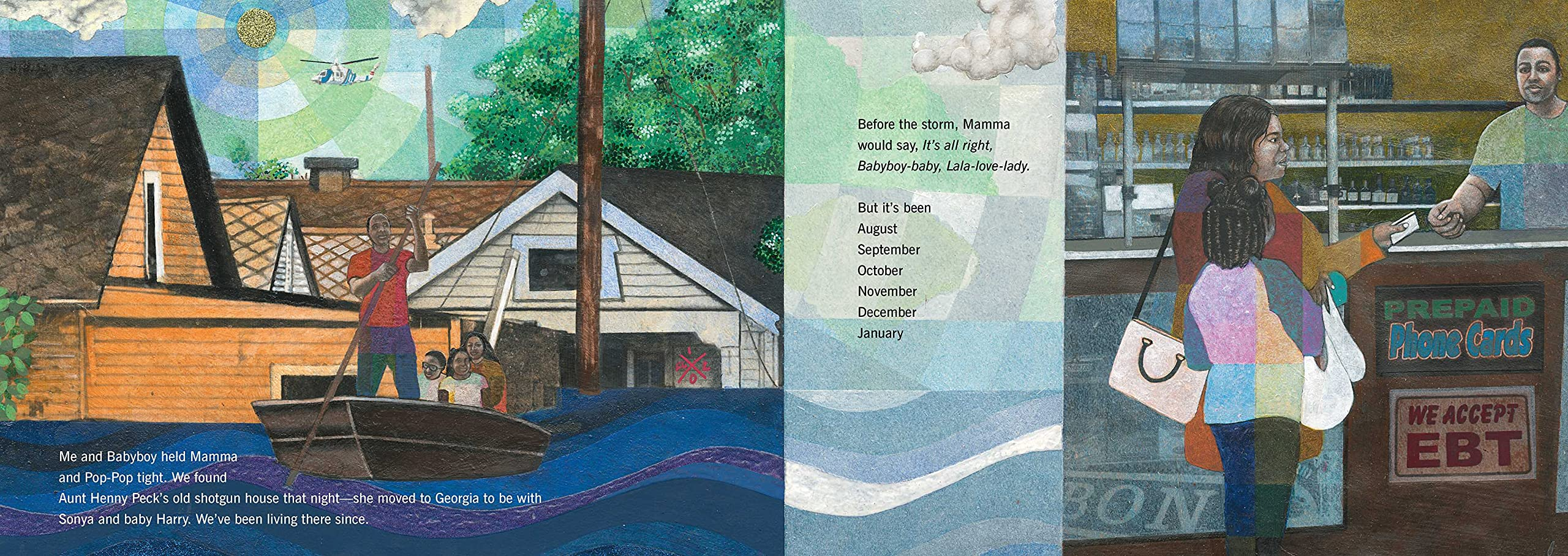
Summary:  Life has been pretty grim since Laia and her family survived Hurricane Katrina.  They’re living in temporary housing, facing a long wait for their home to be rebuilt.  Her dad hasn’t picked up his trumpet since the storm, and her mom no longer sings or dances.  Mardi Gras has always been the joyful centerpiece of the family’s year, but this year it feels wrong to celebrate.  As the festival approaches, though, Laia decides she’s going to make Mardi Gras happen for her younger brother.  She gets out his drum and is ready to play when her father walks in with some calla lilies for the family, as well as seeds to plant when their house is ready.  Then Babyboy starts tooting on his dad’s trumpet, which he’s secretly taught himself to play, and before long the family is out in the street, ready to celebrate.  The story ends on a hopeful note, with the whole family dreaming about the day their house will be rebuilt.  Includes additional information about Katrina and Mardi Gras after the hurricane and during Covid-19.  Also includes a glossary.  48 pages; grades 1-5.

Pros:  The poetic text and gorgeous mixed media illustrations really capture the spirit of New Orleans and the resilience of surviving a devastating natural disaster.  The author’s note at the end provides excellent information for understanding better the importance of Mardi Gras to the people of New Orleans.

Cons:  Readers who aren’t familiar with New Orleans, the Mardi Gras, and Katrina will need a lot of background information to fully understand the story.

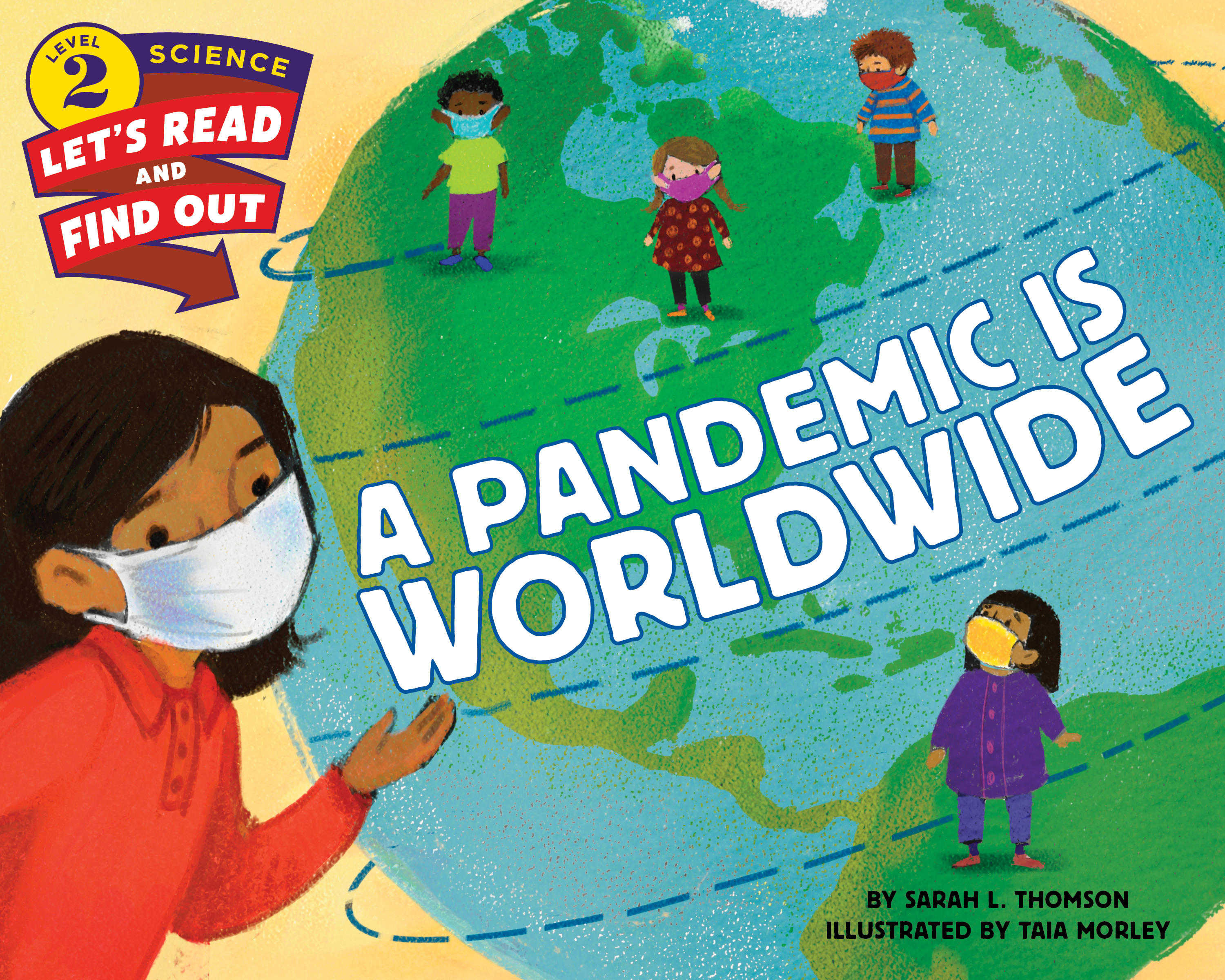
A Pandemic Is Worldwide by Sarah L. Thomson, illustrated by Taia Morley

Published by HarperCollins

Summary:  This book presents a straightforward look at what a pandemic is, with a brief history of past pandemics and an introduction to Covid 19.  There’s a quick look back at the development of vaccines and antibiotics and precautions that were taken in our current pandemic before a vaccine was developed.  The book ends on an optimistic note: “Everyone who wore a mask or washed their hands or stayed home until it was safe helped bring about the day when the pandemic was over at last.”  Includes a glossary, hand washing instructions, and a timeline of past pandemics.  40 pages; ages 4-8.

Pros:  The Let’s-Read-and-Find-Out series continues to do what it’s done well for the last 60 years: present science in a clear and understandable way to preschool and early elementary students.  At least that’s their target audience: I feel like by now I should know the difference between an outbreak, an epidemic, and a pandemic, but I learned that from reading this book.

Cons:  I wasn’t crazy about the small font.

The Puppy Problem (The Daily Bark, book 1) by Laura James, illustrated by Charlie Alder

Published by Bloomsbury Children’s Books

Summary:  When Gizmo the dachshund moves from the city to a small village called Puddle, he’s a little nervous about meeting new dogs.  Fortunately, his neighbor Jilly is a friendly Irish wolfhound with four adorable puppies.  Trouble is soon on the horizon, though, when Jilly learns that her humans are sending the puppies to new homes that are far away.  Jilly is desperate to find local places for her pups, and she and Gizmo set out to enlist the help of the other village dogs.  They hit one dead end after another until Gizmo has an idea inspired by his newspaper editor owner.  He writes up a notice for the other dogs to post, and in no time, new owners in Puddle have been found for all the puppies.  The dogs are so pleased with their success that they decide to start their own newspaper, The Daily Bark, which will undoubtedly be further explored in book 2 of this series. 128 pages; grades 2-4.

Pros:  Early chapter book readers will find it difficult to resist the four adorable puppies and the watchful dachshund on the cover of this charming book.  Filled with colorful illustrations and written in a large font, this would make a great first chapter book.

Cons:  If it takes Gizmo all night to write a 60-word notice, he’s going to have a heck of a time putting out a whole newspaper.

Olu & Greta by Diana Ejaita

Published by Rise X Penguin Workshop

Summary:  Olu and Greta are cousins who have never met, since Olu lives in Lagos, Nigeria, and Greta is from Milan, Italy.  How would they get together?  It’s too far to walk, skate, or dance, and they don’t know how to fly or operate a spaceship.  It’s possible to take a boat or plane, but that hasn’t happened yet.  So they send each other packages and talk through their computers to share their lives long-distance.  The final illustration shows them as teenagers taking a selfie.  32 pages; ages 3-8.

Pros:  This brief story with striking digital illustrations would make a great introduction to a pen pal project, or to get kids thinking or writing about what they would send to someone they had never met.

Cons:  The postal service may struggle to deliver Greta’s package, which is addressed to “Olu, Nigeria.”