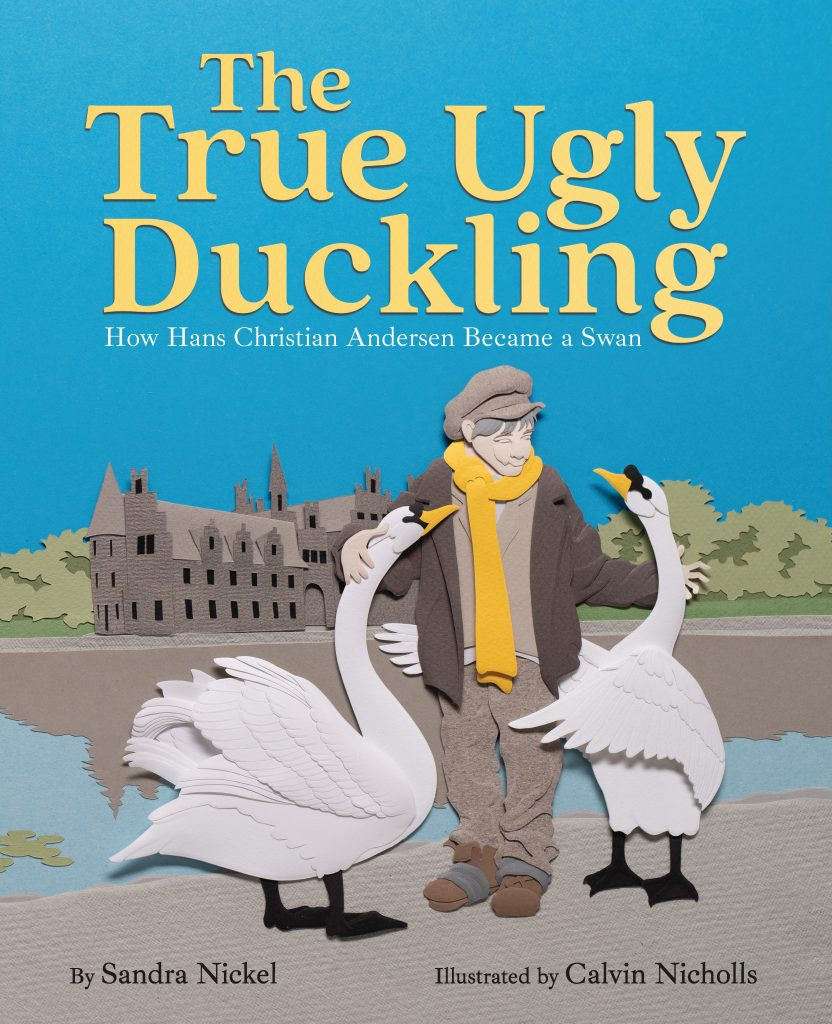
The True Ugly Duckling: How Hans Christian Andersen Became a Swan by Sandra Nickel, illustrated by Calvin Nicholls (Levine Querido, 32 pages, grades K-3). Hans Christian Andersen’s life is presented as a story that parallels his ugly duckling fairy tale. As a child growing up in a small town, he spent his days making up stories and creating costumes to act them out. While a few townspeople were kind, most made fun of him, and young Hans headed to the city of Copenhagen as soon as he could. There, he tried to make it as an actor, dancer, and singer, but he failed at each of these endeavors. Finally, a play he wrote caught the eye of a director who sent him to school. Teachers there made him put aside his storytelling in favor of Latin and history. After six long years, he was able to return to his stories, and although adults found them strange, children loved them. Hans Christian Andersen’s stories and cut paper illustrations earned him a place among the royalty of Copenhagen, and those stories live on today. Includes an author’s note with additional information about Andersen, including how her own autism drew her to write about the storyteller, who likely had both autism and Marfan syndrome.
This lightly fictionalized account of Hans Christian Andersen’s life would make a good introduction to a study of his work, with both biographical information and references to some of his well-known stories. The cut-paper illustrations are beautiful and mirror Andersen’s own work with paper.
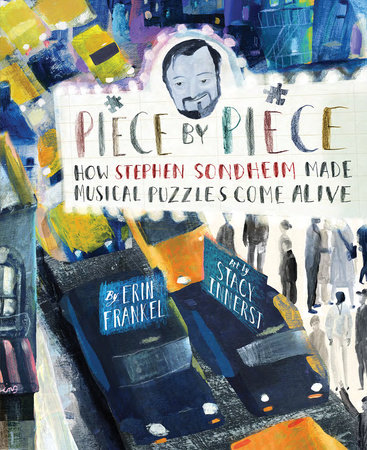
Piece by Piece: How Stephen Sondheim Made Musical Puzzles Come Alive by Erin Frankel, illustrated by Stacy Innerst (Calkins Creek, 40 pages, grades 2-5). Growing up in New York City, Stephen Sondheim was a curious kid who liked to figure out how things worked. When he saw his first musical, he was completely captivated by how the different pieces–music, story, dance–all fit together. After his parents split up, he and his mother moved to Pennsylvania, where he made a new friend Jamie, whose father, Oscar Hammerstein II, became Stephen’s mentor. Stephen wrote his first musical, By George, when he was 15. After college, he got a lucky break when he was offered the role of lyricist for the new musical West Side Story. That brought him enough recognition to start creating his own musicals, and Stephen Sondheim became a Broadway legend. Includes an author’s note, photos, a timeline of Sondheim’s life, and a bibliography.
Another good book for introducing the work of an artist, with a short enough story to easily read aloud but plenty of allusions to Sondheim plays in both the text and illustrations. The puzzle metaphor felt a little forced to me, but it did give me a deeper appreciation for all the parts of a musical that have to work together.
 A Kids Book A Day