A Life of Service: The Story of Senator Tammy Duckworth by Christina Soontornvat, illustrated by Dow Phumiruk

Published by Candlewick

Summary:  Tammy Duckworth’s father worked for the UN, and she grew up all over southeast Asia.  She knew she was American, though, and dreamed of a life of service to her country.  After graduating from college, she joined the Illinois Army National Guard as a unit commander.  Her three-year commitment was up when the US declared war on Iraq.  Although Tammy opposed the war, she didn’t want to leave her unit, so she got permission to extend her service and went to Iraq.  While flying a helicopter there, she was hit by a grenade and lost both of her legs.  Her military career was over, but she wanted to continue to serve, particularly her fellow veterans.  In 2012, she was elected to the House of Representatives, and in 2016, to the Senate.  She became the first Thai American woman and the first female amputee in Congress, as well as the first Senator to give birth while in office.  And I’m happy to report that just a few days ago she became the first Illinois woman to be reelected to the Senate.  Includes a timeline, a list of projects Senator Duckworth has worked on, and additional resources.  48 pages; grades 1-5.

Pros:  In her fourth book this year, Christina Soontornvat relates the story of fellow Thai American Tammy Duckworth’s inspiring life of service.  The appealing illustrations help tell the story, and the back matter makes this an excellent book for research.

Cons:  I wish I had read this just a day early to get it on the blog for Veteran’s Day.

A Book, Too, Can Be a Star: The Story of Madeleine L’Engle and the Making of A Wrinkle In Time by Charlotte Jones Voiklis and Jennifer Adams, illustrated by Adelina Lirius

Published by Farrar, Straus and Giroux

Summary:  Madeleine L’Engle grew up with a writer father and musician mother who encouraged her sense of wonder.  There were often artists at their New York City home, where Madeleine wrote stories from a young age.  She was shy, though, and school was difficult until she used her powers of imagination to make friends.  After college, she worked in the theater, where she met her husband.  They moved to the country and had three children while Madeleine continued her writing, most of which was rejected by publishers.  On a cross-country camping trip, she found inspiration in the Painted Desert and began working on the manuscript that would eventually become A Wrinkle in Time.  As her fame grew, she received many letters from children and always answered, encouraging them to find ways to tell their own stories.  Includes several pages of back matter including a list of Madeleine’s books for young readers, further reading, and a timeline.  40 pages; grades 1-5.

Pros:  I loved the somewhat whimsical illustrations of this picture book biography co-written by one of Madeleine L’Engle’s grandchildren. It’s a great introduction to Madeleine’s life and would be a perfect lead-in to reading A Wrinkle in Time.  

Cons:  I wasn’t crazy about the timeline being on the back cover, although it is printed so it’s not covered by the back flap.

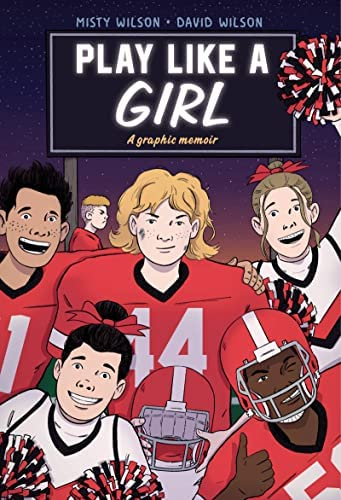
Play Like a Girl: A Graphic Memoir by Misty Wilson, illustrated by David Wilson

Published by Balzer + Bray

Summary:  Misty’s always loved competing with the boys, so when they tell her football’s not for girls, she decides to prove them wrong. It’s the summer before seventh grade, and she convinces her best friend Bree to sign up for seventh grade football with her.  Practices in the August heat are grueling, and the girls have to learn new skills like tackling and learning how to wear football pads.  It proves to be too much for Bree, but Misty sticks with it and becomes an important part of the team.  Most of the boys eventually accept her as a teammate, but a couple never do, which results in some uncomfortable situations.  In between practices and games, Misty deals with friendship issues, a crush on a teammate, and being part of a large blended family.  In the end, she learns the importance of being herself and surrounding herself with people who believe in her.  Includes an author’s note with some additional information about her football career.  272 pages; grades 3-7.

Pros:  This husband-and-wife team has produced an excellent graphic memoir that will inspire kids to try something outside of their comfort zones.  Sure to appeal to the many fans of the ever-growing middle school graphic novel genre.

Cons:  I was bummed that Misty quit football after seventh grade.

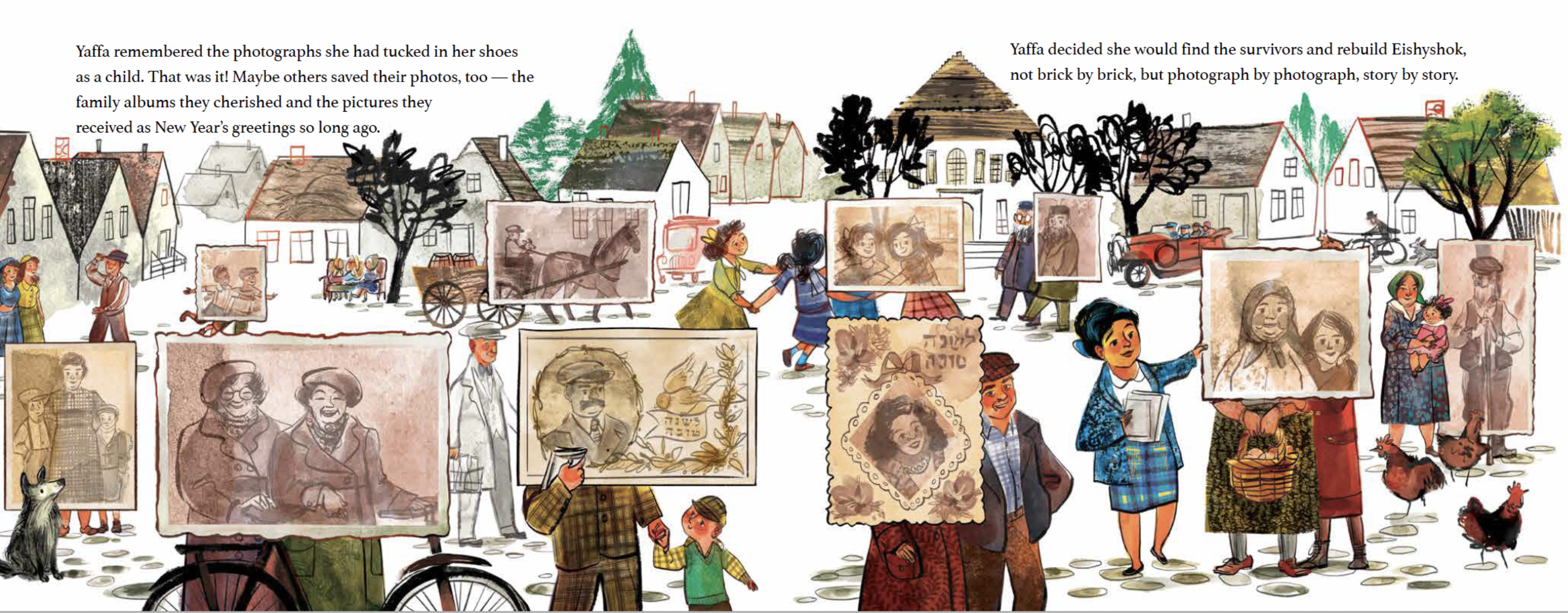
The Tower of Life: How Yaffa Eliach Rebuilt Her Town in Stories and Photographs by Chana Stiefel, illustrated by Susan Gal

Published by Scholastic Press

Summary:  Yaffa Eliach had a happy childhood in the Jewish town (shtetl) of Eishyshok, playing with her friends and older brother and helping her grandmother in her photography studio.  But when Yaffa was six years old, German tanks rolled in and the village, along with most of its inhabitants, was destroyed.  Yaffa’s family managed to flee and lived in hiding for the next several years.  They left their possessions behind except for a few photographs Yaffa hid in her shoe.  After the war, Yaffa moved first to Israel, and then to the United States, where she became a history professor specializing in the Holocaust.  When the Holocaust Museum was built in Washington, DC, President Jimmy Carter asked Yaffa to create an exhibit to show the lives of people who were lost.  Yaffa searched all over the world for photographs of people who had lived in Eishyshok.  Over the course of 17 years, she traveled to six continents to collect over 1,000 photos that were turned into the “Tower of Life” exhibit at the Holocaust Museum.  Includes a timeline of Yaffa’s life, a bibliography, and a brief author’s note.  40 pages; grades 1-4.

Pros:  An inspiring story of an amazing woman who emerged from tragedy to create a beautiful tribute that celebrates the lives of those who died in the Holocaust.  The illustrations capture those lives as well, incorporating photos into the paintings.

Cons:  I would have liked more information about Yaffa in the back matter.

Going Places: Victor Hugo Green and His Glorious Book by Tonya Bolden, illustrated by Eric Velasquez

Published by Quill Tree Books

Summary:  Victor Hugo Green had a successful career as a mail carrier in Leonia, New Jersey, but he also liked to travel.  In the 1930’s, more people were buying cars and using them to visit new places.  Black travelers were less hassled in their cars than on trains, but they also faced Jim Crow laws that prevented them from using certain hotels, restaurants, and other establishments, and sundown laws that prohibited them from being in certain towns after dark.  Green used newspaper ads and articles and the knowledge of friends and co-workers to put together a directory of places that were safe to go.  Known as the Green Book, it started as a pamphlet in 1936, covering the New York City area, but continued to grow to cover the entire U.S. as well as Mexico and Canada.  In 1953, Victor Hugo Green retired from his postal career to spend his time running a travel agency and keeping up with the Green Book.  He died in 1960, a few years before the Civil Rights Act of 1964 made much of the Green Book obsolete.  Includes a timeline, selected sources, and a list of places to learn more about the Green Book.  40 pages; grades 2-5.

Pros:  This fascinating look at the man behind the Green Book weaves in plenty of details about the ways racism affected Black travelers for much of the twentieth century.  The vivid oil paintings bring traveling to life with their colorful postcards, reproductions of black-and-white photos, and maps.  Worthy of a consideration for a Coretta Scott King award or honor.

Cons:  While I was hoping to see a page from the actual Green Book, the illustrations offer only tantalizing glimpses.  Guess I will have to peruse the digital editions listed in the back matter.

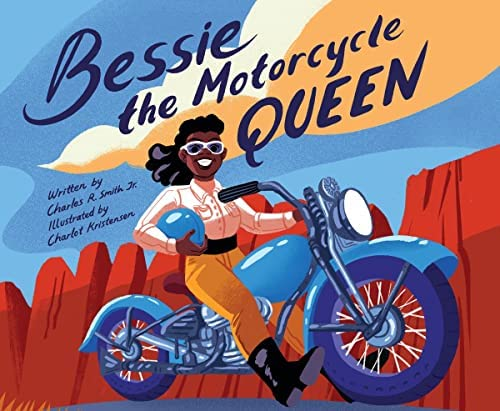
Bessie the Motorcycle Queen by Charles R. Smith, Jr., illustrated by Charlot Kristensen

Published by Orchard Books

Summary:  A daredevil motorcycle rider named Bessie takes the challenge to ride the Wall of Death, fearlessly showing off with no hands and riding sidesaddle.  When she takes off her helmet, the audience is surprised by her “hidden brown face.”  The year is 1929, and a Black woman riding her motorcycle alone across the country faces potentially dangerous situations, especially in the Jim Crow south, where she outruns a truck full of angry KKK members.  But Bessie is undeterred, choosing her destinations by flipping a penny onto a US map, repairing her bike herself, and sleeping on it when she can’t get a room.  The word VROOM is repeated throughout the story as Bessie zooms off to her next location.  Includes additional information about Bessie Stringfield and a bibliography.  40 pages; grades 1-4.

Pros:  The bouncy rhyming text and beautiful illustrations tell an inspiring story about this little-known woman. Although kids may need some explanations about Jim Crow laws and the KKK, this would be a good Black history read-aloud for primary grades.

Cons:  Unfortunately, not much is known about Bessie, so facts about her life like her birthdate and hometown are uncertain.


Maya’s Song by Renée Watson, illustrated by Bryan Collier

Published by HarperCollins

Summary:  Maya Angelou’s story is told in a collection of free verse poems, illustrated with watercolor and collage illustrations.  The story begins with her birth in 1928 and continues through her childhood spent in California, Arkansas, and Missouri, where “her mother’s boyfriend hurt her body, hurt her soul,” leading Maya to stop speaking for five years.  Her love of poetry helped her to recover her voice, and she went on to become a singer and then a poet, befriending James Baldwin, Martin Luther King, Jr., and Malcolm X.  Her memoir I Know Why the Caged Bird Sings brought her to national prominence; the story ends with her reading a poem at Bill Clinton’s presidential inauguration, fulfilling her grandmother’s prophecy that she would be a preacher and a teacher.  Includes a timeline and notes from the author and illustrator.  48 pages; grades 2-6.

Pros:  This amazing poetry biography is sure to be considered for multiple awards for both the writing and the illustrations.  I was immediately drawn into Maya Angelou’s story; Renée Watson is a masterful poet who tells the most difficult aspects of that story in a way that can be shared with young children.  The illustrations are gorgeous, layered with colors and patterns.

Cons:  No additional resources are given.

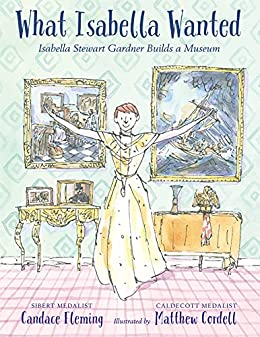
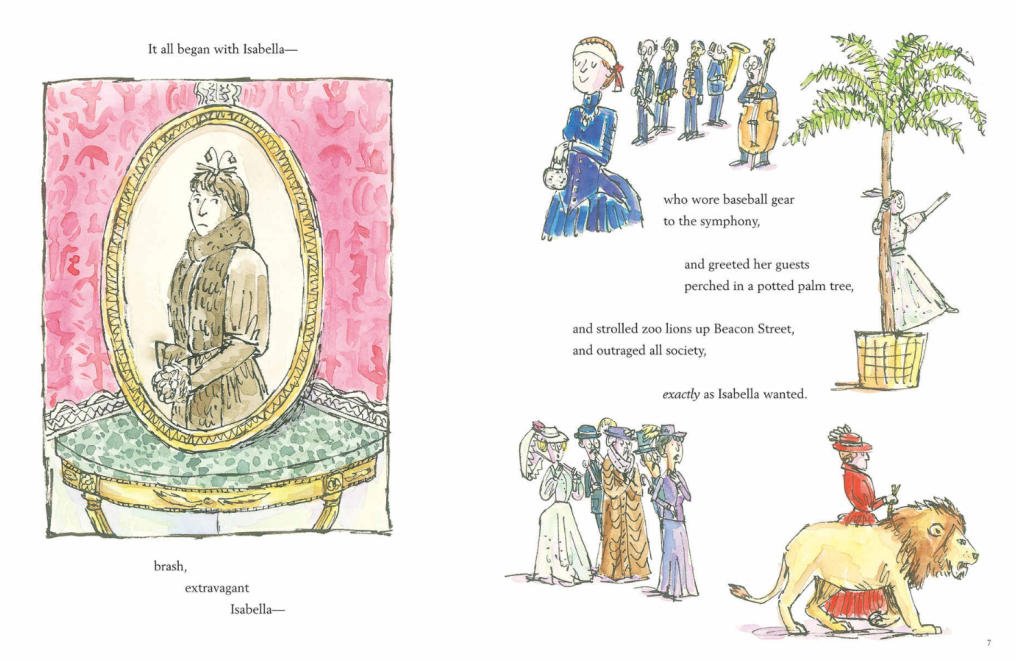
What Isabella Wanted: Isabella Stewart Gardner Builds a Museum by Candace Fleming, illustrated by Matthew Cordell

Published by Neal Porter Books

Summary:  The story begins and ends with the empty picture frames hanging in the Isabella Stewart Gardner Museum following the 1990 robbery of thirteen works of art worth $500 million.  In between, the reader learns of the eccentric Isabella who knew exactly what she wanted and wasn’t afraid to do what she needed to do to get it–even if it meant breaking some laws to obtain European and Asian artworks.  She built the museum herself, living on the top floor and displaying the art on the other three.  When it was done, she opened it to the public twenty days a year for more than twenty years.  Today, the museum is still a highlight to visit in Boston.  Includes an extensive author’s note with more information about Isabella (including her unethical collection practices) and a bibliography.  40 pages; ages 4-8.

Pros:  The lively free verse text and illustrations by Caldecott Medalist Matthew Cordell bring Isabella and her museum to life and pose intriguing questions about the art theft.

Cons:  This is another New England Book Award finalist (the winner was Keepunumuk by Danielle Greendeer in case you’re interested) and may not be of as much interest to those living outside of New England.

I Am Ruby Bridges by Ruby Bridges, illustrated by Nikkolas Smith

Published by Orchard Books

Summary:  Ruby Bridges tells her story of integrating William Frantz Elementary School in 1960 at the age of six.  While she has heard of Brown v. Board of Education, she is more interested in making friends and who her teacher will be.  She is surprised to be driven to school by four white men, to have a white principal, and most of all, to discover that she is the only student in her classroom.  Seeing that empty classroom makes her finally realize what is going on: she is the first Black child to attend the school, and that will allow other Black students to go there too.  “And that’s a good thing, for Black kids.  For white kids, too…for all the kids, once they finally get here!”  Includes a glossary and notes from the author and illustrator.  48 pages; ages 4-8.

Pros:  An inspiring autobiography with bold illustrations that capture young Ruby’s humor and courage.  If you’re looking for a Black history read-aloud for primary grades, this is a perfect choice that shows kids the powerful difference one six-year-old made in a way that they will relate to.

Cons:  You will probably want to supplement this with additional material to explain to kids exactly what it was Ruby did.

Finding My Dance by Ria Thundercloud, illustrated by Kalila J. Fuller

Published by Penguin Workshop

Summary:  The author introduces herself on the first page as Wakaja haja piiwiga, meaning “Beautiful Thunder Woman” from the Ho-Chunk Nation in Wisconsin and the Sandia Pueblo in New Mexico.  She loved dance from the time she received her first jingle dress and began dancing in the powwow at the age of 4.  At 13, she started learning other forms of dance–modern, tap, jazz, ballet–and became a professional dancer after graduating from high school.  Sometimes the restraints of classical dance felt wrong to her, though, and she felt like an outsider.  She has returned to her roots, dancing the eagle dance with a set of eagle wings and now has a daughter of her own.  Remembering how people used to say her name wrong, she corrects those who mispronounce her daughter’s: “Every time someone says our names, they are speaking a language that still exists, and a culture that we still honor, despite many attempts to wipe it out forever.”  40 pages; grades 1-5.

Pros:  This beautiful story will resonate with anyone who is trying to find their place in the world.  It celebrates both dance and indigenous cultures, with lovely illustrations filled with gorgeous colors that play with light, shadows, and patterns.

Cons:  No back matter.