Solving the Puzzle Under the Sea: Marie Tharp Maps the Ocean Floor by Robert Burleigh, illustrate by Raul Colon

Published by Simon and Schuster 

Summary: Marie Tharp fell in love with maps when she and her family moved from place to place for her father’s job. After attending 17 different schools, she studied geography in college, then got a job at Lamont Geological Laboratory at Columbia University.  Looking for a groundbreaking project to work on, she teamed up with her colleague Bruce Heezen to map the ocean floor.  For 20 years, from 1957 to 1977, Heezen collected data on many ocean trips, and Tharp turned the data into maps.  Along the way, she discovered a deep rift in the Atlantic Ocean which helped support the theory of continental drift.  Her maps have been used in schools and museums around the world.  End matter includes more information about Marie Tharp, a glossary and bibliography, and a page entitled, “Things to Wonder About and Do”.  40 pages; grades K-4.

Pros: The first person narration imbues the story with Marie’s own energy and enthusiasm. Colon’s illustrations beautifully capture the light and colors of the seas and the intricacies of Tharp’s maps.

Cons:  The continents are moving an inch or two every year?!

Ada Byron Lovelace and the Thinking Machine by Laurie Wallmark, illustrated by April Chu

Published by Creston Books

Summary:  From the time Ada Byron was a child, she loved the world of science and, especially, math.  She designed a flying machine at the age of 12, shortly before becoming very ill with a case of the measles that left her temporarily blind and paralyzed.  She persevered with her education, however, and when she was 17, she met Charles Babbage, a mathematician and inventor who had created a mechanical calculating machine.  He had also designed, but not built, an Analytical Engine, which was a more sophisticated machine, the forerunner of a computer.  Ada studied his designs for this machine, and created a numerical algorithm that would instruct it.  Although Babbage never built his machine, Ada’s algorithm is considered to be the first computer program.  Back matter includes an author’s note, timeline, and bibliography.

Pros: An inspiring story of a brilliant girl growing up in a time when such brilliance was not generally recognized and nurtured. Chu’s illustrations evoke the early 19th-century feel of Ada’s time in history.

Cons:  The pages describing the young Ada’s design of a flying machine, followed by her bout with measles, seemed a little disjointed and confusing to me.

Voice of Freedom: Fannie Lou Hamer: Spirit of the Civil Rights Movement by Carole Boston Weatherford, illustrated by Ekua Holmes

Published by Candlewick 

Summary:  Fannie Lou Hamer’s story is told in her own poetic voice, illustrated with collage renderings of events throughout her life.  Born in the Mississippi delta, the youngest of 20 children, Fannie Lou had to drop out of school after sixth grade to work in the cotton fields.  She married Perry Hamer and adopted two daughters after being tricked into having an operation to prevent her from being able to have children.  In 1962, she attended her first voter registration meeting, unaware that blacks even had the right to vote.  Within the year she was deeply involved in the Civil Rights Movement, losing her job and her home as a result.  Imprisoned and badly beaten, she refused to give up her work, eventually becoming a national spokesperson for the Student Nonviolent Coordinating Committee and addressing the 1964 Democratic National Convention about voter discrimination.  Fannie Lou also worked to improve conditions in Mississippi, organizing cotton pickers and starting a Head Start program.  She died in 1977.  An author’s note, timeline, and bibliography are included.  56 pages; grades 5-8.


Pros:  A powerful story about a poor, uneducated woman who was able to make a difference on a national level.  The poetic text perfectly captures Hamer’s voice, and is complemented by the large, colorful illustrations.


Cons:  There’s a lot of information here, and even older students may need some historical context to understand all of Hamer’s contributions.

Sewing Stories: Harriet Powers’ Journey from Slave to Artist by Barbara Herkert, illustrated by Vanessa Brantley-Newton

Published by Alfred A. Knopf 

Summary:  Harriet Powers was born into slavery in Athens, Georgia.  She grew up on a cotton plantation, watching women spin, dye, and weave cloth.  She participated in quilting bees, where slave women were given a few hours to sew their own creations instead of having to follow directions of the mistress of the house.  At one of those bees, she met the man who would become her husband.  They married and had five children; when the children were still young, the family received word of the Emancipation Proclamation and were free.  Harriet and her husband worked hard and saved enough money to buy a small farm.  When the price of cotton dropped, Harriet was forced to sell two of her beautiful story quilts.  One of them was purchased by an art teacher who wrote down the stories pictured in the different quilt panels.  An author’s note explains that those two quilts still exist today, in the National Museum of American History in Washington, DC and the Museum of Fine Arts in Boston.  Other back matter includes a bibliography, photos of the two quilts with a list of the stories portrayed on each, and the only known photograph of Harriet in existence.  40 pages; grades K-3.

Pros:  The beautiful quilts are evidence that art can flourish in any environment.  The illustrations capture Harriet’s spirit as well as her works of art.

Cons:  I hesitate to enter into the controversy over the depiction of slavery in A Fine Dessert, but two of the criticisms I have seen—that the portrayal of a slave girl living with her mother is unrealistic, and that the slave girl shouldn’t be pictured with a smile—are present in this book as well.  So far, I’m not aware of similar criticisms for Sewing Stories.

The Boys in the Boat: The True Story of an American Team’s Epic Journey to Win Gold at the 1936 Olympics (Young Readers’ Edition) by Daniel James Brown, adapted for young readers by Gregory Mone

Published by Viking 

Summary:  How did a state university rowing team composed of the sons of poor farmers and lumberjacks beat not only the elite Ivy League, but every team at the 1936 Olympic Games in Berlin?  Here’s the story, beginning with their first day of freshman year.  For Joe Rantz, one of the team members, the story goes back even further, to his impoverished childhood and repeated abandonment by his father and stepmother.  Left completely on his own at the age of 15, he had to overcome deep-seated fears to learn to trust his teammates and work together with the seven other boys in the boat.  A timeline and a description of “the art of rowing” are included at the end.  Grades 4-8.

Pros:  Joe’s story is inspiring, as is the gold-medal race, in which the U.S. team was given a disadvantageous placement by the Germans, and had to row with one of their key members gravely ill.  Sports fans will enjoy learning what it took for this ragtag team to become champions.

Cons:  It would have been nice to get a little more background on some of Joe’s teammates.

Aaron and Alexander: The Most Famous Duel in American History by Don Brown

Published by Roaring Brook Press 

Summary: Aaron Burr and Alexander Hamilton were almost the same age.  Both grew up as orphans, fought in the American Revolution, and were key figures in early American government and politics.  Moving in the same social and professional circles, they were friends early in their careers, but later became bitter political enemies.  Hamilton helped defeat Burr in his presidential campaign against Thomas Jefferson, and again in his bid for governor of New York.  Finally, Burr challenged Hamilton to a duel.  It was an illegal but not uncommon practice at the time; Hamilton had been challenged eleven times before, and Burr had had had a hole shot through his coat in a previous encounter.  On the morning of July 11, 1804, they met in Weehawken, New Jersey, stood thirty feet apart, and shot at each other.  Hamilton was hit and died the next day.  Burr survived, but was forever after despised by much of America.  Includes an author’s note and bibliography.  Grades 2-5.

Pros:  The names Aaron Burr and Alexander Hamilton may be familiar to kids, but they are unlikely to know much about them aside from their famous duel.  This picture book introduces both men sympathetically and gives a good overview of their lives.

Cons: The details of their political differences are a bit skimpy.

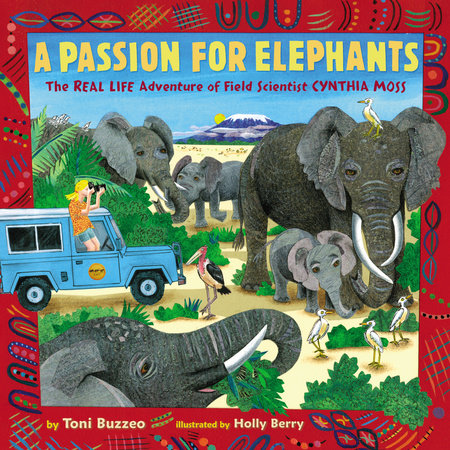
A Passion for Elephants: the real life adventure of field scientist Cynthia Moss by Toni Buzzeo, illustrated by Holly Berry

Published by Dial Books for Young Readers 

Summary:  Cynthia Moss was never afraid of BIG things.  That’s the recurring refrain in this story of scientist Cynthia Moss, who grew up riding horses in Virginia and went on to become a journalist.  An invitation from a college friend sent her to Africa, where she got a job photographing elephants for a zoologist.  This ignited a passion, and she began to recognize individual elephants and their families.  She went on to found the Amboseli Elephant Research Project and made many new discoveries about elephant behavior.  Eventually, concerned about the decline of elephant populations caused by poaching, Cynthia became an activist, working to get a global ban on the sale of ivory in 1990.  Her work continues today, both researching and protecting the elephants she loves.  Back matter includes further information about Moss, further reading, and additional sources.  Grades K-3.

Pros:  An inspiring biography of a scientist who has made a difference.  Less well-known the Jane Goodall, Cynthia Moss’s career parallels hers, in her long years studying animals in Africa and her work around the world to protect them.  The colorful illustrations would make this a great read-aloud to share with kids.

Cons:  The most recent source listed in the additional resources is from 2010.

Enormous Smallness: a story of E. E. Cummings by Matthew Burgess, illustrations by Kris Di Giacomo

Published by Enchanted Lion Books 

Summary: Starting with his somewhat enchanted childhood in Cambridge, Massachusetts (complete with happy family, summers on a New Hampshire farm, and a large tree house heated by a wood stove), this book recounts the life of Edward Estlin Cummings. Estlin was both a poet and an artist.  From an early age, he loved spending time drawing and playing with words, and he continued with both activities for his entire life.  This book emphasizes how he responded to life with his creativity, experimenting with words and poetic forms to express what he experienced as he moved from his home in Cambridge, to Harvard, to France, where he drove an ambulance during World War I, and to 4 Patchin Place in Greenwich Village, his home for much of his adult life.  End matter includes a chronology, several poems, and an author’s note.  Grades 2-5.

Pros:  This book captures the joy E. E. Cummings experienced through his creativity, both in the writing and the illustrations, in which Estlin is consistently portrayed with a smile on his face.  The poems are well-selected to appeal to young readers.

Cons:  Despite their brevity, the poems of E. E. Cummings could be a bit difficult for elementary readers.

Swan: the life and dance of Anna Pavlova by Laurel Snyder, illustrated by Julie Morstad

Published by Chronicle Books 

Summary:  When Anna Pavlova was a small girl growing up in Petrograd, her mother took her to see a ballet.  From then on, she could think of nothing but dancing.  After two years of dreaming, she was finally admitted to the Russian Imperial Ballet School.  While she had natural grace and beauty, her body was very different from the sturdy, acrobatic dancers of the time.  Nevertheless, she worked hard and became a famous ballerina, best known for her role as the lead in The Dying Swan.  Always remembering her own impoverished childhood, Anna traveled the world, bringing dance to people who wouldn’t otherwise have the chance to experience it.  Sadly, at the age of 50, she was in a train accident, caught pneumonia from being outside in the cold, and died.  Grades 1-5.

Pros:  Dance fans will love this beautifully illustrated book with spare, poetic text telling the inspiring story of Anna Pavlova’s life.

Cons:  The text is spare enough that readers might be a bit confused by some aspects of the story.  Be sure to read the author’s note at the end for some clarity.

Fur, Fins, and Feathers: Abraham Dee Bartlett and the Invention of the Modern Zoo by Cassandre Maxwell

Published by Eerdmans Books for Young Readers 

Summary: When Abraham Dee Bartlett was growing up in the early 1800’s, there were no zoos. The closest thing was menageries where animals were kept in small cages for people to come and see. Abraham loved animals and read all that he could about them as a boy and a young man. His vast knowledge of wild animals eventually caught the attention of the London Zoological Society, and he was appointed superintendent of the new London Zoo. During his 38-year tenure there, he revolutionized the care of wild animals. He built larger enclosures for animals, learned how to feed them a healthy diet, and made labels so visitors could learn more about what they were seeing. By empathizing with the wild animals in his charge, he learned to keep them healthy and happy, and developed animal care methods that are used by zoos and veterinarians today. A timeline, author’s note, and brief bibliography are included. Grades 1-4.

Pros: Not only is this an interesting and inspiring story of a little-known man, but the cut paper collage illustrations are gorgeous. Readers will want to take their time with this book, enjoying both the text and the richly detailed pictures.

Cons: The final Doctor Dolittle-like illustration of Abraham surrounded by smiling animals is probably not entirely realistic.