Persistence, resistance, and a fight for existence

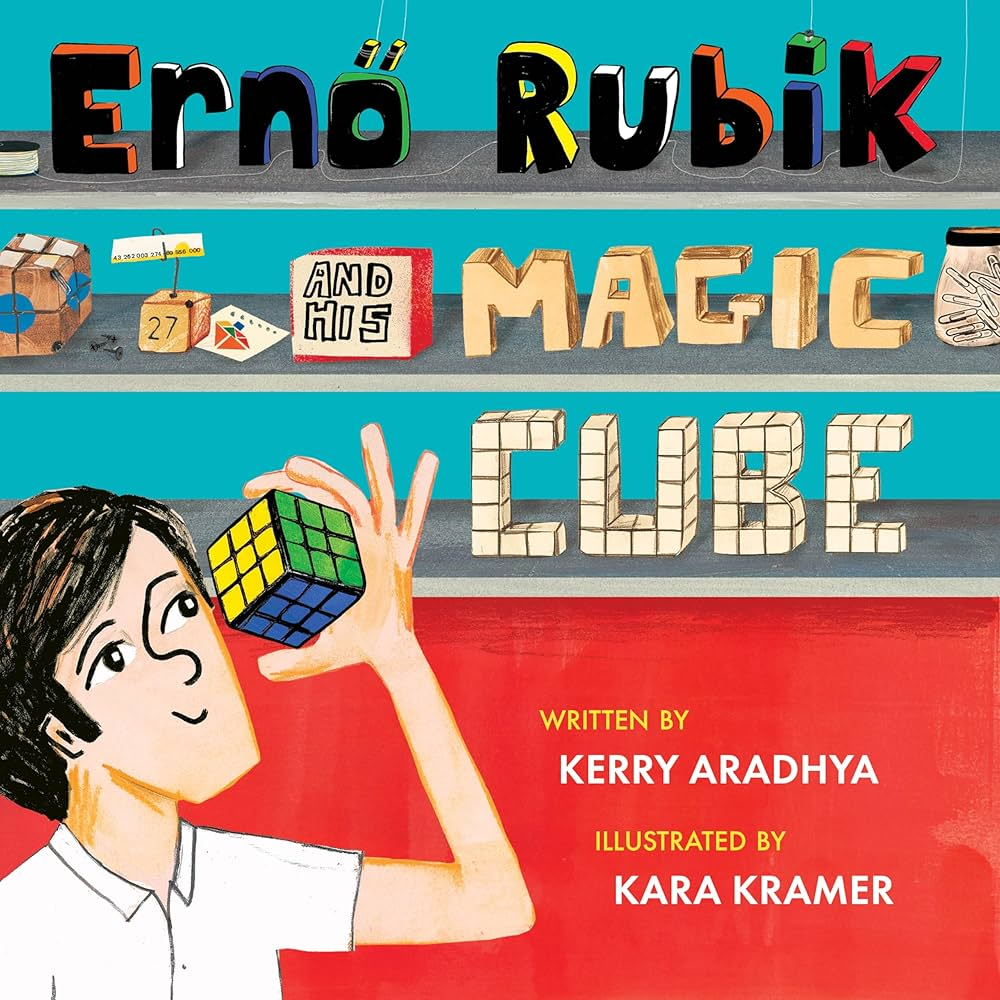
Ernö Rubik and His Magic Cube by Kerry Aradhya, illustrated by Kara Kramer (Peachtree, 32 pages, grades K-4). Ernö Rubik was a solitary kid who enjoyed reading and solving puzzles in his Budapest home. He grew up to be a teacher who would build models to teach his students about three-dimensional objects. His curiosity about cubes led him to try making a big cube out of small ones that could move around but stay connected. His first attempts failed, but he finally found the secret: 26 cubes in three rows, with a round mechanical core. And the rest is history as Ernö’s invention, the Rubik’s Cube, went on to become one of the most popular puzzles of all time. Includes additional information about Rubik and his cube, an author’s note, and a list of three books about the cube.

Although there are some details about Ernö Rubik’s life, the focus is on the Rubik’s cube and the perseverance needed to solve a difficult problem. If kids haven’t tried the cube, they will definitely get their hands on one and start searching YouTube for various solutions.

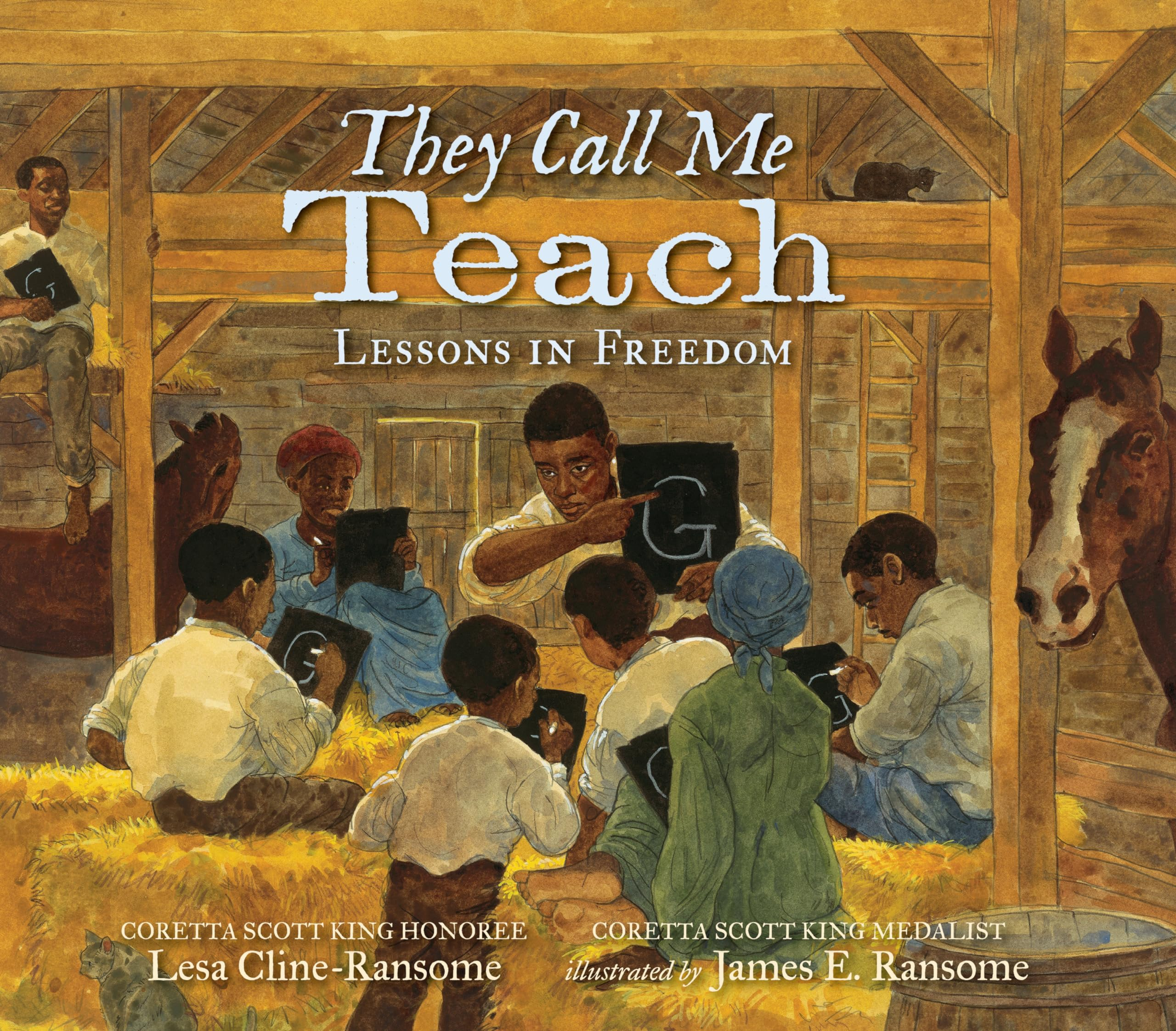
They Call Me Teach: Lessons in Freedom by Lesa Cline-Ransome, illustrated by James E. Ransome (Candlewick, 40 pages, grades 1-5). A young enslaved man is known as Teach, due to his abilities to read and write that he learned growing up with the master’s son. By day he works as a clerk in the master’s store, but at night he teaches other enslaved people to read. He secretly helps people by reading their letters and, in one case, writing a receipt to help a woman escape. Just looking at a newspaper in public results in punishment, leaving readers to infer that there could be much more serious consequences for teaching literacy to other Black people. An author’s note gives more information about Black people’s quest for education throughout history. Includes a list entitled “More Books on Resistance.”

This husband and wife team has created a fascinating story that focuses on the large majority of enslaved people for whom escape was impossible and who tried to resist and improve themselves in the ways that were available to them, despite the risk of cruel punishments. Sure to be a Coretta Scott King award contender.

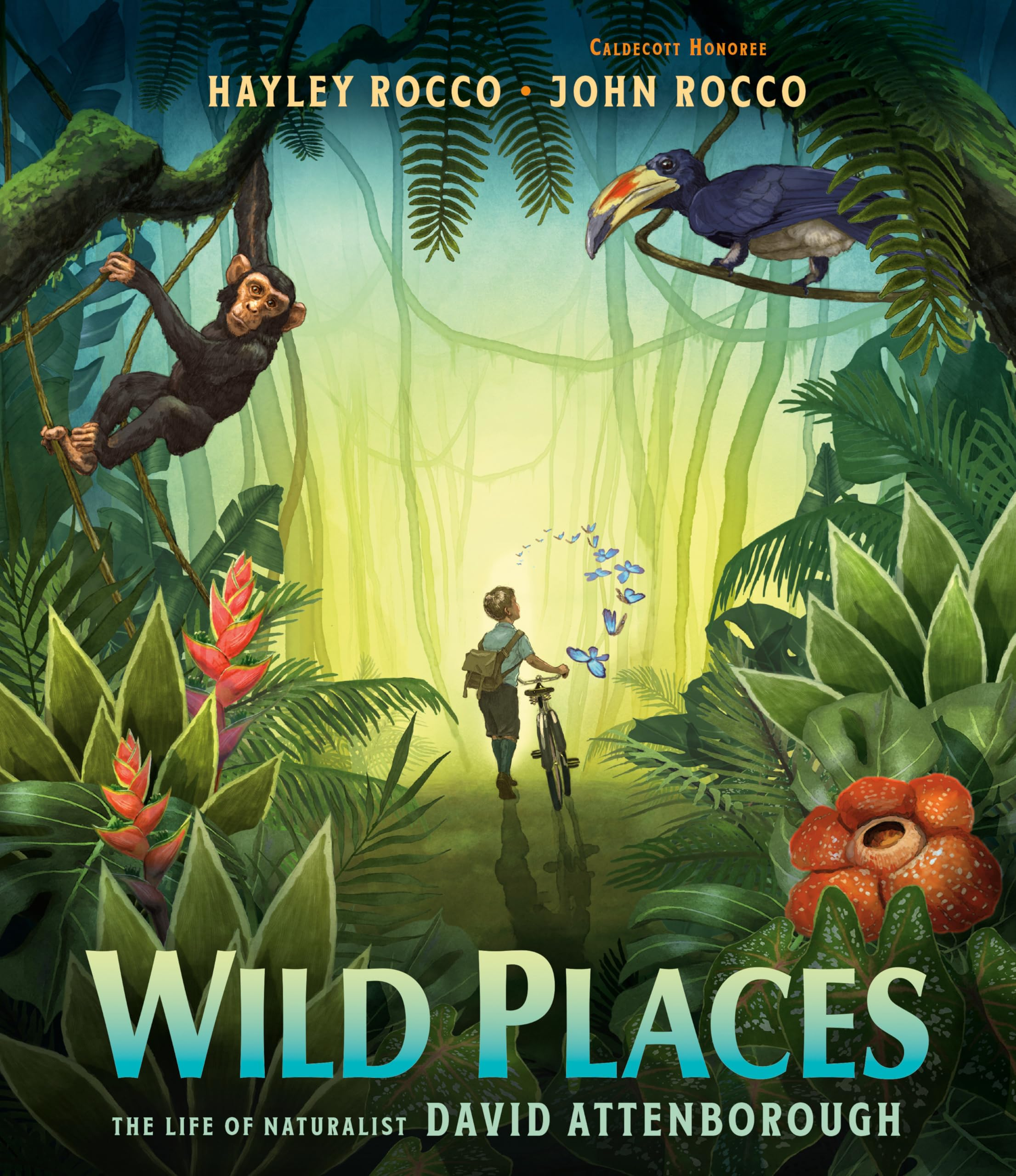
Wild Places: The Life of Naturalist David Attenborough by Hayley Rocco, illustrated by John Rocco (G. P. Putnam’s Sons Books for Young Readers, 48 pages, grades K-3). The story of David Attenborough’s life is told by another husband and wife team. Young David loved exploring the natural world around his English home, and he continued those studies as a university student. When he graduated, television was just becoming popular, and he got a job introducing viewers to the world of nature. Before long, he was traveling all over the world to show people plants and animals of different ecosystems. His travels made him more aware of the ways that wild places were shrinking and living creatures were losing their habitats. David shifted his focus to helping people understand what was happening and giving them information to help them make better choices for the planet, work that he continues today in at the age of 98. Includes an author’s note with additional information about David Attenborough and rewilding, a couple of photos, and a bibliography.

Like the Ernö Rubik biography, this is an engaging read that’s a little light on biographical information. Most pages only contain a sentence or two of text, along with award-winning illustrator’s John Rocco’s beautiful depictions of the natural world. Quotes from David Attenborough are scattered throughout the book, and the end matter fleshes out his life a bit more.

Master storytellers

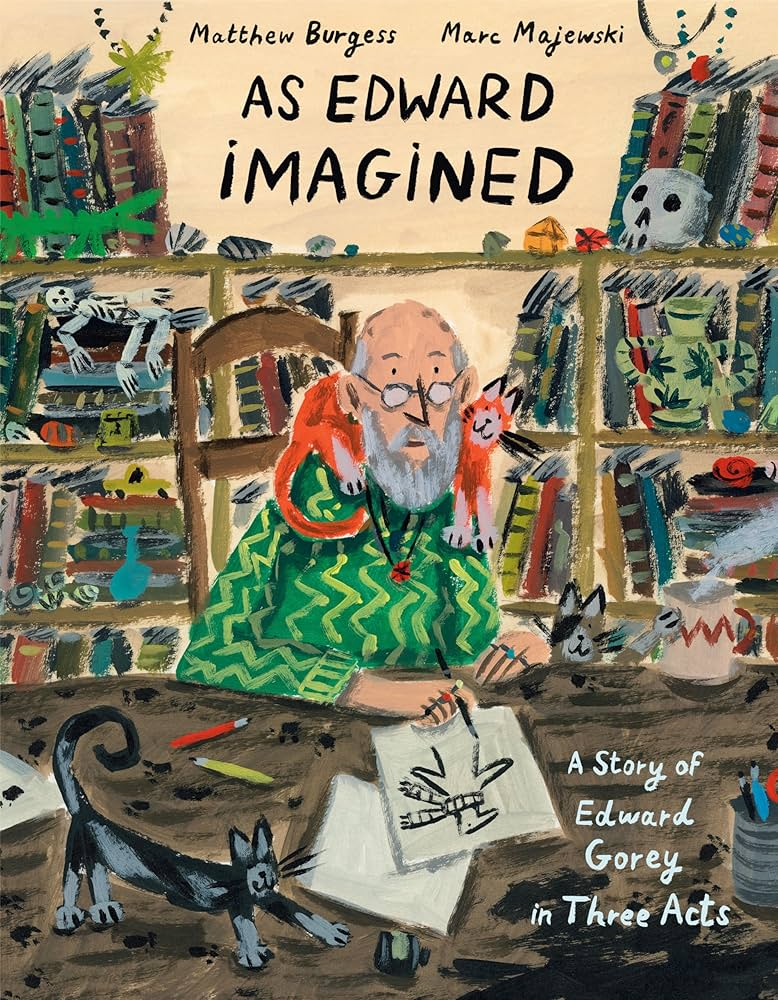
As Edward Imagined: A Story of Edward Gorey in Three Acts by Matthew Burgess, illustrated by Marc Majewski (Knopf Books for Young Readers, 48 pages, grades 2-5). In Act 1, we meet a young Edward Gorey, who learned to read when he was 3 and devoured books, including Dracula at the age of six. This led him to create his own spooky stories, something that he continued to do when he moved to New York City as an adult (Act 2). Not only did he write his own stories, but he illustrated other writers’ books and gained his greatest fame designing the sets for the Broadway adaptation of Dracula and creating introductions to PBS’s Mystery! series. With money earned from those projects, Gorey headed to Act 3, purchasing a house on Cape Cod where he continued to write, draw, and work with local theaters. Edward always led life on his own terms, whether that was wearing green toenail polish as a child, attending nearly every performance of the NYC Ballet for twenty years, or keeping six cats at Elephant House on the Cape. Includes an author’s note, additional resources, and chronology.

Kids may need to be introduced to Edward Gorey’s work, but they will undoubtedly embrace his spooky illustrations and books, and perhaps be inspired to live life to the beat of their own drummer, as Edward Gorey most definitely did. I first learned of Gorey through John Bellairs’ books, which were only briefly mentioned both in this book and when I visited the Edward Gorey Museum on the Cape; this seems like an unfortunate oversight.

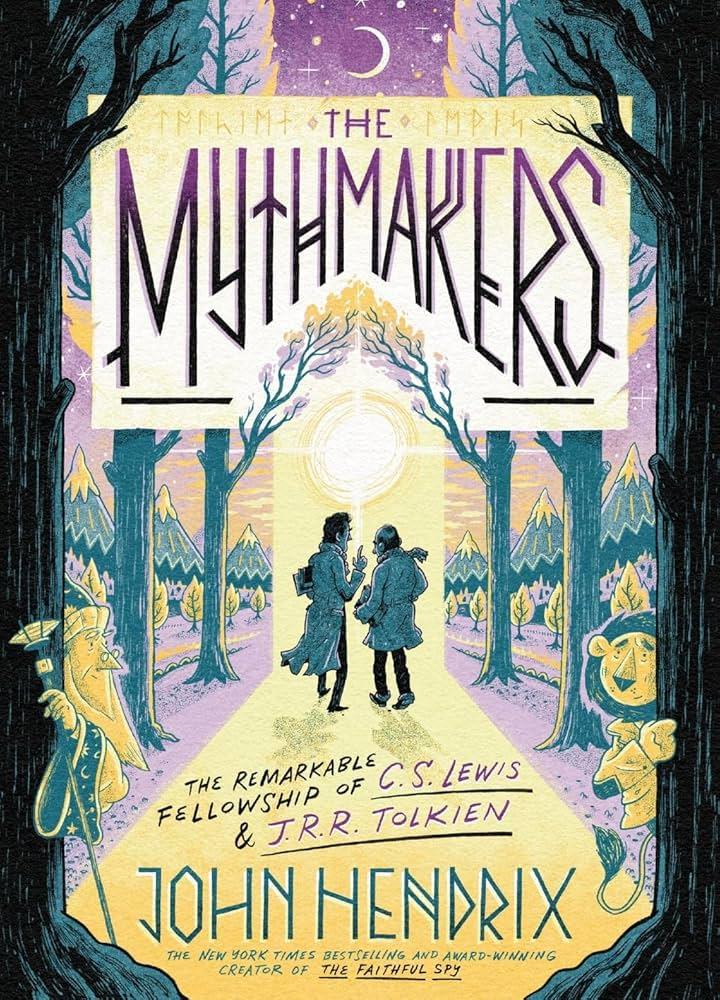
The Mythmakers: The Remarkable Fellowship of C.S. Lewis and J.R.R. Tolkien by John Hendrix (Harry N. Abrams, 224 pages, grades 7-12). C.S. Lewis and J.R.R. Tolkien both suffered early childhood losses but also had mystical experiences of joy as children, often associated with reading myths and fairy tales. After horrific experiences fighting in the trenches of World War I, they both became Oxford dons, where they developed a delightful friendship based on their mutual love of myths and interest in religion. A lifelong Catholic, Tolkien encouraged the agnostic Lewis to follow his spiritual longings, eventually leading Lewis to a dramatic conversion to Christianity. Each supported the other in his writing, and it’s pretty clear that neither the Chronicles of Narnia and especially The Lord of the Rings would have existed without the influence of their friendship and the literary group The Inklings which grew out of that relationship. The main chapters are interspersed with comics featuring a lion and a wizard traveling through the landscapes of Tolkien’s and Lewis’s life, and a poignant final chapter imagines the two men, who sadly had a falling out in the last decades of their lives, reuniting for one last conversation before moving into the great beyond. Includes extensive additional information about mythology, as well as an author’s note about his research, notes, a bibliography, and an index.

As someone who is both a John Hendrix fan and was an obsessive enough fan of C.S. Lewis to actually write a biography of him, I was excited to see this new book. Although it bills itself as a graphic novel, the amount of information far exceeds most of that genre. The lion and wizard segments are in comic format, while the rest of the book is more like an illustrated text. The emphasis is on the friendship between the two men and how their common love of mythology influenced their literary masterpieces. I was a bit disappointed that Lewis’s relationship with Janie Moore, which lasted for decades and had a huge impact on his life, was pretty much left out of the story. Additionally, some of the information about mythology got a bit too dense for me, and I imagine many young adults will have the same experience. Nevertheless, this is a rich story of an extraordinary friendship between two men who changed the landscape of fantasy literature and left behind books that are still beloved today.

Space travel

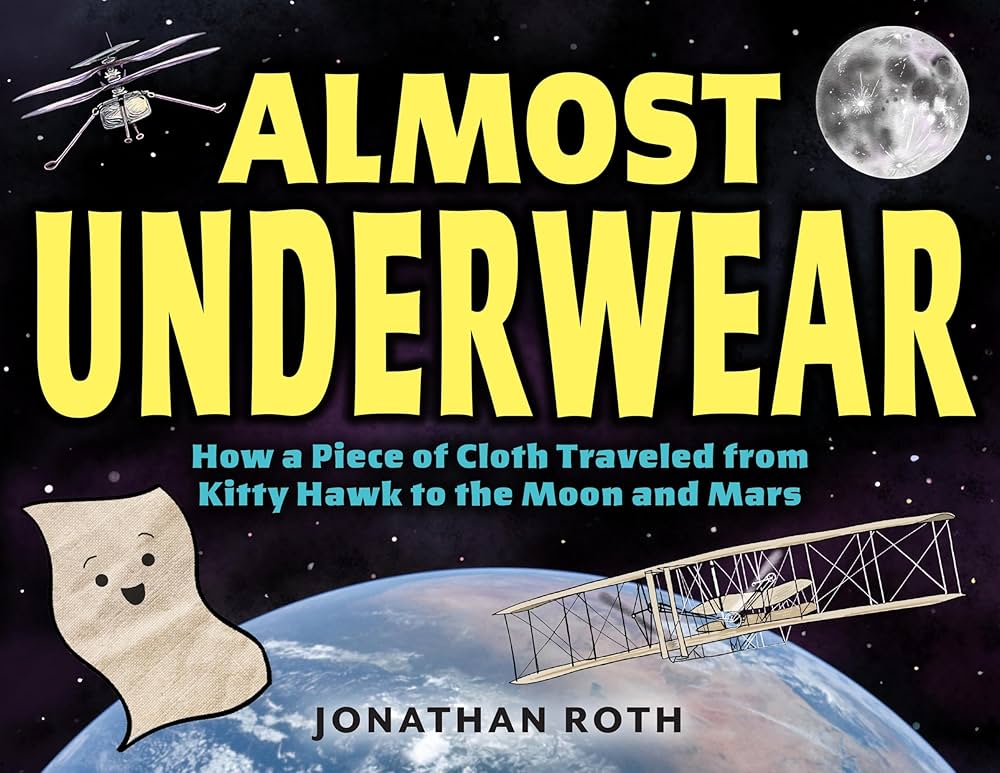
Almost Underwear: How a Piece of Cloth Traveled from Kitty Hawk to the Moon and Mars by Jonathan Roth (Christy Ottaviano Books, 40 pages, grades 1-5). Back in 1903, unbleached muslin was most commonly used to make ladies’ underwear. But one bolt of fabric was purchased by Wilbur and Orville Wright and used for a completely different purpose: to help make the wings of their new flying machine. Although they succeeded, and the muslin went airborne, the machine ultimately was wrecked and went into storage for many years. Shortly before his death, Orville donated swatches of fabric to the new Carillon Historical Park museum in Dayton, Ohio, where it stayed until 1969, when Neil Armstrong carried a piece of it into space. The cloth made it all the way to the Moon, where Armstrong carried it on his moonwalk. The cloth’s final adventures took place in 2020, when it traveled all the way to Mars on board the rover Perseverance. Not only that, but the cloth was attached to Ingenuity, a four-pound helicopter that became the first machine to fly on a different planet. Not bad…for something that could have been some underwear. Includes an author’s note, a glossary of the Perseverance instruments, and a bibliography.

The title reveals the clever hook used to look at three different milestones in air and space travel history, illustrated with combinations of historical photographs and cartoons, including a fun cartoon rendering of the happy piece of cloth. The author does a great job of making STEM history accessible to elementary readers. Pro tip: be very specific when doing a Google images search for Almost Underwear.

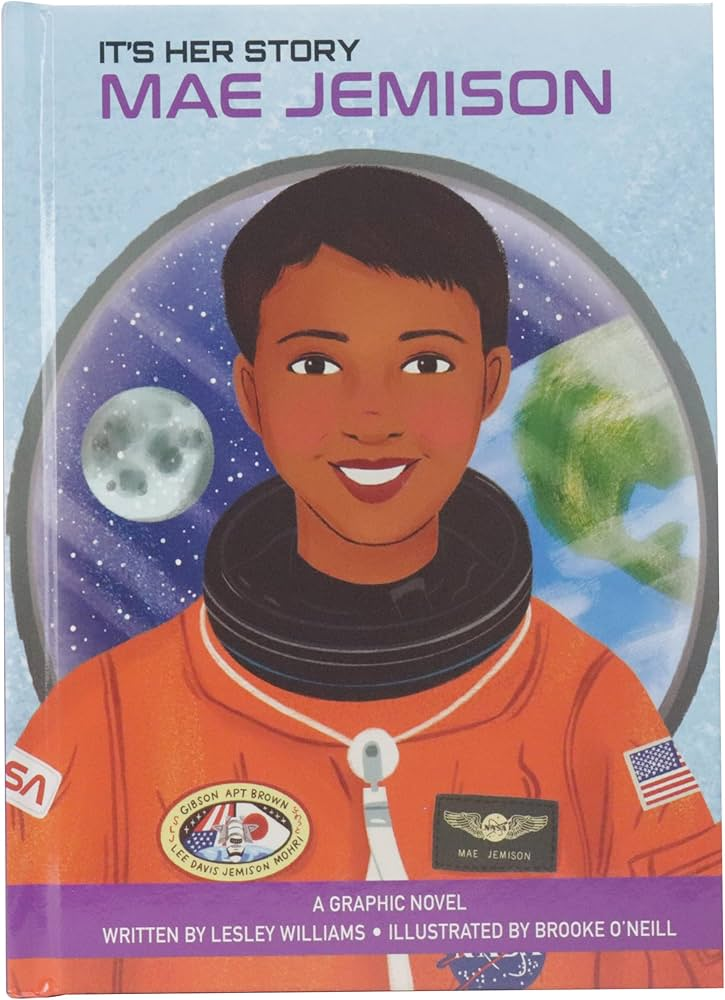
Mae Jemison: A Graphic Novel (It’s Her Story) by Lesley Williams, illustrated by Brooke O’Neill (Sunbird Books, 48 pages, grades 2-5). This short graphic biography tells the amazing life of Mae Jemison, who graduated from high school at age 16, attended Stanford, became an M.D., then transitioned to a career as an astronaut, becoming the first Black woman to go into space. She also loved music and was an accomplished dancer, as well as working for civil rights as a college student and advocating for STEM education as an adult. The last page invites readers to share their dreams, remembering that Mae’s hard work and persistence made hers come true.

This is the first volume of this series I’ve seen, but it looks like there are several others about famous women. The short page count and graphic format will make it appealing to many different types of readers, and it brings Mae Jemison to life in a way that kids will relate to, showing her as a child who had many interests in addition to science. Some additional resources at the end would have been a nice addition.

Graphic memoirs

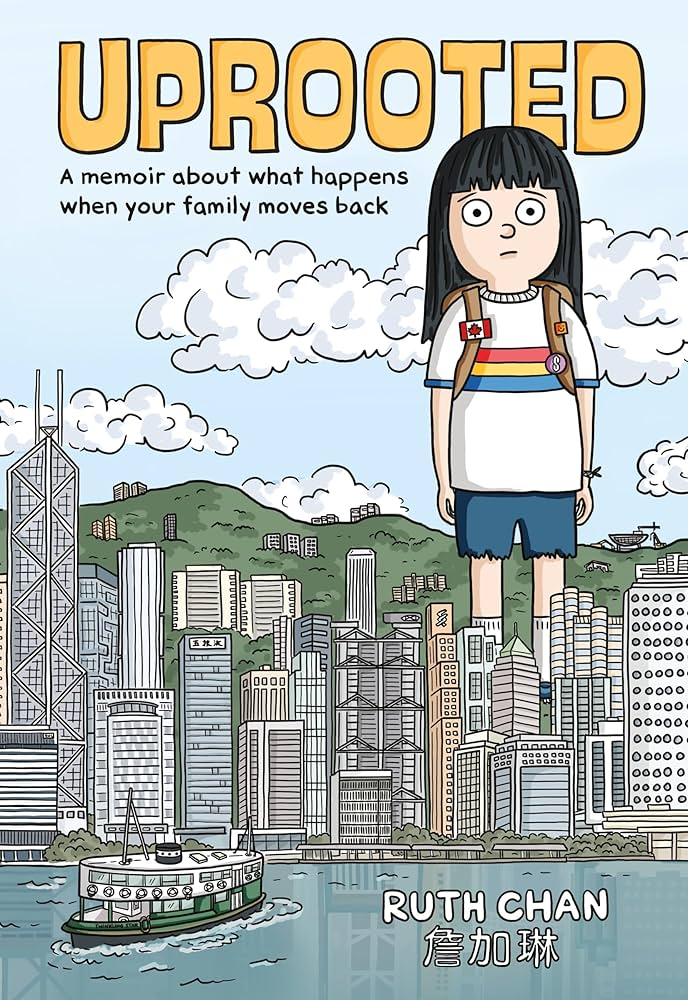
Uprooted: A Memoir About What Happens When Your Family Moves Back by Ruth Chan (Roaring Brook Press, 288 pages, grades 4-7). Having spent her whole life in Toronto, Ruth’s not excited about moving back to Hong Kong to be closer to her mother’s family. Her brother, a senior in high school, stays behind at a Canadian boarding school, and her dad is in China much of the week at his job there. Ruth finds Hong Kong exciting but challenging, with different school subjects than what she’s used to and a language (Cantonese) that she understands but doesn’t feel comfortable speaking. Her mom is enjoying reconnecting with family and friends, leaving Ruth feeling pretty much on her own–except when her parents find out about her grades and nag her to do better at school. Finally, she explodes and tells her parents about all the difficulties she’s dealing with. They’re surprisingly understanding, having believed that Ruth was capable of making all the adjustments, but offering to make some changes to try to help. Her dad’s story of his birth and early days during a difficult time in Chinese history, is woven through the contemporary story, and Ruth draws on it for courage and perseverance during her own difficult times. By the time her brother comes for a visit, Ruth is confident enough to show him all around the city, even trying out her Cantonese on the natives. Includes an author’s note and photos that give more details about her story.

Unlike many immigration graphic novels, like Parachute Kids or Measuring Up, this one is about going back to a country of origin when North America (in this case, Canada) has started to feel like home. Ruth Chan writes in the author’s note that in Canada people saw her only as Chinese, but in Hong Kong, she wasn’t Chinese enough. It’s an interesting perspective, and her father’s stories add an extra dimension that I wish had been developed a bit more. All in all, Ruth comes across as a resilient girl, able to make friends easily and to communicate (in her 13-year-old way) with her parents when things get tough.

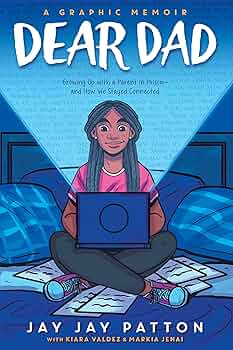
Dear Dad: Growing Up With a Parent in Prison–and How We Stayed Connected by Jay Jay Patton with Kiara Valdez and Markia Jenai (Scholastic Graphix, 128 pages, grades 4-8). Jay Jay Patton’s spent her early life without her dad, who was incarcerated. Her parents did their best to keep the family connected, but phone calls were difficult and expensive, and visits were extremely rare. They relied on letters to keep in touch, with Jay Jay especially liking the math problems and puzzles her father created and sent to her. When Jay Jay was ten, Dad was released from prison, and the family relocated to Florida. Jay Jay struggled with a new school, a new family structure, and the uncertainty of how to tell new friends about her family’s history. Her father had a new job in the tech industry, and the two of them bonded over coding, eventually working together to create the Photo Patch app that helps parents and kids stay in touch when a family member is in prison. Today, at the age of 18, Jay Jay and her dad run the Photo Patch Foundation as well as events to teach kids coding. Includes several pages of photos and additional information about Photo Patch.

This is a fascinating story about a topic (incarcerated parents) that’s not written about much in children’s books. Jay Jay is an amazing role model, and I’m grateful that she’s shared her story, as well as her dad’s. The story itself is only 110 pages without a lot of text, so it felt like some pretty complex issues were given only the briefest coverage.

A ballplayer who dared, a poet who cared, and a sanitation worker who repaired

Call Me Roberto! Roberto Clemente Goes to Bat for Latinos by Nathalie Alonso, illustrated by Rudy Gutierrez (Calkins Creek, 40 pages, grades 2-5). Roberto Clemente loved playing baseball as a boy in Puerto Rico and was thrilled to be scouted by the MLB. After a disappointing season in Montreal, he joined the Pittsburgh Pirates, where he became an All-Star and helped lead his team to the World Series in 1960 and 1971. He won twelve Gold Gloves, was the 1966 National League MVP, and the 1971 World Series MVP. Despite his success, Roberto often faced racism and discrimination. He corrected those who tried to call him Bob and spoke out against the segregation he endured during spring training in Florida. On September 30, 1972, Roberto became the 11th MLB player and the first Latino one to reach 3,000 hits. Includes notes from the author and illustrator, glossary, photos, bibliography, and timeline that tells about Roberto’s death in a plane crash on his way to deliver humanitarian aid to Nicaragua in December of 1972.

I’m ashamed to say that I thought Roberto Clemente was Dominican and that the only thing I knew about him was his death in a plane crash. This biography emphasizes his greatness in baseball, making clear the discrimination he faced and how he fought for justice for himself and other Black and Latino players. The illustrations by Caldecott honoree Rudy Gutierrez are beautiful and deserve a look from this year’s Caldecott committee. The author’s note adds a personal story, since she is a Cuban American sportswriter who has faced some of the same issues Roberto Clemente did.

The Soldier’s Friend: Walt Whitman’s Extraordinary Service in the American Civil War by Gary Golio, illustrated by E. B. Lewis (Calkins Creek, 40 pages, grades 2-5). A look at a lesser-known part of Walt Whitman’s life, when he served as a volunteer nurse in the Civil War. After his brother was wounded, Walt traveled from New York to Virginia to visit him in the hospital. He was so moved by the soldiers he saw that he decided to move to Washington, DC to devote himself to caring for them. Most of what he did was simple: bringing treats, helping men write letters, talking with them, or just listening. Although he was a fervent supporter of the Union cause, he cared equally for soldiers from both sides. Lines from Whitman’s “Leaves of Grass” are woven into the story. Includes photos and additional information about Walt Whitman and his Civil War experiences, along with a list of resources.

This touching story of Walt Whitman’s kindness and caring seems particularly relevant in today’s world when it’s easy to feel like it’s necessary to take sides or that one person can’t make a difference. The author notes at the end that Whitman may have visited as many as 25,000 soldiers, and while he couldn’t influence the outcome of the war, he found a way to express caring and kindness. Except for the lines from “Leaves of Grass,” there’s almost no mention of Walt Whitman’s poetry; it would have been nice to acknowledge his literary contributions in the story or back matter.

Gifts from the Garbage Truck: A True Story About the Things We (Don’t) Throw Away by Andrew Larsen, foreword by Nelson Molina, illustrated by Oriol Vidal (Sourcebooks Explorer, 40 pages, grades 1-4). Nelson Molina was always a collector. His mostly Puerto Rican neighborhood in East Harlem yielded all kinds of treasures. His mom showed him how to turn scrap wood into birdhouses, and Nelson enjoyed fixing up cast-off toys for his younger siblings. As an adult, Nelson became a New York City Sanitation Worker, where he continued to find and fix up things that he found in the trash. He started displaying them in the locker room of the sanitation garage, eventually expanding into other parts of the building. Since retirement, Nelson has opened a museum where he can display his treasures, showing the huge amount of stuff that we put into the trash. Includes tips for reducing, reusing, recycling, and rethinking, as well as photos of Nelson with some of the exhibits from his museum.

Kids will be inspired to look at trash differently, maybe thinking twice before they throw something away. I loved the scene at Christmas where young Nelson happily gives his siblings the toys he’s fixed up for them. Being something of a minimalist, though, the photos of his cluttered museum convinced me that his way of life is not for me.

Finding their voices

Ida B. Wells Marches for the Vote by Dinah Johnson, illustrated by Jerry Jordan (Christy Ottaviano Books, 48 pages, grades 1-5). Although this book tells the story of Ida B. Wells’s life, starting with her birth in Mississippi and continuing with some of her activism in Tennessee and Chicago, the main event is a march in Washington DC in 1913 for women’s right to vote. Many of the organizers felt that this march should be for white women only, or at least segregated (Alice Paul is specifically mentioned as expressing that view). Despite these protests and the suggestions that Ida march at the back of the line with her sorority, she made her way to the Illinois delegation and joined the white women in that group to march for their right to vote. Includes an author’s note, photos, a timeline of Ida B. Wells-Barnett’s life, and a list of sources.

The author does a masterful job of giving readers an overview of Ida’s life but focusing on one specific event that demonstrates the way she stood up for herself and other Black people. The back matter adds a lot and makes this a great resource for research.

Ode to Grapefruit: How James Earl Jones Found His Voice by Kari Lavelle, illustrated by Bryan Collier (Knopf Books for Young Readers, 48 pages, grades 1-5). Young James loved words, especially poetry, but when asked to read in front of the class or to say hello to a visitor at home, the words stuck in his throat. He finally stopped talking and just listened, paying close attention to his teachers, especially Professor Crouch who taught him poetry. James recited the poetry when he was alone, and sometimes he tried writing his own, but sharing it with the class was out of the question for him. One day, a shipment of grapefruit to his house inspired him to write a poem, and with Professor Crouch’s encouragement, James read “Ode to Grapefruit” to the class. This recitation opened the door for him, and he began performing on stage, as a debater and an actor, and eventually the distinctive voice of James Earl Jones became known around the world. Includes notes from the author (a speech pathologist) and the illustrator, as well as information and resources on stuttering and a list of sources.

This would make an excellent read-aloud, since the text is pretty short, and James’s issues are something most kids would relate to. I did wonder about the illustrations with all the kids having a slice of grapefruit in their mouths–did James hand them out, or was he just imagining them? But it would be fun to reveal at the end that the story is about the man who became the voice of both Darth Vader and The Lion King’s Mufasa.

Seeker of Truth: Kailash Satyarthi’s Fight to End Child Labor by Srividhya Venkat, illustrated by Danica da Silva Pereira (little bee books, 40 pages, grades 2-5). As a child in India, Kailash Satyarthi was inspired by the story of how a hummingbird stopped a forest fire by carrying drops of water in its beak. When he saw a boy working as a cobbler by the side of the road, Kailash wondered how he could help him go to school. Like the hummingbird, Kailash started with small deeds to make a difference–raising money and collecting books to help kids who couldn’t afford to go to school. As an adult, Kailash started his career as a teacher, but he wanted to do more. He quit his job and began rescue missions to free children forced to work in factories, mines, and quarries. His work gained international recognition, including the 2014 Nobel Peace Prize, which he shared with Malala Yousafzi, and resulted in worldwide changes to child labor laws. Includes an author’s note with additional information and a couple of photos, and a list for further reading.

This excellent picture book biography tells the story of Kailash Satyarthi’s life in a way that will easily be understandable to kids and will show them the power of a single individual to make a difference in the world. I liked that it tells the story of his entire life, so the reader can see how his ideas evolved, yet keeps the text brief enough for a good read-aloud.

Stories and songs

Go Forth and Tell: The Life of Augusta Baker, Librarian and Master Storyteller by Breanna J. McDaniel, illustrated by April Harrison (Dial Books, 40 pages, grades 2-5). Augusta Baker was raised on her grandmother’s tales of Br’er Rabbit and King Arthur. A college class on folklore encouraged Augusta to become a storyteller herself, and she got a job at a branch of the New York Public Library in Harlem, where she found audiences of children eager for her stories. While most of her young patrons were African American, the books Augusta found in the library rarely had Black characters, and when they did, the portrayals were “RUDE, MEAN, and JUST PLAIN WRONG.” She searched for books (and wrote some of her own) that sought to correct that, compiling lists to share those books with others. Over the years, her work influenced Black writers and educators like James Baldwin, Audre Lorde, Carter Woodson, John Steptoe, and Virginia Hamilton. She extended her outreach through teaching at Columbia and the University of South Carolina, a radio show, and an appearance on Sesame Street and is honored by the city of Columbia, SC each year with a festival called A(ugusta) Baker’s Dozen. Includes a timeline, citations, an author’s note, and photos.

Bridges Instead of Walls: The Story of Mavis Staples by Mavis Staples and Carole Boston Weatherford, illustrated by Steffi Walthall (Rocky Pond Books, 48 pages, grades 2-5). Mavis Staples tells the story of her life (in third person), beginning with her family’s trip north during the Great Migration. Mavis was the youngest, born in Chicago, and as she grew older, she began singing with her father and siblings. They became popular as the Staples Singers, performing gospel music in churches around the Midwest, gradually expanding their repertoire to include blues and folk music. Although their lives and music were firmly grounded in their faith, eventually their fame spread to the secular entertainment world, as well as to supporting Martin Luther King, Jr. and the civil rights movement. Mavis also enjoyed a solo career, which continues to this day, as she is the last surviving member of the Staples Singers. Includes a timeline and lists of recommended listening (songs by the Staples Singers and Mavis Staples) and recommended viewing (documentaries).

These two excellent picture book biographies will introduce readers to amazing Black women who overcame discrimination and other barriers to share their gifts of storytelling and singing. Both are pretty long with lots of references to historical figures that will likely need some introductions for kids. The illustrations in both are amazing and do a great job of incorporating each woman’s art into the story.

A basketball ace, a designer of space, and an ultramarathon race

Wat Takes His Shot: The Life & Legacy of Basketball Hero Wataru Misaka by Cheryl Kim, illustrated by Nat Iwata (Lee & Low Books, 40 pages, grades 2-5). Wataru Misaka was an active child, growing up in Utah as a second-generation Japanese American, or Nisei. His father taught him the Japanese word gambatte, meaning to do your best, and Wat took the lesson to heart, pushing himself to work hard in school, on the basketball court, and later, after his father died, to help support his family. During World War II, Wat’s family escaped being sent to concentration camps, since they didn’t live on the coast, but they still faced discrimination. At the University of Utah, Wat slept under the bleachers in the gym when the segregated dorms were full. He made the college basketball team, but at first didn’t get to play and was barred from away games. When he did get on the court, spectators yelled racist slurs at him. Keeping in mind gambatte, Wat never gave up, eventually leading his team to a national championship. He was recruited by the Knicks, becoming the first player of color in the BAA (later the NBA). After being released from his contract, Wat returned to school and got his engineering degree. He excelled throughout his life, at work, in the community, and on the golf course and bowling alley. The last page shows him exchanging jerseys at a meeting with Asian American NBA star Jeremy Lin. Includes a lengthy author’s note, a photo of Wat in 2008, and a list of sources.

Basketball fans will enjoy this biography, although it’s a bit lengthy with quite a bit of historical context, making it perhaps a better choice for older kids. The history is fascinating, though, with lots of action-packed illustrations, and the lesson in perseverance is an inspiring one.

Mr. Pei’s Perfect Shapes: The Story of Architect I. M. Pei by Julie Leung, illustrated by Yifan Wu (Quill Tree Books, 40 pages, grades 1-5). As a boy in China, Ioeh Ming Pei was fascinated by the volcanic rock statues in his grandfather’s hometown of Suzhou that took shape over many years from water falling on them. His love of structure continued as he grew up, sketching buildings he saw being built in Shanghai before coming to America at the age of 18 to study architecture. He rose to fame in 1964 when Jackie Kennedy selected him to design the John F. Kennedy Presidential Library and Museum. His innovative designs and ways of seeing shapes led to other famous buildings like the Louvre Pyramid and the Rock and Roll Hall of Fame. He returned to Suzhou at the age of 90 for the installation of an art museum he had designed for the city, admiring once again the rock statues he had seen as a child. Includes a timeline and additional resources.

Although I’ve heard of I. M. Pei I didn’t know the many famous buildings he designed. His innovative way of thinking and problem solving is emphasized in the text and especially the illustrations, which show of the beauty of the modernistic architecture Pei helped create.

Daughter of the Light-Footed People: The Story of Indigenous Marathon Champion Lorena Ramírez by Belen Medina, illustrated by Natalia Rojas Castro (Atheneum Books for Young Readers, 40 pages, grades K-4). Lorena Ramírez has become an unlikely ultramarathon champion, competing in races wearing the traditional clothing of her Rarámuri (meaning “light-footed”) people: a skirt and rubber-soled huarache sandals. The story takes place over the course of sixty-mile race, during which she reflects on her past that has brought her to this point. Growing up in a remote corner of Mexico, she became a strong runner by herding goats and cows, playing ball games with her siblings, and walking for hours to buy food. At the end of the race, she is the first to cross the finish line. Includes a two-page note with additional information about Lorena and a list of sources.

Lorena Ramírez’s story is fascinating, the way she has become a champion in an unconventional way, holding onto her people’s traditions and honoring them in the way she dresses. The beautiful illustrations show the people, animals, and landscape of her home. I do wish books like this would give the introductory information at the beginning so the reader (at least this reader) isn’t trying to figure out what is going on throughout the whole story.

Memories of China

Growing Up Under a Red Flag: A Memoir of Surviving the Chinese Cultural Revolution by Ying Chang Compestine, illustrated by Xinmei Liu (Rocky Pond Books, 40 pages, grades 2-6). Ying grew up during China’s Cultural Revolution, with parents, both doctors, who were targeted for being part of the educated class. Her father taught her English and told her stories of his days studying in San Francisco, and the Golden Gate Bridge became a symbol of that life. Ying recalls the day her dad was forced to burn all his English books and papers, hiding his ties to the west from the government. Shortly after that, he was arrested, and life grew increasingly difficult for Ying and her mother, with food shortages and worries about the future. After Mao’s death in 1976, the family was reunited. Ying eventually moved to the U.S. to study, and the final picture shows the family eating with her father’s teacher, Dr. Smith, the Golden Gate Bridge in the background.

Born Naughty: My Childhood in China by Jin Wang with Tony Johnston, illustrated by Anisi Baigude (Anne Schwartz Books, 112 pages, grades 2-5). Imagine Ramona Quimby living in 1980’s Mongolia, and you’ll have a good idea of the vibe of Jin Wang’s lively childhood memoir. Living in a one-room mud hut with her parents and two younger brothers, Jin embraces all of life experiences, whether it’s traveling with her father to fetch the family’s precious water supply, beating the boys at tree-climbing, harvesting mushrooms and potatoes, or learning calligraphy. Real dangers are never far away, and her story of being attacked by a potentially rabid dog is harrowing. The last chapter shows the family taking a break from their demanding lives to celebrate the new year together. In the authors’ notes, Jin Wang shares more details of her life, including a 2019 trip back home that affirmed her happy childhood memories, and she and Tony Johnston relate how they met in yoga class and created this book together.

These two very different memoirs offer contrasting views of Chinese childhoods just a decade apart, one of a middle-class family dealing with government persecution and hardship, the other of a much poorer rural family facing different hardships but able to lead a freer life. Jin Wang’s memoir would make a great book club choice for second or third graders. There are plenty of similar stories for this age group that would make an interesting contrast to Jin’s childhood. While Ying’s story is a picture book, it may appeal to older students up into middle school, who might have a better understanding of the Cultural Revolution and what it meant to the people living through it.

A picture book potpourri

Everyone Gets a Turn by Marianne Dubuc (Princeton Architectural Press, 60 pages, ages 4-9). When friends Bear, Mouse, Turtle, and Hare discover an egg, each one wants to take it home. The egg provides the answer: “Everyone gets a turn!” Mouse found the egg, so he brings it home first, getting to know the egg and learning how to keep it comfortable. Next is Bear, who gets a surprise: the egg hatches, and Little Bird arrives. Hare and Turtle figure out how to feed and care for a young bird, and by the time the visit with Turtle ends, Little Bird has built her own home and is ready to take care of herself. There’s a housewarming party, at which time Little Bird declares she will henceforth be known as Clara, and the five friends and neighbors “continue to grow, each in their own way.” The story could hardly be any cozier or more heartwarming, and the longer page count and graphic novel format will make it appealing to older readers as well as younger kids. I’d love to know the story of how this came to be published by the Princeton Architectural Press.

The Bicycle: How an Act of Kindness Changed a Young Refugee’s Life by Patricia McCormick and Mevan Babakar, illustrated by Yas Imamura (Balzer + Bray, 40 pages, grades 1-4). Mevan tells the story of her childhood, beginning with idyllic early years surrounded by family in Kurdistan. When the Iraqi government begins persecuting the Kurdish people, Mevan and her family are forced to flee, first to Turkey, then to Russia, and finally to the Netherlands. Mevan learns to make herself as invisible as she can. In the Netherlands, she watches people outside her window riding bicycles, but she rarely leaves the apartment herself. It feels like no one sees her, but it turns out that Egbert, the building’s handyman, has noticed her, and one day he brings her a red bicycle. His gift makes Mevan feel “a hundred feet tall,” and before long, she’s outside riding with the rest of her neighbors. An epilogue describes the miraculous reunion she had with Egbert as an adult, including a photo of the two of them, and an author’s note describes her life as a refugee, how it has made her feel like an outsider, and the miraculous power of kindness. This is a touching if bittersweet memoir with an emphasis on the power of one person’s kindness to make a difference. I like how the epilogue ends, describing the ripple effect of her story of finding Egbert: “In a world where there are many people running from war, from hunger, from hatred, people everywhere, of every age, asked themselves: What’s one kind thing I can do?”

The Elephant and the Sea by Ed Vere (Doubleday Books for Young Readers, 32 pages, ages 4-8). Gabriel is an old elephant when we meet him on the first page, sitting in the harbor and remembering his younger days. Back then, he loved to visit the lifeboat crew and dreamed of helping sailors at sea, singing “Heave away, haul away, heave-HO!” But then Gabriel grows…and grows, and the other animals say he’s too big for the lifeboat. He refuses to give up his dream, though, and spends his days collecting driftwood and building. When a storm hits that’s too strong for the lifeboat crew, Gabriel is ready with his own boat that he uses to haul in the entire fleet. “Brave Gabriel, our hero!” the animals hail him. “Can we join you?” “Of course,” Gabriel replies. “But we might need a bigger boat.” And Gabriel enjoys a career of lifesaving, bringing us back to the old elephant remembering. It’s a cute story with a nice theme of perseverance and determination, with a fun “Heave away” repeating refrain. This would make a nice companion to read with Swashby and the Sea.