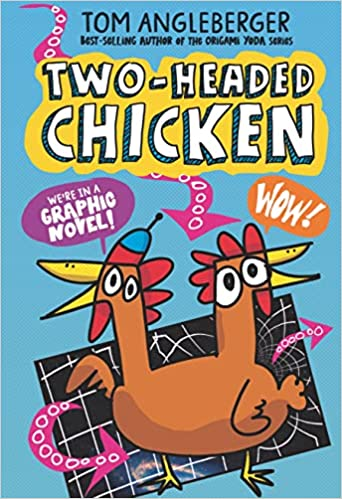
Two-Headed Chicken by Tom Angleberger

Published by Walker Books

Summary:  This is a graphic novel about a two-headed chicken being chased through the multiverse by a fried chicken-loving moose.  Each time it/they is/are about to be eaten, the chicken(s) use its/their Astrohat to escape to another universe.  Along the way, there are quizzes, the world’s longest knock-knock joke, and a fish who wants to talk to you about your feelings.  Just when you feel like you can’t handle another universe, you are suddenly in the book, telling the chicken(s) to hurry up and defeat the moose already.  Which they do.  Using the world’s longest knock-knock joke.  208 pages; grades 2-5.

Pros:  It’s funny, it’s ridiculous, it’s annoying in a good way, and kids will love it.

Cons:  Sadly, I didn’t have jury duty, so I couldn’t run the experiment I tried with Tom Angleberger’s The Rat With the Human Face.

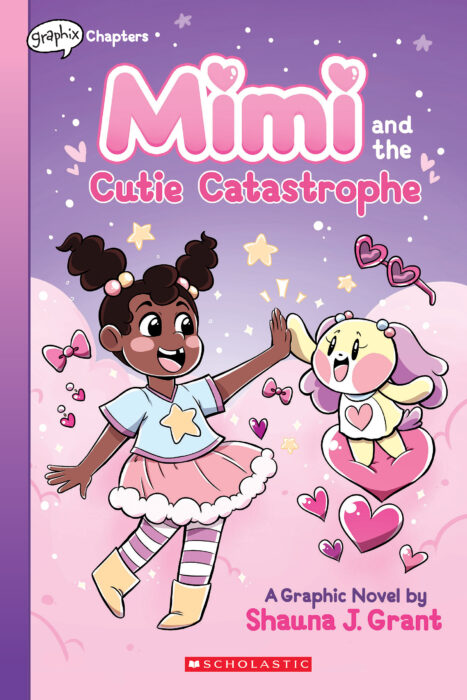
Mimi and the Cutie Catastrophe by Shauna J. Grant

Published by Scholastic Graphix

Summary:  Mimi loves pink and purple, dressing up, and playing with her magical stuffie, Penelope.  An unfortunate consequence of this is that she often gets called “cute”.  To counter this, she tries on different personalities that Penelope is able to create for her: a superhero, a smart teacher, and a cool kid.  Each one fails for one reason or another, and by the end she’s decided to be herself and to speak up for what she wants.  To her happy surprise, those around her see her as strong, smart, and cool.  80 pages; grades K-3.

Pros:  Kids will relate to Mimi’s wish to be seen as more grown up, and the repeating structure of the story makes this a good choice for beginning readers.

Cons:   The girly-girl cuteness was a little thick, as per usual with Scholastic series marketed to girls.

The Inflatables in Bad Air Day by Beth Garrod and Jess Hitchman, illustrated by Chris Danger

Published by Scholastic

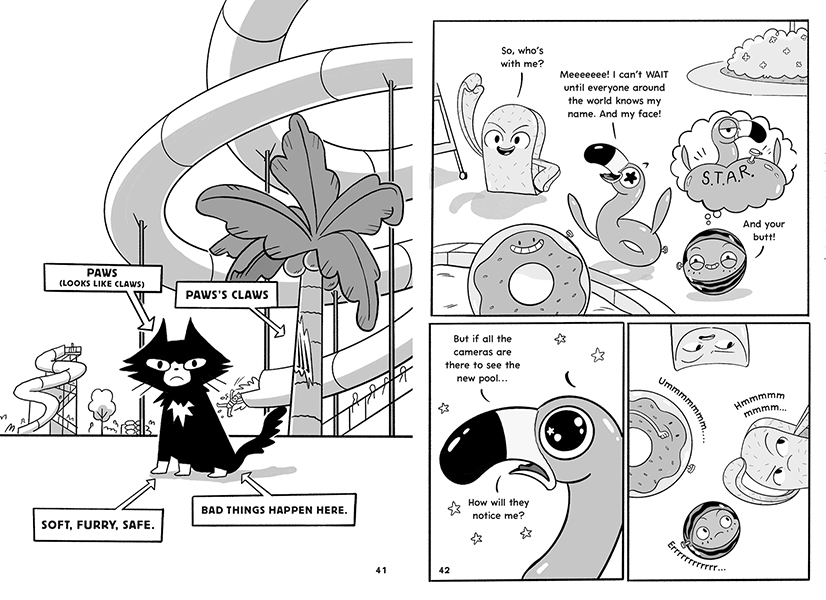
Summary:  A group of inflatable toy friends (flamingo, donut, cactus, watermelon, and raft) live in a water park and help each other out in all kinds of situations, like when they hear there’s a new wave pool opening on the other side of the park.  Seems like inflatables wouldn’t be able to travel, but where there’s a will there’s a way for this crowd.  When they get to the pool, though, Flamingo discovers that his worst nightmare is living there, and they all have to quickly find a way back home again (spoiler alert: this involves a helium tank).  There’s a happy ending for all, and I’m not full of hot air when I tell you book 2 is available now, and book 3 will arrive in October.  128 pages; grades 2-5.

Pros:  Summer may be coming to an end, but you can pretend you’re still at a pool party with this funny group of inflatable friends.  This is sure to be a hit with fans of Dog Man and other graphic novels.

Cons:  This has the look of a Branches book, but it’s more of a graphic novel than those are.  I think a larger format with color would have worked better.

Flipping Forward Twisting Backward by Alma Fullerton

Published by Peachtree

Summary:  Claire can master any gymnastic skill she puts her mind to, but school is another matter.  Reading and writing are just about impossible for her, no matter how hard she tries, and she often acts out due to her frustration.  During one of her frequent trips to the vice-principal’s office, she makes a chance remark that leads him to believe that she may have a learning disability.  Her mother refuses to believe that anything’s wrong, fearing that a label will limit Claire’s chances for success in school, and it takes a near-crisis to convince her to let Claire get tested.  The last few pages see Claire flying through her gymnastics routine with a newfound optimism that things will improve in her academic life as well.  135 pages; grades 3-6.

Pros:  This novel in verse is a quick read that sympathetically portrays a character with dyslexia.  It’s written in a font designed for children learning to read.  The short length and relatable characters and storyline would make it a great choice for an elementary book club. I’ve added it to my newly-updated list of book club suggestions for grades 2-4.

Cons:  The ending felt a bit rushed.

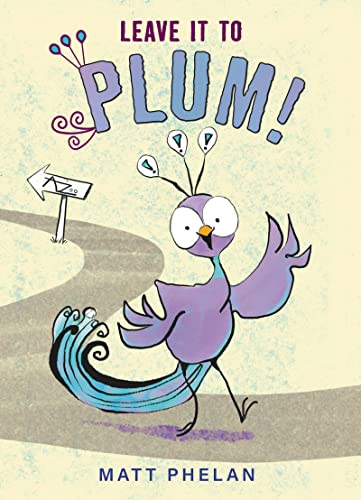
Leave It to Plum! By Matt Phelan

Published by Greenwillow Books

Summary:  Plum is a cheerful peacock who loves his job at the Athensville Zoo, where he and the other peacocks are the official greeters.  Itch is a ningbing (the world’s smallest marsupial) who makes up in evil genius what he lacks in size.  Jeremy is a white cat who tries to do the right thing, but who gets an inferiority complex when he hangs around the big cats.  Lizzie is a kind but lonely young zookeeper in a new town with a new job.  All of these creatures’ stories come together as Itch tries to carry out his dastardly plans, and Plum manages to foil them in his own bumbling fashion.  115 pages; grades 2-5.

Pros:  Matt Phelan has created a pretty complex story with lots of interesting characters that he manages to carry out in just over 100 hilarious pages with plenty of illustrations.  The humor and the fast-paced plot will appeal to many different types of elementary readers.

Cons:  The map of the zoo is a little bare-bones.

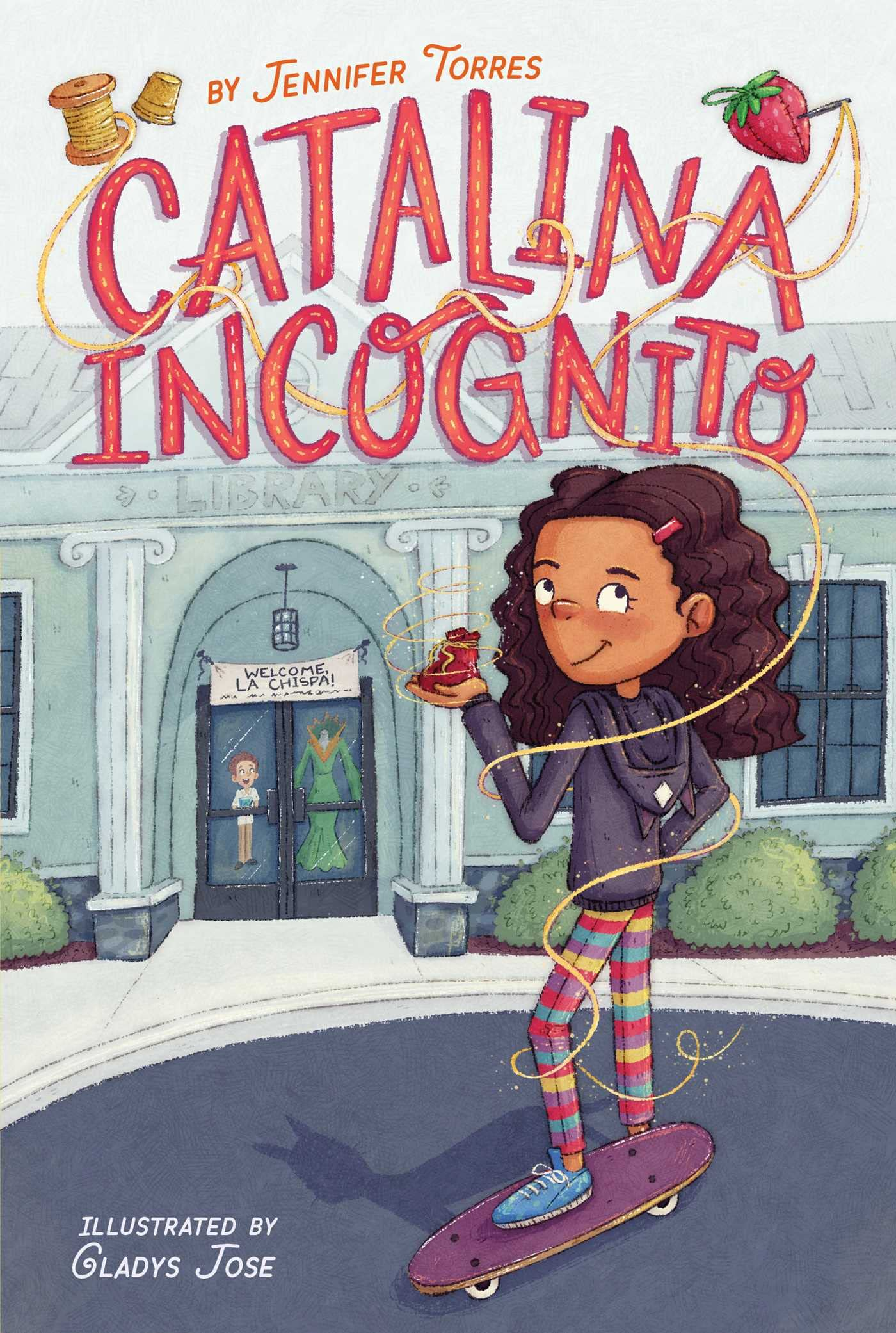
Catalina Incognito (book 1) by Jennifer Torres, illustrated by Gladys Jose

Published by Aladdin

Summary:  Catalina’s a bit disappointed to receive a sewing kit from her Tía Abuela for her birthday.  Usually Tía, a former telenovela star who is also named Catalina, gives more exciting gifts.  For their first sewing lesson, Tía shows Cat how to fix her torn cat sweatshirt.  Later, Cat realizes the sweatshirt can temporarily transform her into a cat.  It turns out the sewing kit has magic in it that can change ordinary clothing into disguises.  Becoming a cat comes in handy when a ruby goes missing from one of Tía’s most famous gowns on display at the local library.  Cat and her frenemy Pablo combine forces to solve the mystery.  This is the first of a four-part series, simultaneously released with book 2 (there’s a preview at the end of this book).  Books 3 and 4 will be out later this year.  114 pages; grades 1-3. 

Pros:  There’s a lot going on in this early chapter book: magic, a mystery, and a few lessons about perseverance.  The illustrations and larger font make it an appealing choice for younger kids.

Cons:  The mystery didn’t start until about halfway through the book and wrapped up pretty quickly. I hope Pablo gets a bigger role in book 2.

Maddie and Mabel by Kari Allen, illustrated by Tatjana Mai-Wyss

Published by Kind World Publishing

Summary:  Maddie and Mabel are two sisters who (usually) love to play together.  Their story is told in five chapters, each of which could stand alone, but which also tie together.  In one of the chapters, Mabel gets tired of Maddie’s bossiness and the two have a fight.  Maddie shows readers how to apologize and before long the sisters are happily back together.  A few pages at the end offer suggestions for discussion.  Book 2 is due out in October.  80 pages; grades K-3.

Pros:  This beginning chapter book reminds me of Laurel Snyder’s Charlie and Mouse series.  There are no adults around, so the two girls have to work things out on their own.  Each page has just a few sentences, but the stories are emotionally satisfying despite their brevity.

Cons:  Those older siblings sure can be bossy. And those younger ones can be a pain in the neck.

Zara’s Rules for Record-Breaking Fun by Hena Khan, illustrated by Wastana Haikal

Published by Salaam Reads

Summary:  Zara lives on a street with several other kids, including her brother Zayd who will grow up to star in his own series.  Before her neighbor Mr. Chapman moved away, he called Zara “Queen of the Neighborhood” and said she ruled with grace and fairness.  A new family moves into Mr. Chapman’s house, and the two kids become part of the neighborhood. Naomi, who is Zara’s age, has enough good ideas for Zara to feel threatened in her role as queen.  Inspired by her uncle’s Guinness Book of World Records, Zara decides to try to set a world record in an attempt to shine the spotlight on herself once again.  As a solo effort, the plan is a failure, but when she starts including her friends, both old and new, it’s a runaway success.  Book 2 will be out in October. 133 pages; grades 2-4.

Pros:  The author cites Beverly Cleary’s Ramona stories as an inspiration, and this book does have that feel to it, with a strong-willed protagonist and a close-knit family and neighborhood.  Unlike Klickitat Street, there’s some diversity in the neighborhood, including Zara’s Pakistani American family.  The plentiful illustrations will appeal to early chapter book readers.

Cons:  As much as I love books like these, I struggle to sell them to kids, who seem to almost always opt for graphic novels instead.

Emily’s Big Discovery (The World of Emily Windsnap) by Liz Kessler, illustrated by Joanie Stone

Published by Candlewick

Summary:  Even though Emily and her mother live on a houseboat, young Emily isn’t allowed to go into the ocean.  Her mother warns her that the water is dangerous.  When Emily gets a chance to try swimming lessons at school, she’s excited and dives right into the pool.  She feels right at home until she gets a strange sensation in her legs, like they’re sticking together.  Her instructor tells her she got a cramp and has her rest by the side of the pool, but Emily can’t stop thinking about what it was like being in the water.  That night, she sneaks off the boat and goes into the ocean.  When she has the same sensation in her legs, she realizes they’ve turned into a tail, and she’s a mermaid!  She meets another mermaid, Shona, and the two become friends and explore the ocean.  Emily returns home in the morning with the feeling that her mermaid adventures have just begun.  56 pages; grades 1-3.

Pros:  Based on the middle grade books about Emily Windsnap, this early chapter book series starter is a real charmer, especially the illustrations. Demand for mermaid books always outpaces supply, so I look forward to adding this series to my library.  Book 2 will be out in September.

Cons: The story has plot holes big enough to sail a ship through. Has Emily never taken a bath?  How could she take swimming lessons at school without her mother’s permission?  Didn’t anyone notice that she became a mermaid in the pool? How does she look so chipper going off to school at the end after being up all night? 

Happily Ever After Rescue Team (Agents of H.E.A.R.T., book 1) by Sam Hay, illustrated by Genevieve Kote

Published by Feiwel and Friends

Summary:  Evie wants nothing more than to be allowed to help out in her parents’ new diner, especially on the day a judge for the Golden Coffee Cup Best Café Contest is supposed to stop by.  But despite her creativity with food (especially ice cream), Evie is accident prone, and after spilling two large blueberry smoothies, her stepmother sends her outside.  A girl Evie’s age has left an old book of fairy tales in the diner, and when she opens it, Agents C (Cinderella), R (Rapunzel), and B (Beauty) come to rescue her.  They have their own ideas about granting wishes, though, and Evie desperately needs some help controlling them.  That help comes in the form of Iris, the original owner of the book, and her cousin Zak.  The three have a series of madcap adventures as they try to undo the damage the fairy tale agents have done and get them to understand what it is Evie wants.  In the end, all of Evie’s wishes come true…except for one, which will undoubtedly be the premise for book number two.  226 pages; grades 2-4.

Pros:  This illustrated chapter book provides lots of laughs and adventures.  Woven into the story are recipes, crafts, and other activities that kids will enjoy.  Perfect for elementary kids who are ready to move on from early chapter books but still like plenty of illustrations.

Cons:  The princesses were pretty annoying.