Elementary heroines

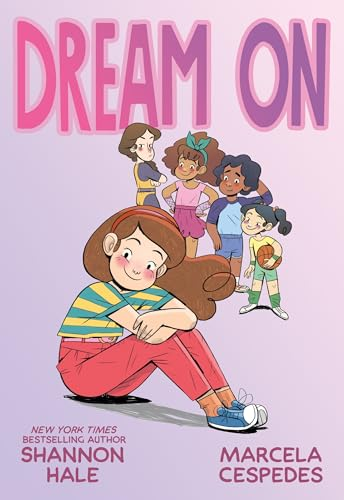
Dream On by Shannon Hale, illustrated by Marcela Cespedes (Roaring Brook Press, 240 pages, grades 3-6). Fourth-grader Cassie has a lot of big emotions as she navigates the difficult terrain of growing up in a small house with a large family and dealing with changing friendships at school. When she sees a flyer in the mail telling her she’s won some fancy prizes, she starts to dream about how this could change her life. Usually, she would enjoy sharing those dreams with her best friend Vali, but recently Vali’s been spending more time with another girl who alternates being friendly and being mean to Cassie. Cassie’s frequently told that she’s too sensitive, but she can’t help the way she feels, and as the story goes on, she learns that being sensitive also means having a greater sense of wonder about the world around her. Things don’t magically resolve themselves, but having good conversations with her mom (who’s often too busy for such things) and with Vali about their friendship helps Cassie feel better about her problems and to find a way to a new normal at school and at home. Includes a note from Shannon Hale about the parallels between Cassie’s 1980’s childhood and her own.

Fans of Shannon Hale’s Real Friends series will be delighted to discover this new graphic novel, with book 2 coming in August 2026. Just as with Real Friends, I found the tone of this book a little melancholy, but it’s a realistic portrayal of a character who is extra sensitive, making her prone to lower moods but also extra appreciative of more joyful ones.

Amina Banana and the Formula for Friendship by Shifa Saltagi Safadi, illustrated by Aaliya Jaleel (G. P. Putnam’s Sons, 128 pages, grades 2-5). Amina’s both excited and nervous about her first day of third grade in America. Her family has recently relocated from Syria to Indiana, and all of them have had to overcome many difficulties, with obstacles still ahead. Being scientifically inclined, Amina writes a five-step formula for making friends at her new school, only to find herself crossing off one step after another after a series of discouraging setbacks. But she finds a kind group of girls who help her with her English and encourage her to share her culture with them and with the rest of the class. By the final pages, Amina has found new friends and the courage to be herself in her new country.

I was wowed and humbled by the courage of Amina and her family in this early chapter book series starter (book 2 is out, and #3 will be published in January). Her dad, a pharmacist in Syria, is working at a fast food restaurant while her physician mom studies to pass the boards so she can practice medicine in the U.S. Despite their hardships, the family is loving, supportive, and has fun together. I’m always happy to find books featuring protagonists in younger elementary grades, so it was nice to discover these two books with girls in fourth and third grades.

Sci Fi graphic novels

Rodeo Hawkins and the Daughters of Mayhem by John Claude Bemis, illustrated by Nicole Miles (Holiday House, 272 pages, grades 4-7). Sidney Poblocki is trying to convince his best friend Walt to try to run away with him after another failed foster family experience when two mysterious groups appear from out of nowhere, each trying to convince him to come with them. He chooses the Paladins over Rodeo Hawkins and the Daughters of Mayhem, drinking a punch that allows him to travel through the multiverse but makes those left behind, including Walt, forget that he even existed. Before long, Sidney realizes he’s chosen the side of evil, but gets a second chance to join Rodeo and her girls, where he learns about a prophecy that someone named Sidney Poblocki will destroy the multiverse, leading the Paladins to have killed every Sidney Poblocki they’ve found before him. All of that happens before page 70, and the rest is a fast-paced story of good vs. evil, as the ragtag Daughters of Mayhem seek to stop the Paladins before they can destroy Sidney…and possibly the entire universe.

While sci-fi graphic novel is not usually my favorite genre, I have to admire the incredible world-building, adventure, and pure fun of this series starter. It seems like a graphic novel that will appeal to fans of Wings of Fire, Amulet, and Animorphs, and I was happy to see a preview for book 2 at the end. Thanks to Holiday House for providing me with an advanced copy; publication is scheduled for September 9.

Schoolbot 9000 by Sam Hepburn (Dial Books, 288 pages, grades 4-7). James is struggling with some big feelings following the death of his artist father who always supported James’s creativity. Now his mom is working all the time, and she’s gotten a HomeBot to help out. James hates the way this domestic robot surveils him at home and around his neighborhood. As if that’s not bad enough, there are new SchoolBot 9000s at school, a couple of robots guaranteed to bring up student test scores. As the machines learn about the students and teachers, they gradually start taking over more and more of the educational process, edging out the human teachers who are offered secret jobs at the company running the program. James feels like he’s the only one who can see the sinister takeover of life by robots, but is one human enough to defeat the power of artificial intelligence?

This book could hardly be more timely, not only the exploration of AI, but the increasing dependence of school administrators on technology and the emphasis above all else on raising test scores, even if that means taking away teacher autonomy and input into the educational process. Despite the weighty topics, it’s also a fun and suspenseful story, and readers will be happy to see the message on the last page: “Stay tuned for the next SchoolBot adventure!”

Some wild and crazy animals

There’s Something Odd About the Babysitter by Elayne Crain, illustrated by John Ledda (Feiwel and Friends, 40 pages, ages 4-8). Freddie’s stressed about a new babysitter, and his parents are so rushed getting out the door that they don’t notice anything unusual. But there’s definitely something odd about the babysitter who wears a trench coat, a bowler hat, and has a furry face and a black mask. The dog seems jumpy, and the babysitter refuses to take off the trench coat, but at least things are not boring. Before long, three raccoons have emerged from the coat, and everyone has a fun evening of puzzles, books, and games. Dinner is garbage, and the babysitters’ manners are appalling, but those details aside, Freddie has a great time. By the time his parents come home, and the “babysitter” has gotten bundled back into a coat and hat, he’s decided that this sitter is pretty special.

This is one of those picture books where the illustrations tell more than the words, and readers will get a kick out of seeing the humans duped by what is obviously three raccoons in a trench coat. This could be a good book to share to help kids who are having a new babysitter. On a side note, this reminded me a lot of the chapter book series Two Dogs in a Trench Coat.

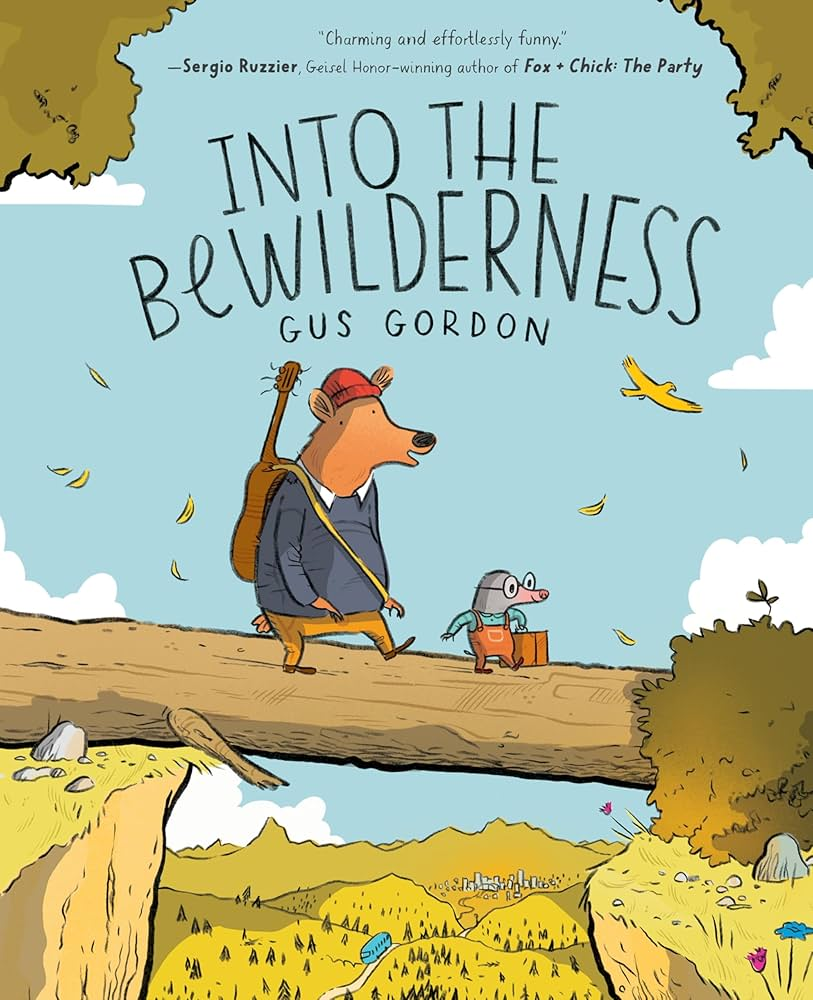
Into the Bewilderness by Gus Gordon (HarperAlley, 192 pages, grades 3-7). Luis is a friendly bear who wonders what’s in the world beyond his woodland home. Gus is a grumpy mole who has no interest in traveling but loves his friend Luis. When Luis gets two tickets to see a play in the big city, he decides to set off on an adventure, and Gus reluctantly joins him. The journey is long, filled with funny mishaps and philosophical musings, and when they finally get to the theater, Luis realizes he’s left the tickets at home. Accepting the inevitable, the two animals head back home, their friendship stronger than ever having survived the stresses of travel together.

Fans of graphic novels featuring animal characters with contrasting personalities (e.g. Peter and Ernesto, Narwhal and Jelly) will get a kick out of this story filled with both big questions and dad-joke level humor. I thought at first it was going to be over a lot of kids’ heads, but it quickly took some goofy turns that assured me younger readers will enjoy it. The art is beautiful, too. And on another side note, this made me think of one of my favorite picture books, Nobody Owns the Moon.

Cinderella stories

CeeCee: Underground Railroad by Shana Keller, illustrated by Laura Freeman (Charlesbridge, 32 pages, grades 1-5). Cecelia, or CeeCee for short, knows that her real name is different, a name that she keeps on a piece of paper hidden away from the people she works for on a Maryland plantation. The mother and two daughters there are always finding ways to scold and punish her, no matter how hard she works, but CeeCee has dreams of one day finding a better life. Binty the cook, in the role of the fairy godmother, sneaks CeeCee food and assures her that she can do anything. She also tells the girl about a prince named Moses who can give her a better life. After months of planning and secretly making herself new clothes to wear, CeeCee is runs away one night to find the mysterious prince. She’s surprised to learn that Moses is a woman named Harriet Tubman, who inspires CeeCee enough to finally share that she is named Edea, after her mama. Includes additional information about Harriet Tubman, names during slavery, Cinderella, and fairy tales.

This is a really interesting combination of Cinderella story and information about Harriet Tubman and the Underground Railroad that would make an excellent compare and contrast exercise with some of the many other versions of Cinderella. The theme of the power of names and the dehumanizing impact of taking away someone’s name could start some good discussions.

The Fairy Tale Fixers: Cinderella by Deborah Underwood, illustrated by Jorge Lacera (Clarion Books, 128 pages, grades 1-5). The Fairy Tale Fixer is just getting ready to go home to a Friday evening pancake supper, when the phone rings. It’s another mouse, and she has an emergency: the house where she lives is filled with screaming and she needs the Fixer to make things right. When the Fixer reluctantly takes the case, he discovers a girl named Cinderella being yelled at by her stepmother and stepsisters. His solution? Send Cinderella to the ball and marry her off to the prince. After all, doesn’t every girl want to marry a prince? But things go off the fairy-tale tracks at that point, and the Fixer learns that it’s a good idea to ask someone what she wants before assuming anything. Cinderella eventually gets her unconventional happily-ever-after, and the Fixer gets a new assistant and a call about a new case: an evil fairy is about to put a princess to sleep for 100 years.

The familiar story gets a fun twist in this new series opener featuring a couple of mice who fracture fairy tales. Kids just starting to read longer books will enjoy the humor and comparing the traditional story to the new version, with the end giving a preview of book 2.

Ghostly graphic novels

Ghost Town by Eric Colossal (Harry N. Abrams, 256 pages, grades 4-7). Lily’s been accepted to a prestigious science academy, which means a move to another town, but she’s sure she doesn’t want her life to change. After purposely failing her science final in an attempt to lose her scholarship, she’s grounded and assigned to volunteer at the library every morning, but that doesn’t stop her from sneaking out to play baseball with her friends. When their ball goes through the window of an old mansion, the kids stumble upon a ghost and a trap for catching other ghosts. As they go through town, cleaning up ghosts and restoring the power that those ghosts have been sucking up, they slowly unravel a mystery involving an old family from town, and one member in particular, who, like Lily, didn’t want anything to change. As she begins to see the destruction his resistance has caused, Lily realizes that change is inevitable, and it’s okay for her to embrace the new things in her life.

This is a fun tween ghostbusters story with the whole gang taking on the task of trapping ghosts and finding out about their past lives, which they accidentally discover can be done by swallowing the ghost and initiating a flashback of its past life. There’s lots of humor, like when some of the ghosts turn out to be animals, but there’s also a pretty serious message conveyed in the big final showdown.

Free Piano (Not Haunted) by Whitney Gardner (Simon and Schuster Books for Young Readers, 256 pages, grades 5-8). Margot loves playing the ukulele and writing songs, but everyone around her seems more concerned with getting likes and follows on social media. Her dad goes off to L.A. to pursue his musical dreams and his goal of 10,000 followers, while her two best friends are getting more action on their channel smashing things from a tree house than Margot gets with her music. When she finds an old synthesizer keyboard with a sign reading “Free Piano (Not Haunted),” she thinks it may be just the thing to help her connect with her dad. Instead, it starts making weird sounds, even when it’s not plugged in, and eventually the ghost of ’80’s pop star Vision appears. Vision encourages Margot to embrace her own talents, and together, the two of them exorcise an evil spirit from Vision’s past who’s been haunting the keyboard. The ghost eventually has to move on, but its clear that her influence has changed the way Margot sees herself and her talents. Includes additional information about the Prophet-5 keyboard featured in the story.

This is sure to be a popular choice for middle school kids struggling with their own identities and parental issues, and it never hurts to throw a ghost or two into the mix. The brilliantly colored artwork conjures up Vision’s 1980’s vibe, with the portrayals of ghosts and the haunted keyboard especially effective.

Two books for LGBTQ+ collections

Trans History: A Graphic Novel: From Ancient Times to the Present Day by Alex L. Combs and Andrew Eakett (Candlewick, 384 pages, grades 8 and up). The title gives a pretty good idea of what this book is: a graphic novel of trans history, starting in ancient times and going to the present, with an emphasis on western cultures. Much of the history is told through the stories of individuals, from ancient Egyptian pharaoh Maatkare Hatshepsut, “a person who was raised to be a queen but instead became a king” to Adelaide/Alexina/Camille/Herculine Barbin, a French intersex woman from the 19th century to trans activists of the twentieth century like Marsha P. Johnson and Sylvia Rivera. Their stories give some idea about beliefs and treatments of trans people were like at that time. The final chapter profiles present-day activists, each of which is written in their own voice. Includes many pages of source notes and a lengthy index.

I often reflect on how much I’ve learned from the thousands of books I’ve read for this blog, and nowhere is this more apparent than in my greater understanding of trans people. Authors like Alex Gino and Kyle Lukoff have helped me understand what it’s like to be a trans kid, and now Alex Combs and Andrew Eakett have added a whole new level of understanding with this outstanding graphic history. Focusing on individuals makes for a fascinating read, and the interviews with contemporary activists are compelling. It’s a huge amount of information, occasionally a bit overwhelming, but definitely an important book to educate readers in such an engaging format.

Athlete Is Agender: True Stories of LGBTQ+ People in Sports edited by Katherine Locke and Nicole Melleby (Christy Ottaviano Books, 224 pages, grades 5-8). In 22 essays, LGBTQ+ people tell the stories of their athletic experiences. Most of the narratives lift up supportive teammates, but there are also examples of bullying and prejudice encountered in sports. Interspersed with personal essays are brief biographies of successful LGBTQ+ athletes like tennis player Billie Jean King, WNBA players (and married couple) Courtney Vandersloot and Allie Quigley, and Olympic gold medalist rugby player and trans activist Ellia Green. The sports are varied: sled dog racing, water fitness, longboarding, and sailing, among others, and each athlete’s experience is equally unique. Introductory material includes a note on pronouns and the history of Title IX, and in the back you’ll find profiles and photos of all the contributors, information on how to be a good teammate and ally, steps to take to form a Queer Athletics Alliance or Gender and Sexuality Alliance at your school, and source notes.

I loved this positive presentation of sports, an area that has been particularly fraught for LGBTQ+ participants, especially trans athletes. The writers are honest about their experiences, and the way gender divisions in sports often made them feel uncomfortable. Each essay could stand on its own as a powerful argument for inclusion in sports, but taken all together that argument becomes all the more compelling.

Which witch?

This Year, a Witch! by Zoey Abbott (Atheneum/Caitlyn Dlouhy Books, 40 pages, ages 4-8). The narrator has had enough of her cute costumes of years past. No more bunny or mouse…this year, she is going to be a witch! She’s been planning this for quite a while, growing her hair, practicing spells, and enlisting her dad to make her a witch costume. On Halloween night, she dresses up, only to scare herself when she looks in the mirror. Dad helps her to take a break, and before long they’re out trick-or-treating, the girl in her witch costume, and her dad dressed up like a cat.

Jazzy the Witch in Broom Doom by Jessixa Bagley (Simon and Schuster Books for Young Readers, 232 pages, grades 3-7). Although Jazzy’s moms and grandmother run a successful broom business, Jazzy’s never had any interest in flying. She’s not too surprised when she’s the only kid at school not to get off the ground during her first flying lessons, trying not to feel jealous when her best friend Aggie is a soaring success. When Jazzy sees a cycling race on TV, she’s sure that she’s found her passion, and using parts from the junkyard and a little magic, she and Aggie create a bike for her. Jazzy discovers she loves biking, but she’s afraid to tell her family. With a supermoon in the forecast, the witches all get ready for a flying parade, and Jazzy is finally forced to confess her shortcomings. She learns that her moms both had their share of youthful struggles, and that everyone is proud of her just the way she is, leading her to come up with an innovative broom design with a comfortable bike saddle that not only allows her to finally learn to fly, but helps other witches as well. Includes an author’s note and a preview of Jazzy’s next adventure.

Evelyn Witch Gets a Pet by Beth Ferry, illustrated by Charles Santoso (Roaring Brook Press, 32 pages, ages 4-8). When Evelyn Witch wakes up with a feeling that something is missing from her life, she can’t quite put her finger on it until she spies the pet shop. Bats, rats, and cats are all beyond her budget, and the only thing she can afford is a box marked “Mystery Pet.” Inside is an egg, which Evelyn is most impatient to have hatch. After a series of outlandish plans to make this happen, she finally realizes that all she can do is be patient, take good care of the egg, and focus on other areas of her life. Her patience is finally rewarded with an appropriate pet for a witch.

Kids will love these three witchy heroines who learn lessons in courage, patience, and being true to themselves in two picture books and a graphic novel. Each one has distinctive artwork that creates a magical world of witches and other fantastic creatures. Halloween may still be three months away, but there’s no reason to wait to read and share these magical books.

We can never have too many middle school graphic novels

Reel Life by Kane Lynch (Graphix, 240 pages, grades 4-7). Galen’s upset when his friend Kyle pulls away from him, but their mutual friend Luna explains that Kyle’s going through a tough divorce and a custody battle with his parents. Galen doesn’t really get it until his own dad announces that he’s leaving Galen’s mom and has a new girlfriend, Jasmine. Galen and Luna use their movie making skills to try to understand not only what’s going on with Galen’s family, but also Luna’s constantly bickering parents. As the kids navigate these difficult relationships, they learn the importance of love, support, and communication. As they wrap up their movie, Galen declares, “It’s OUR story. We get to choose how it ends.”

There’s a lot to love about this graphic novel, including the artwork that resembles an animated film, but especially the underlying upbeat tone that shows kids’ resilience in the face of changing families and friendships. Galen is a kind kid who doesn’t shy away from difficult emotions, is willing to give the new people in his life a chance, but is still–for the most part–able to figure out how to take care of himself.

On Guard!: a Marshall Middle School graphic novel by Cassidy Wasserman (Random House Graphic, 256 pages, grades 4-7). Grace isn’t excited about starting seventh grade after her best friend Ava dumped her at the end of sixth grade and her parents got divorced over the summer. Due to a custody agreement, she’s forced to spend every other week with her self-absorbed mother who makes no effort to understand her daughter. When Grace sneaks into the gym at lunchtime to avoid the cafeteria, she discovers the fencing team practicing there. Although she’s fascinated, she’s sure she’s too much of a klutz to try it. After trying and failing at several other clubs, she finally reluctantly signs up for fencing. To her surprise, she finds out that she has a talent for it and that the team is a surprisingly good source of friendship and support. Using the lessons she learns through fencing, Grace slowly begins to learn how to stand up to her mother and advocate for herself with both of her parents.

I’m hoping the subtitle of this book indicates that there will be other Marshall Middle School graphic novels, as this is sure to be popular with fans of authors like Raina Telgemeier, Kayla Miller, and Maria Scrivan, as well as a good choice for those who enjoyed another fencing graphic novel, Duel. Grace’s struggles with her mother are heartbreaking but ring true, and I like how fencing subtly teachers her skills that she can use in her real life.

Exploring loss and grief

Where Are You, Brontë? by Tomie dePaola, illustrated by Barbara McClintock (Simon and Schuster Books for Young Readers, 48 pages, ages 4-8). The opening spread shows Tomie dePaola looking at a picture of a dog in a heart frame. Turn the page, and Tomie uses a second-person narration that addresses his dog Brontë to show readers how he met his puppy, and how that puppy grew into an adorable dog who loved his toys, his pink collar, and most of all, Tomie. Even after Brontë goes blind, he learns how to find his way and enjoy life. When he dies, Tomie grieves, holding an empty pink collar, drawing a broken heart, and gazing at a vacant dog bed. Seeing a rainbow, the artist is inspired to go home and draw a picture of Brontë, which he puts into the heart-shaped frame, knowing that his beloved dog will always live in his heart. Includes an illustrator’s note about how she created the art for this story that Tomie dePaola left when he passed away in 2020.

Is someone chopping onions in here? Not only is this about the death of a beloved dog, but it’s a reminder of the loss of the beloved Tomie dePaola. The story is simple, but beautiful, with different chapters of Brontë’s life shown, each beginning with the question, “Where are you, Brontë?” Barbara McClintock’s art is a lovely homage that feels very much inspired by dePaola’s work. The ending felt a bit too easy to me but probably just right for the intended young audience.

How to Talk to Your Succulent by Zoe Persico (Tundra Books, 224 pages, grades 4-7). Adara and her father are almost overwhelmed by the death of Adara’s mother. Her dad decides to move them from California to Michigan where they move in with her grandmother. There, much to her amazement, Adara learns that she has inherited her mother’s ability to talk to plants, starting with a small succulent named Perle that her grandmother buys for her. Talking to plants makes Adara feel closer to her mom, but the rest of life still feels overwhelming, and sometimes her own needs mean that she neglects those of others, including Perle and a new friend named Winnie. Meanwhile, Dad is having a hard time seeing what Adara needs, and everyone–Adara, Perle, and Winnie–learn some lessons about advocating for themselves. By the end, Adara and her father are slowly embracing a new normal, which is shown in the photo of them together on the last page with the caption “Light after the dark.” Includes an author’s note, photos of some of the inspirations for the artwork, information on how the book was created, and instructions for propagating succulents.

This is a moving and endearing exploration of grief, with the interesting twist of Adara’s ability to talk to plants. I liked how the author showed how grief can close you off to those around you, and how it’s okay to ask for what you need. The artwork is truly amazing, particularly the depictions of the plants coming to life.

Creature features

Creaky Acres by Calista Brill, illustrated by Nilah Magruder (Kokila, 272 pages, grades 3-7). Nora is happiest winning ribbons at shows with her horse Hay Fever, but when her mom gets a new job, the family moves to a small rural town where the only barn around is Creaky Acres. Filled with quirky humans and animals, including a bunch of opossums and an instructor who doesn’t believe in competing, Creaky Acres feels like a huge disappointment to Nora. On top of that, she’s the only Black kid at her school and finds herself dealing with microaggressions from both students and teachers. But Nora’s love for riding remains strong, and before long, she’s made some tentative connections with the other kids at Creaky Acres. When she hears about an upcoming riding event, she’s determined to compete. Her fellow riders, having heard about Nora’s experiences and seen her ribbons, beg to let them join her, and before she knows it, Nora is coaching a Creaky Acres team. On the day of the event, the results are mixed and sometimes hilarious, but when Nora reunites with friends from her old riding school, she realizes she has found her new place at Creaky Acres.

Give this to fans of Ride On by Faith Erin Hicks, who will enjoy another graphic novel about a group of underdogs who find their own ways in the elite world of horseback riding. It’s a cheery story with endearingly quirky characters, but it also deals with the more serious topics of dealing with racism and learning to be yourself in a new place.

Creature Clinic by Gavin Aung Than (First Second, 224 pages, grades 3-7). Creature Clinic, run by the imperious Dr. Orc, treats all kinds of creatures: trolls, unicorns, griffins, and more. But when an injured human boy is discovered on the bottom of an unconscious giant’s shoe, Dr. Orc refuses treatment, stating that humans are nothing but trouble. Her long-suffering daughter, Dr. Kara Orc, takes pity on the human and secretly helps him on the condition that he leaves the next day. But Mitch, the boy, is fascinated by the clinic, and a sympathetic custodian hides him in a trash bin and wheels him around for a tour. Mitch is able to show Kara and some of the others how his empathetic listening skills can help the patients, but when the senior Dr. Orc discovers Mitch and learns that Kara has been harboring a fugitive, she is furious. Some of the other creatures intercede, reminding the doctor how she defied her father to do what she thought was right, even though it damaged their relationship. Eventually, Dr. Orc sees the error of her ways, lets Mitch stay, and mends things with her daughter. And they all live happily ever after, unless, of course, there’s a sequel in the works. Includes an author’s note and seven illustrated steps that explain how the book was created.

I would love to see that sequel to this imaginative, funny, and original graphic novel that I know kids will love. The world building of the clinic is so clever and detailed, and the issues the various creatures deal with make them seem, well, human. The author’s note relating how the time his daughter spent in the NICU inspired the story adds an extra dimension.