Flowers for Sarajevo by John McCutcheon, illustrated by Kristy Caldwell

Published by Peachtree Publishers
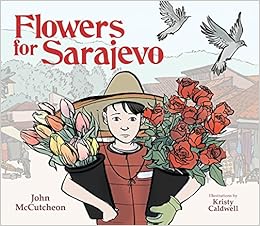
Summary:  Drasko helps his father sell flowers on the streets of Sarajevo.  But when war comes to their city, his father has to go away to fight.  Drasko is left on his own, and the older merchants push him away from the prime selling locations to a corner of the square.  The only good thing about his location is that he backs up to a concert hall and gets to hear the orchestra play.  One terrible day, at ten o’clock in the morning, a bomb falls on a nearby bakery, killing 22 people who were waiting to buy bread.  The next morning, when the clock strikes ten, a cellist from the orchestra comes out to the street and plays a sad and beautiful melody.  He continues to play every day at ten o’clock for 22 days, one day for each person killed by the bomb.  Slowly, life begins to return to normal in the square again, and Drasko works hard to do his part to make it beautiful once more.  Includes information about the Balkan region and Sarajevo, an author’s note about the events that inspired this story, additional resources, and the words and music to the author’s song, “Streets of Sarajevo”.  The book comes with a CD that includes this song and Albinoni’s Adagio in G Minor, the song played by Vedron Smailovic, the cellist in the story.  32 pages; grades 3-7.

Pros:  A sad, moving, and ultimately hopeful story about a part of history kids may not know much about.  The muted illustrations complement the story.  The musical tie-in adds another interesting element to the book.

Cons:  Definitely a picture book for older elementary and middle school students, needing adult support to fully understand the story.
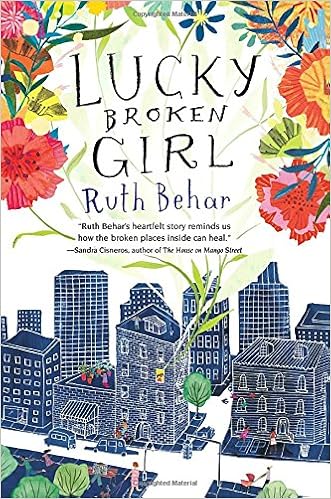
Lucky Broken Girl by Ruth Behar

Published by Nancy Paulsen Books

Summary:  Ruthie is happily adjusting to life in 1960’s Queens, New York, where her family has settled after escaping Castro’s Cuba.  She’s just been promoted from the “dumb class” and has a new pair of coveted go-go boots when her father surprises the family one night with a new car.  Off they go to visit family friends on Staten Island, but on the way home, tragedy strikes.  A car accident leaves five teenagers dead, a woman paralyzed, and Ruthie with her leg so badly broken that she is put in a body cast and bedridden for nearly a year.  Stuck in the family’s small apartment, having to use a bedpan, and unable to eat much for fear of outgrowing her cast, Ruthie is forced to draw on her own resources.  She discovers reading, writing, and painting, and comes to appreciate the friends and family members who work hard to keep her spirits up.  When she is finally released from the cast, she struggles to overcome her fears of reinjuring herself, and again learns to find the courage to leave her bed, venture outside, and eventually return to school.  She must heal from being broken, but as the title says, she learns to count herself lucky as well.  256 pages; grades 4-8.

Pros:  Based on the author’s childhood experience, this is a story of immigrants struggling to find a home in America and a girl struggling to find her way through an extremely debilitating injury.  Behar writes unflinchingly of her fears and how she was able to keep pushing through them.

Cons:  My claustrophobia started kicking in around month 4 of the body cast experience.

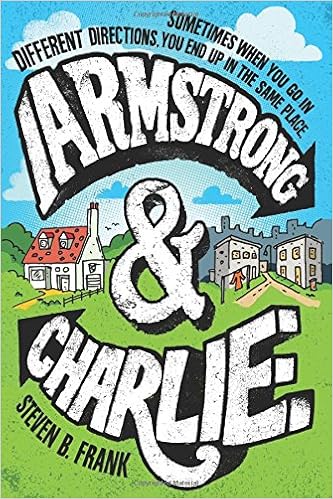
Armstrong & Charlie by Steven B. Frank

Published by HMH Books for Young Readers

Summary:  When “Opportunity Busing” comes to Charlie’s neighborhood school in 1970’s southern California, many of his friends’ parents opt for other schools.  But Charlie’s parents, who have experienced some prejudice against their Jewish faith, choose to keep Charlie at Wonderland.  Some 15 miles away, Armstrong’s parents decide to take advantage of the opportunity, and send their reluctant son to sixth grade at Wonderland.  Told in the alternating voices of the two boys, the story shows the two-steps-forward-one-step-backwards progress of school segregation.  Gradually, the two boys go from sworn enemies to a tentative truce to a close friendship.  Charlie, still hurting from the death of his older brother the previous year, eventually shares his pain with Armstrong, who in turn gives Charlie a taste of what his life in the projects is like.  By the end of sixth grade, they are almost like brothers, unsure if they will see each other again as separate junior high schools loom in their futures.  304 pages; grades 5-8.

Pros:  Both funny and poignant, Armstrong & Charlie grabs the reader immediately with two distinct voices switching off every page or two. With lots of 1970’s era details (how could I have forgotten about click-clacks?), kids will get a taste of what school segregation was and how it affected ordinary kids of both races.

Cons:  While many fifth graders would enjoy this book, be aware that there is quite a bit of profanity, plus detailed discussions of French kissing and spying on naked women, before recommending it to them.

The Inquisitor’s Tale: Or, The Three Magic Children and Their Holy Dog by Adam Gidwitz, illuminated by Hatem Aly

Published by Dutton Children’s Books


Summary:  The first magic child is Jeanne, a French peasant girl who occasionally has “fits” in which she can see the future.  The second is William, a half-African giant of a boy with legendary strength, whose father dropped him off in a monastery when he returned from the Crusades.  The third is Jacob, a Jewish boy whose parents were killed when his village was burned down by some Christian kids/hooligans.  And the dog is Gwenforte, a greyhound who was accidentally killed by Jeanne’s parents when she was a baby, and who has reappeared near her grave a decade later.  Somehow these four find each other and begin a journey through 13th-century France in which they gain the reputation for being either saints or heretics.  They befriend a king, are rescued by an angel, and save the last copies of the Talmud after a massive book burning in the center of Paris.  Their story is pieced together by an unnamed listener, sitting in a tavern and hearing bits and pieces from various travelers.  Along the way, they learn that their friendship is stronger than the hate that divides those around them by class and religion.  A 14-page author’s note (“Where did this story come from?”) tells more about the history of the Middle Ages and some of the characters that appear in the book.  384 pages; grades 5-8.

Pros:  Ironically, the most timely story of the year is one that takes place in 1242.  The prejudices, politics, and poverty are all as sadly familiar to us today as they were almost 800 years ago.  And the last chapter’s call to bear witness to what’s good in life is as inspiring to today’s reader as it was to Jeanne, William, and Jacob.  The “illuminations” on each page add to the Middle Ages feel.  If I were the Newbery committee, this book would get some recognition.

Cons:  The somewhat picaresque nature of this book, as well as the time period it’s set in, may make this hard to sell in a 30-second booktalk.

Cloud and Wallfish by Anne Nesbet

Published by Candlewick 

Summary:  Imagine Noah’s surprise when his parents pick him up from school one day, announcing that they’re leaving that night for a six-months stay in East Berlin where his mother will do research for her master’s thesis.  Not only that, but there are a lot of rules to follow, starting with the fact that Noah and his parents will have different names (Noah becomes Jonah), and Noah’s mom has made up a photo album called the Jonah Book, showing a fictional past for his life so far.  It’s 1989, and everywhere in East Berlin, people are watching and listening.  As Noah’s family settles in, he starts to suspect that his parents are doing more there than helping his mom get her thesis done.  He meets a girl named Claudia, pronounced Cloudia, and he nicknames her Cloud.  She calls him Wallfish after the German word for whale, a reference to his new name, Jonah.  Cloud has learned that her parents have been killed in a car accident while traveling in Hungary, but she is starting to suspect that this may not be true.  As 1989 draws to a close, events unfold very quickly throughout eastern Europe, and Noah, his parents, and Claudia are caught up in history as the Berlin Wall begins to crumble.  400 pages; grades 5-8.

Pros:  A fascinating story about an amazing time in German history.  The reader sees events unfolding through Noah’s eyes, supplemented with “Secret Files” that give more history and reveal a couple of secrets that help explain what Noah is experiencing.  A possible Newbery contender.

Cons:  Definitely a confusing plot; I was still unsure about Noah’s parents’ lives at the end of the story, as is Noah.  Also, the “Secret Files” seemed like an easy way out to explain the background of what was happening, rather than weaving it into the story.

The Wolf’s Boy by Susan Williams Beckhorn

Published by Disney-Hyperion 

Summary:  Set in prehistoric France, Kai’s story begins with the discovery of his clubfoot at birth.  His parents are told to abandon him to the wolves, but the wolves spare his life, and his mother rescues him.  He grows up in a loving home, but is not allowed to hunt or even touch the weapons the other boys use to learn how to become hunters.  Kai has always had a connection to the yellow wolves that live nearby, and when one of the females is killed, Kai decides to adopt one of her pups.  He raises her to be a pet, but some in his community feel threatened by the presence of both Kai and his wolf.  After a near-fatal showdown with some of the other boys, Kai decides he must strike out on his own, with only Uff, his wolf, for a companion.  The second half of the book tells the story of his survival, including a mysterious Ice Man who rescues Kai from an avalanche and nurses him back to health in a cave.  Near the end, Uff is mauled by a bear and nearly killed; that crisis helps Kai decide that it is time for him to return home.  240 pages; grades 3-7.

Pros:  People from a far-distant past come to life in the pages of this exciting historical fiction story.  Kids will connect with Kai’s experiences with his family, bullies, a girl he likes, and most of all, the dog he loves.

Cons:  Because the setting is so unfamiliar, kids may find some parts of the story confusing.

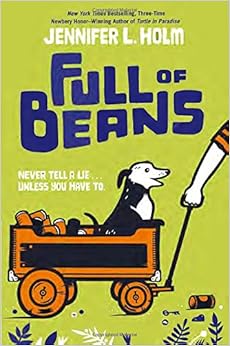
Full of Beans by Jennifer L. Holm

Published by Random House Books for Young Readers 

Summary:  Beans and his family are down on their luck.  It’s 1934, and Key West, Florida has been hit hard by the Great Depression.   Beans’ mother takes in laundry, while his father has left for New Jersey, hoping to find a factory job.  When local bootlegger Johnny Cakes offers Beans a job pulling fire alarms to distract the townspeople while Johnny smuggles out his whiskey, it’s hard to say no.  But when a real fire ravages his best friend’s house, the fire department thinks it’s another false alarm and doesn’t show up.  Tortured by guilt, Beans leaves behind his life of crime and starts focusing on some of the New Dealers who are trying to turn Key West into a tourist resort.  It seems like a crazy plan at first, but Beans and the rest of the Key West kids pitch in to clean up and fix up their town.  Before long, movie stars and other rich and famous types are flocking to Key West, and it looks like Beans’ luck may have turned around at last.  An author’s note tells more about Key West and President Franklin Roosevelt’s New Deal plans to transform it.  208 pages; grades 3-6.

Pros:  A sequel to Newbery honor book Turtle in Paradise, this story follows Turtle’s cousin Beans and his family and friends.  The pages are crowded with memorable characters, including cameos by Robert Frost and Ernest Hemingway.  Beans provides a funny, tough-guy narration to the events of his town that will transport readers to a slice of life in the 1930’s.

Cons:  I haven’t read Turtle in Paradise, and am pretty sure I would have had a greater appreciation for some of the characters and incidents in this book if I had.

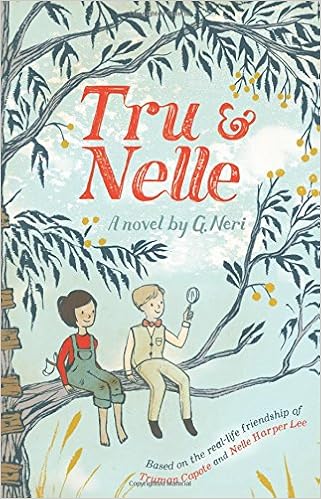
Tru and Nelle by G. Neri

Published by HMH Books for Young Readers 

Summary:  When Tru and Nelle first meet, he thinks she is a boy and she thinks he is a girl.  After exchanging a few rounds of insults, the two become fast friends.  Both live in Monroeville, Alabama, a sleepy little town in the throes of the Great Depression, but their combined imaginations create a force to be reckoned with.  They love to read, and Sherlock Holmes becomes a favorite.  Before long, Tru is Sherlock and Nelle is Watson, and they’re on the prowl for a real mystery.  A break-in at the local drugstore provides one, but it ends in disaster, and the two decide it’s safer to write their stories than to act them out in real life.  Eventually, Tru’s socialite mother remarries and sends for him to join her in New York City, but first he throws a blow-out farewell party that results in a confrontation with the local Ku Klux Klan.  The writing, the friendship, the wild party…all foreshadow what would happen to these two children who grew up to become Truman Capote and (Nelle) Harper Lee. 336 pages; grades 3-5.

Pros:  Fans of To Kill a Mockingbird will enjoy learning more about the real-life Scout and Dill.  The writing beautifully captures the Depression-era South.  Modeled on Capote’s Breakfast at Tiffany’s, the book ends with a few short stories which are flesh out the longer novel.

Cons:  Readers in the targeted age range aren’t likely to be familiar with Harper Lee or Truman Capote, making this a much less appealing choice for the younger crowd.

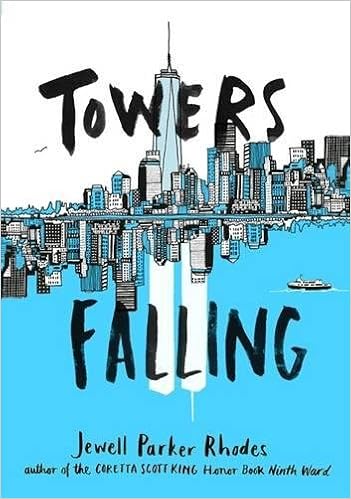
Towers Falling by Jewell Parker Rhodes

Published by Little, Brown Books for Young Readers

Summary:  Deja’s home is a single room that she shares with her parents and younger brother and sister in a Brooklyn homeless shelter.  Her father, for reasons that are unclear to Deja, is unable to hold a job; her mother’s salary as a waitress isn’t enough to cover basic living expenses for the family.  With the move to the shelter, Deja has to change schools.  She’s nervous at first, but quickly makes two friends, Ben and Sabeen, and discovers that she likes this school better than any other she’s attended.  There’s a new curriculum for the fifth graders this year, teaching them about 9/11 and their connection to that event.  At first, Deja’s mystified by this, as she’s never heard about the events of 9/11.  Gradually, she comes to understand not only the tragic day itself, but its impact on her friends—Ben, whose father served in the military in Iraq and Sabeen, whose Muslim family has had to deal with prejudice and discrimination—and her own family.  As Deja becomes more insistent, her father gradually tells her about what happened to him on that fateful day, and together, they begin to move toward healing and rebuilding their family.  240 pages; grades 4-6.

Pros:  A powerful story to commemorate the 15th anniversary of 9/11.  Readers who weren’t alive in 2001 will learn along with Deja the events of that day and how it changed the people of the United States.

Cons:  It was difficult for me to believe that a fifth-grader who had spent all her life in New York City had never heard about the World Trade Center or 9/11.

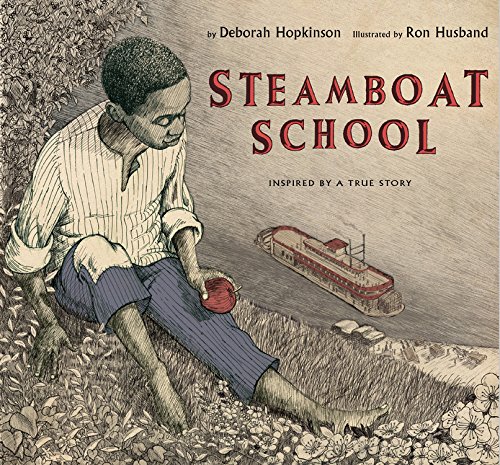
Steamboat School: inspired by a true story by Deborah Hopkinson, illustrated by Ron Husband

Published by Disney Hyperion 

Summary:  James isn’t too enthusiastic on his first day of school.  Held in a windowless church basement, it’s the only school available for free blacks living in Missouri in the 1840’s.  It’s called a Tallow School, because it’s lit by candles.  “We make our own light here,” explains his teacher, Reverend John.  When a state law is passed prohibiting schools for “negroes and mulattoes”, Reverend John is undaunted.  He spends months building and refurbishing a steamboat on the Mississippi river.  Finally, one morning at dawn, the children meet their teacher, who rows them out to the boat.  It’s a school!  And state law doesn’t apply to the river, so the students are safe to resume their education.  An author’s note tells more about John Berry Meachum, who was the real Reverend John.

Pros:  A fascinating and inspiring piece of historical fiction, beautifully illustrated by the first African-American animator at Walt Disney Studios.

Cons:  Not much is known about this school and the students who attended it.