Snow Horses: A First Night Story by Patricia MacLachlan, illustrated by Micha Archer

Published by Margaret K. McElderry Books
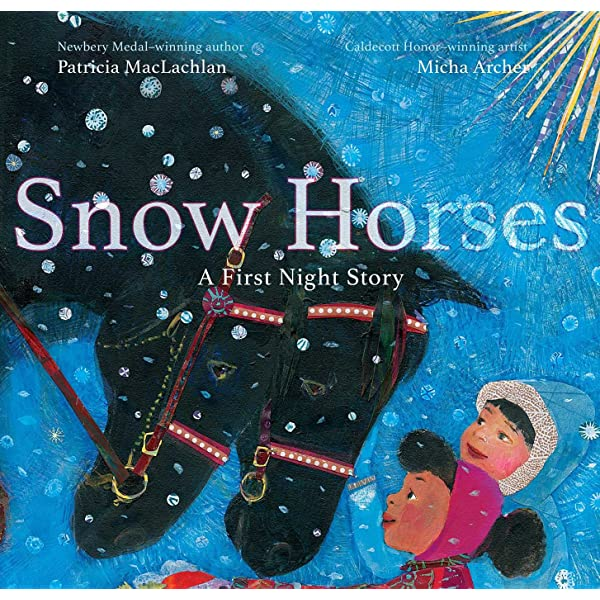
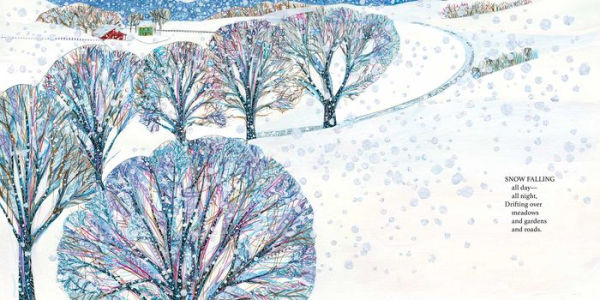
Summary:  A young woman named Jenny guides her two horses, Tom and Tim, out into a snowy night for a New Year’s Eve celebration.  First, they pull a sleigh full of children around town before dropping them off at their houses to snuggle into bed.  They next go to the manor to pick up the older people, who enjoy reminiscing about their childhood days on their sleigh ride.  Finally, the two horses are led back into the barn where they are bedded down for the night.  Everyone falls asleep as New Year’s Eve turns into New Year’s Day.  40 pages; ages 4-8.

Pros:  The lyrical text and gorgeous collages capture a snowy night filled with celebration.  The colors and textures make for some amazing illustrations by Caldecott honoree Micha Archer.  A perfect addition to winter holiday collections.

Cons:  It’s a bit more slow-moving and contemplative than some other holiday stories.
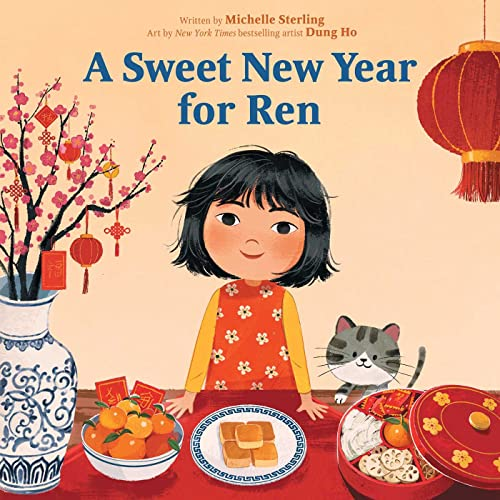
A Sweet New Year for Ren by Michelle Sterling, illustrated by Dung Ho

Published by Simon and Schuster/Paula Wiseman Books

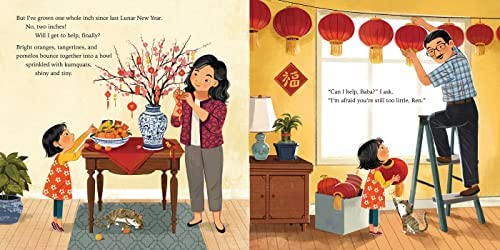
Summary:  Ren is excited to be getting ready for the Lunar New Year.  There’s plenty of food to prepare, but every time Ren asks to help, she’s told that she is too little (even though she has recently grown two inches!).  Finally, her big brother Charlie comes home, and he has the patience to gently guide Ren through making pineapple cakes.  She is happy when the family sits down to the holiday dinner that she has made something to contribute.  After dinner, everyone gathers outside to watch the fireworks.  Includes an author’s note at the beginning about her connection to Lunar New Year and a recipe for pineapple cakes at the end.  32 pages; ages 4-8.

Pros:  A happy introduction to Lunar New Year, narrated by an enthusiastic young girl who loves the holiday and her family.  The cheerful illustrations will help readers visualize the different foods and decorations.

Cons:  I thought there would be more of a plot resolution around Ren being repeatedly told that she was too little.

Murray Christmas by E. G. Keller and A Very Mercy Christmas by Kate DiCamillo, illustrated by Chris Van Dusen

Published by Harry N. Abrams

Published by Candlewick

Summary: Murray is a dog who takes his job as family protector very seriously. When the family starts doing odd things like bringing a tree into the house and hanging laundry by the fireplace, Murray tries to get things back to normal. He starts seeing a weird guy in a red suit everywhere, and then one night the guy appears in his house! Murray tries to get him out, and the ensuing chaos nearly ruins Christmas. But Santa turns out to be pretty helpful, and the two of them work to set things back to rights. Although Murray can’t figure out why this man doesn’t use the front door like everyone else, he’s happy to find a present waiting for him on Christmas morning…his own Santa hat. 40 pages; ages 4-8.

Many readers will be familiar with the characters and setting of A Very Mercy Christmas. Stella wants to go caroling, but the humans are all too busy. She heads down the street with Mercy and General Washington the cat and decides to try singing a solo carol. When the animals join in (in their own ways), they’re joined by Maybelline the horse. All the ruckus brings the humans out to join in, and then they all head back to the Watsons’ for some buttered toast. 32 pages; ages 4-8.

Pros: Kids are sure to get a chuckle out of both of these Christmas books featuring some pretty loveable animals and warm holiday spirit.

Cons: Those who haven’t read the Mercy Watson books may be a bit mystified by some of the characters and situations.

A Pilgrim-free Thanksgiving book list

With the Thanksgiving “history” we learned in school being largely debunked, many of the traditional holiday books no longer feel appropriate. Here’s a list of books I’ve reviewed over the years that focus on other aspects of the holiday, like family, feasts, and gratitude.

Twelve Dinging Doorbells: An Every-Holiday Carol by Tameka Fryer Brown, illustrated by Ebony Glenn

Published by Kokila

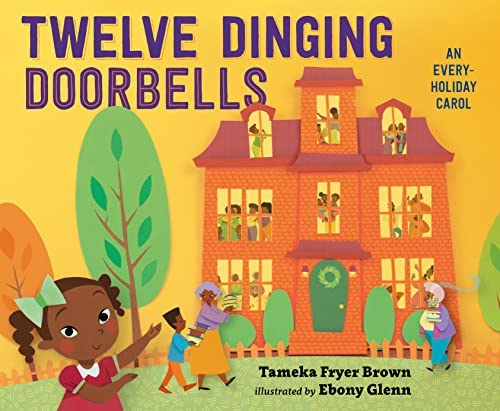
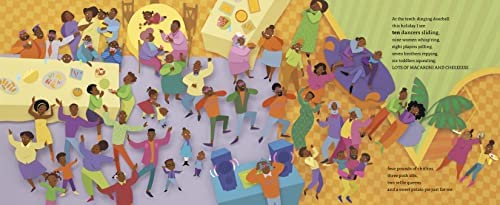
Summary:  As the subtitle suggests, this is a book that could be used for any large family gathering, although it’s based on “The Twelve Days of Christmas”.  The cumulative text begins with “a sweet potato pie just for me,” then goes on to two selfie queens, three posh sibs, all the way to eleven stinky sides (side dishes) and twelve crowded steps as an extended family gathers for a holiday meal.  Macaroni and cheese replace five golden rings with different variations as the day goes on (lots of mac and cheese, where’s my mac and cheese, and finally, who needs mac and cheese?).  The narrator and her grandmother share the sweet potato pie–just for her–on the final page.  32 pages; ages 3-8.

Pros:  A great holiday choice that features a joyful Black family’s gathering with colorful illustrations, all kinds of people, and plenty of yummy food.

Cons:  While I enjoyed the macaroni and cheese humor, I kind of missed the number five.

The Perfect Tree by Corinne Demas, illustrated by Penelope Dullaghan

Published by Harry N. Abrams

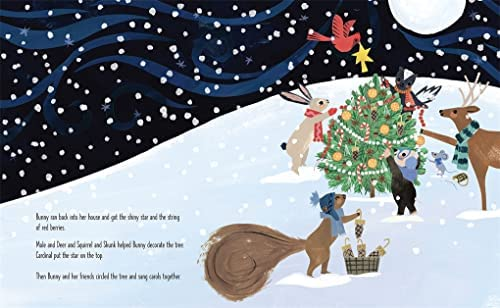
Summary:  Bunny goes out the day before Christmas looking for a tree that is just her size.  Along the way, she meets different animals who all have ideas about what makes the perfect tree: Squirrel says it should be bushy like his tail, Mole looks for a tree with a point like a mole’s nose, Cardinal thinks color is the most important ingredient, and Skunk says that it’s smell.  Each tree Bunny finds lacks one of those characteristics.  Finally, too cold to look any further, she heads for home.  To her surprise, she discovers the perfect tree not far from where she lives.  She runs to get her saw but can’t bring herself to cut the tree down.  The animals get together and decorate their outdoor tree, then gather around it to sing carols.  32 pages; ages 3-8.

Pros:  Kids will love this heartwarming Christmas story with its repeating text, adorable animals, and happy ending.

Cons:  The final tree doesn’t seem to fit Bunny’s criteria for being “just her size”.  

Giving Thanks: How Thanksgiving Became a National Holiday by Denise Kiernan, illustrated by Jamey Christoph

Published by Philomel Books

Summary:  Starting with a few thoughts about gratitude and how it’s expressed around the world, the book moves to the history of American Thanksgiving, with Sarah Josepha Hale’s campaign to create a national Thanksgiving holiday.  Abraham Lincoln finally agreed, declaring the holiday for November 26, 1863.  It was challenging to find much to be grateful for in the midst of the Civil War, but people celebrated and have continued to up to the present.  Turkey dinners, marching bands, and soup kitchens are all depicted as ways Thanksgiving is observed, and readers are asked to cite their own favorite parts of Thanksgiving.  Includes additional resources.  32 pages; ages 4-8.

Pros:  An excellent resource for those revisiting the history of Thanksgiving, as no mention is made of the Pilgrims or the Wampanoag.  It’s a good update to Thank You Sarah: The Woman Who Saved Thanksgiving by Laurie Halse Anderson (2002).  The excellent illustrations will serve as a good springboard for discussing kids’ heritages and traditions.

Cons:  It felt like the book tried to cover a lot of ground, making it feel a bit disjointed at times.

Keepunumuk: Weeâchumun’s Thanksgiving Story by Danielle Greendeer, Anthony Perry, and Alexis Bunten illustrated by Garry Meeches Sr. 

Published by Charlesbridge

Summary:  Maple and Quill love visiting N8hkumuhs (pronounced NOO-kuh-mus), their grandmother, and hearing her stories.  One story she tells is of Weeâchumun (corn), and how she and her sisters Beans and Squash helped new people who came to their land.  They sent dreams to the First People to alert them of the newcomers’ plight, and the people sent Ousamequin and Tisquantum to greet them and show them how to plant corn, beans, and squash.  When there was a successful harvest, the First People and the new people celebrated together with a three-day feast.  “Many Americans call it a day of thanksgiving,” concludes N8hkumuhs.  “Many of our people call it a day of mourning.” Includes a glossary and introduction at the beginning and additional information about the Wampanoag tribes, storytelling tradition, harvest feasts, and tradition of giving thanks at the end, as well as a recipe and a photo of the real Maple and Quill.  32 pages; grades K-4.

Pros:  An excellent addition to Thanksgiving collections that gives the Wampanoag perspective and includes some good information in the back matter.  The illustrations beautifully portray various animals and the spirits of the Three Sisters.

Cons:  Kids might need some help with the transition between the opening scene with N8hkumuhs, Maple, and Quill and the main story. I was confused until I realized that the weeâchumun (corn) that N8hkumuhs mentioned was the same as Weeâchumun, the spirit of corn and the protagonist of N8hkumuhs’ story.

Free At Last: A Juneteenth Poem written by Sojourner Kincaid Rolle, illustrated by Alex Bostic

Published by Union Square Kids

Summary:  This free verse poem begins with the news arriving in Galveston, Texas: the war is over, and “all who live in bondage here shall from now until be free.”  The words and oil paintings depict Black people’s reactions.  Some head for their shacks, which they now declare home; some go to another farm to work “for a pittance and a little plot of space.”  Others pray, dance, or head farther away.  The last few pages depict their descendants celebrating that freedom, right up to the present day.  An author’s note tells how she was introduced to Juneteenth in the 1980’s and wrote this poem, originally published in 2004, and how Juneteenth has gained wider recognition, eventually becoming a national holiday in 2021.  32 pages; grades K-4.

Pros:  The beautiful words and pictures in this book make it an excellent addition to Juneteenth literature, and a perfect way to observe the holiday.

Cons:  It would have been interesting to get more information about the fate of the different people portrayed in the book, and how their decisions to stay close to home or travel affected their futures.

Raquela’s Seder by Joel Edward Stein, illustrated by Sara Ugolotti

Published by Kar-Ben Publishing

Summary:  Raquela and her family live in Spain during a time when it’s forbidden for them to practice their Jewish faith.  They celebrate Shabbat each week in their wine cellar, but Raquela has only heard about Passover.  One year she asks her parents if they can have a seder.  Her mother says it’s too dangerous, but her father, a great fisherman, gets a thoughtful look in his eyes.  The night before Passover begins, Raquela’s parents pack a basket, and the next night they sneak onto her dad’s fishing boat.  Papá takes them to his favorite secret fishing spot, where they drop anchor and proceed to have a seder dinner.  An old fisherman sees them when they return, saying that it must have been a special night for Papá to take his family out fishing with him.  Raquela says to her father, “It was a night different from all other nights.”  Includes additional information about Passover and the Spanish Inquisition and its consequences for Spanish Jews.  32 pages; grades K-3.

Pros:  An excellent book for celebrating Passover that weaves the original Passover story into the Spanish one and focuses on the hope and endurance of both groups of Jews.

Cons:  I wouldn’t have objected to a bit more historical back matter.