Two (or more) of a kind

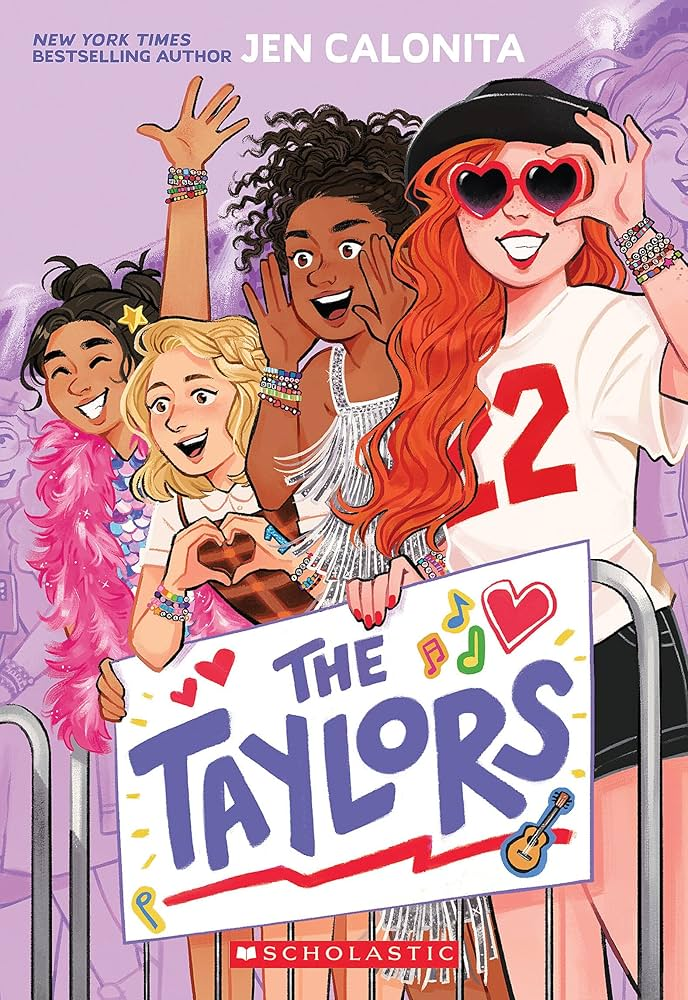
The Taylors by Jen Calonita (Scholastic, 224 pages, grades 3-6). Taylor, a.k.a. Teffy, is nervous about starting fifth grade, which is at the middle school. She’s surprised and delighted to discover three other girls named Taylor in her class, each one named, as she is, for Taylor Swift. The pop superstar’s Eras Tour is coming to their hometown of Indianapolis, and all four are desperate to get tickets. They come up with different strategies, most notably selling friendship bracelets to try to raise the exorbitant sums the tickets are fetching online. When not pursuing their Swiftie passions, the four try out for cheerleading and navigate the occasionally bumpy roads of fifth grade, including dealing with mean girl Hannah and some misunderstandings among themselves. Although they’re not able to realize their dream of buying tickets, they decide to attend the Tay-gating party next to the stadium, where their loyal friendship pays rich dividends in the form of a surprise truly worthy of Taylor Swift.

Although this story already feels slightly dated (the Eras Tour ended almost a year ago), the friendship of Teffy, Tay-Tay, TS, and Taylor is truly an inspiring one, showing four girls whose loyalty and integrity helps them achieve their lofty goals. Although it’s technically a middle school story, I like that the girls are in fifth grade, making this a great choice for elementary readers. 

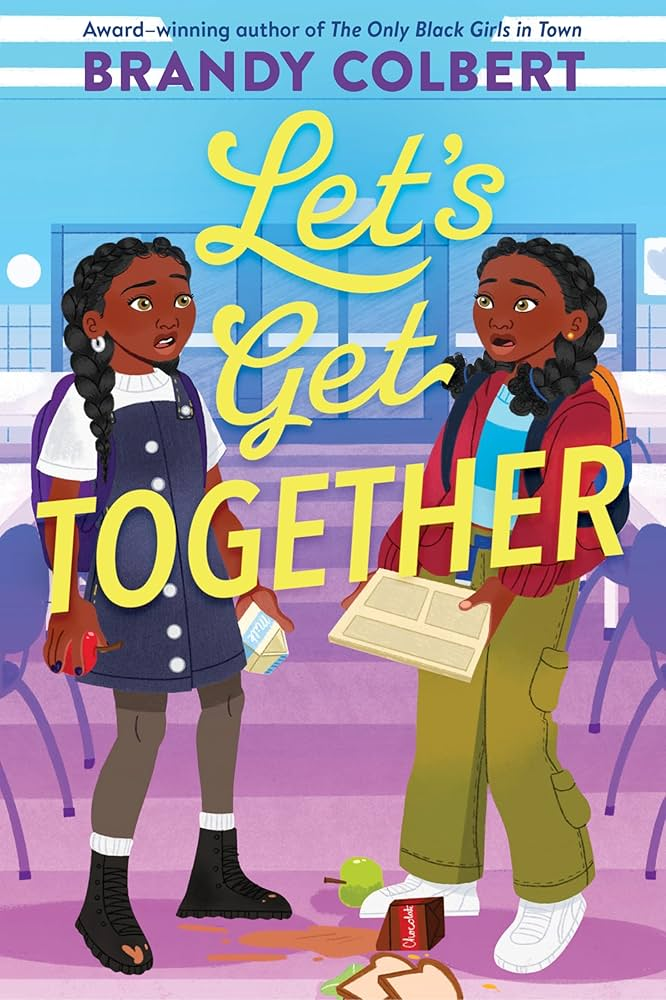
Let’s Get Together by Brandy Colbert (Clarion Books, 304 pages, grades 4-7).  In alternating chapters, Kenya and Liberty tell their story of sixth grade. Liberty’s been in the foster system most of her life and has finally landed in a good home with a woman named Joey. She’s nervous about her first day of middle school, but doesn’t expect the surprise that meets her there: a popular girl named Kenya who looks exactly like her. There’s tension between the two girls from the start, and a big fight at the sixth-grade mixer lands them both in the principal’s office, where Kenya’s father realizes he’s finally found his long lost daughter–Kenya’s twin. As the girls learn about their past, they slowly become good friends and decide there’s only one way to a happy ending: get Kenya’s dad and Joey to fall in love and get married. The author’s note tells of her love of the original Parent Trap movie that inspired this story as well as additional information about children in the U.S. foster care system.

Those who have watched either of the Parent Trap movies will appreciate the parallels in this take-off, although Liberty’s story of being taken by her mom, who struggled with mental illness and drug abuse, has a more serious tone, and also provides a more realistic reason why parents would separate their twins. Despite that, the story is fun and the alternating chapters gives readers a chance to get to know each twin equally well.

A ghostly vacation and a creepy operation

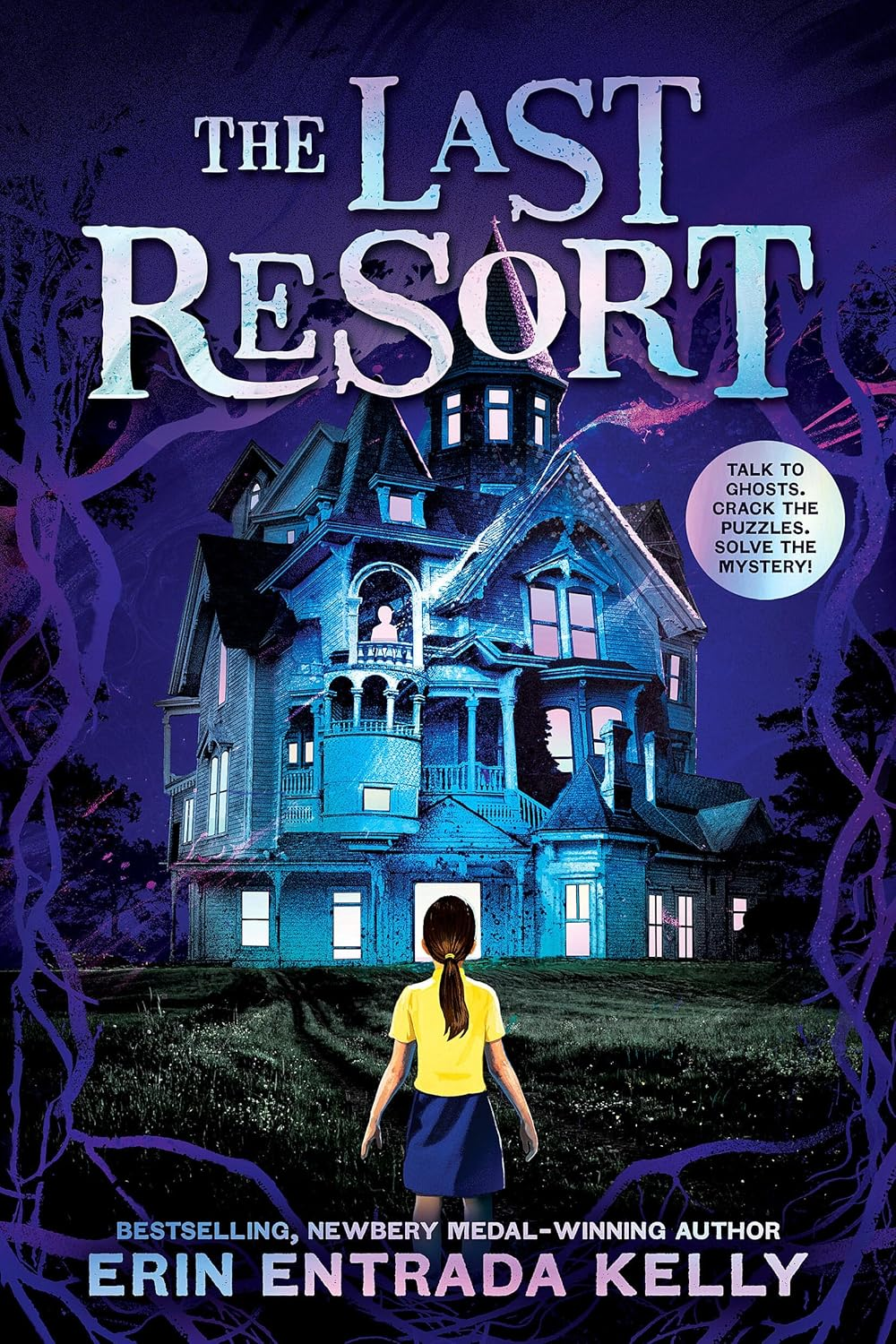
The Last Resort by Erin Entrada Kelly (Scholastic Press, 240 pages, grades 4-7). When Lila’s Grandpa Clem dies, leaving an old inn to her father, the whole family has to leave their home in Phoenix to spend the summer at the inn in Ohio, sorting out the estate. Lila’s despondent about the trip, fearing it will further estrange her from her two former best friends, who have started accusing her of being overdramatic and leaving her out of things. The inn is pretty creepy, and Lila begins seeing strange people appear and disappear, including her late grandfather who she never met. When he tells her he was murdered, Lila is determined to figure out what happened to him and teams up with her neighbor Teddy and her brother Caleb to solve the mystery. As the people around her start having nightmares that reflect their worst fears, the situation becomes increasingly desperate, and Lila finds that the personality traits she’s often been criticized for having are an asset when it comes to dealing with ghosts and haunted mansions. Thanks to Scholastic for providing me with a free copy of this book.

This is a classic Scholastic series: a bunch of popular authors each write a book in a series, combined with a gimmick that will have kids clamoring for the latest installment at their book fairs or Scholastic flyers (think 39 Clues or Horizon) In this case, a few of the illustrations have QR codes that lead readers to a site where the ghosts tell their stories and allow readers to solve mysteries. While this method of storytelling is unlikely to showcase Newbery winners like Kelly (and book 2’s Jasmine Warga) at their creative best, this is a fun ghost story with an engaging protagonist who learns that what she’s been told is “too much” is actually her own imaginative and courageous personality.

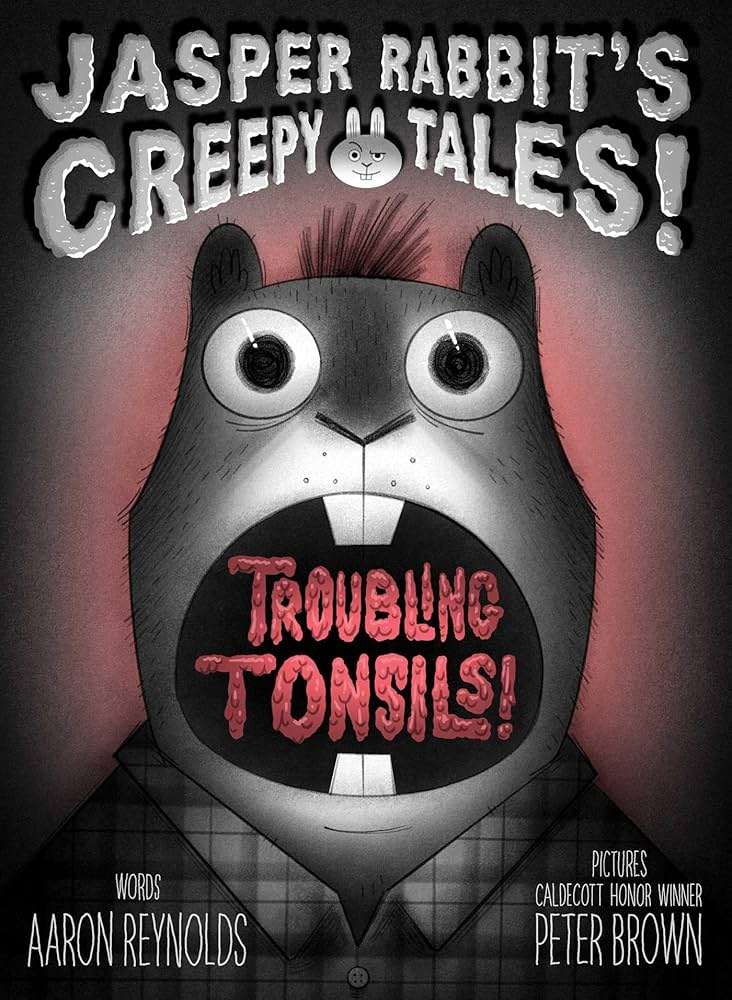
Troubling Tonsils! (Jasper Rabbit’s Creepy Tales) by Aaron Reynolds, illustrated by Peter Brown (Simon and Schuster Books for Young Readers, 88 pages, grade 1-4). Our old Creepy Carrots/Crayon/Pair of Underwear friend Jasper Rabbit introduces main character Charlie Marmot and his tonsils, then the tale begins innocently enough with Charlie coming down with a sore throat. A trip to the doctor reveals tonsillitis, and an operation is scheduled for a few days hence. Charlie’s actually excited, asking the doctor if he can put the tonsils in a jar to bring in for show-and-tell. By the time surgery day arrives, Charlie’s throat feels better, and the doctor is shocked when he does a quick pre-op check and discovers that the tonsils are gone! No one can explain this, but Charlie is sent home, where he starts to experience strange sights and sounds in the middle of the night. Finally, exhausted, he falls into a deep sleep one night, only to discover upon waking that he….

Well, now, I guess you’ll just have to read this short chapter book to find out, won’t you? To be honest, the Creepy books aren’t my favorites, but kids can’t get enough of them, and I trot them out every Halloween to universal joy. Fans will be delighted to see this new chapter book series, perfect for those who are just moving up to that level. The story is a perfect blend of funny and creepy, with an ending worthy of The Twilight Zone. Look for book 2, Unsettling Salad, in February, 2026.

Elementary heroines

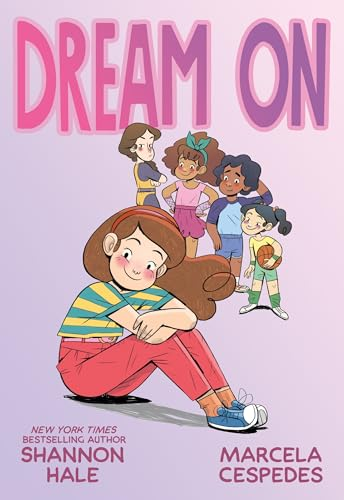
Dream On by Shannon Hale, illustrated by Marcela Cespedes (Roaring Brook Press, 240 pages, grades 3-6). Fourth-grader Cassie has a lot of big emotions as she navigates the difficult terrain of growing up in a small house with a large family and dealing with changing friendships at school. When she sees a flyer in the mail telling her she’s won some fancy prizes, she starts to dream about how this could change her life. Usually, she would enjoy sharing those dreams with her best friend Vali, but recently Vali’s been spending more time with another girl who alternates being friendly and being mean to Cassie. Cassie’s frequently told that she’s too sensitive, but she can’t help the way she feels, and as the story goes on, she learns that being sensitive also means having a greater sense of wonder about the world around her. Things don’t magically resolve themselves, but having good conversations with her mom (who’s often too busy for such things) and with Vali about their friendship helps Cassie feel better about her problems and to find a way to a new normal at school and at home. Includes a note from Shannon Hale about the parallels between Cassie’s 1980’s childhood and her own.

Fans of Shannon Hale’s Real Friends series will be delighted to discover this new graphic novel, with book 2 coming in August 2026. Just as with Real Friends, I found the tone of this book a little melancholy, but it’s a realistic portrayal of a character who is extra sensitive, making her prone to lower moods but also extra appreciative of more joyful ones.

Amina Banana and the Formula for Friendship by Shifa Saltagi Safadi, illustrated by Aaliya Jaleel (G. P. Putnam’s Sons, 128 pages, grades 2-5). Amina’s both excited and nervous about her first day of third grade in America. Her family has recently relocated from Syria to Indiana, and all of them have had to overcome many difficulties, with obstacles still ahead. Being scientifically inclined, Amina writes a five-step formula for making friends at her new school, only to find herself crossing off one step after another after a series of discouraging setbacks. But she finds a kind group of girls who help her with her English and encourage her to share her culture with them and with the rest of the class. By the final pages, Amina has found new friends and the courage to be herself in her new country.

I was wowed and humbled by the courage of Amina and her family in this early chapter book series starter (book 2 is out, and #3 will be published in January). Her dad, a pharmacist in Syria, is working at a fast food restaurant while her physician mom studies to pass the boards so she can practice medicine in the U.S. Despite their hardships, the family is loving, supportive, and has fun together. I’m always happy to find books featuring protagonists in younger elementary grades, so it was nice to discover these two books with girls in fourth and third grades.

Let’s visit the Goodreads 2026 Mock Newbery list!

As you’ll see, I’ve been a little resistant to these three books, all of which are currently at or near the top of the Goodreads 2026 Mock Newbery list. I thought I’d dive into them during the last couple weeks of summer before school started. One that I did not get to, and probably won’t, is Max in the Land of Lies by Adam Gidwitz, simply because it’s a sequel which I don’t usually review. I did love the original, Max in the House of Spies, so I feel pretty confident rooting for it to get Newbery acclaim.

Rebellion 1776 by Laurie Halse Anderson (Atheneum/Caitlyn Dlouhy Books, 416 pages, grades 5-9). Elsbeth tells her story from March, 1776 through the end of November, a time when she is working for the Pike family in Boston while searching for her father who’s mysteriously gone missing. He’s the only family member she has left after her mother and siblings died of smallpox when they lived in Philadelphia. There’s a lot going on in 1776 Boston, starting with the evacuation of all British loyalists after the Patriot army takes the city (I finally learned what Evacuation Day is and why it’s still celebrated in Boston). Elsbeth witnesses the financial fall and rise of the Pike family, as well as their struggles with the decision about whether to inoculate their children against smallpox. In the end they proceed, and it falls on Elspeth to nurse them through the mild cases of the disease that they have to suffer in order to create immunity. After months of anxious searching, Elsbeth is finally reunited with her father, and a final chapter gives a report of what happens to her and other characters up until 1781. Includes a note on sources which details the immense amount of research that went into writing this book.

I didn’t know that I wanted to read a 400-page historical fiction novel about the American Revolution, and I’m afraid many middle school readers will feel the same way. Which would be a shame, because this is an extremely compelling story with all sorts of interesting characters, many of whom I’ve had to leave out of my brief review. The chapters are short and the plot keeps humming along, making it a quicker read than I thought it would be. Readers will learn a lot about American Revolution history and find parallels to contemporary life, most notably the vaccine controversy and the fact that ordinary life goes on even when you are living through revolutionary times.

The Undead Fox of Deadwood Forest by Aubrey Hartman (Little, Brown Books for Young Readers, 320 pages, grades 4-7). Clare is an undead fox who has made his home in Deadwood Forest for the last six years, ushering lost animals to their afterlife in one of four realms: Pleasure, Peace, Purpose, or Pain. His life, such as it is, is quiet, and he has learned to keep himself busy reading and tending his mushroom garden to keep away disturbing thoughts about being abandoned by his mother and the car accident that led to his demise as a kit. When he gets wind of a prophecy that could shatter his peaceful life, Clare sets out to make sure that it doesn’t happen. His least favorite animal, a badger, appears at his door, and although he tries to usher her into the afterlife, she seems unable to cross over. As All Hallows’ Eve approaches, Clare begins to have some insights into his life that eventually allow him to let the prophecy unfold and his own path to change dramatically.

I can’t decide how I feel about this book. The story, characters, and world-building are all exceptionally well done, and there are interesting questions about life, death, and self-acceptance that would make this a great choice for a book club. At the same time, I felt myself having to push to get through it, as it started to feel like kind of a heavy read, so it may not be for everyone. Based on the writing alone, though, I would not be unhappy to see it get a Newbery.

The Trouble with Heroes by Kate Messner (Bloomsbury Children’s Books, 368 pages, grades 4-7). This novel in verse opens at the end of the 7th grade school year for 13-year-old Finn Connelly. Not only is he in danger of failing two classes, but he’s in a lot of trouble for vandalizing the headstone of Edna Grace Thomas, a local woman famous for her love of the Adirondack Mountains and her support of other climbers. Edna’s daughter makes Finn an offer: he and his family won’t have to pay for damages if Finn will hike the 46 highest peaks in the Adirondacks over the summer along with Edna’s dog Seymour. Knowing his mom can’t afford to pay, Finn reluctantly agrees to go, accompanied on each hike by one of three local climbers. As the summer progresses, Finn’s resentment gradually gives way to a love of hiking, as he uses the long climbs and the beautiful vistas to process his grief about his dad, a firefighter known for his heroism on 9/11 who struggled with addiction and died while working long hours during Covid. Finn learns more about his dad and slowly unravels his own feelings of grief and anger, while figuring out his own talents and using them to help his family move forward.

This book sounded a bit mawkish to me, but I’m happy to say I was completely wrong. I would love to see it get a Newbery, because I think it has a lot of kid appeal. The verse format makes the 350+ pages move pretty quickly, and Messner injects plenty of humor and lightheartedness despite the weighty topics. Finn goes through some pretty big changes, but they all feel in keeping with being 13 years old. And there’s a pretty lovable dog as the cherry on top.

Family: it’s complicated

Danilo Was Here by Tamika Burgess (HarperCollins, 304 pages, grades 5-8). Danilo’s family has gone through tough times since his beloved Papá left for the United States to try to find work, shortly before the U.S. bombed his Panamanian neighborhood in December, 1989. Papá has stopped writing and sending money, and Danilo is determined to find out what’s happened to him. When he gets recruited for a California baseball clinic shortly after his family has been forced to move into a refugee camp, he decides to go and try to find his father. Danilo inherited his baseball talent from Papá, and when he discovers his dad lives less than an hour away, he writes a letter inviting him to come watch the team play. But things don’t go as planned, and Danilo finds himself in the unfamiliar position of being the worst player on the team, with PTSD and worries about his mother and sister distracting him from the game. When he finally does connect with Papá, he learns that his dad has moved on, and Danilo and his family can’t count on him for support. Fortunately, Danilo finds caring friends and adults in the U.S., and with their help he’s able to figure out what his dreams are and how best to support his family when he returns to Panamá.

In her second middle-grade novel, Tamika Burgess takes a look at the recent history of Panamá, and the effects the U.S. involvement there had on ordinary Panamanians. Readers will relate to Danilo and his struggles with family, friends, and uncertainty about what he wants to do with his life, even though his experiences are likely to be very different from theirs. I hope this will be considered for a Belpré Award.

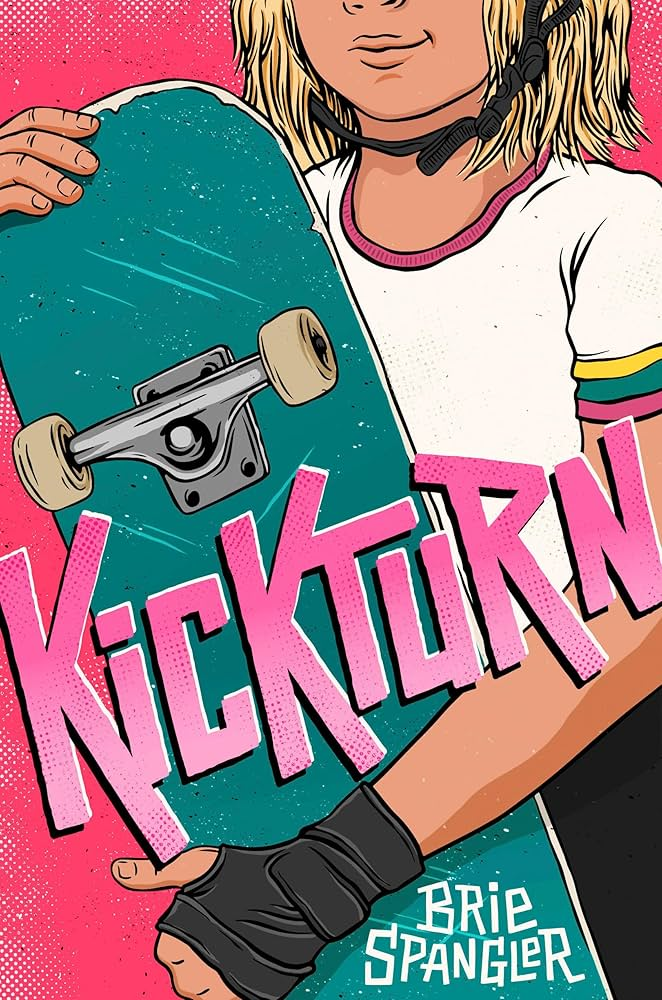
Kickturn by Brie Spangler (Knopf Books for Young Readers, 192 pages, grades 3-6). Ten-year-old Lindy is worn out and jaded after spending two years on a converted school bus, posing for photo shoots for her wellness influencer mom and watching her dad grow increasingly frustrated with the issues of the rundown bus that he quit his tech job for. When the bus completely gives out in San Jose, Lindy is excited to have a place to stay for a while and thrilled to meet some other kids who share her passion for skateboarding. Her hopes for putting down roots are dashed when the local garage is able to miraculously patch the bus together. When her parents start making plans for going back on the road, ignoring their daughter’s pleas, Lindy decides the only way to get their attention is to sabotage the bus. Although they’re furious with her, Lindy’s parents eventually calm down long enough to listen to her concerns (which include failing her fifth-grade homeschool curriculum) and to make a plan that allows them to settle down long enough to make a new plan. Includes sketches and Instagram usernames of real-life kids who love skateboarding.

With its appealing journal format that includes lined pages and lots of sketches and doodles, Lindy provides a behind-the-scenes look at what it’s really like to embrace van life and influencer culture. Although she occasionally sounds a little jaded and world-weary for a fifth grader, her voice is genuine and funny. Even kids who have lived in the same place all their lives will relate to her desires to fit in with friends as well as her struggles to get her parents to listen to what she needs.

Learning Black history through historical fiction

Radiant by Vaunda Micheaux Nelson (Dutton Books for Young Readers, 320 pages, grades 4-7). Fifth grader Cooper Dale is ashamed of the fact that she sometimes wishes she were white, but she can’t help feeling that it would make her life easier at school where she’s the only Black student. While she shares events like grieving the assassination of President Kennedy and excitement about the Beatles with some of her classmates, she’s also the target of racist bullying by other kids, especially Wade. When Cooper’s mom gets a cleaning job with Wade’s family, Cooper finds out that his mother is dying of cancer. Although it’s hard for her to be compassionate, she learns from those around her, including her parents and older siblings, members of her church, and the new Black boy who is dealing with the loss of his own mother. By the end of the book, Cooper has realized that she and Wade may never be friends, but her empathy can help him get through a difficult time and may even change how he sees her and her family.

This novel in verse does an excellent job of weaving historical events of 1963 into a story that today’s readers will relate to. Cooper’s honest voice expresses both her wish to live up to her parents expectations of being “radiant” and her very human emotions in response to some of the difficult situations she encounters.

Will’s Race for Home by Jewell Parker Rhodes (Little, Brown Books for Young Readers, 208 pages, grades 4-7). Will’s family is barely making it as sharecroppers on a cotton farm in Texas when Father hears about the chance for free land in Oklahoma–if they can win the race to get there. Despite the risks of the journey, Father decides it’s worth a try, and 12-year-old Will successfully makes the case to join him. Along the way they encounter a rattlesnake, a rushing river that must be crossed to get to Oklahoma, and a mysterious ex-Civil War soldier named Caesar with some dangerous enemies. Caesar and his horse Midnight join Father and Will, and the three work together to survive and overcome the racism that threatens to derail their plans. When Caesar gets shot, it’s up to Will to ride Midnight all night, covering the last leg of their trip and making his family’s dream of owning land a reality. Includes an author’s note giving more historical context, particularly on the removal of indigenous groups from the land being claimed in the story and the Tulsa Race Massacre that took place in Oklahoma a generation after Will and his family settled there.

Fans of the I Survived series will enjoy this action-packed adventure featuring a courageous hero committed to helping his family. The author’s note addressed some of the more troubling aspects of the land rush, as well as the fact that the story for Black people settling in Oklahoma was unfortunately not as happily-ever-after as Will’s seems to be. I’m guessing both of these books will receive consideration for Newbery and Coretta Scott King awards.

Ghostly graphic novels

Ghost Town by Eric Colossal (Harry N. Abrams, 256 pages, grades 4-7). Lily’s been accepted to a prestigious science academy, which means a move to another town, but she’s sure she doesn’t want her life to change. After purposely failing her science final in an attempt to lose her scholarship, she’s grounded and assigned to volunteer at the library every morning, but that doesn’t stop her from sneaking out to play baseball with her friends. When their ball goes through the window of an old mansion, the kids stumble upon a ghost and a trap for catching other ghosts. As they go through town, cleaning up ghosts and restoring the power that those ghosts have been sucking up, they slowly unravel a mystery involving an old family from town, and one member in particular, who, like Lily, didn’t want anything to change. As she begins to see the destruction his resistance has caused, Lily realizes that change is inevitable, and it’s okay for her to embrace the new things in her life.

This is a fun tween ghostbusters story with the whole gang taking on the task of trapping ghosts and finding out about their past lives, which they accidentally discover can be done by swallowing the ghost and initiating a flashback of its past life. There’s lots of humor, like when some of the ghosts turn out to be animals, but there’s also a pretty serious message conveyed in the big final showdown.

Free Piano (Not Haunted) by Whitney Gardner (Simon and Schuster Books for Young Readers, 256 pages, grades 5-8). Margot loves playing the ukulele and writing songs, but everyone around her seems more concerned with getting likes and follows on social media. Her dad goes off to L.A. to pursue his musical dreams and his goal of 10,000 followers, while her two best friends are getting more action on their channel smashing things from a tree house than Margot gets with her music. When she finds an old synthesizer keyboard with a sign reading “Free Piano (Not Haunted),” she thinks it may be just the thing to help her connect with her dad. Instead, it starts making weird sounds, even when it’s not plugged in, and eventually the ghost of ’80’s pop star Vision appears. Vision encourages Margot to embrace her own talents, and together, the two of them exorcise an evil spirit from Vision’s past who’s been haunting the keyboard. The ghost eventually has to move on, but its clear that her influence has changed the way Margot sees herself and her talents. Includes additional information about the Prophet-5 keyboard featured in the story.

This is sure to be a popular choice for middle school kids struggling with their own identities and parental issues, and it never hurts to throw a ghost or two into the mix. The brilliantly colored artwork conjures up Vision’s 1980’s vibe, with the portrayals of ghosts and the haunted keyboard especially effective.

We can never have too many middle school graphic novels

Reel Life by Kane Lynch (Graphix, 240 pages, grades 4-7). Galen’s upset when his friend Kyle pulls away from him, but their mutual friend Luna explains that Kyle’s going through a tough divorce and a custody battle with his parents. Galen doesn’t really get it until his own dad announces that he’s leaving Galen’s mom and has a new girlfriend, Jasmine. Galen and Luna use their movie making skills to try to understand not only what’s going on with Galen’s family, but also Luna’s constantly bickering parents. As the kids navigate these difficult relationships, they learn the importance of love, support, and communication. As they wrap up their movie, Galen declares, “It’s OUR story. We get to choose how it ends.”

There’s a lot to love about this graphic novel, including the artwork that resembles an animated film, but especially the underlying upbeat tone that shows kids’ resilience in the face of changing families and friendships. Galen is a kind kid who doesn’t shy away from difficult emotions, is willing to give the new people in his life a chance, but is still–for the most part–able to figure out how to take care of himself.

On Guard!: a Marshall Middle School graphic novel by Cassidy Wasserman (Random House Graphic, 256 pages, grades 4-7). Grace isn’t excited about starting seventh grade after her best friend Ava dumped her at the end of sixth grade and her parents got divorced over the summer. Due to a custody agreement, she’s forced to spend every other week with her self-absorbed mother who makes no effort to understand her daughter. When Grace sneaks into the gym at lunchtime to avoid the cafeteria, she discovers the fencing team practicing there. Although she’s fascinated, she’s sure she’s too much of a klutz to try it. After trying and failing at several other clubs, she finally reluctantly signs up for fencing. To her surprise, she finds out that she has a talent for it and that the team is a surprisingly good source of friendship and support. Using the lessons she learns through fencing, Grace slowly begins to learn how to stand up to her mother and advocate for herself with both of her parents.

I’m hoping the subtitle of this book indicates that there will be other Marshall Middle School graphic novels, as this is sure to be popular with fans of authors like Raina Telgemeier, Kayla Miller, and Maria Scrivan, as well as a good choice for those who enjoyed another fencing graphic novel, Duel. Grace’s struggles with her mother are heartbreaking but ring true, and I like how fencing subtly teachers her skills that she can use in her real life.

Two brave girls

The Freedom Seeker by Ruchira Gupta (Scholastic Press, released August 5, 320 pages, grades 4-8). Simi has a happy life in Northern India, where she’s surrounded by friends and family who celebrate her accomplishments at school and on the hockey field. But when a right-wing group comes to power, her Sikh father and Muslim mother become targets. After her father is badly beaten, he’s able to illegally immigrate to the United States, where he’s granted asylum and starts working as a taxi driver in New York. By the time he’s saved enough to send for Simi and her mother, though, immigration policies have changed in the US. The two of them have to make a dangerous desert crossing in Mexico, and they wind up getting separated. Simi makes it to a detention center but has to endure weeks of crowded, prison-like conditions and the agony of not knowing what has happened to her mother. Drawing on her experience as a leader in school and in sports, Simi finds ways to help herself. She’s eventually able to connect with her father, and the two of them work together to find her mom. Simi’s courage and kindness to others helps her to survive and finally bring her family together again.

This book puts a face on the phrase “illegal immigrant,” showing how families must make the difficult decision to leave their homelands, friends, and extended families to escape violence, and the incredibly harsh conditions that they endure in their quest to find a place where they can live in safety. Simi’s voice is compelling, as are the stories of others she meets on the journey, and once I got to about page 100, I had to keep going until I knew she and her family were going to make it. While advanced fourth and fifth grade readers would enjoy this, I think middle school kids would perhaps get more from the story. Thanks to Scholastic for providing me with an advance copy.

The Burning Season by Caroline Starr Rose (Nancy Paulsen Books, 256 pages, grades 4-7). On Opal’s twelfth birthday, she starts her training with Gran, continuing the tradition of women in her family who have served as fire lookouts deep in New Mexico’s Gila National Forest. Although Opal loves her life with Gran and Mom and their small home in a lookout tower, she yearns to move to town and go to middle school like other kids. She also guards a deep secret–she’s afraid of fire, which killed her dad and almost took the rest of the family during a huge wildfire a few years back. When her mom gets stranded in town after a fierce storm and Gran gets injured in the woods, Opal comes face to face with a fire that threatens Gran and their home. Despite her own injuries, she must overcome her fears and fight the fire alone. Opal discovers that sometimes bravery means doing the very thing you’re afraid of and that protecting those you love can give you courage. Includes a seven-page author’s note with additional information about wildfires and the history of fire management.

This novel-in-verse kept me riveted from the first page with its unusual setting and strong characters living a happy if somewhat bare bones life in the middle of the wilderness. The action really picks up when Mom leaves for supplies and they don’t hear from her for several days, then continues when Opal accidentally breaks their only pair of binoculars and Gran gets hurt. Opal’s favorite books are Gary Paulsen’s Brian series, and this story is an homage to their combination of nail-biting survival story and wilderness setting.

Teamwork makes the dream work

Chess Club: The Winning Move by Rebecca Donnelly, illustrated by Isabelle Duffy (Farrar, Straus, and Giroux, 208 pages, grades 3-6). Halima loves playing chess online with her Somalian cousin, but she wishes she had the opportunity to play with kids in real life. When her best friend Jem suggests that she start a chess club at school, Halima is hesitant, but Jem offers to join and provide refreshments, even though her baking skills are much stronger than her chess ones. They manage to recruit two boys to join them: Parker, who’s never enjoyed sports the way his athletic older siblings do, and Daniel, who loves art but is struggling to fit in at middle school. Although they have a slightly bumpy start, Halima rises to the role of leader, and the others start to learn more about chess, enjoying both the game and their new friendships. When they have the opportunity to play in a tournament, they find themselves in a difficult situation involving cheating and have to work together to do what’s right. The promise of a rematch paves the way for a sequel.

A sweet series opener told from the alternating perspectives of four slightly quirky kids who find each other through chess. The appeal of friendship is at least as great as the appeal of the game, but each one grows as both a person and a chess player. A series of mysterious notes helps bring them together and advance their friendship, and the final chapter reveals the slightly supernatural events behind those notes. The illustrations add a nice touch, especially those showing the chess board in various games.

Growing Home by Beth Ferry, illustrated by Terry and Eric Fan (Simon and Schuster Books for Young Readers, 272 pages, grades 2-5. Meet the team: Ivy the ivy plant, Toasty the goldfish, Ollie the violet plant, and Arthur the spider, with occasional appearances by Louise the bee and Sunny the canary. The four main characters live at Number 3 Ramshorn Drive with Mr. and Mrs. Tupper and their young daughter Jillian. The humans are, for the most part, unaware of the activity going on in their home, although all of them get occasional glimpses, especially Jillian. The four start out as rivals, but events dictate that they work together, and in the end, they are able to save the Tuppers from becoming victims of a crime that would most likely ruin their antiques business. By the final pages, all six plant and animal characters–even grumpy Toasty–have come to appreciate their friendship and the special skills each one brings to the team.

This is a charming story by one of my favorite picture book authors, filled with black and white drawings by two of my favorite illustrators. It would be a good chapter book for precocious primary grade readers, and I could also see it being enjoyed as a class read-aloud. Having said all that, it didn’t quite meet my high expectations. It felt like things got off to a meandering start, although the action picked up in the second half. I wasn’t a huge fan of the gentle educational asides addressed to the reader, and it made me appreciate how Beth Ferry is able to impart messages in her picture books with more subtlety. I did love the illustrations, although I missed the colors and sweeping vistas that often characterize the Fan Brothers’ work.