Early reader graphic novels: two mysteries and quite possibly the weirdest book ever!

Cabin Head and Tree Head by Scott Campbell (Tundra Books, 88 pages, grades K-4). Obviously, Cabin Head is a creature with a cabin on his head, complete with a family inside and smoke coming out of the chimney, and Tree Head likewise has a tree on his (aww, look at the kid in the tire swing!). They’re best friends who also enjoy hanging out with other members of their community like Library Head, Pool Head, Volcano Head, and Outhouse Head. In a series of stories, they show that they may not be the brightest lightbulb heads in the chandelier head, but they are loyal friends and funny storytellers. Readers will cheer at the declaration on the final page: “Cabin Head and Tree Head shall return for more wonderful book times.”

Around page 11, I paused to consider: is this the weirdest book I have ever read? I mean, we do have the Noodleheads, not to mention a hit series based on the premise of a dog’s head being attached to a man’s body. But Cabin Head and Tree Head are definitely in the running for weirdest, but also for funniest, and I found myself laughing aloud throughout the book, particularly at the illustrations. I predict great things for these two, so be sure to stock up and keep an eagle eye out for book 2.

Detective Beans and the Case of the Missing Hat by Li Chen (Andrews McMeel, 208 pages, grades 1-4). Beans is an adorable cat detective who sets out to solve the case of the mystery note giver when he finds a series of encouraging notes stuck to his stuff. He’s derailed from this case almost immediately, though, when his lucky detective hat goes missing. Beans spends the day traveling around town, tracking down clues, generally just one step behind the hat as it’s passed from one owner to the next. He finally gets it back, and in the process accidentally catches a wanted diamond thief. The last few pages remind the reader that the mystery note giver still hasn’t been identified, but perhaps this mystery is unraveled in book 2, which came out earlier this year.

This is actually a 2024 book, but I was unable to resist the cute cover, and the rest of the book did not disappoint. Kids will love the artwork, and the story is simple yet engaging enough to hook those who are just starting to read independently. 

Detective Stanley and the Mystery Museum by Hannah Tunnicliffe, illustrated by Erica Harrison (Flying Eye Books, 64 pages, grades 1-4). Detective Stanley is enjoying his first morning of retirement from the Narlybone Criminal Investigation Department when a letter arrives at his doorstep begging him to come to the Narlybone Museum and figure out who’s behind the break-in there. Unable to resist a heartfelt plea–despite having to leave his pancakes behind–Stanley heads to the museum, where he finds a big mess but no stolen items. When he’s framed for the theft of a police officer’s watch, Stanley unexpectedly winds up in jail. From his cell, he’s able to puzzle out what really happened at the museum and convince a police officer to accompany him back to the scene of the crime. There, he unmasks the real thief in dramatic fashion and is able to return to his pancakes in time for supper. Includes information on Piet Mondrian, whose artwork is featured in the story, as well as a preview of book 2.

Another fun mystery for early readers, this one had a surprising number of twists for such a short story, some sly humor, and artwork full of cute animals that brought to mind Richard Scarry’s work as they go about their day.

Animal friendships

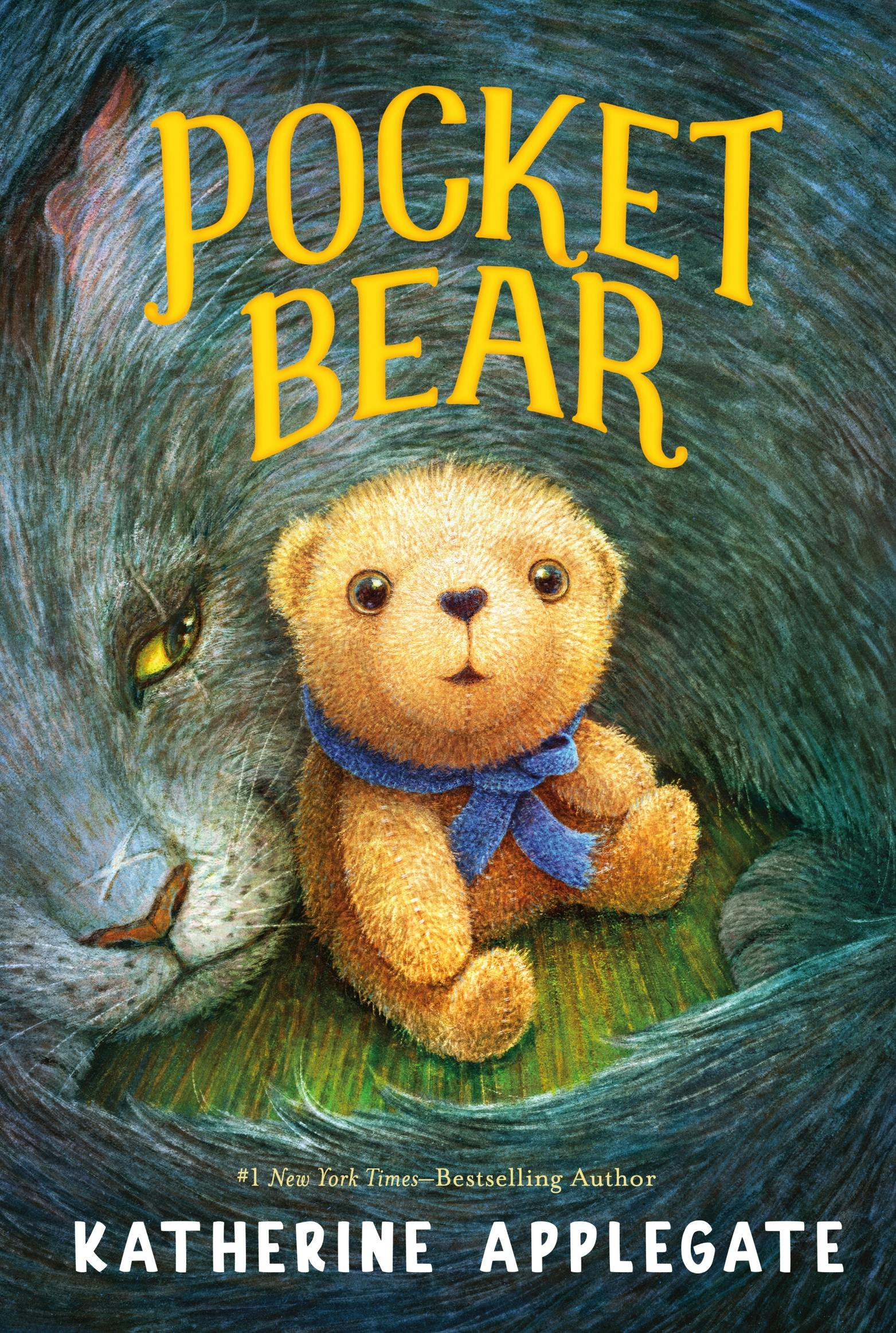
Pocket Bear by Katherine Applegate, illustrated by Charles Santoso (Feiwel and Friends, 272 pages, grades 3-7). Zephrynia is a cat who likes to “rescue” (some would say steal) items that she finds, bringing them to her owner Elizaveta and her daughter Dasha. She always seeks counsel about her treasures from Pocket Bear, a small stuffed bear who traveled in the pocket of a World War I soldier before winding up as a castoff that Dasha found. Dasha was injured and lost her father before she and her mom immigrated to the U.S. from Ukraine, and she has a soft spot for the stuffed animals that Zephrynia brings her, so much so that she cleans them up and offers them a new home through her Second Chances store. When Zephrynia finds an unusual old bear in a dumpster, Dasha works her magic, preparing Berwon to find a new home. But his history makes him the target of an unscrupulous antiques dealer, and Zephrynia finds herself acting unselfishly for the first time to rescue Berwon and bring about a happy ending for him, Pocket Bear, Elizaveta, and Dasha. Includes an author’s note about her inspiration for this story, a little bit of the history of teddy bears, and the soft spot she has for stuffies.

As I was considering books to offer my four fourth-grade reading clubs this fall, I found myself leaning heavily on Katherine Applegate’s books. And why not? The stories are full of heart, memorable characters, interesting plots, and timely messages, yet have short chapters and enough illustrations to make them good choices for those who haven’t read a lot of chapter books. This one will go into the rotation, as it has all the elements mentioned above. And in case you are wondering, one of my groups voted for Wishtree, while another chose Dogtown. (Non-Applegate choices were The Wild Robot and The Guardian Test.)

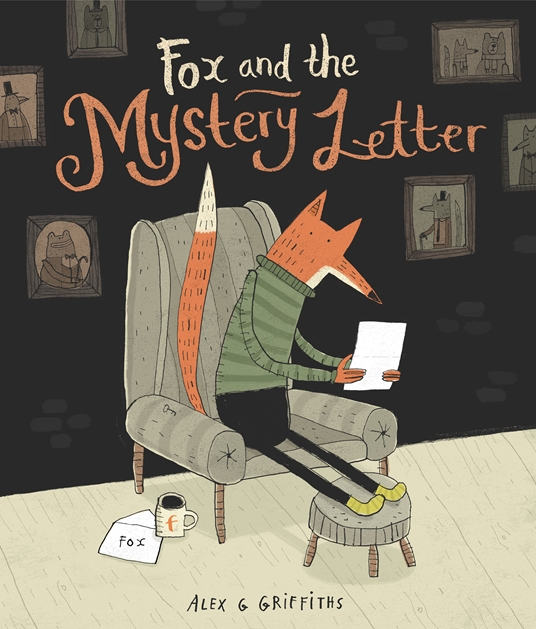
Fox and the Mystery Letter by Alex G. Griffiths (Frances Lincoln Children’s Books, 40 pages, grades K-3). Fox lives in a cottage in the middle of a dense woods. “He lived alone–usually that was just the way he liked it.” But one morning, a large bird delivers a letter that reminds Fox of–oh, never mind. The letter is the beginning of a puzzle that Fox must solve, and with every step, readers get hints that Fox may have had a dear friend in the past with whom he quarreled and parted ways. The hunt takes him through the woods, up a tree, and across the ocean until finally the puzzle is solved and the friendship is repaired.

This is a charming animal story, and who doesn’t enjoy a good scavenger hunt? It’s a great mentor text for making predictions as clues are dropped throughout the story about Fox’s friend and what happened to their friendship. It seemed a bit risky on the part of the friend to trust that Fox would persevere through such a complicated hunt, but he does, and it’s a happy ending for everyone.

A ghostly vacation and a creepy operation

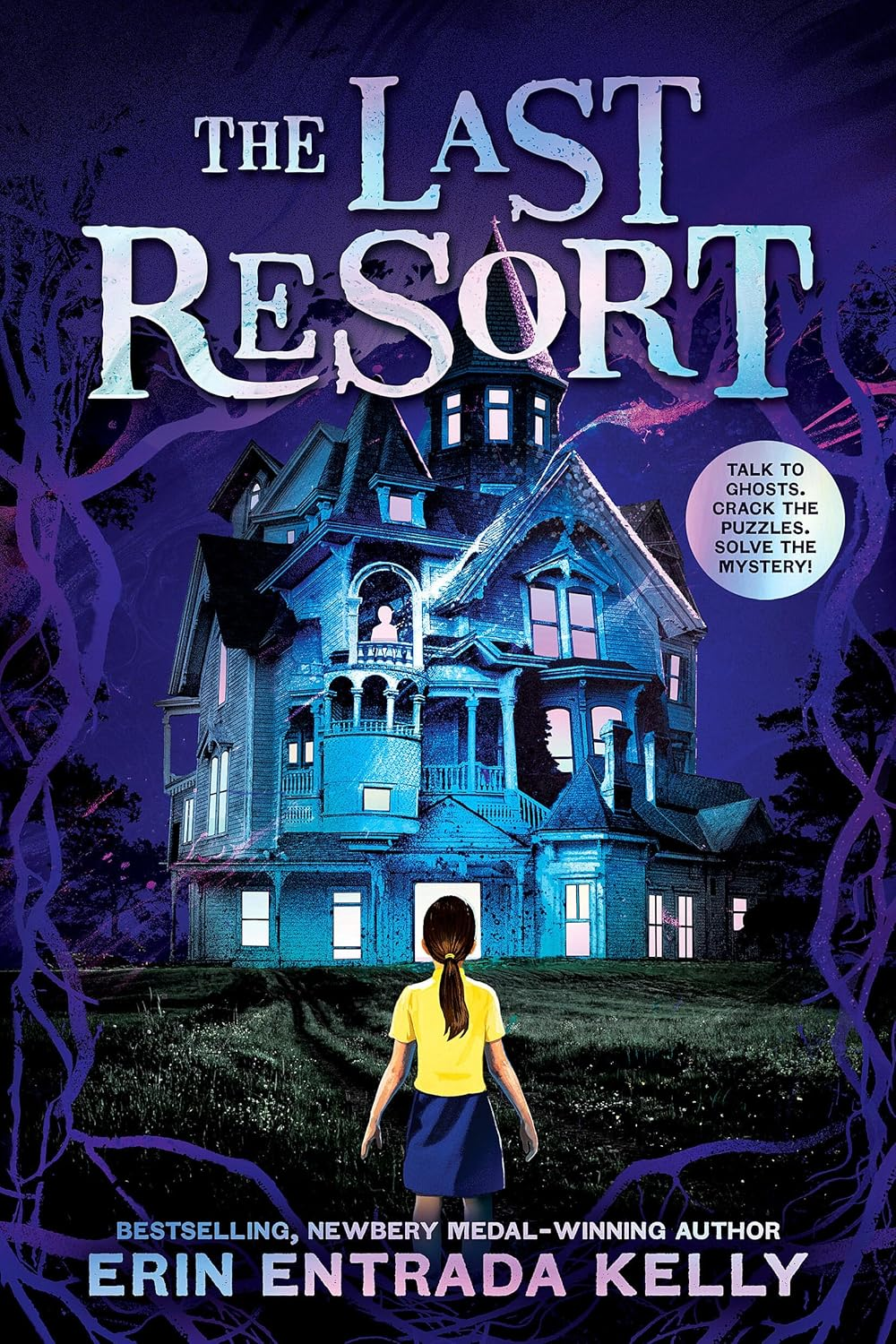
The Last Resort by Erin Entrada Kelly (Scholastic Press, 240 pages, grades 4-7). When Lila’s Grandpa Clem dies, leaving an old inn to her father, the whole family has to leave their home in Phoenix to spend the summer at the inn in Ohio, sorting out the estate. Lila’s despondent about the trip, fearing it will further estrange her from her two former best friends, who have started accusing her of being overdramatic and leaving her out of things. The inn is pretty creepy, and Lila begins seeing strange people appear and disappear, including her late grandfather who she never met. When he tells her he was murdered, Lila is determined to figure out what happened to him and teams up with her neighbor Teddy and her brother Caleb to solve the mystery. As the people around her start having nightmares that reflect their worst fears, the situation becomes increasingly desperate, and Lila finds that the personality traits she’s often been criticized for having are an asset when it comes to dealing with ghosts and haunted mansions. Thanks to Scholastic for providing me with a free copy of this book.

This is a classic Scholastic series: a bunch of popular authors each write a book in a series, combined with a gimmick that will have kids clamoring for the latest installment at their book fairs or Scholastic flyers (think 39 Clues or Horizon) In this case, a few of the illustrations have QR codes that lead readers to a site where the ghosts tell their stories and allow readers to solve mysteries. While this method of storytelling is unlikely to showcase Newbery winners like Kelly (and book 2’s Jasmine Warga) at their creative best, this is a fun ghost story with an engaging protagonist who learns that what she’s been told is “too much” is actually her own imaginative and courageous personality.

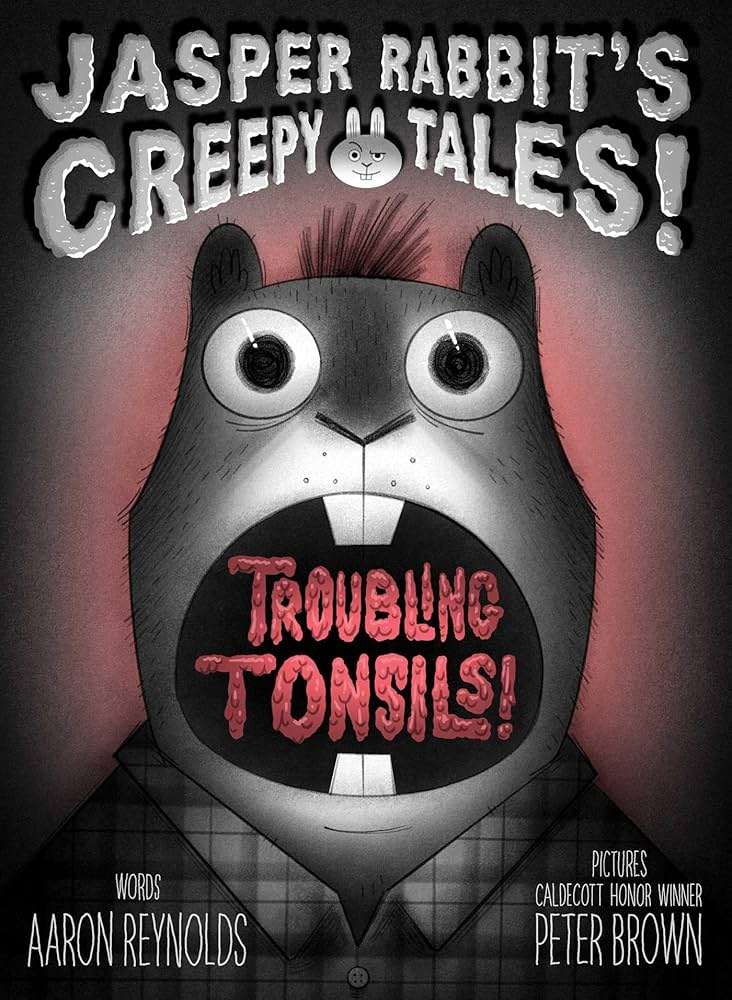
Troubling Tonsils! (Jasper Rabbit’s Creepy Tales) by Aaron Reynolds, illustrated by Peter Brown (Simon and Schuster Books for Young Readers, 88 pages, grade 1-4). Our old Creepy Carrots/Crayon/Pair of Underwear friend Jasper Rabbit introduces main character Charlie Marmot and his tonsils, then the tale begins innocently enough with Charlie coming down with a sore throat. A trip to the doctor reveals tonsillitis, and an operation is scheduled for a few days hence. Charlie’s actually excited, asking the doctor if he can put the tonsils in a jar to bring in for show-and-tell. By the time surgery day arrives, Charlie’s throat feels better, and the doctor is shocked when he does a quick pre-op check and discovers that the tonsils are gone! No one can explain this, but Charlie is sent home, where he starts to experience strange sights and sounds in the middle of the night. Finally, exhausted, he falls into a deep sleep one night, only to discover upon waking that he….

Well, now, I guess you’ll just have to read this short chapter book to find out, won’t you? To be honest, the Creepy books aren’t my favorites, but kids can’t get enough of them, and I trot them out every Halloween to universal joy. Fans will be delighted to see this new chapter book series, perfect for those who are just moving up to that level. The story is a perfect blend of funny and creepy, with an ending worthy of The Twilight Zone. Look for book 2, Unsettling Salad, in February, 2026.

Ghostly graphic novels

Ghost Town by Eric Colossal (Harry N. Abrams, 256 pages, grades 4-7). Lily’s been accepted to a prestigious science academy, which means a move to another town, but she’s sure she doesn’t want her life to change. After purposely failing her science final in an attempt to lose her scholarship, she’s grounded and assigned to volunteer at the library every morning, but that doesn’t stop her from sneaking out to play baseball with her friends. When their ball goes through the window of an old mansion, the kids stumble upon a ghost and a trap for catching other ghosts. As they go through town, cleaning up ghosts and restoring the power that those ghosts have been sucking up, they slowly unravel a mystery involving an old family from town, and one member in particular, who, like Lily, didn’t want anything to change. As she begins to see the destruction his resistance has caused, Lily realizes that change is inevitable, and it’s okay for her to embrace the new things in her life.

This is a fun tween ghostbusters story with the whole gang taking on the task of trapping ghosts and finding out about their past lives, which they accidentally discover can be done by swallowing the ghost and initiating a flashback of its past life. There’s lots of humor, like when some of the ghosts turn out to be animals, but there’s also a pretty serious message conveyed in the big final showdown.

Free Piano (Not Haunted) by Whitney Gardner (Simon and Schuster Books for Young Readers, 256 pages, grades 5-8). Margot loves playing the ukulele and writing songs, but everyone around her seems more concerned with getting likes and follows on social media. Her dad goes off to L.A. to pursue his musical dreams and his goal of 10,000 followers, while her two best friends are getting more action on their channel smashing things from a tree house than Margot gets with her music. When she finds an old synthesizer keyboard with a sign reading “Free Piano (Not Haunted),” she thinks it may be just the thing to help her connect with her dad. Instead, it starts making weird sounds, even when it’s not plugged in, and eventually the ghost of ’80’s pop star Vision appears. Vision encourages Margot to embrace her own talents, and together, the two of them exorcise an evil spirit from Vision’s past who’s been haunting the keyboard. The ghost eventually has to move on, but its clear that her influence has changed the way Margot sees herself and her talents. Includes additional information about the Prophet-5 keyboard featured in the story.

This is sure to be a popular choice for middle school kids struggling with their own identities and parental issues, and it never hurts to throw a ghost or two into the mix. The brilliantly colored artwork conjures up Vision’s 1980’s vibe, with the portrayals of ghosts and the haunted keyboard especially effective.

Girl detectives

Gus and Glory by Sarah Guillory (Roaring Brook Press, 240 pages, grades 4-7). Glory’s mother disappears the summer she’s 12 years old, and since her dad spends most of his time on the road as a truck driver, Glory is sent to live with her grandparents in Louisiana. Glory aspires to be a detective, and she’s determined to solve the mystery of what has happened to her mother. When a bloodhound named Gus finds Glory and leads her to his owner who has broken his leg, she gets an assistant with a big personality and a keen nose. While Gus’s owner recuperates, the dog comes to live with Glory and her grandparents, causing some unexpected changes in their lives. When Glory tries to train Gus in tracking, her grandfather, who’s been depressed since suffering a stroke, takes an interest and begins to rejoin the family. Gus also leads Glory to a new best friend, whose big, warm family welcomes her to the community. As the summer winds down, Glory uncovers some difficult truths about her mother and starts to come to terms with the fact that her life has changed forever. When Gus’s owner admits that Gus is too much for him and offers to let Glory keep him, she sees that sometimes love means letting someone move on to a life that is better suited for them. Gus’s big voice helps Glory to speak up and advocate for herself, and those honest conversations with her dad and grandparents lead to a rich new life for Gus, Glory, and the rest of their family.

I got the impression from reviews that this was going to be more of a mystery, but while Glory aspires to be a detective and does some investigating into her mother’s disappearance, the focus is more on her difficult family situation and the way a beloved new dog helps her come to terms with what’s going on in her life. While I would probably not shelve it in the mystery section, it’s a heartwarming story that will be enjoyed by dog lovers everywhere.

Opal Watson: Private Eye by Brittany J. Thurman (Storytide, 224 pages, grades 4-7). Based on a podcast, this mystery features feisty Opal Watson, a seventh grader who doesn’t let her retinitis pigmentosa slow her down, although she does sometimes use a white cane named Pinkerton to help her find her way. Returning home to Chicago from a visit with her grandmother Meme in Louisiana, Opal discovers that her usually calm father is stressed by the slow renovations being done on the Crescent, the apartment building he manages and that Opal’s family lives in. Some of the other residents report hearing strange sounds and feeling mysterious drafts, and Opal is determined to figure out what’s going on, with the help of her best friend Madison and cousin Frank. A class project with a new girl named Ivy sparks Opal’s interest in the Great Migration that Meme was a part of and turns out to have a surprising connection to the Crescent. Opal and her friends solve the mystery and save the Crescent, but another mystery connected to her school project offers the promise of a sequel.

Opal is an inspiring character as well as a persistent detective, and the story offers not just a mystery but a compelling family story with some interesting Chicago history woven in. I wish there had been some back matter about the historical stuff, as well as a reference to the podcast, which I only learned about from reading the reviews. I look forward to listening to some episodes!

Summer reading

A Day at the Beach by Gary Schmidt and Ron Koertge (Clarion Books, 224 pages, grades 3-7). These 28 stories take place over the course of a single summer day at Rockcastle Beach on the Jersey Shore. They’re divided into four sections by time of day, bookended by a brother and sister going for early morning and evening runs on the beach. Dealing with a wide variety of issues including a father’s cancer, bullying, a stray dog, and a lost phone, the stories are studies of the kids’ emotions as well as the human interactions and compassion that help them through. As anyone who has spent a day on a crowded beach knows, meetings can be fleeting, and lives can intersect, then diverge again forever.

I’m not much of a short story fan, since the hardest part of a book for me is starting it and getting to know the characters. But the writing in this book is so amazing, the stories so compelling, and the feeling of being on a crowded New Jersey beach on a hot summer day so perfectly captured, that I could not put this book down. Anyone who aspires to write fiction would do well to study this collection of stories to see how engaging characters and situations can be created in just a few pages.

Blood in the Water by Tiffany D. Jackson (Scholastic Press, 272 pages, grades 5-8, publication date July 1). Kaylani’s nervous about spending the summer with the Watsons, family friends who live on Martha’s Vineyard, but after dealing with her dad’s arrest and imprisonment, her parents both feel she could benefit from time away from Brooklyn. While Mr. and Mrs. Watson are welcoming, their granddaughters Cassie and London are not, and Kaylani questions whether she belongs in their affluent Black community that has long history on the island. When one of Cassie’s friends, popular and friendly Chadwick, dies mysteriously one night, the whole community is shocked, and Kaylani decides to use her keen powers of observation to try to figure out what happened. Her investigations lead her to a tangled web of family allegiances and deceit, putting her own life in jeopardy, but ultimately she is able to find out what happened, getting justice not only for Chadwick but for her father as well.

This mystery features a spirited and determined protagonist, with an interesting setting on Martha’s Vineyard that made me want to learn more about the island’s Black history. The mystery is compelling and will have readers guessing right up to the last few pages. I can’t think of too many middle grade mysteries that feature a murder, leading me to recommend this more as a middle school book. Thanks to Scholastic for providing me with a free advance copy of this book.

A collection of mysteries and the mystery of collections

Casey’s Cases by Kay Healy (Neal Porter Books, 160 pages, grades 2-5). Fifth grader Casey aspires to be a detective, and sees a mystery in almost every situation. Who is the new girl? Where is her missing hair band? What did her crush write in his notebook? Who is the owner of the lost cat she found? Some mysteries are solved in a few minutes (the hair band), while others take the whole book to solve (the new girl, Jan, who becomes Casey’s best friend), and some have surprise twists (the stray cat, whose growing belly turns out not to be from eating too much tuna). Here’s hoping that Casey and Jan will team up for another book of mysteries.

The humor, simple story line, and short chapters will make this an appealing choice for beginning and/or reluctant readers, who may also enjoy copying the drawings that employ basic shapes, such as the triangle-headed Casey.

Monti and Leo: A Mystery in Pocketville by Sylvie Kantorovitz (Walker Books, 80 pages, grades 1-4). Monti and Leo enjoy looking at Mrs. Sheep’s collection of small figurines on display at the local library. In fact, Monti is so enchanted with one item in the collection that he’s a prime suspect when it disappears. Leo wrestles with his feelings that Monti might have wanted it enough to take it, but ultimately he believes in his friend’s innocence and sets out to solve the mystery. When he starts hearing about other missing items around town, he discovers a bird he’s never seen before flying overhead with an item in her beak. Leo runs after the bird, climbs a huge tree, and discovers all the missing treasures–including the figurine–in the bird’s nest. In the final chapter, Monti thanks his friend and reveals his new collection: containers, each one holding a mini collection of different small items.

This is book two of a series I missed last year (thank you, Walker Books for sending me a review copy). The animal cast will appeal to fans of Mr. Wolf’s Class, and it would make a good book for those just starting with chapter books. I’m always fascinated by animal stories in which some of the animals act like humans and others are more like animals (like how Marc Brown’s Arthur has a pet dog), so I was intrigued by the fact that one crow was living in a nest acting bird-like, while another one was the local librarian.

A Pocket Full of Rocks by Kristin Mahoney, illustrated by E. B. Goodale (Knopf Books for Young Readers, 40 pages, ages 3-8). Mom may say a pocket full of rocks will make your coat dirty, Dad might ask where your other mitten will go, and your sister will dismiss them as ordinary, but you know those rocks will make excellent chairs for fairies, or let you write on the sidewalk if you don’t have chalk. There are other collections to fill your pockets as the year goes on: petals in the spring, seashells in the winter, and acorns in the fall. Each object fires up your imagination, and at the end of the year, you can use them for presents: a bowl of shells for Dad’s dresser, tiny pictures on the acorns for your sister, and a bag of petals for Mom to put in the drawer with her sweaters. And a pocket full of rocks for you to make sleds for the fairies.

Wow, this book really took me back, as my older daughter–soon to turn 30–was a collector just like the narrator. I don’t remember flower petals, but our house had plenty of rocks, shells, and acorns, with imaginative stories about each collection. This would be a lovely book to begin a conversation about collecting, seasons, or making crafts from your imagination, with illustrations that beautifully capture each season.

Two novels about Indigenous communities

The Ribbon Skirt: A Graphic Novel by Cameron Mukwa (Graphix, 192 pages, grades 4-7). Anang is a two-spirit (non-binary) 10-year-old, who wishes to make a ribbon skirt to wear for powwow. Because Anang is perceived as a boy, they have had bullying issues at school, resulting in a decision to homeschool. When Sherry, a former friend turned mean girl, comes to stay at Anang’s house, there’s some tension between the two kids. Anang is afraid they’ll be made fun of for wearing a ribbon skirt, but their kind grandmother offers support and advises them to consult with spirits. Various animals assist Anang in their quest for skirt materials, and as the items seem to magically appear one by one, Anang and Sherry are also able to work out their differences. The skirt is complete in time for powwow day, and Anang joyfully participates in the dancing before inviting Sherry to join them. Includes a glossary of Ojibwe words and additional information about ribbon skirts, two-spirit, powwows, and a recipe for manoomin, a wild rice and berry salad.

This fairly short graphic novel covers a wide range of topics, with a main character who has struggled with others’ acceptance of their gender identity but seems to have emerged stronger from the experience. I loved the supportive community Anang is part of, and readers will enjoy the helper animals who all seem to have pretty healthy senses of humor.

Find Her by Ginger Reno (Holiday House, 224 pages, grades 5-8).  Wren’s Cherokee mother has been missing for the last five years, ever since Wren was seven years old.  Her white father, the local police chief, is a stickler for protocol, frustrating Wren who wants to know all the details of the investigation.  Her grandmother Elisi has lived with the family since Mom’s disappearance, taking care of Wren and her dad, and instilling in Wren pride in her Cherokee heritage.  Wren has a natural instinct for finding lost things, especially animals, and when pets are found dead or tortured, she wants to find out what is going on.  With a new friend Brantley, she starts to investigate the animal crimes and eventually makes a discovery that turns her and Brantley’s worlds upside down.  While Wren and Brantley are able to solve the mystery, her mom remains missing at the end of the book, strengthening Wren’s resolve to find out what has happened.  Includes information on the Missing or Murdered Indigenous Women and Girls database and Fort Gibson, Oklahoma, the town in Cherokee Nation where the story takes place.

This is a riveting mystery by debut author Ginger Reno (Cherokee), which shines a light on the issue of missing and murdered indigenous women.  There are some pretty heavy issues in the story, including bullying, child abuse, and animal abuse, making it perhaps a better choice for middle school readers.

Read at your own risk!

The Secret Dead Club by Karen Strong (Simon and Schuster Books for Young Readers, 240 pages, grades 4-7). Wednesday has always been able to see ghosts, a power she inherited from her mother, grandmother, and great-grandmother. When an encounter with a wicked ghost almost kills her, Wednesday and her mother end their extended RV trip and return to her great-grandmother’s house in Georgia. There, Wednesday finds herself drawn to two girls who have formed a secret Dead Club for those who can either see ghosts or believe that they exist. A third girl has left the club under somewhat mysterious circumstances, and a fourth member died the previous year and starts appearing to Wednesday as a ghost. Most of the women in her family have lost their ability to see ghosts when they hit puberty, so Wednesday isn’t sure how much longer she’ll hold onto her powers. When the girls in the club need her help to resolve a potentially dangerous ghostly mystery, Wednesday has to decide how much she is willing to trust them, herself, and the ghosts to try to set things right.

Full disclosure: this is the only book in this post that I actually read from start to finish. Although there was some creepy ghost stuff–including a prologue in which a grieving father becomes possessed by an evil spirit and kills his two children–a lot of the focus is on the changing nature of middle school friendships and the emotions that accompany those transitions. I saw a review that called this book the Baby-Sitters Club meets Stranger Things, and I feel like that is an apt description.

Give Me Something Good to Eat by D. W. Gillespie (Delacorte Press, 272 pages, grades 4-7). Every year, the town of Pearl, North Carolina celebrates Halloween with a big blowout, but before the night is over, a child disappears, and all the residents’ memories of that kid are wiped clear. All of them, that is, except for seventh grader Mason, who still recalls the time five years ago that his best friend Marcus vanished, and even his own mother forgot that he had ever existed. When Mason’s younger sister Meg goes missing, it’s up to him and his three friends, Serge, Becca, and Mari, to discover the town’s dark underside and rescue Meg. UnderPearl is filled with monsters, giant spiders, and a horrifying witch who controls everything and has no intention of letting Meg escape.

I started reading this book just before bed, and after two nights of bad dreams, I finally decided it was not for me. Horror fans will undoubtedly love the monsters and frightening situations the kids find themselves in, but be warned that this is a genuinely scary book that may not be for everyone.

Once They See You: 13 Stories to Shiver and Shock by Josh Allen, illustrations by Sarah Coleman (Holiday House, 192 pages, grades 4-7). Holiday House sent me a copy of this book recently. I was delighted, since Josh Allen’s other other short story collections, Only if You Dare and Out to Get You are extremely popular in my library. Fans of Alvin Schwartz’s classic Scary Stories collections will also enjoy these.

Ghostly graphic novels

Welcome to Scare School (Scare School Diaries, book 1) by Jarrett Lerner (Aladdin, 144 pages, grades 1-4). Bash is one nervous ghost about starting Scare School, an institution that caters to monsters. His classmates are vampires, spiders, werewolves, and even a snot monster, a creature that scares Bash more than any of the others. He’s happily surprised to find a friend in Itsy, a spider who winds up as his roommate. Classes are tough, though, and the hardest one is his Creature Intensive with grouchy Mr. Crane, where Bash has to learn the skills specific to ghosts. If he’s not proficient by the end of the first two weeks, he’ll get sent home. With the help of Itsy and some other surprising supporters, Bash finds a way to get through it all and is ready to take on whatever else might come his way at Scare School.

Written in a diary format with lots of illustrations, this very unscary book will appeal to kids moving into longer chapter books. Despite being a ghost with some pretty unconventional classmates, Bash has experiences at school that kids will relate to. I’m happy this is billed as book 1, and I hope we won’t have long to wait for a sequel. Scare factor: Too small to detect.

The Night Librarian by Christopher Lincoln (Dial Books, 256 pages, grades 4-8). Twins Page and Turner Reed are alone a lot, with parents who travel all over the world and a nanny who likes to take a lot of time off. With not much better to do, they decide to go to the New York Public Library one day to find out how much their father’s rare copy of Dracula is worth. When the book goes missing at the library, they’re plunged into a wild series of adventures, guided by Night Librarian Ms. Literati, who shows them how fictional characters can be released from their books. Aided by Wonderland’s Alice, Jim Hawkins, Jack of beanstalk fame, and Tinkerbell, the team sets off on a mission to rescue the library from some of the evil characters who have managed to escape from their books. The final scene results in chaos and the destruction of the library…until H. G. Wells’s time machine turns things back again.

While not exactly scary, the black and purple palette of the nighttime library conjures up spookiness, offset by the fun adventures and opportunities to meet literary characters. Younger readers might need a little help straightening out who’s who, but the nonstop action, humor, and fun characters will appeal to kids right through middle school. Oldsters like myself will be inspired to learn that author Christopher Lincoln is publishing his debut graphic novel at the age of 71. Scare factor: Pretty low, mostly just a spooky atmosphere.

Read At Your Own Risk by Remy Lai (Henry Holt and Co., 160 pages, grades 3-6. Hannah recounts in a journal the story of how she has been cursed. It started when she and her friends went up to the school’s attic and played a Ouija board-like game to try to summon up spirits. Hannah tried to trick them, and as a result, it seems as though she’s been cursed. At first, there are small signs, like being pushed by invisible hands and skinning her knees, but soon things get more gory: a gash in her forehead, a tooth that mysteriously falls out, silverfish crawling through her gums and coming out of the gash. School rumor has it that she has eight days to break the curse–or else. By day eight, it seems as though everything is in a downward spiral, but there may be one last hope….

Wow, Remy Lai sure has changed since she created the cute and charming Pawcasso! Although there’s some humor and maybe even a little macabre charm, this story is a genuine horror tale. It’s a pretty quick read, thank goodness, because you won’t want to put it down! Kids who are looking for scary stories will be flocking to this one, for sure. Scare factor: Considerable.