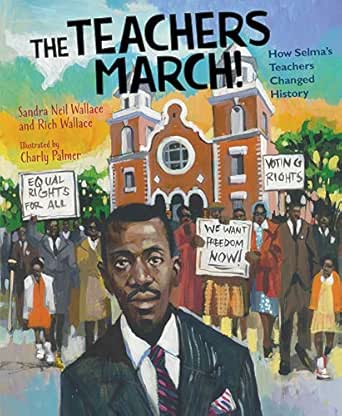
The Teachers March! How Selma’s Teachers Changed History by Sandra Neil Wallace and Rich Wallace, illustrated by Charly Palmer

Published by Calkins Creek

The Teachers March!: How Selma's Teachers Changed History - Kindle edition  by Wallace, Sandra Neil, Wallace, Rich, Palmer, Charly. Children Kindle  eBooks @ Amazon.com.
The Teachers March!: How Selma's Teachers Changed History: Wallace, Sandra  Neil, Wallace, Rich, Palmer, Charly: 9781629794525: Amazon.com: Books

Summary:  Reverend F. D. Reese, a science teacher at R. B. Hudson High School in Selma, Alabama, was determined to vote.  He decided to organize his fellow teachers, who were considered leaders in the community, and invited Martin Luther King, Jr. to visit town to encourage the group.  On the appointed day, teachers walked from school to the courthouse, carrying the toothbrushes and sandwiches they would need in jail.  Although the sheriff threatened them with arrest, ultimately they were allowed to complete the march and return to school.  Their action inspired their students and members of other professions to organize their own protests, and Selma became one of the most important cities in the civil rights movement.  Includes authors’ and illustrator’s notes, photos, a timeline, and a bibliography.  44 pages; grades 2-6.

Pros:  A fascinating history of a little-known but important part of the civil rights movement, told from the perspectives of Reese and Joyce Parrish, the 15-year-old daughter of another teacher.  The back matter makes it an excellent research resource.

Cons:  It’s quite long and a bit wordy for a picture book.

If you would like to buy this book on Amazon, click here.

The World’s Poorest President Speaks Out edited by Yoshimi Kusaba, illustrated by Gaku Nakagawa

Published by Enchanted Lion Books

The World's Poorest President Speaks Out: Yoshimi, Kusaba, Gaku, Nakagawa,  Wong, Andrew: 9781592702893: Amazon.com: Books

Summary:  It’s 2012, and world leaders have gathered in Brazil for the Rio+20 Summit to discuss climate change and the environmental crisis.  “One after another, they gave speeches, but no one says anything new.”  Then José Mujica, president of Uruguay, steps to the podium.  Described as “the world’s poorest president” for donating 90% of his salary to charity and choosing to live on his farm instead of in the presidential palace, Mujica questions the whole system of capitalism, asking the participants if they were really committed to living in harmony with nature, as they said, or driven by production and consumption.  “Shared human happiness is the greatest treasure of all,” he concludes.  “If we appreciate the beauty of nature and life itself and care for our world, we will be able to continue to live well as humans on this planet.”  40 pages; grades 3+

Pros:  Mujica’s speech is as timely today as it was eight years ago, and will resonate with older readers (middle school and up) at least as much as with the picture book crowd.

Cons:  The title makes Mujica sound like an object of pity when really he seems to have figured out a lot more about life and happiness than most other world leaders.

If you would like to buy this book on Amazon, click here.

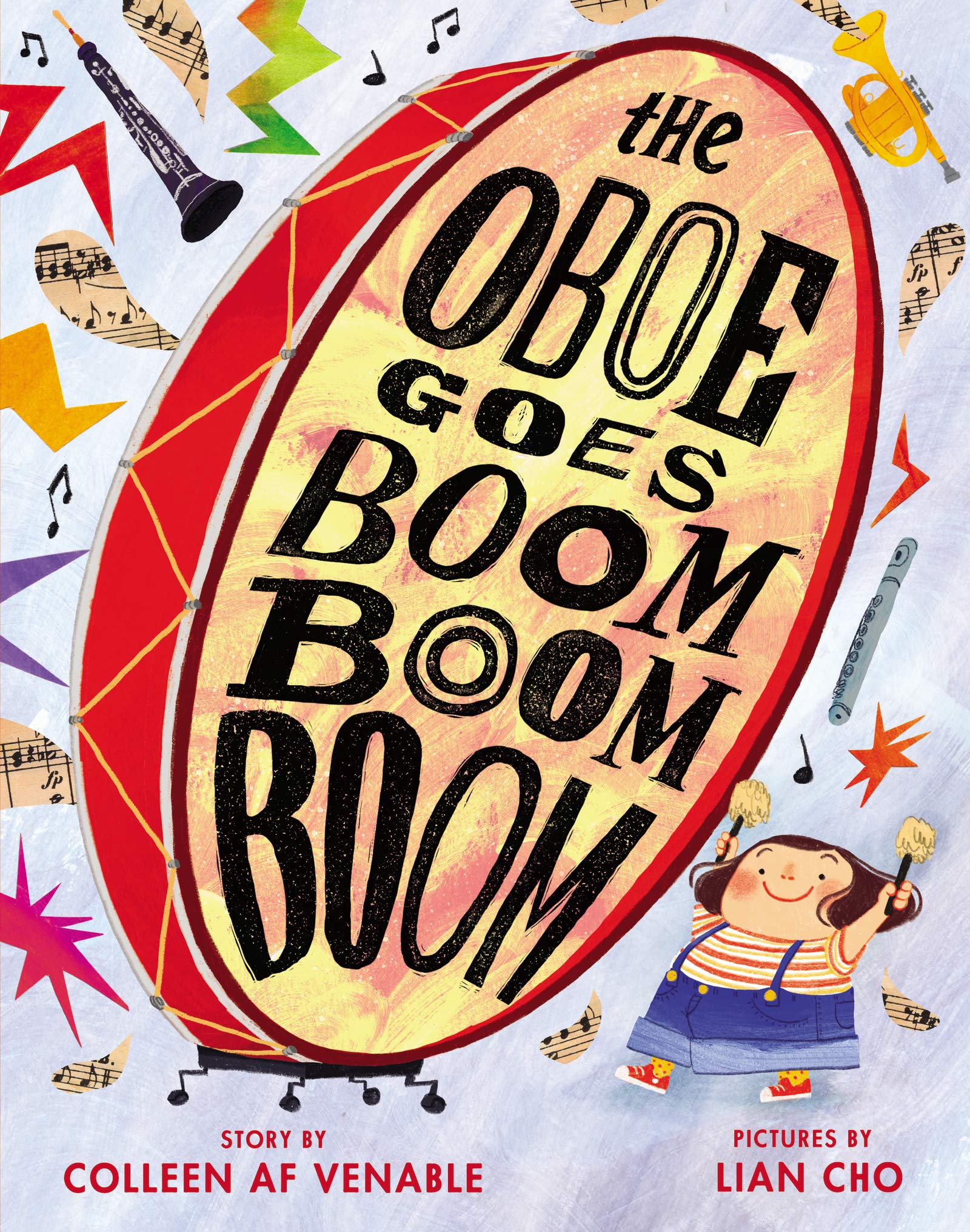
The Oboe Goes Boom Boom Boom by Colleen AF Venable, illustrated by Lian Cho

Published by Greenwillow Books

The Oboe Goes Boom Boom Boom: Venable, Colleen AF, Cho, Lian:  9780062494375: Amazon.com: Books
Fall 2020 Children's Announcements: Publishers F-L

Summary: Band director Mr. V. says there is a perfect instrument for everyone, and proceeds to introduce them one by one.  He invites each player to give a demonstration, but every time Felicity bangs her bass drum, “Boom Boom Boom” and drowns out the other instrument.  Mr. V. continues, explaining the reed on a clarinet, the double reed on an oboe, the valves on a trumpet, and so forth, but gets increasingly agitated as Felicity doesn’t stop with the drum.  Finally, he introduces the one instrument that can drown out Felicity: the tuba.  Its “WHOMP WHOMP WHOMP” overpowers the “Boom Boom Boom” so that when it’s finally time to introduce the percussion section, the tables are turned on Felicity.  The final two pages introduce the real-life musicians who inspired the kids in the band, with a short biographical paragraph about each.  40 pages; grades K-4.

Pros:  A fun introduction to band instruments with interesting facts about each one.  This would be perfect to read to those elementary kids trying to decide what they want to play.  Connecting each kid in the story to a real-life musician who plays (or played) their instrument is a nice added touch.

Cons:  If the oboe is considered a band instrument, it seems like the bassoon and French horn should have been included too.

If you would like to buy this book on Amazon, click here.

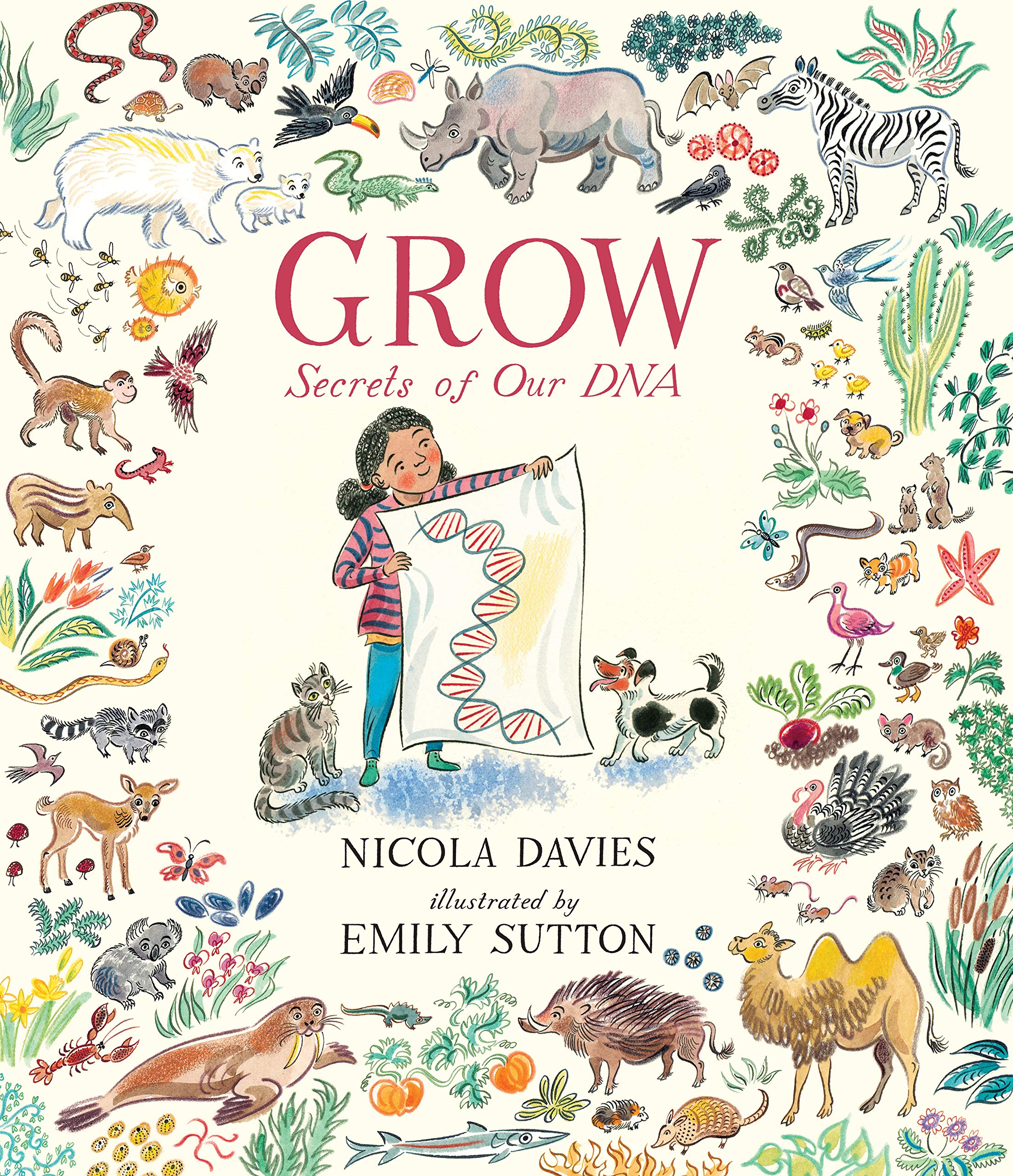
Grow: Secrets of Our DNA by Nicola Davies, illustrated by Emily Sutton

Published by Candlewick

Grow: Secrets of Our DNA: Davies, Nicola, Sutton, Emily: 9781536212723:  Amazon.com: Books

Summary:  All living things grow: some quickly, some slowly, some a little, and some a lot.  Humans grow from a tiny dot to an adult, following a set of instructions coded into DNA, the genetic code.  Humans’ genetic code is similar to some animals, like chimpanzees, less similar to other animals like dogs, and even less similar to plants.  But all forms of life are connected, and all connect back to earlier forms of life “because all life has always been written in one language”.  Includes an afterword called “How did you grow?”.  40 pages; grades K-5.

Pros:  Nicola Davies does a masterful job of explaining DNA and genetics in a way that allows me to confidently recommend this book for kids as young as kindergarteners.  The gorgeous illustrations showing all kinds of animal and plant life make it even more accessible for readers of all ages.

Cons:  I was surprised there were no resources for further research included at the end.

If you would like to buy this book on Amazon, click here.

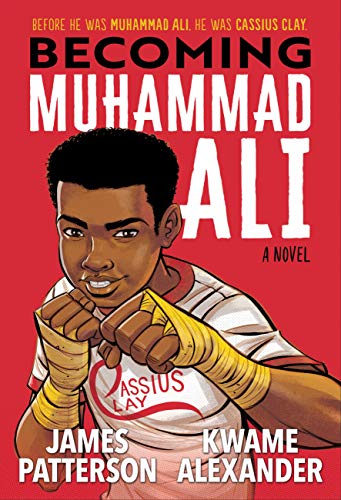
Becoming Muhammad Ali by James Patterson and Kwame Alexander, illustrated by Dawud Anyabwile

Published by Jimmy Patterson Books (Little, Brown)

Becoming Muhammad Ali - Kindle edition by Patterson, James, Alexander,  Kwame, Anyabwile, Dawud. Children Kindle eBooks @ Amazon.com.

Summary:  Round One: Cassius Clay’s friend Lucky and the rest of Cassius’s friends and family are awaiting the results of the 1958 Golden Gloves championship.  16-year-old Cassius is in Chicago, 300 miles from his home in Louisville, KY.  The phone rings, and the story shifts to Cassius’s voice, told in verse.  Clay didn’t win that championship, but he relates how he got there: the friends and relatives who influenced him, the events that led him to boxing, the unflagging discipline and confidence that helped him in his training.  By the time we get to Round Nine, Cassius is ready to return to the Golden Gloves competition and become a champion.  Lucky introduces each round, then finishes with a Final Round, in which he tells what happened to Cassius Clay, later Muhammad Ali, during the rest of his career.  320 pages; grades 4-7.

Pros:  Apparently, Kwame Alexander has been a Muhammad Ali fan since he read Ali’s autobiography as a kid, and he uses his considerable poetic talents to bring the boxer life.  I wasn’t sure I liked Lucky’s prose sections at first, but they did flesh out the story, setting up the action for the poetry parts. This is sure to be an enormously popular choice for kids.

Cons:  I’m curious about the collaboration James Patterson, who seems more like a brand than an actual author these days.  I would have preferred this to be the sole work of Kwame Alexander, whom I’m sure could have pulled it off without any help.

If you would like to buy this on Amazon, click here.

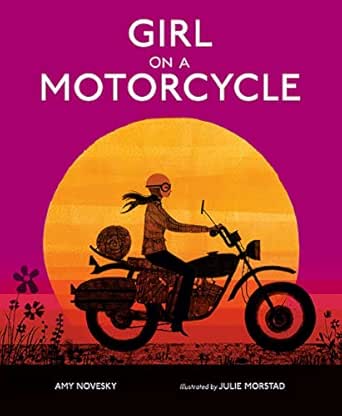
Girl on a Motorcycle by Amy Novesky, illustrated by Julie Morstad

Published by Viking Books for Young Readers

Girl on a Motorcycle - Kindle edition by Novesky, Amy, Morstad, Julie.  Children Kindle eBooks @ Amazon.com.
Girl on a Motorcycle: Novesky, Amy, Morstad, Julie: 9780593116296:  Amazon.com: Books

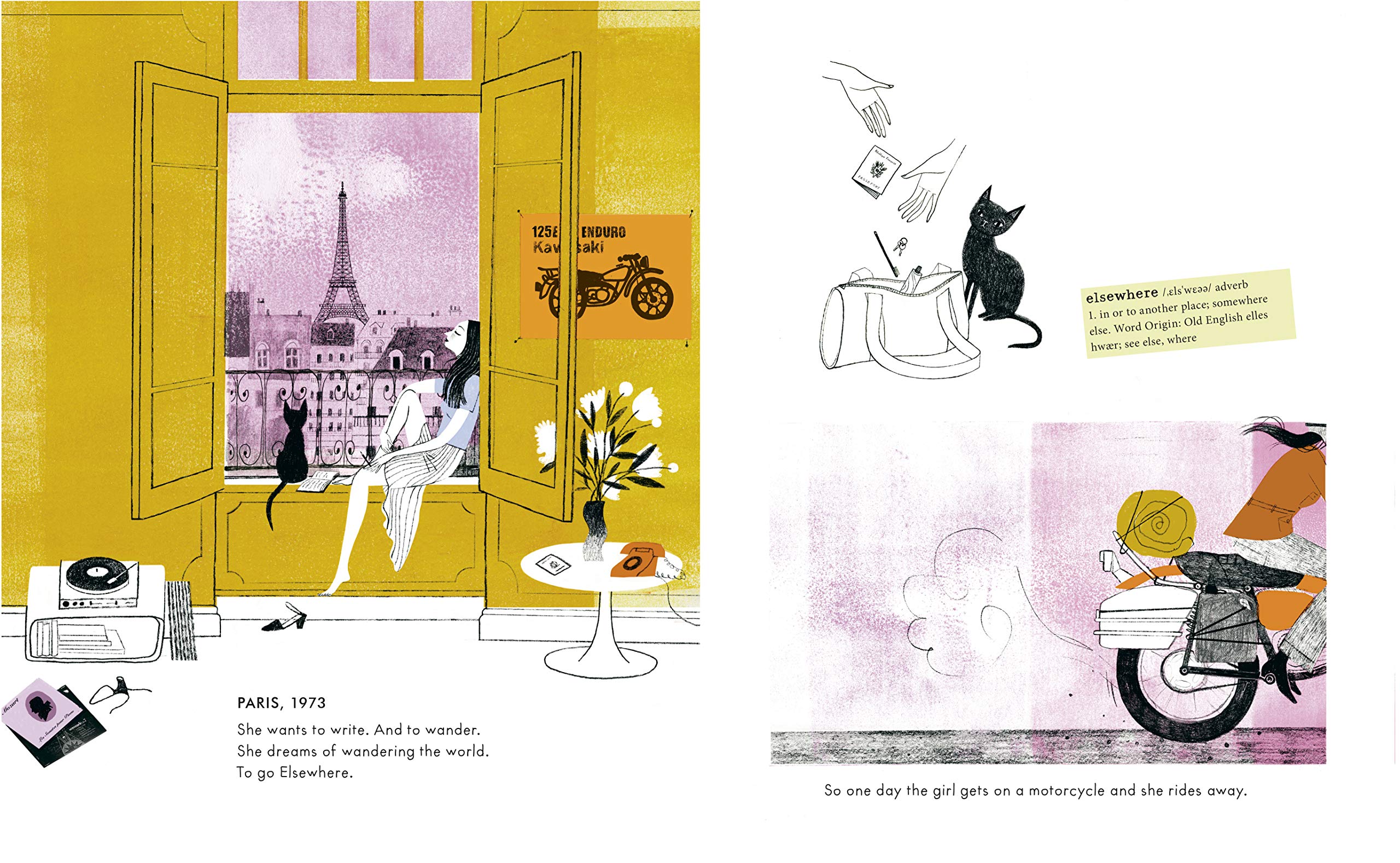
Summary:  In 1973, a girl in her Paris home dreams about going somewhere else.  One day she packs up her motorcycle (her packing list includes tools, a sleeping bag, cookware, and a pretty white dress), and heads to Canada (she flies; it’s not clear how the motorcycle gets there).  She travels on her motorcycle from Montreal to Alaska, then flies to Japan.  From there, it’s on to a number of Asian countries, then back into Europe: Bulgaria, Yugoslavia, Hungary, Austria, Germany, and finally, home to France.  She has become the first woman to travel around the world by motorcycle.  Includes additional information and photos about Anne-France Dautheville, the Frenchwoman on whom this story is based, and an author’s note.  48 pages; grades 2-6.

Pros:  A fun, true story that may inspire others to lead a more adventurous life.  The illustrations are full of interesting details and lists like “How to drink tea in India” and “How to make a fire”.  The information at the end will answer many of the questions about the real-life woman who made this journey.

Cons:  I was surprised there was no map anywhere showing Dautheville’s route.

If you would like to buy this on Amazon, click here.

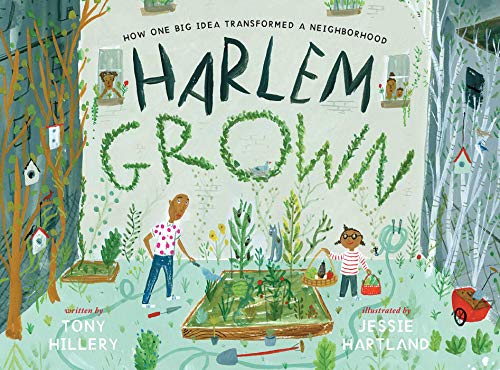
Harlem Grown: How One Big Idea Transformed a Neighborhood by Tony Hillery, illustrated by Jessie Hartland

Published by Simon and Schuster/Paula Wiseman Books

Harlem Grown: How One Big Idea Transformed a Neighborhood - Kindle edition  by Hillery, Tony, Hartland, Jessie. Children Kindle eBooks @ Amazon.com.

Harlem Grown: How One Big Idea Transformed a Neighborhood: Hillery, Tony,  Hartland, Jessie: 9781534402317: Amazon.com: Books

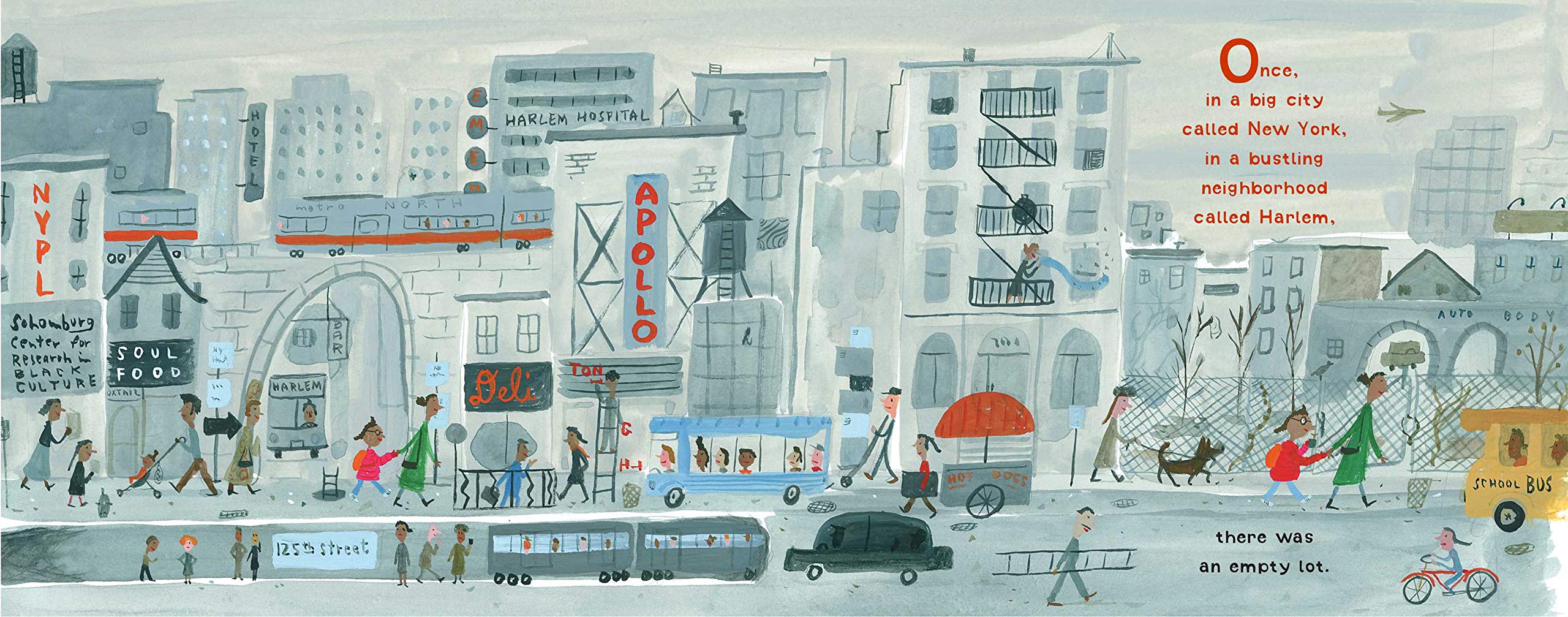
Summary:  The story begins with an empty lot filled with trash, across the street from a school, P.S. 175.  A man named Mr. Tony came to their school.  When he saw the lot across the street, he had an idea.  He and the kids cleared the lot, then filled it with clean soil and started to plant.  They grew vegetables, fruit, and herbs.  When some plants died, they planted new ones.  Mr. Tony built raised beds.  They watered and weeded, and finally had tomatoes, cucumbers, peppers, berries, and more to take home and enjoy.  Includes a note from the author, who is Mr. Tony, about how this single lot has grown to twelve sites around Harlem with 22 full time staff; a photo of him standing outside one of the gardens; instructions on how to start a garden; and additional resources.  40 pages; ages 4-8.

Pros:  An inspiring true-life story of how one man moved from a difficult situation (he started volunteering at P.S. 175 when he had to close his business in 2010) to create something that benefits many people in his community.

Cons:  I would have loved more photos.

If you would like to buy this book on Amazon, click here.

A Thousand Glass Flowers: Marietta Barovier and the Invention of the Rosetta Bead by Evan Turk

Published by Atheneum Books for Young Readers

A Thousand Glass Flowers: Marietta Barovier and the Invention of the  Rosetta Bead - Kindle edition by Turk, Evan, Turk, Evan. Children Kindle  eBooks @ Amazon.com.
A Thousand Glass Flowers: Marietta Barovier and the Invention of the  Rosetta Bead: Turk, Evan, Turk, Evan: 9781534410343: Amazon.com: Books

Summary:  Marietta Barovier grew up in fifteenth-century Murano, an island near Venice, where her father and brothers worked as glassblowers.  She wanted to learn the craft, but it wasn’t something girls did.  She persisted, though, hanging around the shop, and finally her father showed her how.  One day, she and her father took a trip to Venice to visit a wealthy patron.  Marietta discovered a small glass bowl covered with flowers, and was told that the technique for making such glass had been lost.  Years later, she remembered the bowl when she tried a new technique, layering different colors of glass together to make beads.  These rosetta beads became valuable currency and spread throughout the world. Includes an author’s note with additional information about Barovier and her beads, and a note about the art. 48 pages; grades 2-5.

Pros:  Evan Turk’s dazzling illustrations were inspired by Renaissance and Impressionist artists, with hues of yellow, gold, and orange that capture the fiery heat of glassblowing and the light and energy of Venice.  The story of Marietta is fascinating (although slightly fictionalized, since records about her are sparse), and could make a nice addition to an art curriculum.

Cons:  Although there are a couple photos of Evan Turk learning to blow glass and sketching in Italy, I would have liked to have seen some of the beads.

If you would like to buy this book on Amazon, click here.

Your Place in the Universe by Jason Chin

Published by Neal Porter Books

Your Place in the Universe - Kindle edition by Chin, Jason. Children Kindle  eBooks @ Amazon.com.

Summary:  An eight-year-old is about five times as tall as this book…but only half as tall as an ostrich.  The ostrich is half as tall as the tallest land animal, the giraffe, but the giraffe is 20 times shorter than the tallest living thing, a redwood tree.  The journey continues outward: skyscrapers, mountains, outer space, all the way to the very edges of the universe.  It then comes back to Earth, and that group of eight-year-olds, who are capable of looking into the sky and imagining their place in the universe.  Includes additional information on Earth, the solar system, the universe, and making maps and models, as well as notes on the text and the illustrations, and a list of selected sources.  40 pages; ages 4-8.

Pros:  Although this sort of journey has been shown before (Cosmic View: The Universe in 40 Jumps or Powers of Ten), Jason Chin brings his own deft touch to it.  As always, Chin’s illustrations are amazing in their details, colors, and realistic renderings (I was particularly awed by the panoramic view of Mount Everest showing a juxtaposition with the tallest skyscrapers).  The simple comparisons make this accessible to early elementary kids, but the back matter makes it hefty enough for older readers.  Sure to be a contender for another Sibert award.

Cons:  I’m feeling pretty insignificant right now.

If you would like to buy this book on Amazon, click here.

If You Want to Visit a Sea Garden by Kay Weisman, illustrated by Roy Henry Vickers

Published by Groundwood Books

If You Want to Visit a Sea Garden - Kindle edition by Weisman, Kay,  Vickers, Roy Henry. Children Kindle eBooks @ Amazon.com.
If You Want to Visit a Sea Garden: Weisman, Kay, Vickers, Roy Henry:  9781554989706: Amazon.com: Books

Summary:  A child and adult are seen in silhouette at the beach as the sun rises.  They’re there to visit a sea garden, a reef created by indigenous people for thousands of years by lining up boulders at the lowest tide line.  This creates a habitat for a variety of sea creatures, and the two see clams, whelks, sea stars, hermit crabs, and a wide variety of other creatures.  They join others digging for clams, planning to steam some and smoke others to eat later.  Before they leave, they do their part to tend to the sea garden, fixing a wall and clearing away driftwood and seaweed.  As the sun sets, they row away, heading back home.  Includes a page of information about sea gardens, including three photos.  32 pages; grades K-4.

Pros:  An interesting lesson on a method of sustainably harvesting seafood that has been done on the Pacific Northwest coast for over 3,000 years.  The illustrations are magnificent, with different vivid background colors showing the times of day throughout the story.  There were interesting faces and designs in the pictures that I wish were explained somewhere.

Cons:  I had trouble picturing what a sea garden looked like, and the photos at the end were so small that they still didn’t really clear it up for me.

If you would like to buy this book on Amazon, click here.