Peace and Me: Inspired by the Lives of Nobel Peace Prize Laureates by Ali Winter, illustrated by Mickael El Fathi

Published by Lantana Publishing

Image result for peace and me ali winter amazon

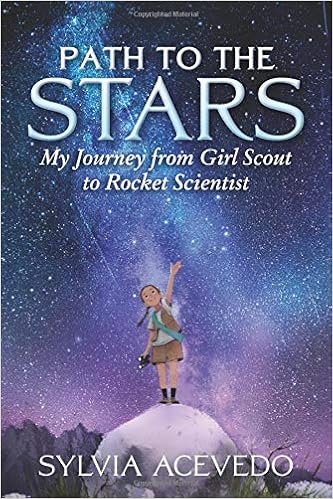
Summary:  Twelve Nobel Peace Prize winners are profiled, along with the man who started it all, Alfred Nobel.  Winners are presented in chronological order, beginning with Jean Henry Dunant in 1901 and finishing with Malala Yousafzai in 2014.  Some will likely be familiar to kids (Martin Luther King Jr., Mother Teresa, Nelson Mandela), while others are less well known (Fridtjof Nansen, Rigoberta Menchu Tum, Shirin Ebadi).  The first two pages show an interesting timeline, with each person’s name and year shown on a sailboat on the Pacific Ocean.  The last two have a world map showing the country of origin for each recipient.  32 pages; grades 1-5.

Pros:  An interesting and important collection of people for kids to know about.  The collage-style illustrations are fascinating, with lots of details to notice.  Kids will enjoy finding the girl on the cover who appears in every one.

Cons:  Only 12 of the many interesting recipients are profiled.

If you would like to buy this book on Amazon, click here.

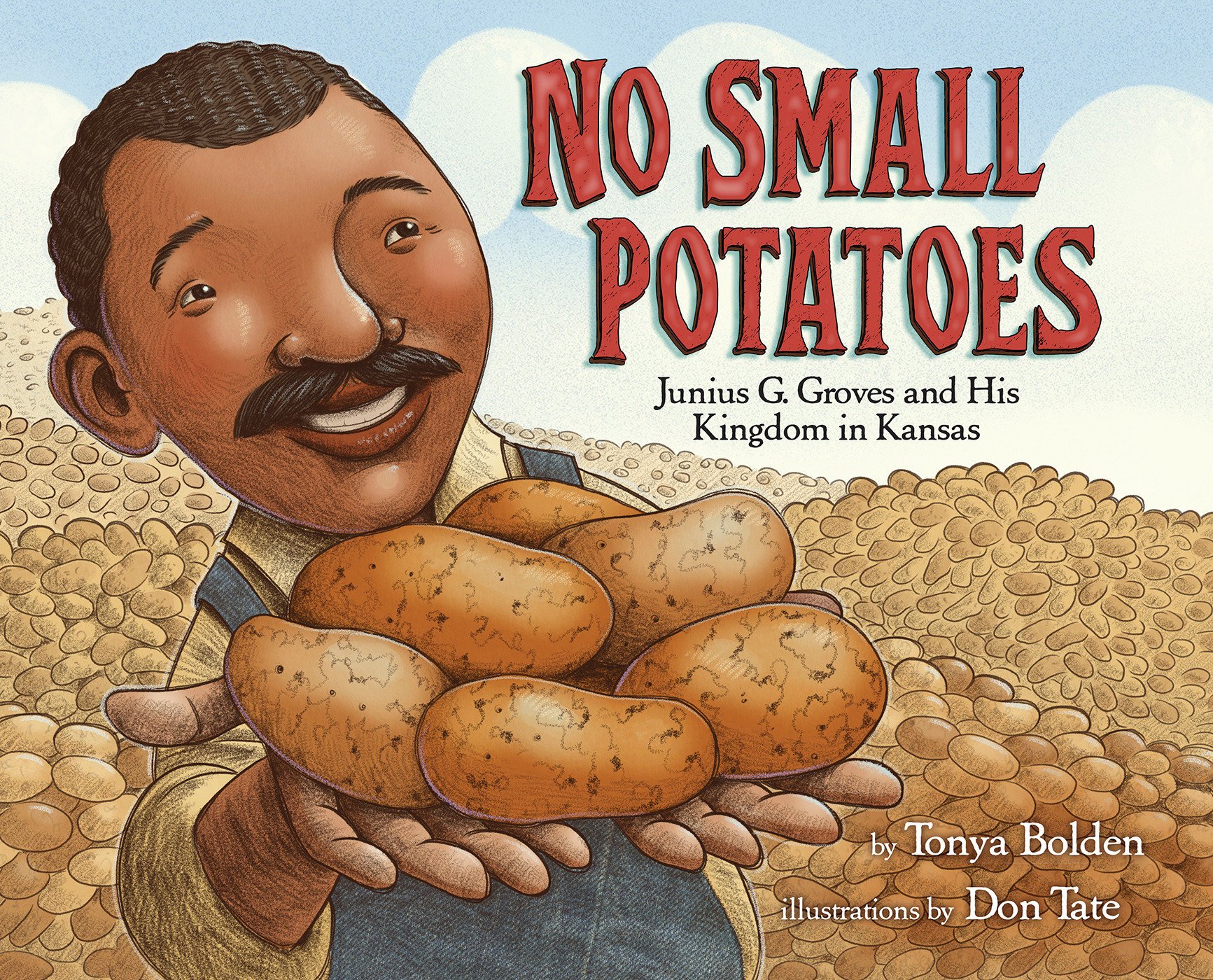
No Small Potatoes: Junius G. Groves and His Kingdom In Kansas by Tonya Bolden, illustrated by Don Tate

Published by Knopf Books for Young Readers

Image result for no small potatoes amazon

Image result for no small potatoes junius

Summary:  Slavery ended just a few years after Junius Groves was born on a plantation in Kentucky.  As a young man, he headed for Kansas to farm.  Starting out as a hired hand earning 40 cents a day, he worked hard to become a foreman, tripling his wages and eventually allowing him to rent his own land to farm.  With his wife Matilda at his side, he saved enough money to buy a farm.  The two of them worked hard, along with their twelve children, to make the farm prosperous.  Their main crop was potatoes: in 1894 he was named Potato King of Wyandotte County by the local paper; six years later, he was called the Potato King of the whole state of Kansas, and in 1902, he was crowned Potato King of the World.  In addition to millions of pounds of potatoes, Junius helped grow a church, a store, a golf course, and a town called Groves Center.  Includes a timeline, glossary, and list of sources.  40 pages; grades 1-4.

Pros:  A real rags-to-riches tale extolling the rewards of hard work, told in a style that almost makes it feel like a tall tale.

Cons:  The potential downside of vying for the title of Potato King of the World at the Thanksgiving table today.

If you would like to buy this book on Amazon, click here.


Pass Go and Collect $200: The Real Story of How Monopoly Was Invented by Tanya Lee Stone, illustrated by Steven Salerno

Published by Henry Holt and Co.

Image result for pass go and collect 200 amazon

Image result for pass go and collect 200 salerno

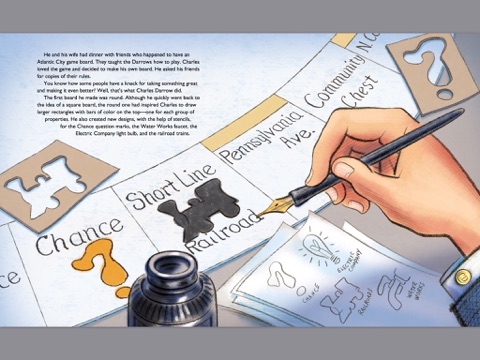
Summary:  The history of one of the world’s most famous board games isn’t a straightforward one.  The earliest form of Monopoly was a game called the Landlord’s Game, created in 1903 by a woman named Lizzie Magie who wanted to show the injustice of landlord-tenant relationships.  Her game had dice, a bank, two kinds of cards called Luxury and Legacy, four railroads, and 22 properties on lots with purchase prices and rents. The game caught on, although an effort by Magie to sell it to Parker Brothers failed, and the properties were named after Atlantic City, NJ landmarks by a teacher in 1930.  During the Great Depression, a man named Charles Darrow, out of work, redesigned the Atlantic City game board and began selling handmade copies from home. Parker Brothers turned him down, too, but when his game became a big seller, they changed their minds. After buying Lizzie Magie’s patent for $500, Charles Darrow and Parker Brothers went on to make millions with the game of Monopoly.  The author ends with some questions: Did Lizzie Magie make a wrong move? Did Charles Darrow? Whatever the answers, there’s no denying that Monopoly’s a winner for many. Includes Monopoly trivia and math, an author’s note, and a list of sources. 40 pages; grades 2-5.

Pros:  A remarkably complex history is laid out in an understandable fashion, with illustrations that document the evolution of the game.

Cons:  Polls done in 2013 and 2017 have resulted in the discontinuation of the classic iron, boot, thimble, and wheelbarrow tokens.  I was always particularly fond of the thimble.

If you would like to buy this book on Amazon, click here.

Unstoppable: How Jim Thorpe and the Carlisle Indian School Football Team Defeated Army by Art Coulson, illustrated by Nick Hardcastle

Published by Capstone

Image result for unstoppable how jim thorpe amazon

Image result for unstoppable how jim thorpe amazon

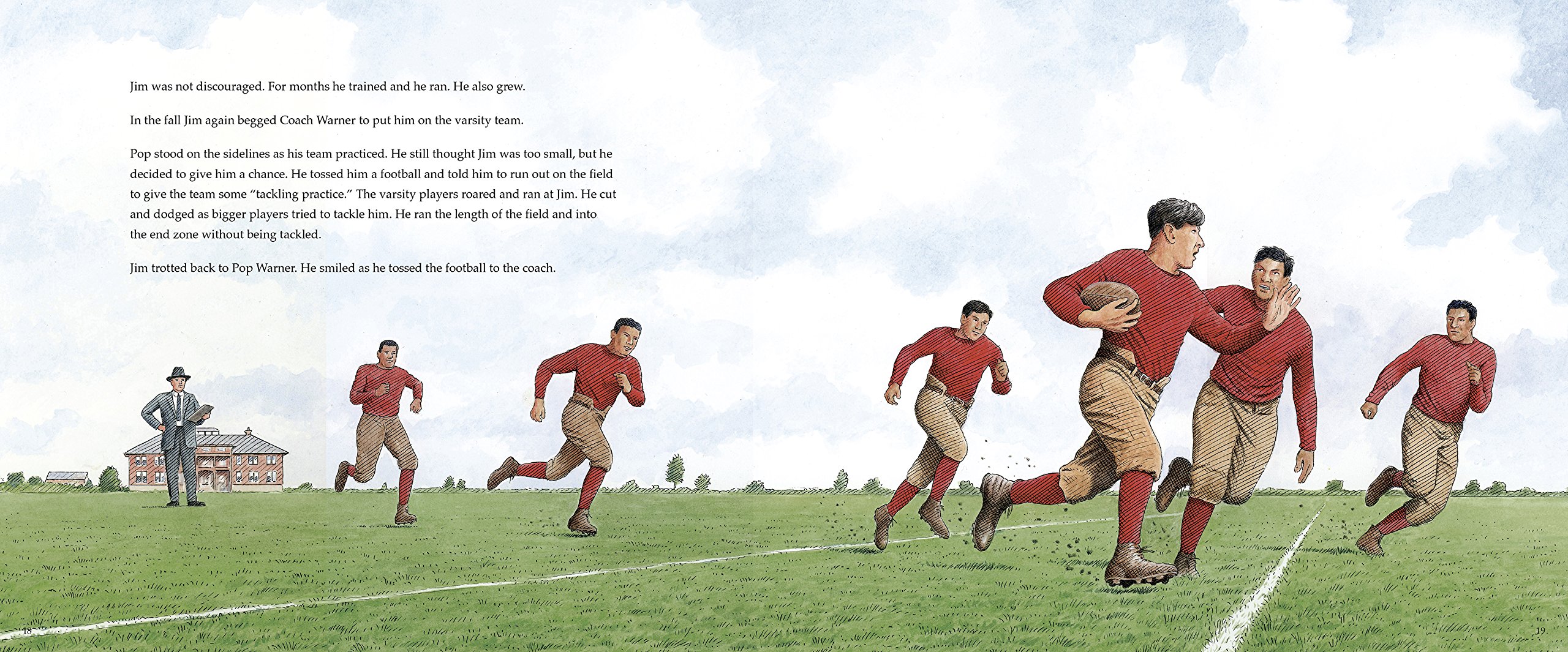
Summary:  The big game against Army is the climax of this book, but there’s a long story to be told before that.  Jim Thorpe, like so many other Indian children, was sent to boarding school, where he was forced to have his hair cut, wear school-issued clothing, and stop speaking his native language.  After running away from a school in Kansas, his father sent him to the Carlisle Indian Industrial School in Pennsylvania. He excelled at all sports there, becoming a football and track star and winning a couple of gold medals at the 1912 Olympics.  Later that year, Thorpe and the Carlisle team traveled to West Point to play against a team that included Dwight Eisenhower and three other future generals. The symbolism of the future Army soldiers versus the Indians was not lost on anyone as the Carlisle team played a new kind of football created by coach Pop Warner and won the game 27-6.  Includes additional information on Jim Thorpe, other members of the Carlisle team, Pop Warner, and the Carlisle Indian Industrial School, as well as a glossary and a list of additional information sources. 40 pages; grades 3-6.

Pros:  So many people (including me) know Jim Thorpe mainly as the guy who lost his Olympic medals for playing semi-professional baseball, but there is so much more to his story.  This is a good introduction to Thorpe, the Carlisle Indian Industrial School, Pop Warner, and the early days of football.

Cons:  Due to the picture book format, a lot of the more interesting (and in some cases, horrifying) details are omitted.  For a more comprehensive picture, read Steve Sheinkin’s Undefeated: Jim Thorpe and the Carlisle Indian School Football Team.

If you would like to buy this book on Amazon, click here.

Ski Soldier: A World War II Biography by Louise Borden

Published by Calkins Creek

Image result for ski soldier borden amazon

Summary:  Growing up in Sharon, Massachusetts, Pete Siebert taught himself to ski on an old pair of wooden skis he found in his parents’ barn.  As he got older, his parents took him and his sister to the White Mountains of New Hampshire, where he became a proficient racer and vowed to one day open his own ski resort.  After graduating high school, he enlisted in the army, the 10th Mountain Division of soldiers on skis. After training in the Colorado Rockies, the division was shipped overseas to Italy, where they took part in a daring nighttime attack on Germans in the Apennines Mountains.  Pete was wounded so severely doctors weren’t sure he would walk again, but he was determined to ski. He persevered and recovered enough to make the 1950 U.S. men’s ski team. And in 1962, his boyhood dream came true when he opened the Vail Ski Resort in Colorado. Includes additional information about Pete Seibert and the 10th Mountain Division, as well as a list of sources.  176 pages; grades 4-8.

Pros:  Told in verse, with plenty of photos, this story will appeal to skiers and World War II buffs.  It’s a quick read, but the story is engaging, and readers will learn a lot about Pete and an unusual chapter in military history.

Cons:  The cover makes the book look kind of old.

If you would like to buy this book on Amazon, click here.


She Made a Monster: How Mary Shelley Created Frankenstein by Lynn Fulton, illustrated by Felicita Sala

Published by Knopf Books for Young Readers

Image result for she made a monster amazon

Image result for she made a monster sala

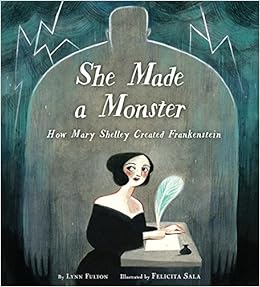
Summary:  On a dark and stormy night two hundred years ago, young Mary sat in her room trying to think of a story.  Downstairs, she could hear her friends Lord Byron and Percy Shelley (soon to be her husband) talking about their own stories.  The group had decided to have a contest to see who could write the best ghost story in a week, and the deadline was approaching.  Finally, Mary went to bed, but in her dreams, she saw a huge creature lying on a table, with a terrified young student shrinking away from him.  Mary knew the young man had brought this being to life. Jolted awake, heart pounding, she realized she finally had an idea for her story. Includes an author’s note about Mary Shelley’s story, Frankenstein, with additional information about Mary and her mother Mary Wollstonecraft, who is referenced in the book.  40 pages; grades 2-5.

Pros:  The writing and illustrations create a deliciously creepy feeling as readers learn about the history behind Mary’s famous book.  This would be an excellent supplement to anyone reading Frankenstein.

Cons:  This is a somewhat fictionalized account (the author’s note tells the parts she took some liberties with) and not really a biography, since it only covers a single episode in Mary Shelley’s life.

If you would like to buy this book on Amazon, click here.

Starstruck: The Cosmic Journey of Neil DeGrasse Tyson by Kathleen Krull and Paul Brewer, illustrated by Frank Morrison

Published by Crown Books for Young Readers

Image result for starstruck neil degrasse amazon

Image result for starstruck frank morrison

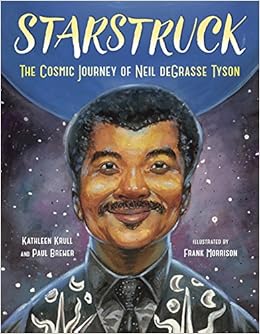
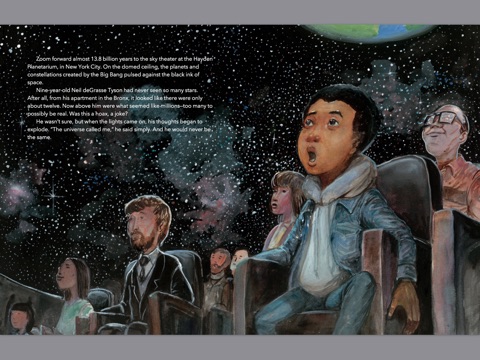
Summary:  Growing up in the Bronx, young Neil DeGrasse Tyson only saw a few stars in the night sky.  He couldn’t believe his eyes when he visited the Hayden Planetarium at age 9 and saw how many stars were really there.  From that time on, Neil was fascinated by astronomy. His parents supported him, buying him a telescope and books, and a sixth-grade teacher suggested he take an advanced class at the planetarium.  He went on to the Bronx High School of Science and Harvard, where he learned all he could about science, while also enjoying dancing and wrestling. Eventually, he wound up back at the Hayden Planetarium as a director, and has become a voice for science, appearing on TV and writing books and tweets to share his enthusiasm.  In life and in the universe, says Tyson, “It’s always best to keep looking up.” Includes an authors’ note and sources.  48 pages; grades 1-5.

Pros:  The authors show how Tyson turned his passion into a rewarding career through hard work and determination.  The illustrations capture his energy, as well as the beautiful night sky.

Cons:  I often see books like this recommended for grades K-3 (all the reviews I looked at, as well as Amazon, had that range for their recommendations).  I find picture book biographies are appreciated by upper elementary and middle school students even more than the younger ones.

If you would like to buy this book on Amazon, click here.

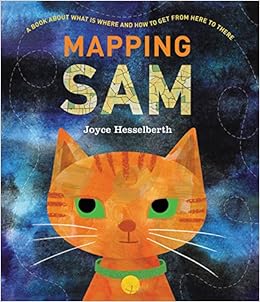
Mapping Sam by Joyce Hesselberth

Published by Greenwillow Books

Image result for mapping sam amazon

Image result for mapping sam

Summary:  After Sam’s family is asleep, she slips outside for some nighttime feline adventures.  Maps are used to enhance her journey: a map of her route, a map showing what Sam looks like inside; a map of what’s under the pond she visits, as well as one of a molecule of water in the pond.  As Sam ponders the night sky, there are maps of the larger world and universe: the earth, the planets, and constellations. Finally Sam heads back inside to join her family in sleep and dreams, and the author concludes with the question, “Can you map a dream?  You might try.” Includes additional information about each map shown in the book. 40 pages; ages 4-8.

Pros:  A clever and engaging introduction to maps.  The author defines a map as “a picture, usually on a flat surface, that shows what is where and how to get from here to there”, and this broad definition allows her to show how maps are useful in many different areas of life.

Cons:  It would have been helpful to have that definition at the beginning rather than the end.  I found myself thinking, “That’s not a map!” as I read the book until it became clear on the last page.


Anne Frank’s Diary: The Graphic Adaptation adapted by Ari Folman, illustrations by David Polonsky

Published by Pantheon
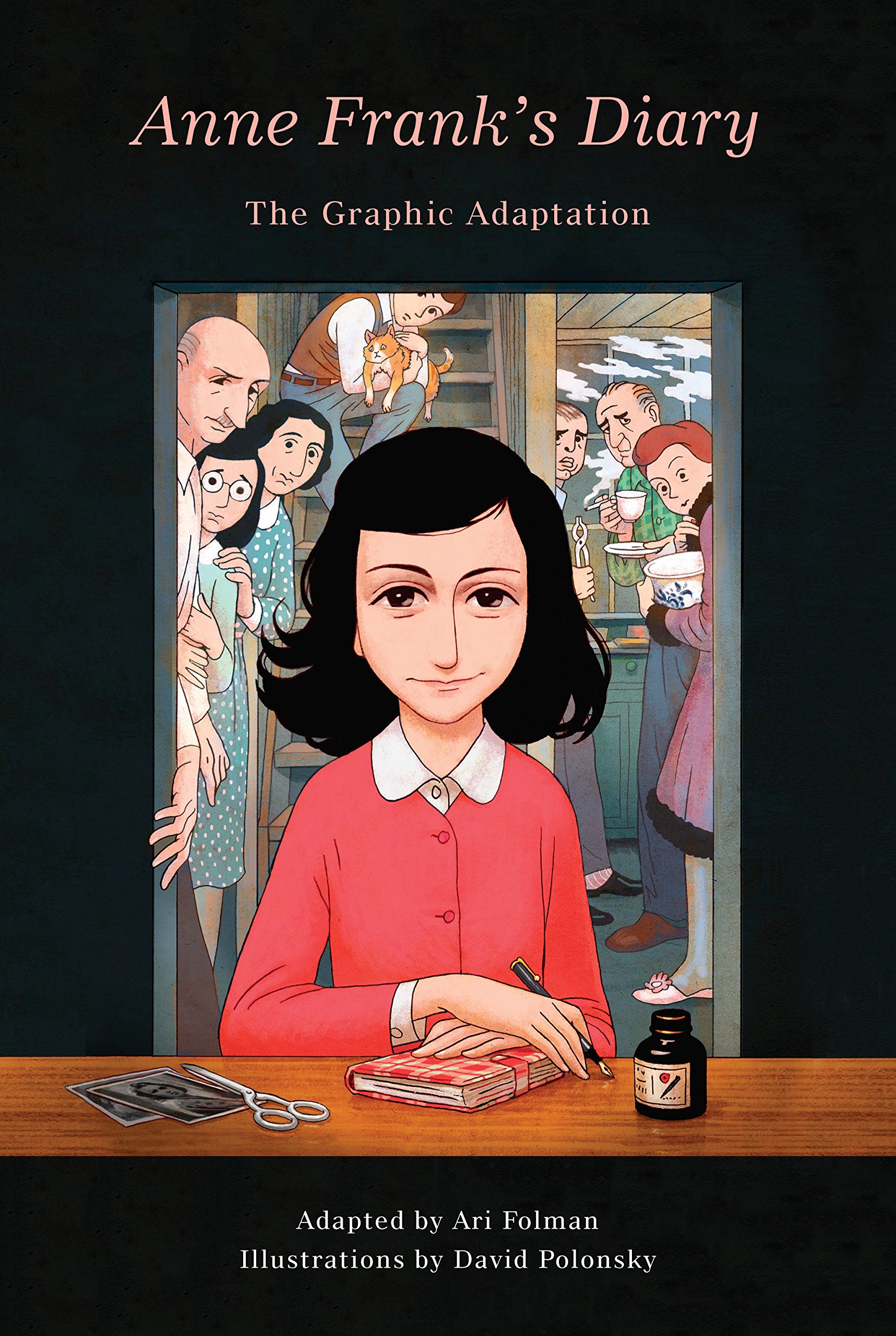
Image result for diary anne frank graphic novel amazon

Image result for diary anne frank graphic novel

Image result for diary anne frank graphic novel

Summary:  In his adaptor’s note, Ari Folman describes how he was approached by the Anne Frank Fonds (Foundation) to create an animated film for children as well as a graphic novel based on Anne’s life.  He estimated that turning the entire diary into a graphic novel would have taken about ten years and resulted in 3500 pages. Instead, he took the essence of Anne’s diary, beginning shortly before she and her family went into hiding and continuing until her last entry before all the members of The Secret Annex were arrested in August 1944.  Although life in the annex was extremely stressful–not only was it a matter of life and death to stay hidden, but day-to-day life was monotonous, there were plenty of squabbles among the eight people, and the food situation grew increasingly worse–Anne manages to find a great deal of humor and insight as she observes her family, the van Daans, and Albert Dussel. The afterword, as ever, is heartbreaking, as the reader learns of the tragic deaths of Anne, her mother and sister, Dussel, and the Van Daans, and of Otto Frank’s discovery and publication of her diary.  160 pages.

Pros:  I was skeptical about how Anne’s diary would translate into a graphic novel, but both the adapter and the illustrator have done a truly amazing job.  Despite the grim topic, there is a lot of levity in both the text and illustrations, and the approximately 5% of the original document that is shown here really captures Anne’s voice and spirit.

Cons:  It’s hard to recommend this for an age group; it really depends on individual readers.  Of course, there is the whole Holocaust topic that is the backdrop for the entire book. In addition, there are more sexual references than I remembered from my original high school reading, including a detailed description by Anne of female genitalia that I was pretty surprised to have forgotten.  Turns out that passage was edited out of many diary editions, including the one I previously read, but it is here, with illustrations, in this one.

If you would like to buy this book on Amazon, click here.
Path to the Stars: My Journey from Girl Scout to Rocket Scientist by Sylvia Acevedo

Published by Clarion Books

Image result for pathway to the stars sylvia acevedo amazon

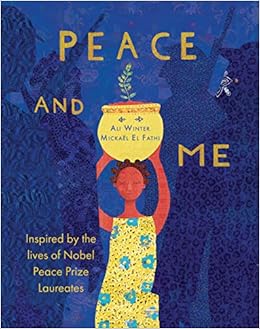
Summary:  Sylvia Acevedo grew up in a Mexican-American family in New Mexico.  Her father was born in the U.S., graduated from college, and worked as a chemist, but expected his daughter to become a wife and mother.  From an early age, Sylvia had different ideas. Her younger sister’s tragic case of meningitis changed the family dynamics, and Sylvia was often left to advocate for herself.  She excelled at school and learned how to set and reach goals through Girl Scouts. Graduating at the top of her class, she gave up her dreams to attend Stanford University, staying at home to help take care of her younger siblings while she got her industrial engineering degree from New Mexico State University.  After graduation, she worked at the Jet Propulsion Laboratory in Pasadena and got a master’s degree at Stanford. After serving many years on the board of Girl Scouts USA, she was appointed CEO of the organization in 2017. 320 pages; grades 5-8.

Pros:  Ms. Acevedo clearly demonstrates how hard work, perseverance, and determination can lead to success beyond one’s wildest dreams.  As a veteran of Girl Scouts, including a 13-year stint as a leader, it was interesting to me to see how scouting has influenced Sylvia’s life.

Cons:  I never had the success selling GS cookies door to door that young Sylvia did.  

If you would like to buy this book on Amazon, click here.