She Made a Monster: How Mary Shelley Created Frankenstein by Lynn Fulton, illustrated by Felicita Sala

Published by Knopf Books for Young Readers

Image result for she made a monster amazon

Image result for she made a monster sala

Summary:  On a dark and stormy night two hundred years ago, young Mary sat in her room trying to think of a story.  Downstairs, she could hear her friends Lord Byron and Percy Shelley (soon to be her husband) talking about their own stories.  The group had decided to have a contest to see who could write the best ghost story in a week, and the deadline was approaching.  Finally, Mary went to bed, but in her dreams, she saw a huge creature lying on a table, with a terrified young student shrinking away from him.  Mary knew the young man had brought this being to life. Jolted awake, heart pounding, she realized she finally had an idea for her story. Includes an author’s note about Mary Shelley’s story, Frankenstein, with additional information about Mary and her mother Mary Wollstonecraft, who is referenced in the book.  40 pages; grades 2-5.

Pros:  The writing and illustrations create a deliciously creepy feeling as readers learn about the history behind Mary’s famous book.  This would be an excellent supplement to anyone reading Frankenstein.

Cons:  This is a somewhat fictionalized account (the author’s note tells the parts she took some liberties with) and not really a biography, since it only covers a single episode in Mary Shelley’s life.

If you would like to buy this book on Amazon, click here.

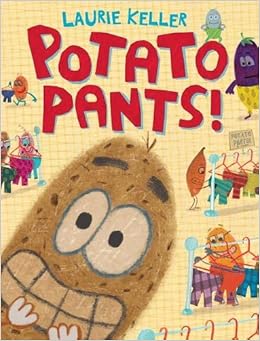
Potato Pants by Laurie Keller

Published by Henry Holt and Co.

Image result for potato pants keller amazon

Summary:  One day only…Lance Vance’s Fancy Pants Store is selling Potato Pants!  Potato is so excited he’s doing the Robot (okay, the Po-bot) before rushing down to the store to get a pair.  But when he gets there, he sees Eggplant inside, wearing his new Eggplant Pants! Yesterday Eggplant went rushing past Potato, pushing him right into a nearby trash can.  Potato is sure Eggplant will mash him again if he goes into the store, so he stands outside, watching all the other happy potatoes happily emerging in their apeeling new pants. Finally, he gets up the nerve to go inside, only to find that the pants have sold out, and when they’re gone…they’re gone.  A couple surprising twists bring about a reconciliation between the two vegetables, both of whom emerge well clad, at least from the waist down. 40 pages; ages 4-8.

Pros:  This wildly goofy, high energy veggie tale will have kids doubled over with laughter.  There’s a little bit of a lesson in forgiveness and friendship at the end, but mostly it’s just a lot of fun.

Cons:   After getting to know this cute and friendly Potato, mashed potatoes may be off the table for me at Thanksgiving.

If you would like to buy this book on Amazon, click here.

Picturing America: Thomas Cole and the Birth of American Art by Hudson Talbott

Published by Nancy Paulsen Books

Image result for picturing america talbott amazon

Image result for picturing america talbott

Summary:  Thomas Cole loved nature and drawing from the time he was a little boy growing up in the English countryside.  When the Industrial Revolution hit, his family fell on hard times and decide to emigrate to America. The family settled first in Ohio, then Pennsylvania, but it wasn’t until they moved to New York that Thomas’s luck began to change.  A merchant named Thomas Bruen admired Cole’s landscape paintings and financed a trip up the Hudson.  Cole’s paintings of the wilderness there brought him fame and fortune, enough to support him on a three-year visit to Europe. He was particularly fascinated by the ruins in Rome, and painted a series of landscapes depicting a society moving from wilderness to civilization and back again.  He returned to the U.S., where he married and settled in the Catskills, living and working there until his death at the age of 47. His style, known as the Hudson River school of art, was the first American art movement, and influenced many other American artists for generations. 32 pages; grades 1-5.

Pros:  This straightforward biography is illuminated with many of Cole’s paintings, showcasing an important early American artist.

Cons:  A timeline would have been useful, since only one date is given in the text (1818, the year the Coles came to the U.S.).

If you would like to buy this book on Amazon, click here.

Zola’s Elephant by Randall de Seve, illustrated by Pamela Zagarenski

Published by HMH Books for Young Readers

Image result for zola's elephant amazon

Image result for zola's elephant

Summary:  The narrator has a new neighbor, a girl named Zola.  Their mothers have already met and decided the two kids should be friends.  The narrator is sure Zola already has a friend–an elephant–because she saw a big box being moved into the house.  She imagines Zola eating toast with her elephant, playing in the bathtub with him, and enjoying a game of hide-and-seek together. After each page showing what she’s imagining, the illustrations show what’s actually going on at Zola’s house: she’s eating toast alone, washing dishes, then kicking her heels against the wall, bored and lonely.  Finally, the narrator gets up the courage to knock on Zola’s door. Together they watch the couch getting unpacked from the big box, then sit on it together as a new friendship is born. 40 pages; ages 4-8.

Pros:  The author and illustrator show kids how to overcome their fears and reach out to new friends.  Caldecott honoree Pamela Zagarenski’s colorful and imaginative paintings give readers plenty to savor.

Cons:  The narrator’s clown-like costume is a little creepy.

If you would like to buy this book on Amazon, click here.

Imagine by Juan Felipe Herrera, illustrated by Lauren Castillo

Published by Candlewick

Image result for imagine herrera amazon

Image result for imagine lauren castillo

Summary:  Former U.S. Poet Laureate tells the story of his life in a poem inviting readers to imagine his past and their own futures.  Starting off as a little boy who loved nature (“If I picked chamomile flowers as a child/in the windy fields and whispered/to their fuzzy faces,/imagine”), he shows his life as a child of migrant farm workers, having to repeatedly leave his home and friends, and going to school not knowing any English.  He loved his new language, using it to write poetry, then learning music so he could turn his poems into songs. Each sentence ends with the word “imagine”. He concludes: “If I stood up/wearing a robe/in front of my familia and many more/on the high steps/of the Library of Congress/in Washington, D.C., and/read out loud and signed/my poetry book/like this–/Poet Laureate of the United States of America/Imagine what you could do.”  32 pages; grades K-5.

Pros:  This picture book-length poem allows Herrera to tell his own amazing story as well as to inspire kids to follow their own dreams.

Cons:  I almost cried when I got to the end and there was no author’s note or biography to give more information about Herrera.

If you would like to buy this book on Amazon, click here.

Best Friends in the Universe by Hector and Louie also by Stephanie Watson, with drawings by Le Uyen Pham

Published by Scholastic

Image result for best friends in the universe amazon

Image result for best friends in the universe pham

Summary:  Hector and Louie are such good friends, they want to tell you all about it, so they’re writing a book called Best Friends in the Universe.  Why are they best friends? There are five million reasons! They both want a python; their moms got them both a fish instead (that they both named Python); they both love dance parties and inventing new foods like a peanut butter toast milkshake.  They’re such good friends that they know each other’s secrets…like that Louie once wet his pants after drinking too much milkshake and that Hector likes Linda Berger. Uh-oh, they weren’t supposed to say that! Suddenly the best friends are in a fight and not speaking.  They’re even writing a book called WORST Friends in the Universe! But after awhile, the two boys realize life without a best friend is lonely. Acknowledging that they are both not the greatest at keeping secrets, they patch up their friendship. The book is over, but their friendship is not!  40 pages; ages 4-8.

Pros:  Some positive messages about friendship and forgiveness, told with exuberant cartoon bubbles and illustrations that look like kids’ drawings on notebook paper.

Cons:  A peanut butter toast milkshake?

If you would like to buy this book on Amazon, click here.


What Do You Do With A Voice Like That? The Story of Extraordinary Congresswoman Barbara Jordan by Chris Barton, illustrated by Ekua Holmes

Published by Beach Lane Books

Image result for what do you do with a voice like that amazon

Image result for what do you do with a voice like that amazon

Summary:  From an early age, Barbara Jordan had a powerful voice.  As she grew up, she had to figure out how she would use it: as a teacher?  A preacher? Finally, she decided to become a lawyer. But the work bored her.  She moved into politics, instead–or at least she tried to. It took three attempts, but she finally won a seat in the Texas Senate.  From there, her voice took her to the U.S. Congress. She used that voice to speak out against Nixon in 1974. Barbara’s star was rising, but, unknown to the public, she suffered from multiple sclerosis.  She retired from Congress in 1979 and moved back home, where she taught at the University of Texas. Jordan died in 1996, but her legacy lives on through her former students. Includes an author’s note, timeline, and additional sources.  48 pages; grades 2-6.

Pros:  One huge benefit of doing this blog has been learning about so many inspiring people whom I have heard of but didn’t really know much about.  Here is a perfect example, and it is beautifully and imaginatively illustrated by Caldecott honoree Ekua Holmes.

Cons:  Too bad Barbara Jordan isn’t still around to lend her inspiring voice to the current political discourse.

If you would like to buy this book on Amazon, click here.

Quiet by Tomie dePaola

Published by Simon and Schuster Books for Young Readers

Image result for quiet tomie depaola amazon

Image result for quiet tomie depaola amazon

Summary:  A grandfather is walking with his two grandchildren.  They notice how everything around them is busily moving: birds fly, the dog runs, a frog jumps, and dragonflies beat their wings. Grandfather suggests they sit and rest, so they find a seat on a bench under a tree.  They notice the birds have quieted down, and their dog is taking a nap. The frog is sitting on a lily pad, and the dragonflies are resting nearby. The kids notice they can think and see when they’re still, and the book concludes that “To be quiet and still is a special thing.”  32 pages; ages 3-8.

Pros:  A simple, quiet book to encourage kids to stop and be still once in a while.  Tomie dePaola’s peaceful illustrations complement the text perfectly.

Cons:  There’s not much of a story, just a simple lesson.

If you’d like to buy this book on Amazon, click here.

Starstruck: The Cosmic Journey of Neil DeGrasse Tyson by Kathleen Krull and Paul Brewer, illustrated by Frank Morrison

Published by Crown Books for Young Readers

Image result for starstruck neil degrasse amazon

Image result for starstruck frank morrison

Summary:  Growing up in the Bronx, young Neil DeGrasse Tyson only saw a few stars in the night sky.  He couldn’t believe his eyes when he visited the Hayden Planetarium at age 9 and saw how many stars were really there.  From that time on, Neil was fascinated by astronomy. His parents supported him, buying him a telescope and books, and a sixth-grade teacher suggested he take an advanced class at the planetarium.  He went on to the Bronx High School of Science and Harvard, where he learned all he could about science, while also enjoying dancing and wrestling. Eventually, he wound up back at the Hayden Planetarium as a director, and has become a voice for science, appearing on TV and writing books and tweets to share his enthusiasm.  In life and in the universe, says Tyson, “It’s always best to keep looking up.” Includes an authors’ note and sources.  48 pages; grades 1-5.

Pros:  The authors show how Tyson turned his passion into a rewarding career through hard work and determination.  The illustrations capture his energy, as well as the beautiful night sky.

Cons:  I often see books like this recommended for grades K-3 (all the reviews I looked at, as well as Amazon, had that range for their recommendations).  I find picture book biographies are appreciated by upper elementary and middle school students even more than the younger ones.

If you would like to buy this book on Amazon, click here.

Mapping Sam by Joyce Hesselberth

Published by Greenwillow Books

Image result for mapping sam amazon

Image result for mapping sam

Summary:  After Sam’s family is asleep, she slips outside for some nighttime feline adventures.  Maps are used to enhance her journey: a map of her route, a map showing what Sam looks like inside; a map of what’s under the pond she visits, as well as one of a molecule of water in the pond.  As Sam ponders the night sky, there are maps of the larger world and universe: the earth, the planets, and constellations. Finally Sam heads back inside to join her family in sleep and dreams, and the author concludes with the question, “Can you map a dream?  You might try.” Includes additional information about each map shown in the book. 40 pages; ages 4-8.

Pros:  A clever and engaging introduction to maps.  The author defines a map as “a picture, usually on a flat surface, that shows what is where and how to get from here to there”, and this broad definition allows her to show how maps are useful in many different areas of life.

Cons:  It would have been helpful to have that definition at the beginning rather than the end.  I found myself thinking, “That’s not a map!” as I read the book until it became clear on the last page.