Pedal Power: How One Community Became the Bicycle Capital of the World by Allen Drummond

Published by Farrar, Straus, and Giroux

Summary:  Forty years ago, the Dutch city of Amsterdam had streets clogged with traffic, dangerous to anyone attempting to ride a bicycle.  How did it become the capital city of bicyclists, home to more bikes than cars?  Back in the 1970’s a young mother named Maartje Rutten watched beautiful old buildings being destroyed to make room for more highways, roads that were dangerous for her and friends who wanted to bicycle with their kids.  She began organizing protests, blocking the roads with demonstrations and even parties.  The fun turned serious when she met Vic Langenhoff, a reporter whose young daughter was killed by a car while biking to school.  The two joined forces, and their steady pressure on the government resulted in fewer cars, more bicycles, and safer streets.  Amsterdam has served as a model for making streets bike-friendly in other cities around the world like Tokyo and New York.  An author’s note tells more about Maartje Rutten and her campaign and gives a brief bibliography.  Great cyclists from around the world are shown on the endpapers.  40 pages; ages 4-10.

Pros:  Just in time for Earth Day, another inspiring environmental story from Allen Drummond, nicely illustrated with his cartoon-style watercolors.

Cons:  Kids may have to be led to this book, as the subject matter might not grab them right away.

Boat of Dreams by Rogerio Coelho

Published by Tilbury House Publishers

Summary:  An old man wakes up in his house on an island.  He sees a bottle bobbing in the sea with a piece of paper inside.  Removing the paper, he begins to draw, creating a picture of a magical-looking flying ship.  He puts the picture back in the bottle and returns it to the ocean.  A boy walks to his home in the city, where he finds an envelope outside the door.  Inside is the old man’s picture.  He draws himself and his cat in the ship, then goes to bed.  Next, he and the cat are on the ship flying toward the island.  When they get there, he and the man embrace, then the boy gives him the picture with his additions.  The man waves as they fly away.  The man gazes at the picture of the boy as his candle slowly goes out.  In the morning, the boy awakens to a new day.  80 pages; grades 2+

Pros:  Wow!  What does it mean? This lengthy wordless picture book could be interpreted in many different ways.  Kids and adults alike will enjoy puzzling over the illustrations to create their own stories.

Cons:  It looks like a picture book, but this will be appreciated more by an older audience.

Hello Spring! by Shelley Rotner

Published by Holiday House

Summary:  Lots of colorful photographs provide an introduction to spring.  The focus is all on flora and fauna as a diverse group of kids discover flowers and other plants and hold baby farm animals.  Wild animals are also mentioned, particularly those who are waking up after a long winter’s sleep.  The text is brief, with some rhyming words and plenty of action verbs (“Frogs hop.  Earthworms creep.  Turtles crawl.”).  The final page announces the longest day of the year, which means the season changes again, to summer.  Includes a brief glossary.

Pros:  Young readers will enjoy familiar springtime sights and will learn to be on the lookout for signs of spring.  The photos are large, colorful, and appealing.

Cons:  It would have been nice to include signs of spring in the city, along with all the suburban/rural photos.

Penguin Day: A Family Story by Nic Bishop

Published by Scholastic Press

Summary:  When a baby rockhopper penguin is hungry, his mother goes in search of food while his father stays home to protect him.  The mother is part of a group of penguins that climbs cliffs and dives into the ocean, braving sea lion and orca predators, to hunt for fish and krill.  Meanwhile, when the baby penguin wanders off to explore, his father must protect him from a hungry skua (bird).  Finally, the family is reunited, and baby penguin gets his (apparently regurgitated) meal.  An author’s note gives more information on these Antarctic penguins.  32 pages; ages 4-8.

Pros:  Nic Bishop has another winning collection of nature photographs that will be popular with primary grades.  The story will draw them in, and the author’s note can be used to teach more about the penguins.

Cons:  The story was a bit more mundane than the photos.

Big Cat, Little Cat by Elisha Cooper

Published by Roaring Brook Press

Summary:  A white cat lives alone for some time before being joined by a small black kitten.  The white cat shows the kitten when to eat, when to drink, where to go (in the litter box), how to be, and when to rest.  Big cat, little cat.  The kitten grows into a big cat, even bigger than the white one.  The two cats spend years together, working and playing, until one day, the white cat has to go.  And he doesn’t come back.  That’s hard for everyone, including the humans, until a white kitten joins the family, and the cycle begins again.  Big cat, little cat.  40 pages; ages 3-6.

Pros:  The cycle of life in the simplest terms, yet very moving.  Both the text and illustrations are minimalist black and white, but they work together to create a strong story and message.

Cons:  It’s a tearjerker!

Bunny’s Book Club by Annie Silvestro, illustrated by Tatjana Mai-Wyss

Published by Doubleday Books for Young Readers

Summary:  Bunny loves summer story hours, but when fall comes, story time moves inside.  Bunny’s not sure animals are welcome in the library, so he decides to try to sneak in at night.  After some investigation, he discovers that the book drop provides a handy entryway into the library.  He helps himself to a big stack of books, which he takes back to his burrow.  When Porcupine drops by, he’s intrigued by all Bunny’s books, so Bunny lets him in on his secret.  Before long, it’s a secret no longer, and Bear, Mouse, Frog, and a host of others are using the book drop.  Everyone’s having such a good time one night, that they don’t hear the librarian turning the key in the door.  They’re caught red-handed, but luckily, the librarian’s solution is to give each one of them a library card and turn them loose among the bookcases.  The final two pages show Bunny’s Book Club, every animal cozily reading, surrounded by teacups and cupcakes.  40 pages; ages 3-7.

Pros:  An inviting introduction to the library and having your own library card.  The pictures are adorable.

Cons:  Bear’s trip through the book drop looks pretty uncomfortable


Noisy Night by Mac Barnett, pictures by Brian Biggs

Published by Roaring Brook Press

Summary:  “What is going La La La above my head?” wonders the little boy standing on his bed.  All the reader can see is a pair of legs and feet.  Turn the page, and you’re on the next floor up.  A man is singing opera.  Above his head is the sound “ma ma ma”, which turns out to be a cooing baby.  And so it goes, on up through a multi-story apartment building.  The last floor is inhabited by an old man hollering, “Go to bed!”  Peace descends as everyone settles down for a good night’s sleep.  32 pages; ages 3-7.

Pros:  Can you guess what’s on the next page?  Kids will have fun trying to figure out what’s making each noise.  The bright, comic illustrations with cartoon bubble dialogue are eye-catching.

Cons:  Are quotation marks going the way of the dinosaurs, with all dialogue now encapsulated in cartoon bubbles?

Short Stories for Little Monsters by Marie-Louse Gay

Published by Groundwood Books


Summary:  19 stories are 48 pages, each one a two-page spread with plentiful illustrations.  All kinds of critters are featured, from “The Secret Life of Rabbits” to “What Do Trees Talk About?” to “Snail Nightmares”.  There are also plenty about humans, including “The Incredible Invisible Boy” and “Zombie Mom”.  Many of the stories are told in panel format, similar to graphic novels.  Readers will enjoy studying some of the more complex illustrations, such as the one showing where a rabbit goes when he jumps down a hole or what a little girl sees when she closes her eyes.  The endpapers feature a colorful parade of kids and animals.  48 pages; grades K-3.

Pros:  A charming and witty book that will definitely be appreciated by kids of all ages. The stories are funny, the illustrations complement them perfectly, and the comic book format is appealing.

Cons:  Wait, is the title implying that kids are monsters?

Anywhere Farm by Phyllis Root, illustrated by G. Brian Karas

Published by Candlewick

Summary:  A celebration of gardening and plants, told in rhyming text.  Gardens can be anywhere: “An old empty lot/makes a good growing plot. But a pan or a bucket,/a pot or a shoe,/a bin or a tin, or a window will do.”  You just need seeds, dirt, water and sunlight to grow all kinds of things.  The landscapes shown are mostly urban, and the gardens range in size from small containers to large plots.  If enough people in your community get inspired, the anywhere farm might just turn into an everywhere farm.  32 pages; ages 2-7.

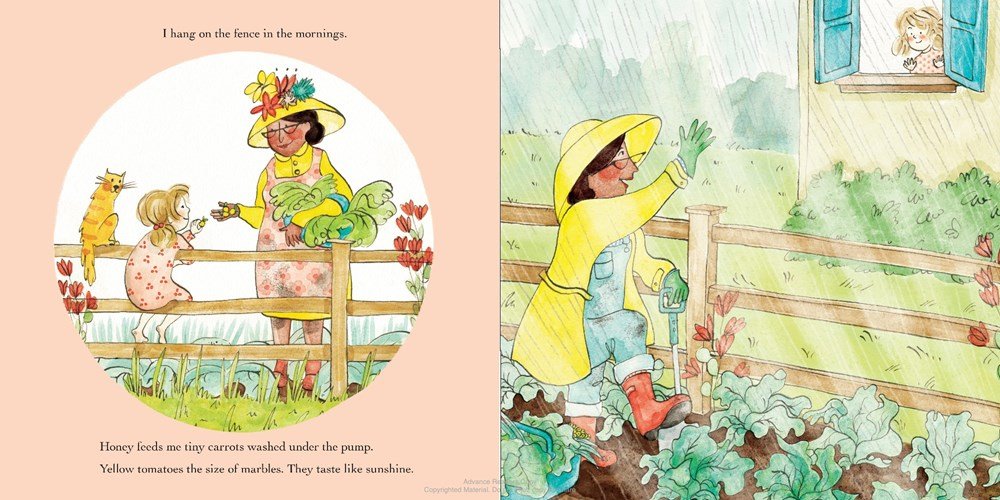
Pros:  Perfect for springtime, the rhymes are extra catchy and would be fun to read aloud.  The gardeners come in all shapes, sizes, ages, and colors, and the gardens are equally diverse.

Cons:  The whole gardening process is a bit oversimplified.

Laundry Day by Jessixa Bagley

Published by Roaring Brook Press

Summary:  Badgers Tic and Tac are bored.  They reject several ideas from their mother, until she suggests they help her hang the laundry on the clothesline.  She leaves them to the job while she heads to the market.  When the laundry basket has been emptied, the boys are still enjoying their new activity.  They move on to the winter clothes and blankets, then pillows, lampshades, and even the toaster, adding twine as they run out of clothesline.  When Ma Badger returns, the reader gets an aerial view of what she sees, lines running all through the yard with every imaginable object hanging from them.  Calmly, she informs them that they forgot a couple of things.  The final page shows Tic and Tac hanging from the seats of their pants with clothespins, complaining once again that they are bored.  32 pages; ages 3-6.

Pros:  A funny story brought to life by Bagley’s detailed, colorful illustrations.

Cons:  I knew right away that trip to the market was going to be a bad idea.