Best in Snow by April Pulley Sayre

Published by Beach Lane Books 

Summary:  “A freeze. A breeze. A cloud. It snows.”  So begins this photo essay on snow, a follow-up to last year’s Raindrops Roll by Sayre.  Each page has a large photo or two of snowflakes in action, covering trees, animals, and the ground.  The sun comes out, the snow softens, and the ice begins to melt.  But before long, the snow begins again.  The final two pages give quite a bit of additional information on snow, along with a short list of books you can read to learn more.  40 pages; ages 3-8.

Pros:  A visually stunning science book which can be enjoyed by all ages.  Not only does it provide excellent information and beautiful photographs, but the writing would be a good mentor text on using strong verbs.

Cons:  Stopping after the thaw would have provided a happier ending.


Billions of Bricks: A Counting Book about Building by Kurt Cyrus

Published by Henry Holt and Company 

Summary:  A man, woman, and boy start building on the first page with bricks…two, four six.  People and bricks multiply with dizzying speed from there until the end of the book: molding and baking the clay to make bricks, mixing mortar, and building, building, building.  Schools, malls, government buildings: all are built with millions and billions of bricks.  Finally, at the end, “The work is nearly done, the cleanup has begun, let’s count the bricks we didn’t use, all together—one!”  32 pages, ages 4-8.

Pros:  Kids will love the catchy rhymes and the intricate illustrations showing many different people building immense structures with bricks.  While not a counting book in the traditional 1-2-3 sense, teachers can use it to introduce counting by two’s, five’s, and ten’s.

Cons:  Some child labor laws were undoubtedly violated in these pages.

A Family is a Family is a Family by Sara O’Leary, illustrated by Qin Leng

Published by Groundwood Books 

A Family Is a Family Is a Family: Sara O'Leary, Leng, Qin: 9781554987948:  Amazon.com: Books

Summary:  When her teacher asks the class what makes their families special, the narrator isn’t sure how to answer.  She quietly listens to her classmates answer the question.  There are large families and small families, families with two moms and two dads, divorced parents and stepparents, families who all look alike and those who all look different.  Finally, the girl remembers a time with her family in the park.  Someone asked her foster mother to point out her real children.  Her mom answered, “Oh, I don’t have any imaginary children.  All my children are real.”  Conclusion:  A family is a family is a family.  32 pages; ages 4-8.

Pros:  Filled with family love and warm, funny illustrations, this book is perfect to share with children and invite them to think about what is special about their own families.

Cons:  It is no accident I am posting a book celebrating different kinds of love today.

The Princess and the Warrior: A Tale of Two Volcanoes by Duncan Tonatiuh

Published by Abrams Books for Young Readers 

Summary:  Izta is a princess of the people, so when she falls in love, it isn’t with one of the wealthy suitors who travel from distant lands to court her.  The warrior Popoca can’t offer her riches, but he recognizes her kind heart and promises to always be faithful to her.  The king would prefer a more titled son-in-law, but he agrees to let the two marry if Popoca can defeat Jaguar Claw, a neighboring king who has caused trouble for years.  Popoca goes off to battle.  When Jaguar Claw realizes he is near defeat, he sends a messenger to tell Izta that her fiancé has been killed.  Grief-stricken, she drinks a potion that the messenger says will ease her sorrow.  Instead, it puts her into a deep sleep from which she never awakens.  When Popoca returns, he brings her outside to try to revive her, and there they stay, together, until they have turned into the two volcanoes, Iztaccihuatl and Popocatepetl.  An author’s note gives more history of this Aztec legend.  40 pages; grades 1-4.

Pros:  A captivating retelling of a Mexican legend that explains the existence of two volcanoes visible from Mexico City.  Award-winning author-illustrator Duncan Tonatiuh brings his distinctive style to the art done in the traditional Aztec style.

Cons:  Even with the glossary and pronunciation guide at the end, pronouncing the Aztec words is a challenge.

Pablo Finds a Treasure by Andree Poulin, illustrated by Isabelle Malenfant

Published by Annick Press 

Summary:  Pablo and his sister Sofia spend their days hunting for treasure on Treasure Mountain, the local dump.  They’re joined by many other children who look for items that their parents can resell to buy a little food.  Sometimes they find old food, and eat it quickly before someone can steal it.  Their worst enemy is Filthy-Face, a man who bullies the children into handing over their treasures.  On this particular day, Pablo is having trouble finding anything; Sofia is doing better and scolds him for overlooking bits of plastic that can be recycled.  Just when he is ready to give up, Pablo finds a gold chain.  He and his sister excitedly make a list of all the things they’d like to buy with the chain until suddenly Filthy-Face looms in front of them.  He steals everything, and the two children have to run home empty-handed…until they arrive safely and Pablo reveals where he has hidden the gold chain.  32 pages; grades 1-4.

Pros:  An eye-opening look at poverty in an unnamed country.  The gray-toned illustrations match the sober subject.  This would make a good read-aloud to prompt further discussion or writing.

Cons:  It’s a pretty bleak story.

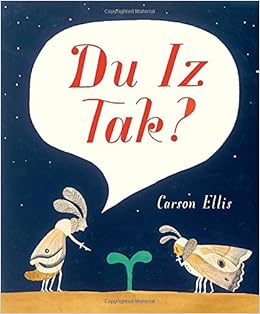
Du Iz Tak? by Carson Ellis

Published by Candlewick Press 

Summary:  The seasons come and go in a world populated by a variety of insects who, apparently, speak an insect language.  “Du iz tak?” seems to mean “What is that?”, and it’s a question one dragonfly asks another when it comes across a small green plant poking through the ground.  Other insects join the group, and as the plant grows, they create homes in its leaves.  A spider weaves a giant web on the top, which seems like a problem until the spider is carried off by a huge bird.  The plant eventually grows an enormous flower (“unk gladdenboot!”) which, over time, droops and scatters its seeds.  Through it all, a cocoon has been hanging from a nearby branch.  After the plant dies, a moth emerges and performs a nighttime dance with the seeds to a cricket’s fiddle music.  Winter passes, and in the spring all the seeds sprout, posing the question yet again, “Du iz tak?”  48 pages; ages 4-8.

Pros:  Wow!  An enormously creative, original take on the seasons.  The youngest readers will love poring over the pictures, examining the detailed changes from one page to the next.  Older kids will have fun trying to translate the language from context clues.  The Caldecott committee should put this one on its short list.

Cons:  Emerging readers may find the text confusing.

Like a Bird: The Art of the American Slave Song written by Cynthia Grady, concept and art by Michele Wood

Published by Millbrook Press

Like a Bird: The Art of the American Slave Song (Millbrook Picture Books):  Grady, Cynthia, Wood, Michele: 9781467785501: Amazon.com: Books

Summary:  Coretta Scott King Award winner Michele Wood has created beautiful paintings inspired by thirteen African American slave songs, such as “Jacob’s Ladder” and “Go Down, Moses”.  There is a one-page introduction that begins with the question, “What does a bird have to do with American slave songs?”  Each two page spread includes the song with music, a painting, and a paragraph or two of text giving some background about the song.  The bird motif in the title and introduction is carried out through the book, with a white dove appearing in every painting.  The last several pages include lyrics to all the songs, a glossary, bibliography, and a list of books and websites for additional reading.  40 pages; grades 3-6.

Pros:  This unique book would make an excellent addition to music and art libraries.  The beautiful paintings express both pain and hope, and contain interesting and symbolic details.  The words and music make the songs accessible to all readers.

Cons:  Listening to way too many “Wee Sing” cassettes in my children’s early years caused those versions to spring into my mind as soon as I saw many of these song titles.

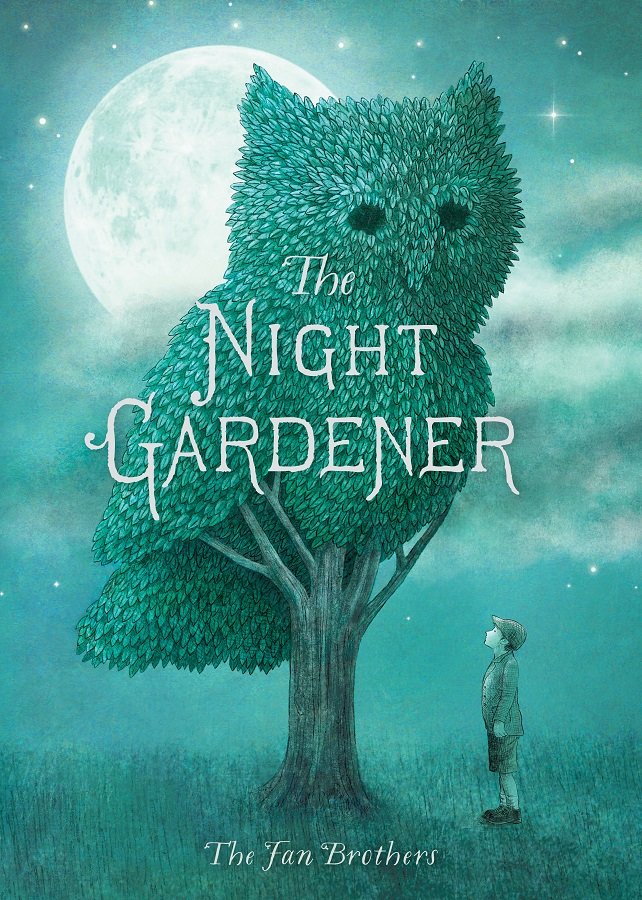
The Darkest Dark by Chris Hadfield and Kate Fillion, illustrated by the Fan Brothers

Published by Little, Brown, and Company 

Summary:  Chris loves pretending he’s an astronaut, but when the sun sets, he has a problem.  He’s scared of the dark and refuses to go to sleep in his own bed.  Finally, his father issues an ultimatum: if Chris doesn’t go to sleep, they’ll all be too tired to go next door the next day.  That does the trick.  Chris falls asleep and dreams his favorite dream, about landing on the moon.  And the next day, watching on the only TV on the island where his family spends the summer, Chris sees the first man walk on the moon.  He realizes that the darkest dark is in outer space.  And he knows that he wants to explore that darkness, and that he won’t be alone, because his dreams will be with him.  An author’s note tells how Chris grew up to be one of the first Canadians in space and the first Canadian Commander of the International Space Station.  Also included is a montage of photos of Chris Hadfield as a child and an adult, and a message from him about following your dreams.  48 pages; ages 4-8.

Pros:  A book about overcoming your fears and following your dreams, particularly inspiring because it’s about a real person.  Brothers Eric and Terry Fan beautifully capture both the dark and the brilliant summer moon.

Cons:  Kids may not snap out of their fears of the dark quite as quickly as Chris does.

Freedom Over Me: eleven slaves, their lives and dreams brought to life by Ashley Bryan

 Published by Atheneum Books for Young Readers 

Summary:  Many years ago, as he explains in his ending author’s note, Ashley Bryan received a collection of documents relating to slavery from the 1820’s through the 1860’s.  He chose one of these, an 1828 appraisal of 11 slaves from the Fairchilds estate and created stories for each of them.  He has given each of them a name, connections to each other, and a trade or talent that each has used to increase the wealth of the estate.  Of course, this increase in wealth was not enjoyed by any of them.  Each slave has a portrait and two narrative poems, one describing himself or herself, and the other telling about his or dreams.  Almost everyone ends with a longing for freedom.  Their master has died, the mistress is selling the slaves, and they have no idea where they will end up.  The original document is shown at the end, along with the author’s note.  56 pages; grades 4-7.

Pros:  The sadness of slavery is profound in these poems of dignified, talented people, many of whom remember their lives and families in Africa.  Bryant has done a masterful job of bringing them to life, both in words and pictures.

Cons:  I wanted to know where the estate was, but no details were given.

We Found a Hat by Jon Klassen

Published by Candlewick Press 

Summary:  Two turtles find a hat lying in the desert.  They each try it on.  It looks good on both of them. But there are two turtles and only one hat.  So it only makes sense that they would walk away and leave the hat behind.  Right?  But one of the turtles can’t stop thinking about that hat.  Night falls, and one turtle is falling asleep.  The other one waits until his companion is dreaming, and then….  48 pages; ages 4-8.

Pros:  The hat trilogy is now complete, with this book finishing what I Want My Hat Back and This Is Not My Hat started.  The deadpan humor, the intrigue, the ambiguous ending, and unique illustrations are all part of this one as well.

Cons:  Unlike the other two, the ending is ambiguously happy.  While this might sound like a “Pro”, kids love those surprise endings.  Did the bear really eat the rabbit?  Did the big fish eat the little fish?  This ending seemed a little too pat for this particular series.