Miss Mary Reporting: The True Story of Sportswriter Mary Garber by Sue Macy, illustrated by C. F. Payne

Published by Simon and Schuster


Summary:  Mary Garber was considered a bit of a tomboy growing up in North Carolina.  She played tackle football on the boys’ team and loved going to football games with her father.  After college, she knew she wanted to be a reporter, but her first job on the society page didn’t exactly suit her.  During World War II, most sports writers went to war, so Mary got to fill in, a job she continued for the next forty years.  Not only did she blaze trails for women sportswriters, but she was among the first to report on African American teams and players, most famously Jackie Robinson.  If a kid tried hard, Miss Mary would report his or her achievements in a positive way, resulting in adults who sometimes thanked her for her coverage many years later.  As the author notes at the end, “Mary Garber didn’t set out to change the world, but change it she did.”  End matter includes author’s note, a timeline, and additional resources.  40 pages; grades 1-4.

Pros:  A lively biography of a little-known woman who followed her passion and opened doors for others as she went.  The slightly goofy illustrations lend a light-hearted feel to the text.

Cons:  Mary looks pretty much exactly the same in the illustrations from childhood through retirement.

Bringing the Outside In by Mary McKenna Siddals, illustrated by Patrice Barton

Published by Random House Books for Young Readers 

Summary:  An ethnically diverse group of young children enjoy the outdoors in all seasons.  In spring they play in the mud, they enjoy a summer trip to the beach, in fall they play in the leaves, and winter brings cold and snow.   After each outdoor adventure, they bring a bit of the outdoors in.  At the end, they enjoy a box filled with photos of their adventures as well as a few keepsakes likes shells, leaves, and sticks.  32 pages; ages 3-6.

Pros:  The rollicking rhyming text and exuberant illustrations should be enough to pry any young couch potato away from the Xbox and into the great outdoors.

Cons:  The text seemed more like a song than a rhyme, but alas, there was no music provided, and I’m pretty sure it’s beyond my capabilities to make any up.

The Wildest Race Ever: The Story of the 1904 Olympic Marathon by Meghan McCarthy

Published by Simon and Schuster 

Summary:  How times have changed.  Back when the 1904 Olympic marathon was held, it was part of the World’s Fair in St. Louis.  41  men signed up to participate, but on race day, only 32 showed up.  The course washed out several days before the event, so a new course was mapped, much hillier than the original.  One of the participants was chased off the road by a dog; another kept stopping for snack breaks along the way; a third struggled when his trainer fed him strychnine mixed with an egg white to keep up his energy.  Despite the 90-degree heat, there were only two water stops, and some of the water was contaminated, forcing more than one man to drop out due to stomach issues.  One racer jumped into a car for several miles, then tried to pass himself off as the winner by running the last bit of the race.  In the end, Thomas Hicks, the American guy who consumed strychnine, managed to stumble across the finish line as the first legitimate winner.  End matter includes additional information about the race and a few of the racers, plus a bibliography.

Pros:  Lots of laughs reading about a race that resembled “It’s A Mad, Mad, Mad, Mad World”.  Kids will enjoy comparing and contrasting the 1904 marathon with today’s Olympics.  Meghan McCarthy’s pop-eyed cartoon illustrations add a great deal of fun to the story.

Cons:  The cast of characters was a little large to keep track of in a picture book.  I had to keep referring back to a two-page spread at the beginning that profiled the main runners.

Yaks Yak: Animal Word Pairs by Linda Sue Park, illustrated by Jennifer Black Reinhardt

Published by Clarion Books


Summary: Yaks yak, dogs dog dogs, crows crow. Each two-page spread has an animal whose name is also a verb; the illustration depicts the animal demonstrating the action and includes a definition of the verb.  The final two pages list all the words, with a history of both the animal name and the action word; at the top of the list is a definition of homographs, words that are spelled and pronounced the same but have different meanings.  40 pages; ages 4-8.

Pros:  Word lovers will have lots of fun with this book and will enjoy thinking of more homographs when they’re finished.  The illustrations are adorable with plenty of humor.

Cons:  I struggled to think of even one other animal homograph…bears bear bears?


The Typewriter by Bill Thomson

Published by Two Lions 

Summary: Two boys and a girl are riding their bicycles past a closed amusement park, when they spy something on top of a bee ride. It’s an old typewriter case.  These three members of the iPhone generation are intrigued by the old machine.  The girl puts a piece of paper in the roller and types “Beach”.  Instantly a beach appears.  The kids take turns creating a beach ball, ice cream, and, mistakenly, a giant crab.  Fortunately, they have the presence of mind to type “Big wave”, which takes care of the monster crustacean.  Finally, the girl types “The End”, and the kids find themselves back at the amusement park on the same wintry day.  They box up the typewriter and put it back where they found it, then continue on their way.  40 pages; ages 4-8.

Pros:  The author of Chalk and Fossil has created another wordless tour de force with gorgeous life-like illustrations telling a story of creativity and imagination.

Cons:  The plot seemed a bit too derivative of Chalk.

Swap! by Steve Light

Published by Candlewick Press

Summary: Two sailors have a problem: their ship is too old to sail. When one of them loses a button, the other has an idea.  Swap!  They swap the button for two teacups; two teacups for three coils of rope; two of the coils of rope for four oars.  Slowly their collection grows until they have enough items to refurbish the ship.  Then it’s anchors a-weigh, and they are back out to sea.  40 pages; ages 3-7.

Pros: Although the story is simple, the artwork is not. Similar to Light’s two previous books, Have You Seen My Dragon? And Have You Seen My Monster?, the main story is told with color, while the black-and-white activity is mostly in the background. That activity is pretty complex, though, and will have kids poring over the pages to see all that’s happening.

Cons:  Due to the detailed illustrations, this is probably better for one-on-one sharing than reading to a large group.

Bloom by Doreen Cronin, illustrated by David Small

Published by Atheneum 

Summary:  “Once upon a time, in a beautiful glass kingdom, there lived an unusual fairy named Bloom.”  Bloom uses her magic to help keep the kingdom beautiful, but she’s muddy and heavy-handed (and footed), and eventually, through mutual agreement, the kingdom and fairy part ways.  Many years later, the glass all over the kingdom is breaking, and no one can fix it.  It’s decided that a messenger should go into the forest and convince Bloom to return.  The king tries and fails, the queen tries and fails; the last hope is an ordinary girl named Genevieve.  Unlike the king and queen, Genevieve isn’t afraid to get her hands dirty, and Bloom teachers her how to use the mud to make bricks and build things.  Delighted, Genevieve returns, teaches others her new-found skills, and saves the kingdom. 40 pages; ages 4-8.

Pros:  Award-winning author-illustrator team Cronin and Small contribute to make a magical tale that extols the virtues of hard work and girl power.

Cons:  “[T]here is no such thing as an ordinary girl,” said Bloom.  Just in case you missed the message of the story the first two or three times.

Emma and Julia Love Ballet by Barbara McClintock

 Published by Scholastic Press


Summary:  Emma and Julia both love ballet.  Emma goes to her beginners’ class, while Julia takes a class with the company she’s part of.  When Emma warms up and stretches, Julia is doing the same in her class.  Both work hard at the barre, then soar through their dance moves.  At the end of the day, Emma is excited to be going to a ballet performance.  Afterwards, she gets to go backstage, where she meets some of the dancers, including Julia.  Emma gets a big hug, and some words of encouragement that Julia was also once a little girl who loved ballet.  32 pages; ages 4-8.

Pros:  Young ballerinas will love seeing the dancers of all ages on these pages.  The illustrations are simple, yet detailed enough to give a real feel for the world of ballet.  Bringing the two ballet fans together creates a satisfying and inspiring ending.

Cons: How did Emma get to go backstage? Readers might think this is a standard part of every performance.


The Almost Terrible Playdate written and illustrated by Richard Torrey

Published by Doubleday Books for Young Readers 

Summary:  A boy and a girl ask each other, “What do you want to play?”  Unfortunately, neither one has an answer the other one likes.  The boy wants to a dinosaur or a dragon or a race car driver; the girl a magical wizard or a ballet instructor or queen of the universe.  As each one makes a suggestion, the other one’s imagined interpretation of the idea is shown in a crayon cartoon bubble, purple for the girl and green for the boy.  Finally, unable to agree on anything, they go their separate ways.  Each one starts creating with blocks, but is unable to keep from looking at what the other is doing.  Finally, they break down and tell what they’re making; this inspires them to make up a game that includes both creations, and by the end of the playdate, they’re ready to make plans to get together another time.  40 pages; ages 3-7.

Pros:  A good lesson on the art of compromise.  Kids will enjoy the illustrations of what the two characters are thinking.

Cons:  The ideas for games were a little gender stereotypical.

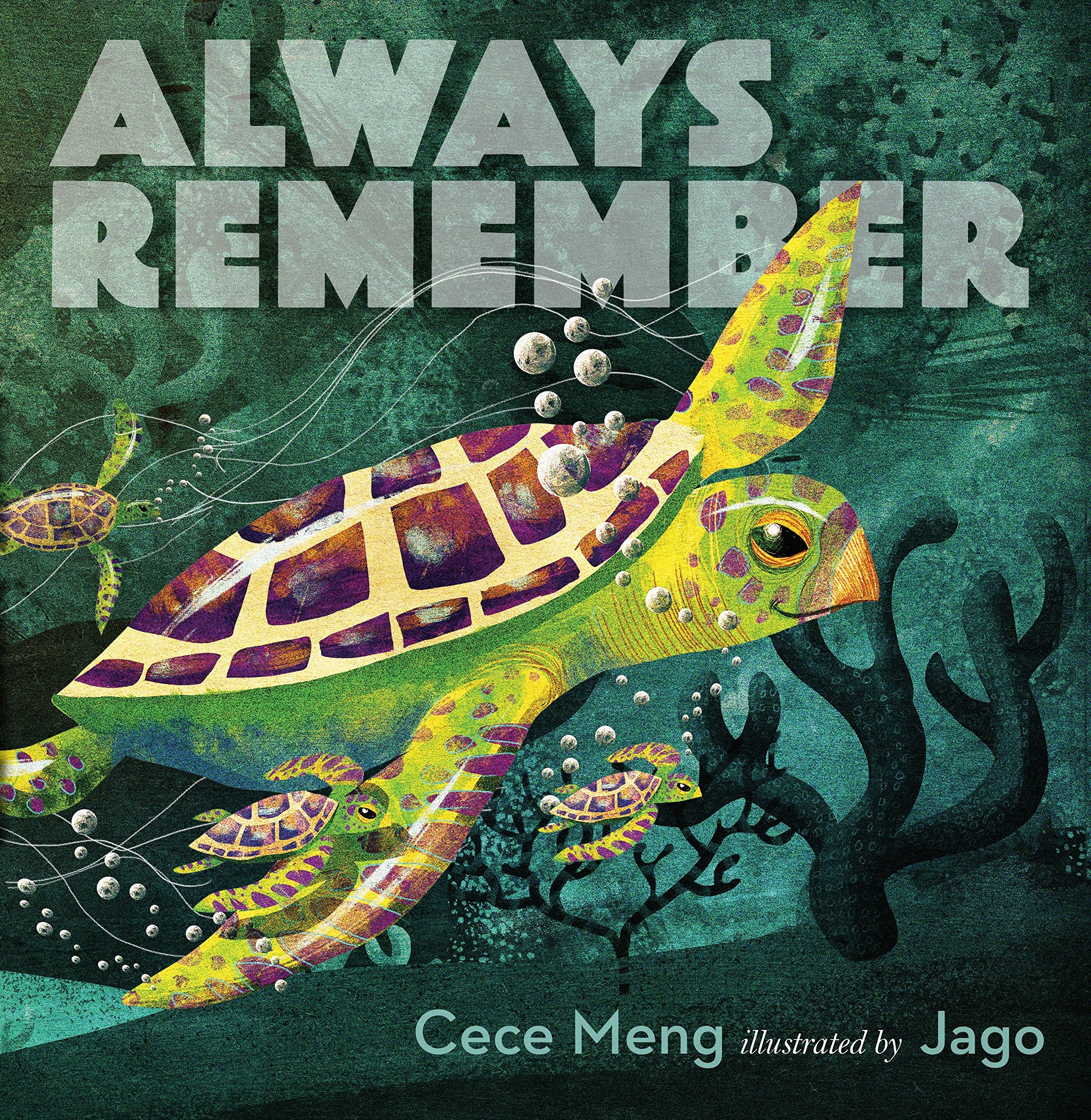
Always Remember by Cece Meng, illustrated by Jago

Published by Philomel Books

Always Remember: Meng, Cece, Jago: 9780399168093: Amazon.com: Books

Summary:  When Old Turtle takes his last breath and swims his last swim, the waves carry him away, and his friends remember him.  The young turtles remember how he taught them how to swim; the otters remember how he loved to play and have fun; the manatee remembers how he rescued him when he was tangled in a fishing net.  At the end, they conclude that Old Turtle lived a life filled with kindness, love, and helpfulness, and his legacy will live on through their own lives.  32 pages; ages 3-7.

Pros:  A beautifully illustrated simple story that celebrates a life well-lived and gives children a way to look at death as the completion of life.

Cons:  Another three-Kleenex read-aloud.