Finding Winnie: The True Story of the World’s Most Famous Bear by Lindsay Mattick, illustrated by Sophia Blackall

Published by Little, Brown and Company 

Summary:  When Cole asks him for a bedtime story, his mother tells him the tale of Harry Coleburn, a veterinarian who rescued a bear at a train station.  It was 1914, and Harry was traveling from Winnipeg to basic training before going overseas to be an army veterinarian.  The bear, named Winnie for Winnipeg, went with him on all his travels, proving himself to be a most intelligent and entertaining addition to the troops.  Finally, it was time to go to the front, and Harry knew he couldn’t take Winnie with him. Winnie moved to a new home in the London Zoo, where he was later discovered by Christopher Robin Milne, and found his way into stories written by Christopher’s father, Alan Alexander (A. A.) Milne.  The story unfolds in much the same way the Winnie-the-Pooh books do, with a parent telling a child a story.  At the end, the mom/author reveals that Harry Coleburn was her great-grandfather and is her son Coe’s namesake.  Six pages of photos of Harry, Winnie, Lindsay, and Cole are included at the end.  Grades K-3.

Pros:  Lovely illustrations illuminate Lindsay’s fascinating and endearing story to her son.  The revelation of the family connection is an interesting bonus, and the photos enhance that.

Cons:  Two excellent, well-illustrated picture books telling this exact same story (see Winnie: The True Story of the Bear Who Inspired Winnie-the-Pooh by Sally Walker) in the same year seems like a bit of an unfortunate glut on the market.

The Nutcracker Comes to America: How Three Ballet-Loving Brothers Created a Holiday Tradition by Chris Barton, illustrated by Cathy Gendron.

Published by Millbrook Press 

Summary:  Although the Nutcracker ballet seems like a timeless holiday tradition, it’s only been around since the second half of the twentieth century.  Three brothers from Utah, Willam, Harold, and Lew Christensen, were responsible for bringing the Russian ballet to the U.S.  The Christensens came from a dancing family and grew up to become dancers, vaudevillians, and, eventually, teachers and producers.  During World War II, money and dancers were both in short supply.  The brothers were working in San Francisco and needed a hit to keep ballet alive in that city. When Willam heard someone whistling Tschaikovsky on a city street, he was reminded of a production of the Nutcracker he had been involved with years before.  The brothers’ low-budget production premiered on Christmas Eve and was a huge hit.  Over the next several years, the show spread to other cities across the country, so that by the 1960’s, the Nutcracker tradition had taken hold.  Back matter includes notes from the author and illustrator about their research, a timeline, a summary of the story of the Nutrcracker, and suggestions for further reading.  Grades 2-5.

Pros:  I was surprised to learn how recently the Nutcracker came to America.  The history was interesting, and the illustrations, inspired by Edgar Degas, capture the grace and beauty of ballet.  The conversational tone of the text keeps the story moving along.

Cons:  Some of the details of the brothers’ lives seemed extraneous to the main story.  A little editing might have made this a better read-aloud for younger readers.

Time for Cranberries by Lisl H. Detlefsen, illustrated by Jed Henry

Published by Roaring Brook Press 

Summary:  This year, Sam is old enough to help his parents with the cranberries.  He enjoys driving with them to the marsh, then participating in each step of the process that gets the berries from their vines to the delivery truck.  After the harvest, the whole family enjoys cranberry pies for Thanksgiving.  Back matter includes recipes for cranberry sauce and cranberry pie, a glossary, and an author’s note that describes her family’s Wisconsin home in a cranberry marsh.  Grades K-3.

Pros:  Lively illustrations of the family and the various trucks and machines involved in harvesting match Sam’s enthusiasm as he describes the process.  Perfect for Thanksgiving story times.

Cons:  I didn’t quite follow all the steps of harvesting.

This Is My Home, This Is My School by Jonathan Bean

Published by Farrar Straus Giroux 

Summary:  A boy explains how his home is his school, too.  His three sisters are his classmates, his mom is his teacher, and his dad is the substitute who takes over at the end of the day. They have many classrooms, including all the rooms in their house, the telescope on the back deck, and the public library.  Recess and gym are spent in the backyard, hanging out in the tree house and playing soccer with friends.  Sometimes there are field trips to do art or explore nature.  There are opportunities for learning all day long, right up to the final bedtime story.  Endpapers show the real Jonathan and his three sisters during their own homeschooling days.  Ages 4-8.

Pros:  Homeschooling is presented in a positive light, with a loving family supporting each other in all their educational endeavors.  The illustrations are appropriately childlike and busy, showing the chaos of four curious, active children pursuing learning.

Cons:  It looks pretty exhausting.

The Whisper written and illustrated by Pamela Zagarenski

Published by Houghton Mifflin Harcourt Publishing 

Summary:  A little girl in a red hood gets to borrow a book her teacher promises is full of wonderful stories.  As she races home with the book, the words leak out the bottom and drift away, until a clever fox catches them in his net.  Arriving at home, the girl is disappointed that the book has only pictures, no stories.  She’s about to abandon it when she hears a whispered voice telling her to use her imagination.  Back she goes to the first illustration, trying to imagine what the story would be.  Her stories grow more creative and complex with each page, until she falls asleep.  In the morning, she rushes back to tell her teacher how much she loved the book, helping the clever fox reach some grapes along the way.  Grades K-3.

Pros:  This book reminded me of one of my favorite elementary school creative writing exercises, where the teacher would post a picture and we’d have to write a story about it.  The sumptuous illustrations could inspire endless stories.  This would also make a great introduction to wordless picture books and how to make up your own stories.  Look for the fox’s appearance on every page.

Cons:  Kids may need some help appreciating this book, which doesn’t have the conventional story arc.

We Forgot Brock! By Carter Goodrich

Published by Simon and Schuster Books for Young Readers 

Summary:  Phillip and Brock are best friends.  It’s a little annoying that Mom and Dad can’t see Brock and don’t believe that he exists, but they generally don’t let this bother them.  One night, the whole family goes to the Big Fair, where they ride on the merry-go-round, the bumper cars, and the tilt-a-whirl.  Phillip falls asleep after the Ferris wheel ride, and the family heads for home, unaware that Brock is still riding the Brain Shaker.  When Phillip wakes up at home, he realizes that Brock is still at the fair.  Meanwhile, Brock is on the Ferris wheel, trying to find Phillip and his family.  A little girl named Anne and her friend Princess Sparkle Dust see him and bring him home with them.  The next day, Phillip rides his bike around, looking for Brock, and eventually finds him with Anne.  All four become fast friends, which works out great, because at least Mom and Dad can see Anne.  Ages 3-8.

Pros:  A fun take on the imaginary friend story, told with great respect for the imaginary friends.  I love the drawings of Brock and Princess Sparkle Dust.  Look for Brock’s blushing cheeks when he rides home in the back seat with the princess.

Cons:  With two swords, Brock seems to be a bit heavily armed to be going to the fair.

Aaron and Alexander: The Most Famous Duel in American History by Don Brown

Published by Roaring Brook Press 

Summary: Aaron Burr and Alexander Hamilton were almost the same age.  Both grew up as orphans, fought in the American Revolution, and were key figures in early American government and politics.  Moving in the same social and professional circles, they were friends early in their careers, but later became bitter political enemies.  Hamilton helped defeat Burr in his presidential campaign against Thomas Jefferson, and again in his bid for governor of New York.  Finally, Burr challenged Hamilton to a duel.  It was an illegal but not uncommon practice at the time; Hamilton had been challenged eleven times before, and Burr had had had a hole shot through his coat in a previous encounter.  On the morning of July 11, 1804, they met in Weehawken, New Jersey, stood thirty feet apart, and shot at each other.  Hamilton was hit and died the next day.  Burr survived, but was forever after despised by much of America.  Includes an author’s note and bibliography.  Grades 2-5.

Pros:  The names Aaron Burr and Alexander Hamilton may be familiar to kids, but they are unlikely to know much about them aside from their famous duel.  This picture book introduces both men sympathetically and gives a good overview of their lives.

Cons: The details of their political differences are a bit skimpy.

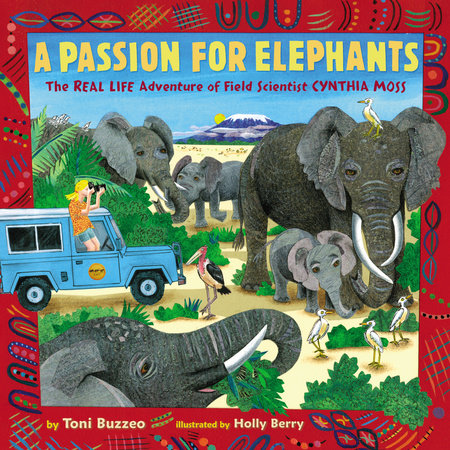
A Passion for Elephants: the real life adventure of field scientist Cynthia Moss by Toni Buzzeo, illustrated by Holly Berry

Published by Dial Books for Young Readers 

Summary:  Cynthia Moss was never afraid of BIG things.  That’s the recurring refrain in this story of scientist Cynthia Moss, who grew up riding horses in Virginia and went on to become a journalist.  An invitation from a college friend sent her to Africa, where she got a job photographing elephants for a zoologist.  This ignited a passion, and she began to recognize individual elephants and their families.  She went on to found the Amboseli Elephant Research Project and made many new discoveries about elephant behavior.  Eventually, concerned about the decline of elephant populations caused by poaching, Cynthia became an activist, working to get a global ban on the sale of ivory in 1990.  Her work continues today, both researching and protecting the elephants she loves.  Back matter includes further information about Moss, further reading, and additional sources.  Grades K-3.

Pros:  An inspiring biography of a scientist who has made a difference.  Less well-known the Jane Goodall, Cynthia Moss’s career parallels hers, in her long years studying animals in Africa and her work around the world to protect them.  The colorful illustrations would make this a great read-aloud to share with kids.

Cons:  The most recent source listed in the additional resources is from 2010.

Two White Rabbits by Jairo Buitrago, illustrated by Rafael Yockteng

Published by Groundwood Books 

Summary: A little girl and her father are making the difficult journey from Central America or Mexico to the United States. They travel first by small boat, then on the top of a freight train.  They’re delayed by soldiers, and have to run away.  Sometimes the father has to stop and work to earn more money.  The story is told by the girl, who doesn’t know where they’re going.  She passes the time counting birds, clouds, and soldiers.  She plays with a boy when her father has to work.  She wonders where they are going and how long it will take to get there.  Grades K-3.

Pros:  A fascinating and eye-opening story for children living north of the border.  The text, in the little girl’s voice, doesn’t explain many of the things going on in the illustrations, like the father grabbing his daughter and fleeing from soldiers.  There are few details given about their homeland, making the story more universal.

Cons:  It’s hard to understand what’s going on just from reading the text.  Young readers will need an adult to give the story some context.

Enormous Smallness: a story of E. E. Cummings by Matthew Burgess, illustrations by Kris Di Giacomo

Published by Enchanted Lion Books 

Summary: Starting with his somewhat enchanted childhood in Cambridge, Massachusetts (complete with happy family, summers on a New Hampshire farm, and a large tree house heated by a wood stove), this book recounts the life of Edward Estlin Cummings. Estlin was both a poet and an artist.  From an early age, he loved spending time drawing and playing with words, and he continued with both activities for his entire life.  This book emphasizes how he responded to life with his creativity, experimenting with words and poetic forms to express what he experienced as he moved from his home in Cambridge, to Harvard, to France, where he drove an ambulance during World War I, and to 4 Patchin Place in Greenwich Village, his home for much of his adult life.  End matter includes a chronology, several poems, and an author’s note.  Grades 2-5.

Pros:  This book captures the joy E. E. Cummings experienced through his creativity, both in the writing and the illustrations, in which Estlin is consistently portrayed with a smile on his face.  The poems are well-selected to appeal to young readers.

Cons:  Despite their brevity, the poems of E. E. Cummings could be a bit difficult for elementary readers.