Mama’s Nightingale: A Story of Immigration and Separation by Edwidge Danticat, illustrations by Leslie Staub

Published by Dial Books for Young Readers

Summary: Saya’s mother, an immigrant from Haiti, is in jail for not having the right papers. Saya and her father visit Mama every week, but it’s not the same as having her at home.  Saya’s father writes letters every evening, contacting politicians and reporters to try to get help.  One evening, Saya decides to write her own story.  Her father sends it to a newspaper, and a few days later, a reporter comes to interview them.  As a result of the story in the paper, Saya’s mother gets to see a judge who allows her to go home while she waits for her papers to come through.  In the author’s note, Edwidge Danticat tells the story of how she and her parents were separated by immigration until she was twelve years old.  Grades K-3.

Pros: Kids will be fascinated by Saya’s story and inspired by the way she helps her mom. The illustrations are beautiful, with bold colors and symbols from Mama’s stories woven into the pictures of the family.

Cons:  Expect a lot of questions about what is going on with this family from readers unfamiliar with immigration laws.

I Am Yoga by Susan Verde, art by Peter H. Reynolds

Published by Abrams Books for Young Readers 

Summary: A girl explains what she does when the world is spinning too fast and she wonders how to fit in. She quiets her body and mind, slows her breathing, and practices yoga poses.  Tree pose allows her to touch the sky, star pose allows her to shine.  When she’s done, she is rested and calm, the world seems just the right speed, and she fits into it just fine.  The sixteen poses shown in the book are named and described on three pages at the end.  Ages 4-8.

Pros:  A fun introduction to yoga poses for young children.

Cons:  I still struggle with downward dog.

Archie the Daredevil Penguin by Andy Rash

Published by Viking

Summary:  On the one hand, Archie’s afraid of swimming with the other penguins because of all the strange creatures lurking in the briny deep.  On the other hand, he’s got more courage than anyone else in his attempts to avoid swimming by flying (shooting himself from a giant slingshot, leaping off an ice-brick wall with a pair of wings strapped on, etc.).  The other penguins applaud his bravery, but what they really want is for Archie to join them on Iceberg Nine for a fish fry.  The only way to get there, as far as they’re concerned, is to swim.  Finally, Archie tries firing himself over to the iceberg on a rocket, which melts the ice and strands him in the ocean.  He’s in for a few surprises out there in the briny deep, but the bottom line is, he discovers he loves swimming.  Ages 3-7.

Pros:  This would be a fun read-aloud, with its cartoon-bubble dialog and entertaining penguin characters.  There’s a good lesson about overcoming fears and trying new things.

Cons:  Archie’s rocket fuel is probably not helping the polar ice cap situation.

Swan: the life and dance of Anna Pavlova by Laurel Snyder, illustrated by Julie Morstad

Published by Chronicle Books 

Summary:  When Anna Pavlova was a small girl growing up in Petrograd, her mother took her to see a ballet.  From then on, she could think of nothing but dancing.  After two years of dreaming, she was finally admitted to the Russian Imperial Ballet School.  While she had natural grace and beauty, her body was very different from the sturdy, acrobatic dancers of the time.  Nevertheless, she worked hard and became a famous ballerina, best known for her role as the lead in The Dying Swan.  Always remembering her own impoverished childhood, Anna traveled the world, bringing dance to people who wouldn’t otherwise have the chance to experience it.  Sadly, at the age of 50, she was in a train accident, caught pneumonia from being outside in the cold, and died.  Grades 1-5.

Pros:  Dance fans will love this beautifully illustrated book with spare, poetic text telling the inspiring story of Anna Pavlova’s life.

Cons:  The text is spare enough that readers might be a bit confused by some aspects of the story.  Be sure to read the author’s note at the end for some clarity.

How the Sun Got to Coco’s House by Bob Graham.

Published by Candlewick Press 

Summary: The sun is the star of this book as it travels around the world while Coco is asleep. It travels through frozen forests, across the desert, and over the mountains.  The sun is playful, joining with the wind to blow off a fisherman’s cap.  It’s patient, as it waits outside a window to be let in.  Finally, it barges through Coco’s window.  After rushing around the world, the sun has time to spend the day playing with Coco out in the snow.  Ages 4-6.

Pros:  This is a great introduction to the concept of time zones, with the sun rising in different places on earth at different times.  The watercolor illustrations beautifully capture sunrise in a wide variety of environments.

Cons:  It seems to be cold and snowy in every place on earth.

Hiawatha and the Peacemaker by Robbie Robertson, illustrated by David Shannon

Published by Abrams Books for Young Readers 

Hiawatha and the Peacemaker: Robertson, Robbie, Shannon, David:  9781419712203: Amazon.com: Books

Summary:  Rock and Roll Hall-of-Famer Robbie Robertson teams up with Caldecott honor winner David Shannon to tell the story of how the Six Nations Iroquois Confederacy was formed.  On page one, Hiawatha’s entire family has been killed, and his village burned to the ground.  In the midst of his despair, the Peacemaker approaches him, paddling a mysterious stone canoe, and invites Hiawatha to join him on a mission of peace.  The Peacemaker brings a message of forgiveness and peace to the Iroquois nations, but his voice is soft and he speaks with a stutter.  He needs Hiawatha’s powerful speaking abilities to convince the nations to stop their fighting.  Finally, everyone has joined together except the Mohawk, led by the evil Chief Tadodaho.  Tadodaho is the one responsible for the destruction of Hiawatha’s village.  Hiawatha must look deep within himself to find the forgiveness that is the only way to bring peace to the entire Iroquois nation.  Includes an historical note that tells the history behind this story and an author’s note that adds the personal tale of how Robertson came to write this book.  Grades 3-8.

Pros:  David Shannon’s beautiful paintings illustrate this fascinating blend of history, folklore, and mythology.  Take some time to appreciate the details of the story which has timely messages about peace and forgiveness.

Cons:  I found the story confusing until I read the historical note.  Some sources recommend this book for ages 4-8, but I don’t think audiences much younger than ten would fully appreciate it.

My Leaf Book by Monica Wellington

Published by Dial Books for Young Readers 

Summary: It’s autumn, and the narrator fills up her leaf book with specimens she finds around her. She sees leaves that look like fans, stars, and hearts. Some are red, some orange, yellow, or violet. Pages alternate between bright trees with simple shapes on them and close-ups of more accurate renditions of the different types of leaves; these pages have a fact or two about trees and leaves. The last page gives directions for leaf prints and leaf rubbings. Ages 3-7.

Pros: A good introduction to different types of leaves. Young kids will be inspired to get outside and see if they can find leaves that match the ones in the illustrations.

Cons: Yet another tiny font, this time for the facts about leaves. And, editors, yellow print on an orange background?  No.

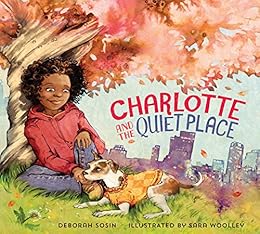
Charlotte and the Quiet Place by Deborah Sosin, illustrated by Sara Woolley

Published by Plum Blossom Books

Charlotte and the Quiet Place - Kindle edition by Sosin, Deborah, Woolley,  Sara. Children Kindle eBooks @ Amazon.com.

Summary: Charlotte lives in a noisy world. Her house is noisy, her street is noisy, even the library is noisy. Charlotte wishes she could find a quiet place. One day, she takes her dog for a walk in the park. He sees a squirrel and breaks free to chase it. Charlotte runs after him, and they end up in a quiet grove. When Charlotte sits down to catch her breath, she notices her breathing going in and out. Her thoughts slow down, and she finds herself, finally, in a quiet place. After that, whenever the world around her starts getting too noisy, Charlotte knows how to breathe deeply, slow her thoughts, and get back to the quiet place she found in the grove. Ages 3-8.

Pros: An excellent introduction to mindfulness and meditation for young kids.

Cons: An author’s note about the importance of mindfulness for children and some helpful tips for achieving it would have been useful.

.

Out of the Woods: a true story of an unforgettable event by Rebecca Bond

Published by Farrar Straus Giroux Books for Young Readers 

Summary: Antonio lives in the hotel his mother runs in 1914 Canada. He loves helping the different workers there and exploring the rooms on the second and third floors. One day, when Antonio is almost five, a man on the third floor spots smoke in the woods. Before long, the hotel is surrounded by fire, and all the inhabitants have to wade into the lake. As the fire closes in, wolves, moose, porcupine, bears, and other forest inhabitants join the humans in the lake. People and animals stand together until the fire passes by. The animals return to the forest, and the people go back to the hotel, which miraculously survived the blaze. An author’s note shows a picture of the real Antonio, the author’s grandfather, and tells how the story of the forest fire was passed down in her family. Grades 1-4.

Pros: A good mentor text for memoir writing. Kids will be fascinated by the forest fire and the gathering of all the animals. The beautiful illustrations look like old-time photographs.

Cons: The old-fashioned cover is not particularly eye-catching. Kids might have to be led to this book.

Fur, Fins, and Feathers: Abraham Dee Bartlett and the Invention of the Modern Zoo by Cassandre Maxwell

Published by Eerdmans Books for Young Readers 

Summary: When Abraham Dee Bartlett was growing up in the early 1800’s, there were no zoos. The closest thing was menageries where animals were kept in small cages for people to come and see. Abraham loved animals and read all that he could about them as a boy and a young man. His vast knowledge of wild animals eventually caught the attention of the London Zoological Society, and he was appointed superintendent of the new London Zoo. During his 38-year tenure there, he revolutionized the care of wild animals. He built larger enclosures for animals, learned how to feed them a healthy diet, and made labels so visitors could learn more about what they were seeing. By empathizing with the wild animals in his charge, he learned to keep them healthy and happy, and developed animal care methods that are used by zoos and veterinarians today. A timeline, author’s note, and brief bibliography are included. Grades 1-4.

Pros: Not only is this an interesting and inspiring story of a little-known man, but the cut paper collage illustrations are gorgeous. Readers will want to take their time with this book, enjoying both the text and the richly detailed pictures.

Cons: The final Doctor Dolittle-like illustration of Abraham surrounded by smiling animals is probably not entirely realistic.