We Are Here by Tami Charles, illustrated by Bryan Collier

Published by Orchard Books
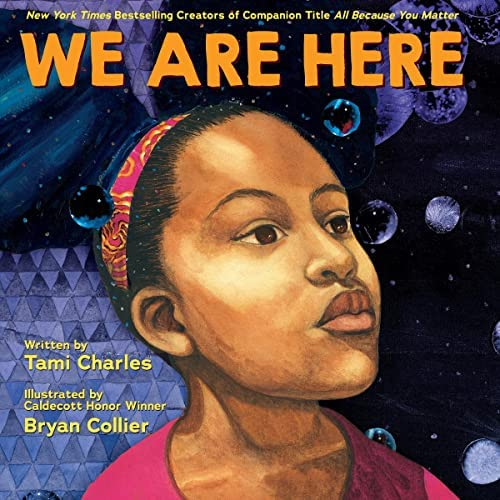
Summary:  The team behind All Because You Matter has created a new book celebrating Black contributions around the world to music, food, fashion, and science.  Written for a daughter that she never met (as explained in the author’s note), the free verse poem and illustrations feature a girl as she learns about the ways Black people have shaped the world throughout human history.  There are references to the pandemic and Black Lives Matter protests in both the text and the illustrations, which concludes, “You are brilliant, extraordinary, far-beyond-ordinary, the very best of who we are.” Includes additional information about some of the people and concepts referenced in the text, as well as notes from the author and illustrator.  40 pages; grades 1-5.

Pros:  An empowering picture book filled with beautiful words and pictures that may inspire readers to delve deeper into the history of Black people all over the world.  

Cons:  The writing is pretty abstract, so, while this is recommended as a picture book for preschool and primary grades, I think older kids would get more from it.

An American Story by Kwame Alexander, illustrated by Dare Coulter

Published by Little, Brown Books for Young Readers

Summary:  “How do you tell a story that starts in Africa and ends in horror?”  Kwame Alexander was moved to write this poem after he realized his daughter’s fourth-grade teacher wasn’t teaching students about slavery, because she was anxious and hadn’t been trained in how to teach that piece of the American story.  With distinctive illustrations that combine sculptures and paintings, the book portrays life in Africa, people being captured, the Middle Passage, and the horrors of slavery once they arrived in America.  The narrative is interspersed with pictures of a class learning from a teacher who is somewhat hesitant to teach the story, but who is encouraged by her students to tell them the truth.  How do you tell the story? “You do it/by being brave enough/to lift your voice,/by holding/history/in one hand/and clenching/hope/in the other.”  56 pages; grades 3-7.

Pros:  I have been sharing Kwame Alexander’s The Undefeated with fourth and fifth graders this week, and I think this book is even more powerful.  I know I can feel uncomfortable talking to elementary students about racism and slavery, but they are ready to hear about it, and this is an important book for making sure that happens.  The illustrations are equally powerful and mark my first Caldecott prediction for 2024.

Cons:  I saw recommendations in several places for ages 4-8, but I think it’s more appropriate for older elementary kids.


Chloe’s Lunar New Year by Lily LaMotte, illustrated by Michelle Lee

Published by HarperCollins

Summary:  Chloe is excited to celebrate Lunar New Year, as she and her parents and younger brother Noah work all day getting ready for the evening’s reunion dinner with extended family.  There are all kinds of food to prepare, as well as a thorough cleaning of the house, sweeping out the old to make room for good luck in the new year.  Chloe mentions her grandmother, A-má, several times throughout the day, but when evening falls, only her aunt and uncle come for dinner.  Everyone enjoys all the foods they’ve prepared, and the final pages show the family lighting incense and putting food in front of a photograph of A-má, honoring their ancestor.  Includes an author’s note about Lunar New Year, with specific information about how it is celebrated in Taiwan, and a recipe for Fortune Cake.  40 pages; ages 4-8.

Pros:  Another good resource for Lunar New Year, with a simple story and cheerful illustrations showing a family preparing for and celebrating the holiday.  The bit about A-má is left open for interpretation but provides a good way to show the custom of honoring ancestors.

Cons:  Like A Sweet New Year for Ren, this was a little light on the plot.

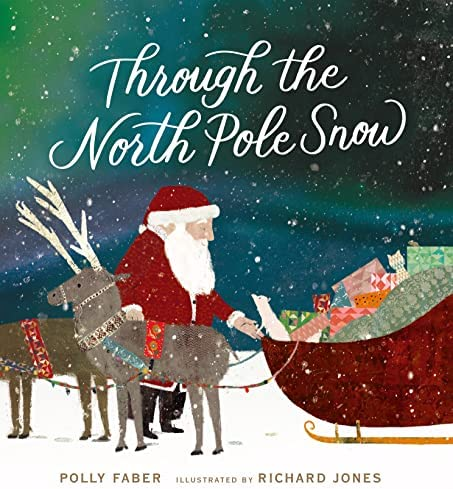
Through the North Pole Snow by Polly Faber, illustrated by Richard Jones

Published by Candlewick

Summary:  A little fox out hunting accidentally falls through the roof of a house buried in the snow.  He’s rescued by a pair of red-clad arms belonging to an old, tired-looking man with a white beard.  After getting comfortable, the fox settles in at the end of the man’s bed, and the two enjoy a long winter’s nap.  With the arrival of warmer weather, they wake up, and the man gets to work building all kinds of things to fill his empty shelves.  As the days start to grow short again, snow arrives along with a blizzard of letters.  The man reads each one, using them as a guide to fill his bag.  On Christmas Eve, he hitches up his reindeer, and the fox accompanies Santa Claus as he rides his sleigh into the night sky.  32 pages; ages 4-8.

Pros:  This became my go-to holiday book to read to my PreK-1 students.  They enjoyed gathering clues with the fox to learn Santa’s identity and job.  The pictures at the end will certainly get everyone in the Christmas spirit.

Cons:  The fox seemed a bit slow to catch on. The clues are all there, but he doesn’t completely catch on until he’s taking off in the sleigh with Santa and the reindeer.

The Christmas Book Flood by Emily Kilgore, illustrated by Kitty Moss

Published by Farrar, Straus and Giroux

Summary:  A girl searches for a gift book for Jólabókaflóɗ, or the Christmas Book Flood.  As the nights grow longer, people all over Iceland shop in bookstores and by searching the Book Bulletin to find books that they will give as gifts on Christmas Eve.  Time is running out, but the girl finally finds the perfect book.  On Christmas Eve, she and her family exchange books, then everyone settles down with blankets, pillows, and hot chocolate to read through the long December night.  Includes an author’s note with additional information about the Christmas Book Flood.  40 pages; ages 4-8.

Pros:  The very definition of hygge, this cozy book with its colorful illustrations is the perfect Christmas Eve read, for yourself or to give as a gift.

Cons:  Preschoolers may not find book shopping to be the most exciting holiday activity to read about.

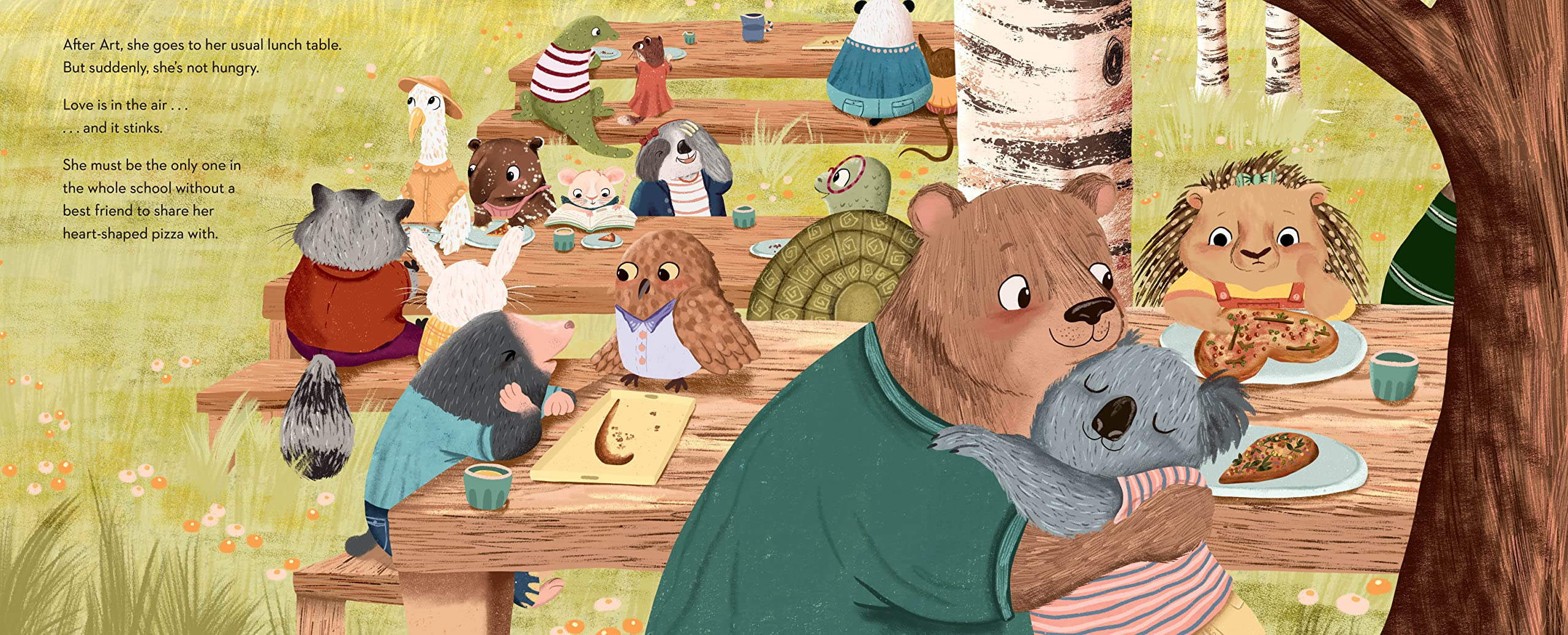
The Mystery of the Love List by Sarah Glenn Marsh, illustrated by Ishaa Lobo

Published by Viking Books for Young Readers

Summary:  As the only porcupine in her class, Pippa sometimes feels like she stands out.  It’s a lonely feeling.  When her teacher makes a Valentine’s assignment to compile a list of “things that take up room in your heart”, Pippa would rather read her latest Sherlock Gnomes book.  But when she finds a heart with a list that’s similar to her own, she puts her detective skills to work trying to figure out who her potential friend might be.  It’s a tough case to crack, but when Pippa finally figures it out, she comes up with the perfect way to connect: writing a new story called “Sherlock Gnomes and the Mystery of the New Best Friend,” which she leaves for her friend to find in her desk.  The last page shows Pippa and new friend Mitzie the Mouse meeting up in the forest.  32 pages; ages 4-8.

Pros:  A cute story for Valentine’s Day that celebrates friendship and introduces some elements of mystery books.  Kids will have fun spotting Pippa’s new friend in the pictures before she figures out who it is.

Cons:  It doesn’t feel like the right week to be thinking about Valentine’s Day.

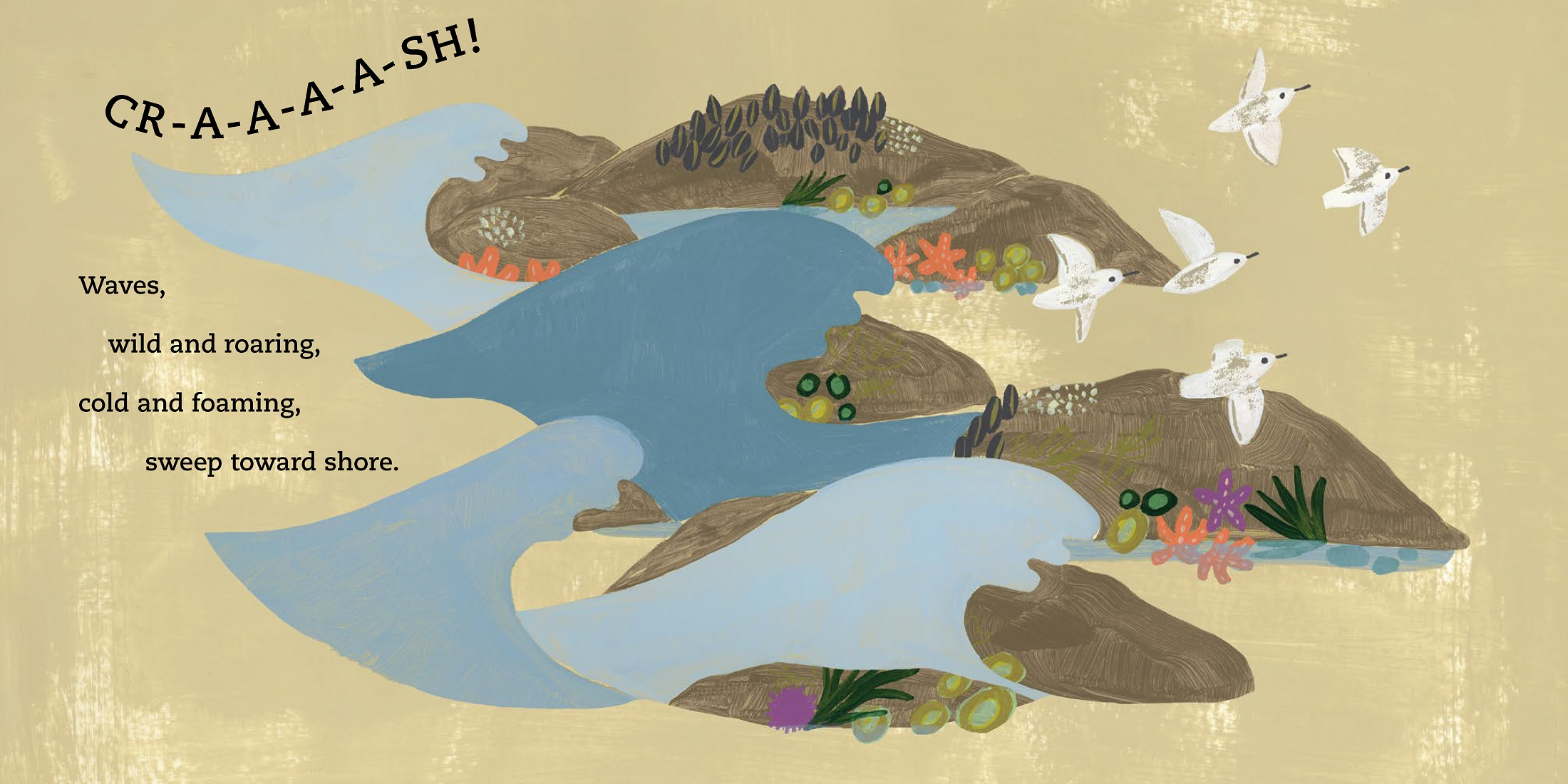
The Tide Pool Waits by Candace Fleming, illustrated by Amy Hevron

Published by Neal Porter Books

Summary:  The cycle of a tide pool is explored, starting with a wave crashing onto the shore, the water pooling in some rocks.  As the sun warms the water, all kinds of creatures gather in the pool–barnacles, mussels, an octopus–and they all wait.  Finally, the wait is over, as another wave crashes, connecting the tide pool to the rest of the ocean.  The animals swim around and eat, and slowly, the cycle begins all over again.  Includes thumbnail illustrations of the various animals mentioned with additional information, websites, and a diagram of the different parts of the tide zone.  40 pages; ages 4-8.

Pros:  I loved the illustrations in this introduction to tide pools, which is a great resource for preschool and primary grade science lessons.  The colors are beautiful, and kids will enjoy learning about the different critters.

Cons:  If you’re seeking an action-packed thriller, you may have to look elsewhere.

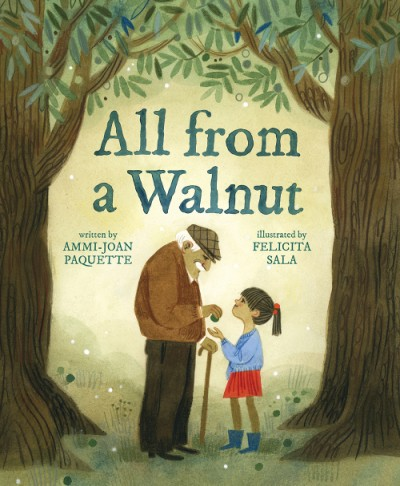
All from a Walnut by Ammi-Joan Paquette, illustrated by Felicita Sala

Published by Harry N. Abrams

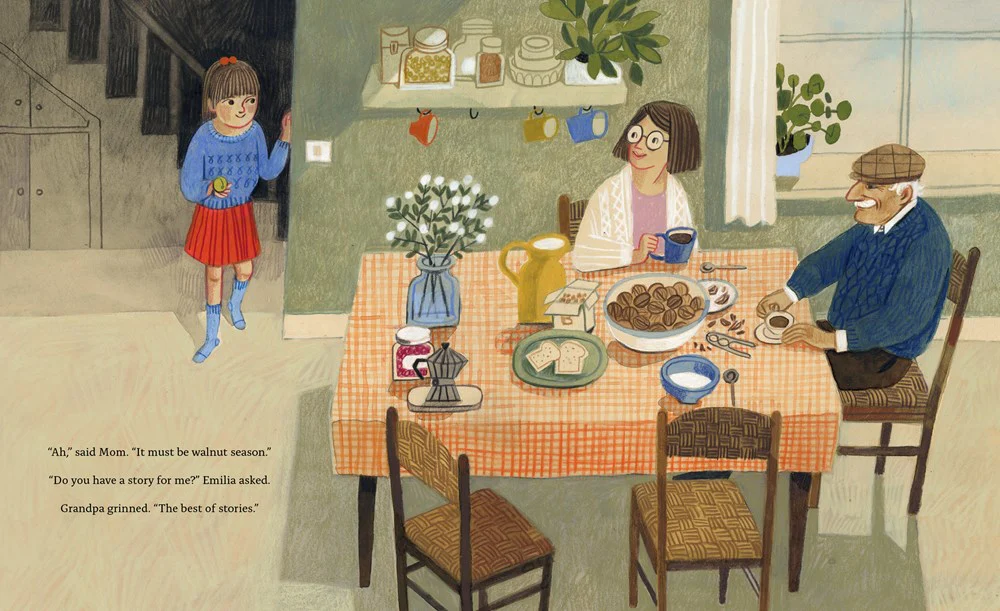
Summary:  When Emilia wakes up to find a walnut on her nightstand, she asks Grandpa if he has a story for her.  He tells her how he immigrated to the United States as a boy, bringing with him a nut from a walnut tree.  When he got to America, he planted it, moving the pot it was in when his family moved, and eventually planting in the yard of the house he and his wife bought.  Now there are two trees, a smaller one planted by Emilia’s mother as a girl.  Grandpa helps Emilia plant the walnut she found.  It flourishes under her care, but at the same time Grandpa grows weaker, until finally, Emilia has to say good-bye to him.  When she notices her sapling looking “as droopy as she felt,” she decides to transplant it next to the other two trees in the yard.  She knows that one day, she will give a walnut to her own child to begin a new tree.  40 pages; grades K-4.

Pros:  A beautiful story that explores grief and loss but also looks at how life continues with each new generation.

Cons:  The new tree looked like it was planted too close to the bigger trees.

The Bird Book by Steve Jenkins and Robin Page

Published by Clarion Books

Summary:  The husband-and-wife team of Jenkins and Page have created a picture book jam-packed with information about birds.  From their anatomy and physiology to their evolution from dinosaurs to record-holders in the avian world, readers will learn fascinating facts about birds, accompanied by Steve Jenkins’s trademark cut-paper illustrations.  Includes a four-page table listing every bird mentioned in the book, with its size, diet, range, and the page where it can be found; also, a list of books and websites with more information.  48 pages; grades 1-5.

Pros:  Another beautiful offering by Robin Page and the late Steve Jenkins, with a ton of information offered in an appealing format with stunning illustrations.

Cons:  Another childhood bubble was burst when I learned that the oldest bird on record is a pink cockatoo that lived to the age of 83, not Dr. Dolittle’s 199-year-old parrot Polynesia.

Mae Makes A Way: The True Story of Mae Reeves, Hat & History Maker by Olugbemisola Rhuday-Perkovich, illustrated by Andrea Pippins

Published by Crown Books for Young Readers

Summary:  Published in collaboration with the Smithsonian National Museum of African American History and Culture, this book traces the story of Mae Reeves, a Black woman who left Georgia in the 1930’s to become a milliner.  She eventually opened her own shop in Philadelphia, creating hats for celebrities like Marian Anderson, Lena Horne, and Ella Fitzgerald.  She kept her business going while raising three children and being active in her community, helping other Black businesses.  Mae lived to be 104, long enough to see artifacts from her shop included in the Smithsonian’s National Museum of African American History and Culture.  Includes interviews with Mae’s daughter Donna and with Dr. Reneé Anderson, Head of Collections at NMAAHC, as well as information about the museum and a list of sources.  48 pages; grades 2-5.

Pros:  A fascinating biography of a woman who never became famous but who lived a full life, following her own dreams and helping others.  Readers will be inspired to head to Washington, D.C. to see Mae’s hats in the museum.

Cons:  It’s a long picture book for reading aloud.