Keeping the City Going by Brian Floca

Published by Atheneum

Keeping the City Going - Kindle edition by Floca, Brian, Floca, Brian.  Children Kindle eBooks @ Amazon.com.
Keeping the City Going: Floca, Brian, Floca, Brian: 9781534493773:  Amazon.com: Books

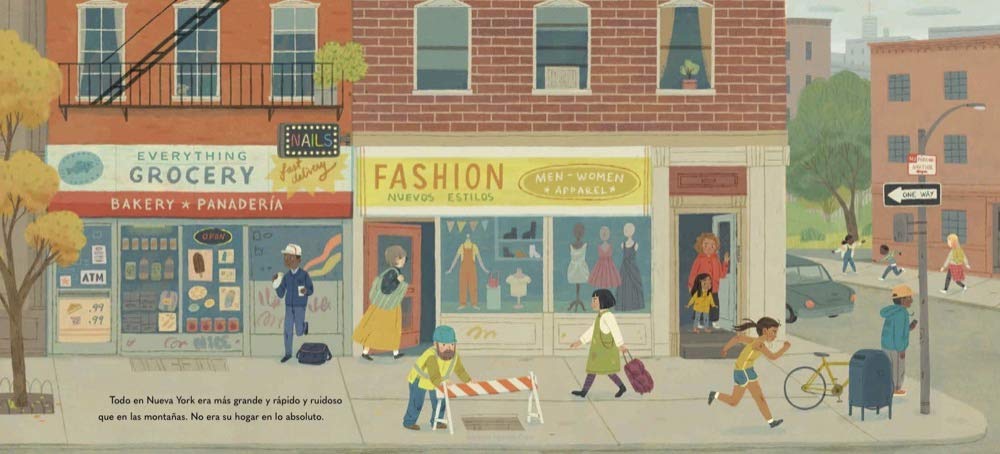
Summary:  When everyone had to stay home, wondering what would happen next, they looked out their windows at the empty city.  It wasn’t quite empty, though; there were still some people out in the streets keeping the city going.  Delivery people, trash collectors, construction workers, medical personnel, transit workers: they all continued to show up for work even when the rest of us stayed home.  The story ends with neighbors who gathered at their windows, balconies, and roofs to cheer, play instruments, and bang on pots and pans, acknowledging that they are still part of the city and saying thank you to those who are keeping it going. Includes an author’s note.  40 pages; ages 4-8.

Pros:  Another picture book inspired by the Covid pandemic, this one celebrates the essential workers who didn’t get to stay home when everyone else did.  The bouncy almost-rhyming text makes a nice complement to award-winning Illustrator Brian Floca’s lifelike drawings of vehicles and the people who operate them.

Cons:  Although I think it’s important to have books that commemorate the past year, I do wonder how they’re going to stand the test of time.

Fred Gets Dressed by Peter Brown

Published by Little, Brown Books for Young Readers

Fred Gets Dressed: Brown, Peter: 9780316200646: Amazon.com: Books
Blog Tour ~ Fred Gets Dressed by Peter Brown ~ Excerpt + Giveaway –  Twirling Book Princess

Summary:  Fred enjoys running around the house without any clothes on, but when he gets to his parents’ room, he decides to explore.  He considers both dad’s and mom’s clothes, then decides that mom’s are more to his liking.  He puts some on, then decides to check out her jewelry and makeup.  He’s just had a little lipstick mishap when in walk Mom and Dad.  A wordless page shows them all looking at each other; the next wordless page has them all smiling.  Then the three of them (and the dog) get to work decorating themselves, and pose at the end for what looks like a photo with the caption “Now Fred is dressed.”  The final page shows him running away, his dress revealing his backside and the one garment he has failed to put on.  48 pages; ages 3-8.

Pros:  A fun celebration of individuality which makes its point about gender clothing choices without hitting the reader over the head with it.  As soon as I saw the first page I thought of Peter Brown’s Mr. Tiger Goes Wild, and indeed, there were some parallels, with clothing representing the tension between doing what society expects and following your heart.

Cons:  Those writing the one-star reviews on Amazon might want to go go back and reread Mr. Tiger Goes Wild.

Out of the Blue: How Animals Evolved from Prehistoric Seas by Elizabeth Shreeve, illustrated by Frann Preston-Gannon

Published by Candlewick

Out of the Blue: How Animals Evolved from Prehistoric Seas: Shreeve,  Elizabeth, Preston-Gannon, Frann: 9781536214109: Amazon.com: Books

Summary:  Which two are the most closely related: hippo, dolphin, shark?  That question is asked before the title page; the text goes back to the beginning of life on earth to find an answer.  Each two-page spread shows animals for a geologic period, with several sentences of text telling what happened during this time.  The final three (Paleozoic Era, Mesozoic Era, and Cenozoic Era) are covered on two pages and take us up to the present, where we learn how the hippo and dolphin are related.  “Always changing.  Always evolving.  From out of the blue…and back again.”  Includes a list of sources.  32 pages; grades 1-5.  

Pros:  An excellent introduction to geological history and evolution.  Kids will enjoy poring over the illustrations of so many interesting creatures from so many different time periods.  A first-rate science book.

Cons:  It’s pretty challenging to cover the history of life on Earth in just 32 pages, and I can’t help thinking a little more back matter could have added more substance.

I Do Not Like Yolanda! by Zoey Abbott

Published by Tundra Books

I Do Not Like Yolanda: Abbott, Zoey: 9780735266513: Amazon.com: Books
I Do Not Like Yolanda – A Picture Book About Facing Your Fears – Mutually  Inclusive

Summary:  The narrator enjoys writing letters, loves stamps, but does not like Yolanda.  She writes to her pen pal in Sri Lanka, her grandma in Washington, DC, and her friend who moved to Uganda.  She does not, however, write to Yolanda.  Turns out Yolanda is a post office worker, and the girl has had some bad experiences with her.  Once, she spent an hour drawing a picture on her envelope, only to have Yolanda slap a postage label across it.  Another time, she dropped some change that Yolanda was giving her and didn’t have enough money to buy her stamps.  One day, she gathers up all her lucky charms and goes to the post office, hoping to get anyone but Yolanda to wait on her.  But wouldn’t you know it, Yolanda is the only one working.  So she tries something new: she asks Yolanda how her weekend was.  And Yolanda tells her.  She made the meal from Babette’s Feast, and it was delicious.  The girl realizes she has all kinds of questions about the meal as she walks away, and resolves to get in Yolanda’s line next time so she can ask them. 44 pages; grades K-3.

Pros:  Another picture book celebrating letter-writing and the postal system.  This one has an important message about confronting your fears, especially those around other people, and how sometimes we mask those fears by deciding not to like someone.  Definitely a fun conversation starter.

Cons:  It seemed unlikely that this girl would be captivated by a meal that included turtle soup, caviar, and rum sponge cake. 

Cars, Signs, and Porcupines! By Ethan Long

Published by Henry Holt and Co.

Amazon.com: Cars, Signs, and Porcupines!: Happy County Book 3 (Happy  County, 3) (9781250765987): Long, Ethan, Long, Ethan: Books
Cars, Signs, and Porcupines! | Ethan Long | Macmillan

Summary:  It’s a beautiful, bustling morning in Happy County, and the animals are ready for a busy new day.  Community helpers are around to take care of the county, a job that includes chasing down a herd of playful porcupines.  There are street signs around to help everyone find their way, with explanations of what the different signs mean.  Cars, trains, and airplanes move the animals around the county, and allow readers to explore roads, airports, and waterways.  As the sun sets at the end of the day, the porcupines are back at Pauly and Polly’s Porcupine Playland, and the Happy County residents are ready for a relaxing evening.  48 pages; ages 3-6.

Pros:  Fans of Richard Scarry’s Busytown will enjoy this series (this is book 3) which, like Scarry’s books, is a visual feast of quirky characters engaged in interesting activities.  There’s also an educational element in each book; in this case, it’s teaching about signs and directions.  Fun for the whole family.

Cons:  The characters are introduced on the front endpapers, which of course means I couldn’t see them all in my library book.  By now, I’m sure you know how I feel about that.

What the Kite Saw by Anne Laurel Carter, illustrated by Akin Duzakin

Published by Groundwood Books

What the Kite Saw - Kindle edition by Carter, Anne Laurel, Duzakin, Akin.  Children Kindle eBooks @ Amazon.com.
What the Kite Saw: Carter, Anne Laurel, Duzakin, Akin: 9781773062433: Amazon.com:  Books

Summary:  When the narrator’s town is occupied, his brother and father are taken away, and a curfew is imposed each night.  He witnesses tanks rolling down his street and soldiers shooting at someone who breaks curfew.  He and his friends can gather in the park for an hour each day.  One day, he gets an idea that he shares with his friends.  Back home, he makes a star-shaped kite, and that night, he flies it from his rooftop.  Soon other kites are flying in the sky.  But not for long: soldiers fire on the kites and shoot them down.  That night the boy tells his mother and sister a story about what the kite saw as it flew high above their city.  Includes a two-sentence author’s note stating that the story was inspired by Palestinian children but could take place any place that children love to fly kites and are threatened by war.  32 pages; grades 2-5.

Pros:  A timely story of hope during a grim time.  The drab illustrations through most of the story contrast with the colorful ones when the boy and his friends gather in the park and fly their kites.  This could lead to some thoughtful discussions with upper elementary and middle school kids.

Cons:  Most recommendations I saw started at ages 4 and 5.  I’d be hesitant to put it in the picture book collection for preschool and primary ages.

Bubbles…Up! By Jacqueline Davies, illustrated by Sonia Sánchez

Published by Katherine Tegen Books

Bubbles . . . Up!: Davies, Jacqueline, Sánchez, Sonia: 9780062836618:  Amazon.com: Books

Summary:  A girl shares her day at the pool with poetic second-person narration: “Your friends circle up/Dunk and splash/Bump and crash/Laugh and laugh/Duck–and up!”  Her mom and younger brother are peripheral characters as she imagines a magical undersea world.  A brief thunderstorm clears the pool, but after it passes, the girl is off again.  There’s no end to the fun in sight, as the last page shows everyone floating on a giant inflatable ring.  32 pages; ages 3-8.

Pros:  An energetic summer slice-of-life, with both the text and illustrations celebrating the fun of a day at the pool.

Cons:  My fingers and toes feel pruney.

Something’s Wrong! A Bear, a Hare, and Some Underwear by Jory John, illustrated by Erin Kraan

Published by Farrar, Straus & Giroux

Something's Wrong! | Jory John | Macmillan

Summary:  Ever have one of those dreams where you suddenly realize you’re only wearing your underwear (or worse)?  Jeff the bear’s about to leave his house, and he can’t figure out what’s wrong.  He ate breakfast, he watered  his plant, he took a bath, he tried on his gift from his grandma…. Readers will notice right away what the gift was, but off Jeff goes into the forest, where bug-eyed animals ask “Why is that bear wearing underwear?” as he walks away.  Jeff tries to move forward confidently, but can’t help feeling that something is amiss.  Finally, he goes to his best friend, Anders the rabbit, who tells him what’s up, then addresses all the animals in the forest about it.  A little reverse psychology takes care of everything, and Anders tells him, “Good friends are like good underwear, Jeff.  They’re reliable and they’re supportive.”  40 pages; ages 3-8.

Pros:  Put this book on display before a first grade class comes into the library, and if it’s still there when they’re lined up to leave, start checking for pulses. Would pair well with Who Wet My Pants? in a “bears in compromising positions” story hour.

Cons:  It’s like a nightmare come true.

How to Build an Insect by Roberta Gibson, illustrated by Anne Lambelet

Published by Millbrook Press

How to Build an Insect - Kindle edition by Gibson, Roberta, Lambelet, Anne.  Children Kindle eBooks @ Amazon.com.
How to Build an Insect: Gibson, Roberta, Lambelet, Anne: 9781541578111:  Amazon.com: Books

Summary:  Readers learn about insects’ body parts as a young artist works on creating one.  First comes the head, followed by the thorax and the abdomen.  Decisions are made about a skeleton, legs, and wings.  Then the senses are considered: eyes, ears, a mouth, and antennae.  Decorations like hair and horns are the final touch before the insect is given a place to live and a snack, at which point the artist declares the work done.  Includes a two-page labeled illustration of an insect, a glossary, and instructions for building an insect model.  32 pages; grades K-4.

Pros:  An engaging way to learn about insects, with large, colorful illustrations and text that reads like a conversation between the narrator and the artist.  A perfect example of blending art and science.

Cons:  Kind of an anti-climactic ending.

Sunrise Summer by Matthew Swanson, illustrated by Robbi Behr

Published by Imprint

Sunrise Summer: Swanson, Matthew, Behr, Robbi: 9781250080585: Amazon.com:  Books
Sunrise Summer | Matthew Swanson | Macmillan

Summary:  When she was two years old, illustrator Robbi Behr’s family bought a piece of land in Coffee Point, Alaska to start a commercial salmon fishing business.  She and her sister and brother return every summer to keep the business gong.  This story is told from the viewpoint of Robbi (and her author husband Matt Swanson)’s oldest daughter who gets to be part of the fishing crew for the first time.  Starting with the bush plane ride that gets them there, readers learn each step of the salmon fishing process that is hard work but ultimately rewarding.  The last four pages are a note from Behr that gives the history of her family’s connection to Coffee Point, including photos and additional scientific information.  48 pages; ages 4-9.

Pros:  I really loved this book for both the beautiful illustrations of Alaska and the fascinating true story of this family’s summers there.  I can’t wait to share this story with kids at my school to give them a glimpse of an unusual way to spend the summer.

Cons:  I only know Matthew Swanson and Robbi Behr from their excellent The Real McCoys series and have somehow missed their other picture books.