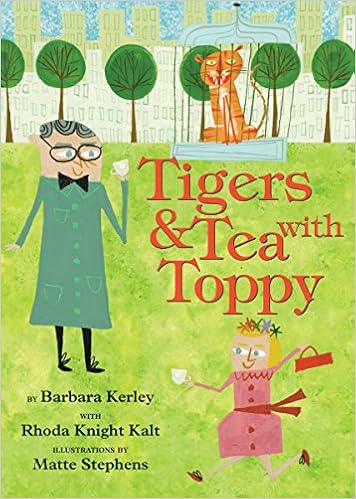
Tigers and Tea With Toppy by Barbara Kerley and Rhoda Knight Kalt, illustrated by Matte Stephens

Published by Scholastic

Image result for tigers and tea with toppy amazon

Image result for tigers and tea with toppy

Summary:  Rhoda loves spending weekends in New York City with her Grandpa Toppy and Grandma Nonnie.  On Saturday, Toppy, whose real name is Charles R. Knight, takes his granddaughter to the American Museum of Natural History where he shows her the paintings he created of animals and prehistoric scenes.  Even though he is legally blind, he is able to draw and paint the dinosaurs from their fossilized skeletons. The next day they visit the Central Park Zoo where Toppy shows Rhoda the animals he studied so closely to learn how to draw them accurately.  Rhoda, Toppy, and Nonnie finish off the weekend with a celebratory tea at the Plaza Hotel. Includes author and artist notes with more information about Knight and the creation of the book; source notes; some of Knight’s animal drawings; and photos of Toppy and Rhoda.  48 pages; grades K-3.

Pros:  A fun way to introduce the life of Charles Knight.  One interesting tidbit: illustrator Matte Stephens is legally blind, like Knight was, and uses some of the same techniques to create his art.

Cons: I would have enjoyed seeing more of the prehistoric paintings.

If you would like to buy this book on Amazon, click here.

Mama Dug A Little Den by Jennifer Ward, illustrated by Steve Jenkins

Published by Beach Lane Books

See the source image

Image result for mama dug a little den amazon

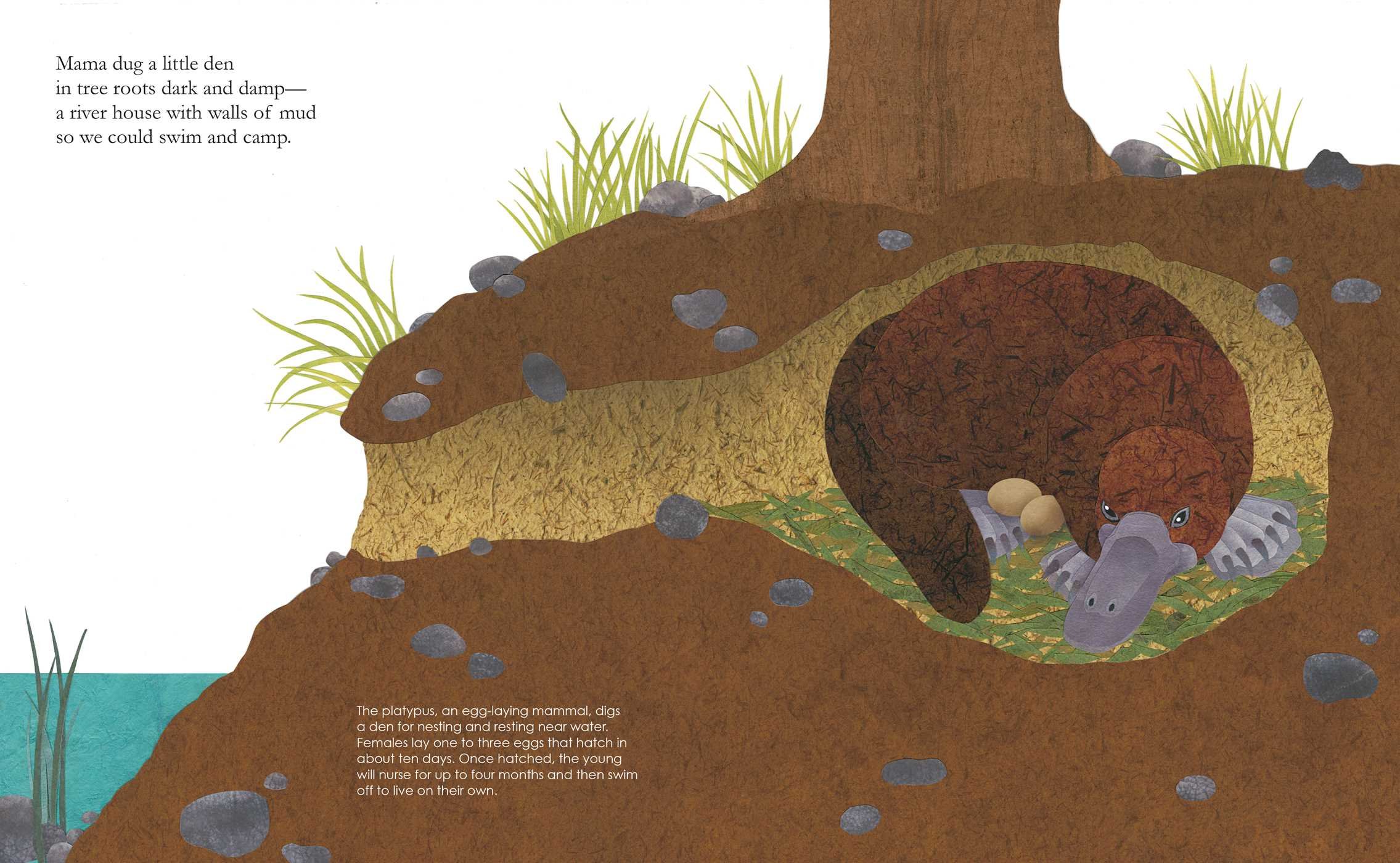
Summary:  Each two-page spread has a rhyme beginning with the line “Mama dug a little den” (“Mama dug a little den/beneath a fallen tree./An earthy home as soft as moss,/a nursery for three” is the first one about red foxes).  A smaller paragraph gives additional information. The illustrations are in Steve Jenkins’ signature cut-paper collage style, and show the animal in its den and some of the surrounding habitat. A final page contains a note from the author about how she came to write the book, and some additional information about what to look for if you find a den to determine what kind of animal lives there.  32 pages; ages 4-8.

Pros:  In this follow-up book to Mama Built A Little Nest, preschoolers will learn a bit about animal homes and how to discover them in their own backyards.  As president of the Steve Jenkins fan club (well, I would be, if there were such a thing), I appreciated the beautiful illustrations.

Cons:  The back matter was so small and unobtrusive, many readers may miss it.

If you would like to buy this book on Amazon, click here.

Who Eats Orange? by Dianne White, illustrated by Robin Page

Published by Beach Lane Books

Image result for who eats orange diane white amazon

Image result for who eats orange robin page

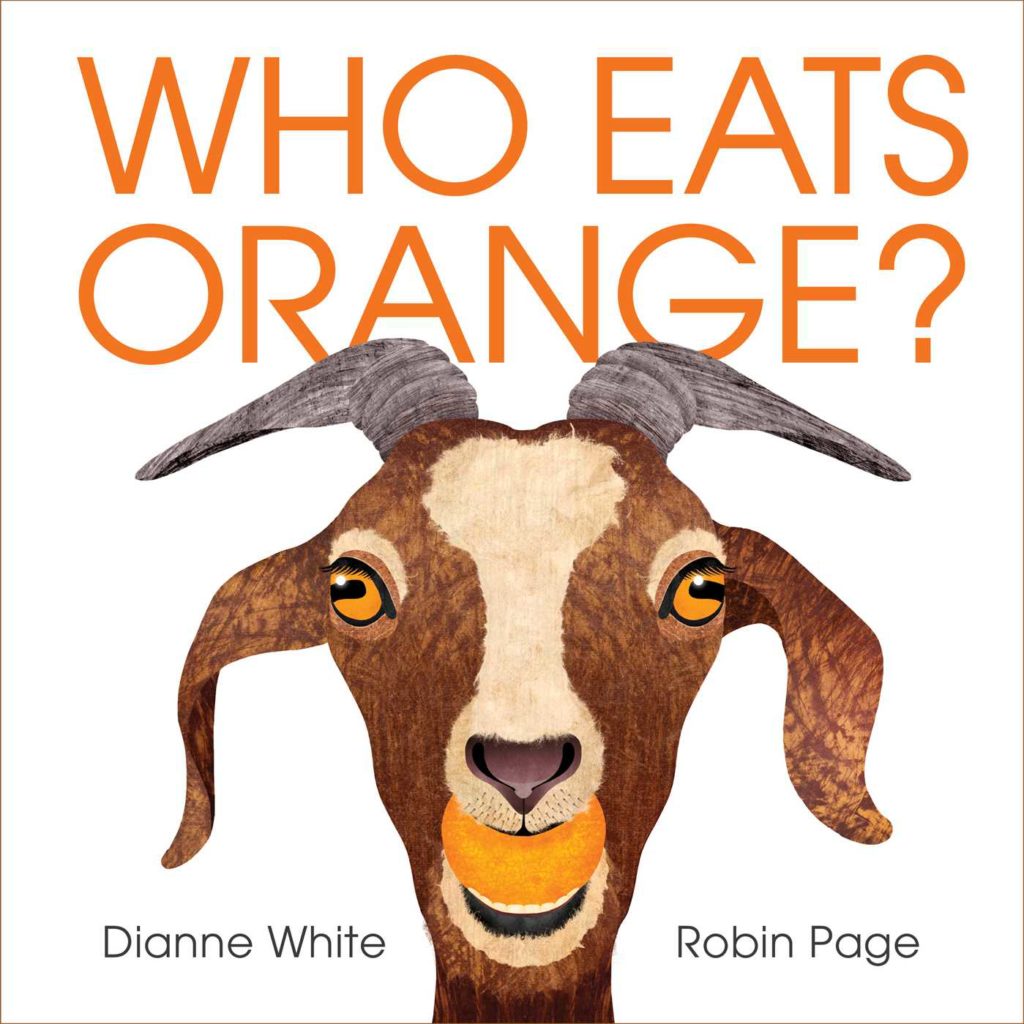
Summary:  Animals, foods, colors, and habitats are introduced in this book that has a repeating question and answer format: “Who eats orange? Bunnies in their hutches do. Chickens in the henhouse too.  Who else eats orange? Goats. Pigs. Gorillas too? Gorillas? No! Gorillas don’t eat orange. They eat…green.” The large illustrations have plenty of color on a simple white background. Humans, the book concludes, eat a rainbow of colors.  The last two pages list various habitats with the animals from each listed and additional information about what and how that animal eats. 32 pages; ages 4-8.

Pros:  Catchy rhymes and eye-catching graphics make this an appealing introduction for a wide variety of topics.

Cons:  The habitats listed at the end include farms, Africa, ocean, forest, rainforest, and tundra; but Africa is a continent with many different habitats.

If you would like to buy this book on Amazon, click here.

The Secret Life of the Little Brown Bat by Laurence Pringle, illustrated by Kate Garchinsky

Published by Boyds Mills Press

Image result for secret life little brown bat amazon

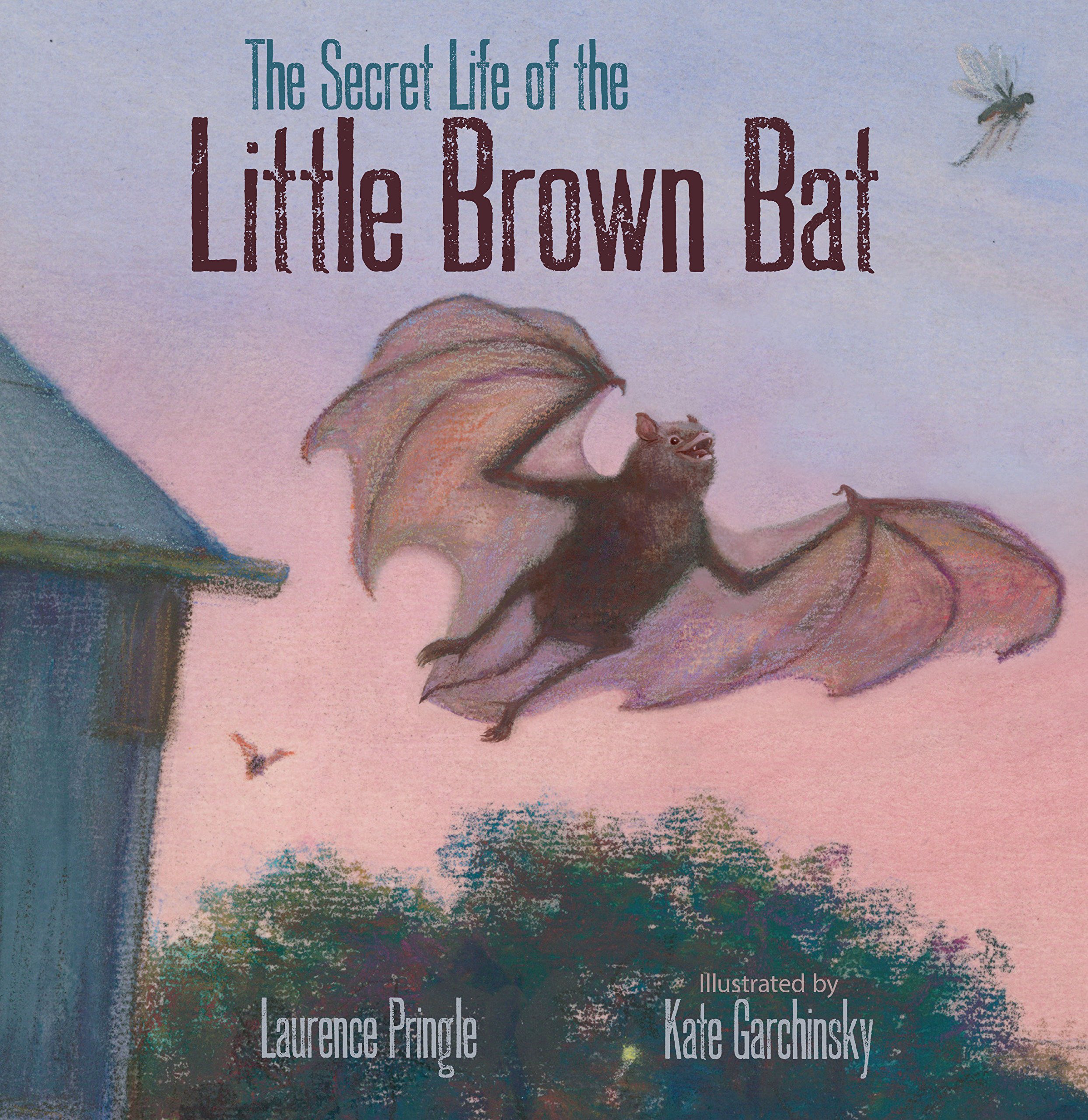
Summary:  This story starts shortly after Otis, a little brown bat, has left his mother and is living on his own.  Watching how Otis spends his days and nights, the reader will learn the physical characteristics of bats, their diet, where they live, how they hunt using echolocation, and their life cycle.  The illustrations mostly portray Otis at night in a variety of settings: roosting in an abandoned building, hibernating in a cave, flying through the sky, and hunting for insects in a meadow. At the end, Otis has found a mate and is settling down for a long winter’s sleep.  Includes two pages of additional information about little brown bats and a glossary. 32 pages; grades 1-4.

Pros:  An excellent introduction to a bat’s life, told in a narrative form that will hold readers’ interest.  The pastel illustrations on the dark background provide striking portrayals of Otis (whose name comes from his species’ scientific name, Myotis lucifugus) and the other bats.

Cons:  Otis didn’t really seem to be leading a “secret life”.

If you would like to buy this book on Amazon, click here.

Spring After Spring: How Rachel Carson Inspired the Environmental Movement by Stephanie Roth Sisson

Published by Roaring Brook Press

Image result for spring after spring amazon sisson

Summary:  Rachel Carson loved nature from the time she was a child.  She spent a lot of time outside, looking and listening to the wonders around her.  Although she grew up far from the ocean, she loved to read about it and imagined what it would be like.  She also enjoyed writing, and planned to study it in college. But after seeing tiny sea creatures through a microscope, she changed her major to biology.  After graduation, she combined her two interests, writing popular books about the ocean. Her most famous work, though, was Silent Spring, based on her research on the effects of pesticides on the environment.  Although not everyone agreed with her conclusions, enough people were concerned that real changes occurred as a result, including the creation of the Environmental Protection Agency and the first Earth Day.  Includes author’s note, notes, and bibliography. 40 pages; grades K-4.

Pros:  A charming introduction to Rachel Carson’s life, emphasizing her lifelong love of nature, especially the ocean, and illustrated with cartoon-style illustrations.

Cons:  The notes gave a lot of interesting information about Carson’s life, but are written in a small, cramped font, and are likely to be overlooked by young readers.

If you would like to buy this book on Amazon, click here.

Saving Fiona: The Story of the World’s Most Famous Baby Hippo by Thane Maynard

Published by HMH Books for Young Readers

Image result for saving fiona amazon

Summary:  When Fiona the hippo arrived two months prematurely, her caretakers at the Cincinnati Zoo sprang into action to save her.  At 29 pounds, she was about one-third the healthy weight for a newborn hippo, and was too weak to climb on her mom’s back or to nurse.  The staff watched over her day and night, creating a hippo formula based on her mother’s milk to feed her. When she was a few months old, she began gradually transitioning to her parents’ care.  Fiona became something of a social media sensation, and a Google News search reveals that as recently as two weeks ago, her growth spurt was making headlines. Includes four pages of back matter with additional information about hippos.  48 pages; ages 4-10.

Pros:  This is my favorite kind of animal nonfiction book…an engaging story, lots of adorable photos, and plenty of information that would make it a good research resource.  I was surprised to read that hippos are the most requested animals at the zoo, but after seeing the photos of Fiona, I can understand why.

Cons:  Some resources about hippos for additional research would have been a nice addition.

If you would like to buy this book on Amazon, click here.

Image result for fiona the hippo

Kiki Greenbriar?

Nothing Stopped Sophie: The Story of Unshakable Mathematician Sophie Germain by Cheryl Bardoe, illustrated by Barbara McClintock

Published by Little, Brown Books for Young Readers

Image result for nothing stopped sophie mcclintock

Image result for nothing stopped sophie mcclintock

Summary:  Growing up during the French Revolution, Sophie Germain faced a number of obstacles to a career in mathematics.  Girls received little education, and Sophie’s parents tried discourage her late-night studies by taking away her candles and warm clothing.  She was undaunted, though, and they finally realized there was no way to stop her from studying math. When she grew up, she corresponded with other mathematicians under a pen name, but they tended to lose interest when they discovered she was a woman.  She kept studying any way she could, and when the Academy of Sciences offered a medal worth 3,000 francs to find a mathematical formula that would predict patterns of vibration, Sophie was determined to find a solution. It took her several years, but in 1816, she became the first woman to win a grand prize from the Royal Academy of Sciences.  Her work helped other mathematicians and engineers build modern skyscrapers, including the Eiffel Tower. Includes additional information about Sophie and the problem of vibration she solved. 40 pages; grades 2-5.

Pros:  Perseverance is the theme of Sophie Germain’s story, and readers will enjoy learning of her eventual success in the face of daunting obstacles.  The illustrations do an amazing job of incorporating numbers and mathematical formulas into Sophie’s world.

Cons:  I really didn’t understand the vibration problem that Sophie was working on.

If you would like to buy this book on Amazon, click here.

The Dinosaur Expert (Mr. Tiffin’s Classroom series) by Margaret McNamara, illustrated by G. Brian Karas

Published by Schwartz and Wade

Image result for dinosaur expert mcnamara amazon

Image result for dinosaur expert karas

Summary:  Kimmy loves science, collecting rocks, leaves, shells, and even owl pellets.  But her favorite collection is her fossils. So she’s excited about her class’s field trip to the natural history museum and eager to share her dinosaur knowledge with the other kids.  But when Jake tells her, “Girls aren’t scientists”, and backs up his statement with photos of male fossil hunters, Kimmy is suddenly less interested in sharing. Mr. Tiffin notices, and leads Kimmy to an exhibit about Zulma Brandoni de Gasparini, a female paleontologist who discovered a dinosaur that was named for her (Gasparinisaura Cincosaltensis).  Even Jake is impressed, and Kimmy regains her confidence and enthusiasm for dinosaurs.  “When I grow up, I want to be just like her,” Kimmy says at the end of the trip. “I think,” replies Mr. Tiffin, “you already are.”  Includes profiles of seven women paleontologists, including one who discovered a fossil from a new species of pterosaur when she was only four years old.  40 pages; grades K-3.

Pros:  Another charming tale featuring Mr. Tiffin working his magic with another member of his class.  There’s plenty of dinosaur information woven into the story for fossil fans.

Cons:  I hope Jake gets his own story so we can learn why he’s so obnoxious.

If you would like to buy this book on Amazon, click here.

Marie Curie by Demi

Published by Henry Holt and Co.

Image result for marie curie demi

Image result for marie curie demi

Summary:  When Marie Curie was born in 1867 Poland, life was difficult.  She had a loving family, but her mother and older sister died when she was still a child.  She and another sister, Bronya, wanted to go to the Sorbonne in Paris, but the family could only afford to send one of them.  Bronya went first, became a doctor, and supported Marie when she was through. Not only did Marie complete degrees in physics and math at the top of her class, but she met another brilliant scientist, Pierre Curie.  They married and pursued their work together, unlocking the secrets of uranium and radium. They won the Nobel Prize in physics; after Pierre’s tragic death, Marie continued their work and won another Nobel in chemistry. The dangers of radiation were unknown at the time (illustrated on the two pages showing women drinking radium and using it in beauty products), and Marie eventually died at the age of 66 from her long exposure to it.  40 pages; grades 1-5.

Pros:  An excellent introduction to Marie Curie’s life; complete, but straightforward enough for primary graders.  Demi’s illustrations are gorgeous, especially the patterns she uses for clothing, curtains, and carpets.

Cons:  Spending four years trying to determine the atomic weight of radium sounds like kind of a drag.

If you would like to buy this book on Amazon, click here.


How to Code a Sandcastle (A Girls Who Code Book) by Josh Funk, illustrated by Sara Palacios

Published by Viking Books for Young Readers

Image result for how to code a sandcastle amazon

Image result for how to code a sandcastle palacios

Summary:  The narrator has been trying to build a sandcastle all summer, but for one reason or another, hasn’t been successful.  On the last day of vacation, she brings her robot Pascal to the beach with her to help build the castle. She explains to the reader what she is doing as she codes Pascal to find a good spot, create a big pile of sand, gather decorations, and shape and embellish the castle.  She makes mistakes as she goes, but figures out what she’s done wrong and corrects them. When the tide comes in and washes her sandcastle away, she can uses the program she’s created to have Pascal build another one, this time with a moat around it. At the end, she and Pascal are ready to create an entire kingdom of sandcastles.  Includes an explanation of code, sequences, loops, and if-then-else statements. 44 pages; grades K-3.

Pros:  A fun introduction to coding terms for the picture book crowd.  The foreword, by Reshma Saujani, founder of Girls Who Code, explains the importance of introducing coding concepts to young children.  The illustrations and different fonts add to the educational value.

Cons:  It would have been helpful to see the entire program for the sandcastle written out somewhere.

If you would like to buy this book on Amazon, click here.