Whose Poop Is That? By Darrin Lunde, illustrated by Kelsey Oseid

Published by Charlesbridge
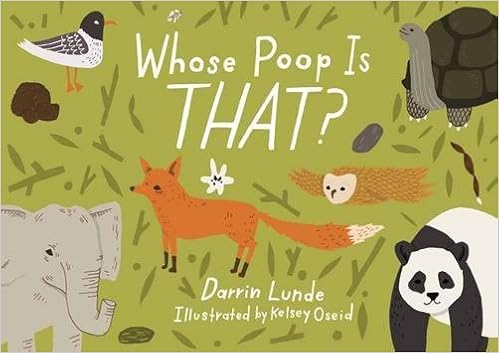
Summary:  Which animal’s poop can be a foot high?  Whose has splinters in it?  Is that bundle of fur and bones a poop?  A question is posed on one page, with a picture of the waste material in question, then the answer is given next, showing the animal who produced it.  Seven animals are profiled, including the extinct ground sloth, which introduces the concept of fossilized poop.  Two pages at the end give additional facts about poops and the animals who make them.  32 pages; ages 3-7.

Pros:  After kids pick themselves up off the floor after splitting their sides over the fact that the word “poop” is in the title of this book, they will actually find out how waste can be used to learn something about animals.  The question-and-answer format makes this a good interactive read-aloud.

Cons:  My Google images search for “Whose poop is that?” had some interesting results.
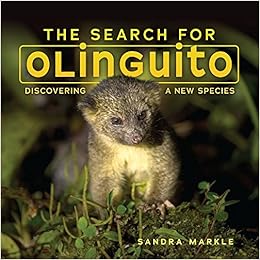
The Search for Olinguito: Discovering a New Species by Sandra Markle

Published by Millbrook Press

Summary:  On August 15, 2013, Kristofer Helgen from the Smithsonian Museum of Natural History announced the discovery of a new mammal called the olinguito.  How was this little animal, a relative of the raccoon and the kinkajou, discovered?  Sandra Markle takes the reader through the preceding decade, during which time Helgen studied pelts and skeletons of an animal called the olingo at museums around the world.  He noticed that some of them were quite different, enough to possibly be a different animal from the olingo.  Eventually, his research led him to the cloud forests of Ecuador and Colombia, where he was able to study the new animal in its habitat, learning enough about it to publish a paper and make his announcement about the new species from the Smithsonian. Includes, glossary, index, and resources to learn more. 40 pages; grades 1-4.

Pros:  An accessible look at science at work, generously illustrated with photographs and maps.  Young scientists will be inspired by the final question: what else is out there?

Cons:  If I discovered a new species based on my knowledge of the olingo, I would come up with a much more original name than olinguito.

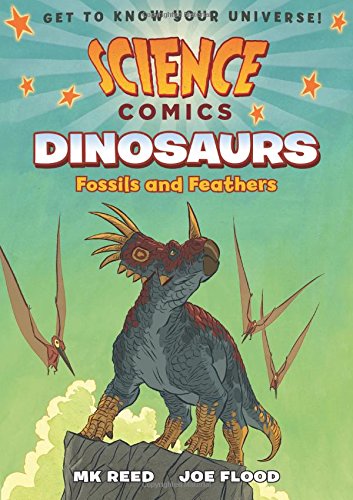
Science Comics: Dinosaurs: Fossils and Feathers by MK Reed, illustrated by Joe Flood

Published by First Second 

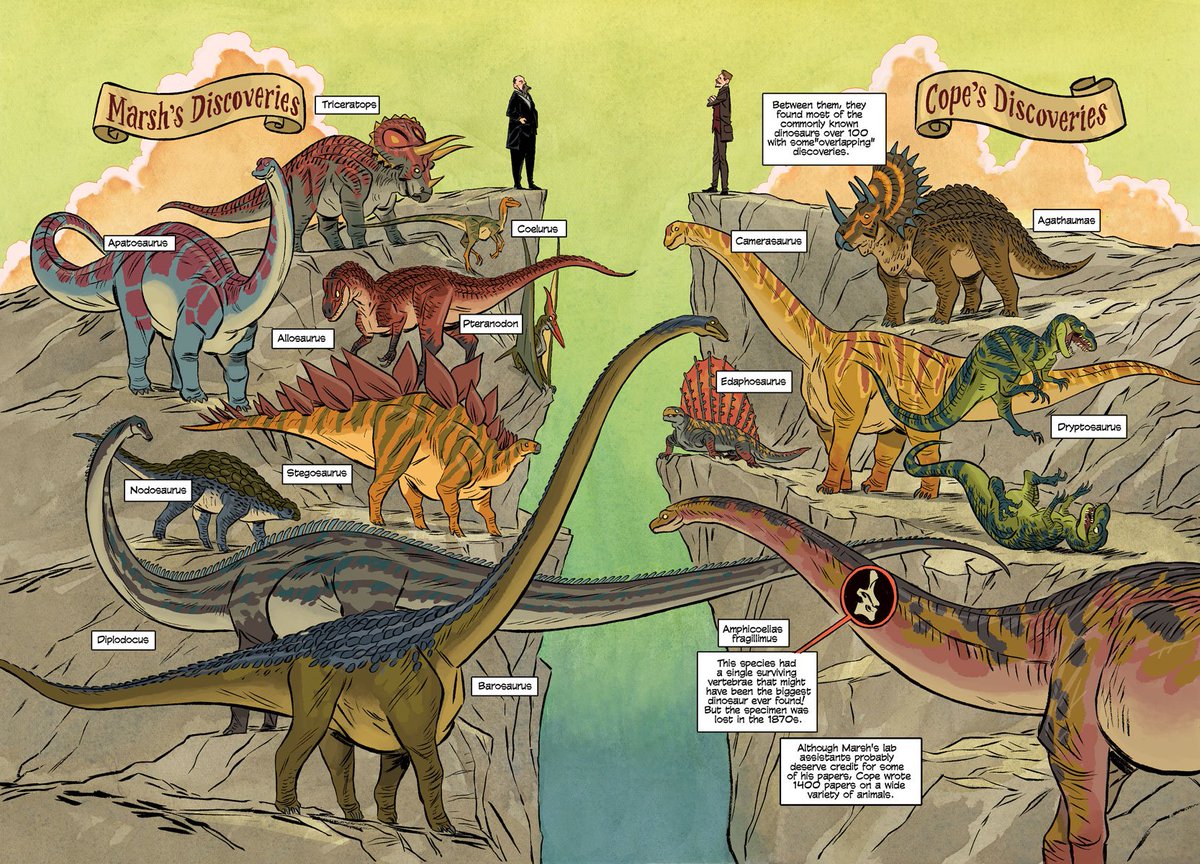
Summary:  Focusing mostly on humans’  gradual discoveries of the history of dinosaurs, this graphic science book covers paleontology from the Industrial Revolution to the present.  In 1800, the reader learns, it was believed that the Earth was 6,000 years old, that dinosaurs had vanished a few thousand years before in Noah’s flood, and that there were no examples of dinosaurs left.  The author updates these beliefs as she moves through history until 2000 when scientists believe the earth is 4.5 billion years old, dinosaurs lived over 65 million years ago, and descendants of dinosaurs are living today.  It’s a fascinating journey, with heroes and villains making discoveries, disputing the claims of their peers, and inching their way toward a better understanding of Earth’s history.  Back matter includes a glossary, a timeline of geologic eras, and a short list of further reading.  Part of a new “Science Comics” series that includes (or will soon include) books on coral reefs, volcanoes, bats, flying machines, and the solar system.  128 pages; grades 4-7.
Pros:  A fascinating history of paleontology with some really spectacular graphics that do a great job of visually depicting concepts like dinosaur sizes and family trees.

Cons:  The list of books for further reading was pretty short, and the titles were several years old.

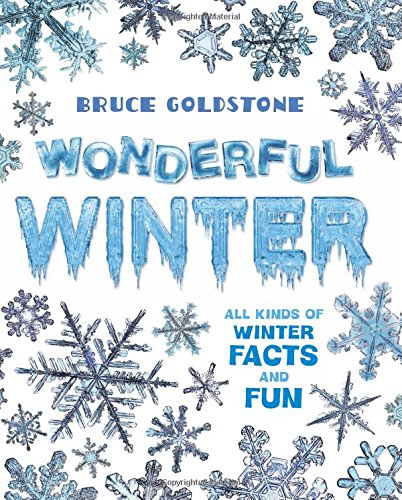
Wonderful Winter: All Kinds of Winter Facts and Fun by Bruce Goldstone

Published by Henry Holt 

Summary:  All kinds of facts about winter are presented, illustrated with large, colorful illustrations.  There’s scientific information about the solstice, snow, animal adaptation, cold, and the simple machines that are used to shovel snow.  The sounds, sports, tastes, holidays, and feelings of winter are all highlighted with their own two-page spreads.  The final four pages include photos and instructions for six winter activities.  This is a follow-up to Bruce Goldstone’s book Awesome Autumn, and from the looks of things at the end of this book, I would say Spectacular Spring cannot be far behind.  48 pages; ages 4-8.

Pros:  A very thorough introduction to winter for the primary grades.  Easy-to-understand science information is interspersed with quick takes on some of the words used to describe winter.  Young readers will enjoy the large, clear photos of familiar winter objects.

Cons:  The “fake snow” activity that involves shredding a disposable diaper sounds a bit messy.

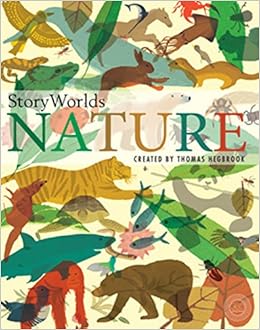
Storyworlds: Nature by Thomas Hegbrook

Published by 360 Degrees 

Summary:  “Every picture tells a story.  What do you think that story is?”  These words on the title page invite the reader to study the 100 wordless pictures that follow and think about what the story is.  On the verso of the title page (I hope I’m using that word right…the page to the left of the title page) are the words Observe, Inspire, and Wonder, with a sentence about each. The final pages show smaller versions of each of the preceding page, with an animal fact about each one.  The final sentence reads, “What do you think that story is?”  64 pages; ages K-5.

Pros:  A unique book that invites creativity, wonder, and a closer observation of the natural world.  The pictures are beautiful, and I could see certain kids spending literally hours studying them all and making up stories about what is happening in each.

Cons:  The size and $25.00 price may make this a less-than-ideal choice for libraries.

Giant Squid by Candace Fleming, illustrated by Eric Rohmann

Published by Roaring Brook Press 

Summary:  Millions of them may live in the oceans, growing to a length of 40 feet or more, yet very little is known of the giant squid.  Scientists first saw a living one in 2006.  Much of what is known about these creatures comes from studying their remains inside sperm whales, whose stomachs can contain thousands of the indigestible squid beaks.  The poetic text of this book tells what little is known of the giants, illustrated with dark undersea paintings that show glimpses of different parts of them.  The final two-page spread is a labeled drawing of the squid’s body.  After that, an author’s note, “The Mysterious Giant Squid” gives more scientific information, and there’s a substantial list of print and online resources.  40 pages; grades K-5.

Pros:  One of my favorite parts of this “job” is learning about topics like the giant squid.  It is amazing that so many of these giant creatures have remained elusive for so long.  The pictures really capture the feel of their deep undersea home, and the author’s note is fascinating.

Cons:  Using the last eight pages to illustrate how the squid’s ink helps protect it (including a few mostly black pages) seemed like a little too much.

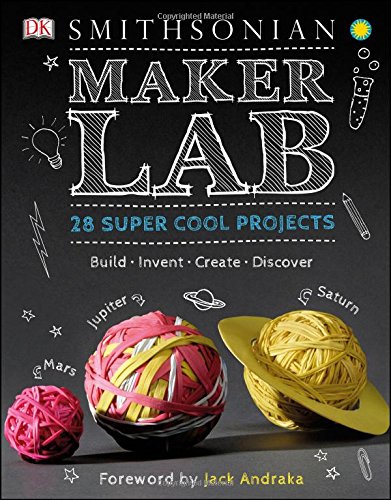
Smithsonian Maker Lab: 28 Super Cool Projects by Jack Challoner; foreword by Jack Andraka

Published by DK Children 

Summary:  28 projects introduce kids of all ages to the fun of science and technology.  The projects are divided into four sections: Food for Thought, Around the Home, Water World, and The Great Outdoors.  Each activity gets a four-page description that includes colorful photos to take young scientists through each step.  A “How It Works” sidebar explains the science behind each project; some also include “Real World Science” to connect with real life science or engineering.  Glossary and index are included.  160 pages; grades 3-7.

Pros:  While there are some tried-and-true projects (making slime, balloon rocket car), they are presented in a clear and interesting manner.  There are also some quirkily interesting ones, such as making a baked Alaska and creatng models of the planets from rubber bands.  Perfect for libraries starting a maker space or for kids who are interested in trying some science at home.

Cons:  No time to think of any…I’m off to my kitchen to turn a lemon into a battery.

Best in Snow by April Pulley Sayre

Published by Beach Lane Books 

Summary:  “A freeze. A breeze. A cloud. It snows.”  So begins this photo essay on snow, a follow-up to last year’s Raindrops Roll by Sayre.  Each page has a large photo or two of snowflakes in action, covering trees, animals, and the ground.  The sun comes out, the snow softens, and the ice begins to melt.  But before long, the snow begins again.  The final two pages give quite a bit of additional information on snow, along with a short list of books you can read to learn more.  40 pages; ages 3-8.

Pros:  A visually stunning science book which can be enjoyed by all ages.  Not only does it provide excellent information and beautiful photographs, but the writing would be a good mentor text on using strong verbs.

Cons:  Stopping after the thaw would have provided a happier ending.


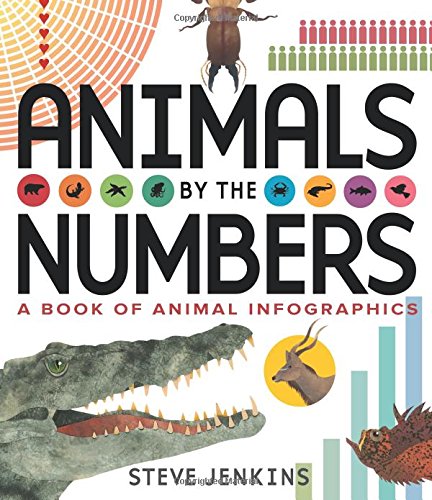
Animals by the Numbers: A Book of Animal Infographics by Steve Jenkins

Published by Houghton Mifflin Harcourt 

Summary:  Teaching kids how to read graphs and charts?  Want to wow kids (or adults) with amazing animal facts (the biomass of termites is twice that of humans; the pistol shrimp makes a sound that’s louder than a jet plane taking off)?  This book has you covered on all fronts.  Looking at many different aspects of animals, including life spans, speed, size, and deadliness, every page has a different infographic that brings the information to life.  The sobering last few pages graph the winners and losers of mass extinctions of the past, including one that is going on right now, and chart the numbers left of some of the most endangered species.  Additional books and websites are listed at the end.  48 pages; grades 2-6.

Pros:  You won’t hear much from any child you hand this book to; he or she will be way too absorbed studying the graphs and charts on every page.  That reader may emerge on occasion to share some fascinating fact with you (a koi fish can live 226 years!  There are 20 times more spider and scorpion species than mammals!).  I’ve already raved about Steve Jenkins’ cut-paper illustrations enough times to fill a pie chart, so I’ll spare you another round.

Cons:  It’s hard to believe those pesky squirrels in my backyard sleep twice as many hours as I do.

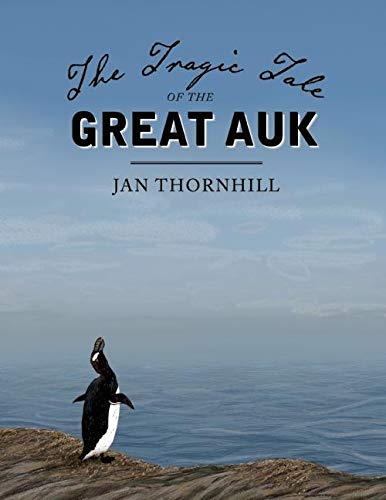
The Tragic Tale of the Great Auk by Jan Thornhill

Published by Groundwood Books

The Tragic Tale of the Great Auk: Thornhill, Jan: 9781554988655: Amazon.com:  Books

The Tragic Tale of the Great Auk: Thornhill, Jan: 9781554988655: Amazon.com:  Books

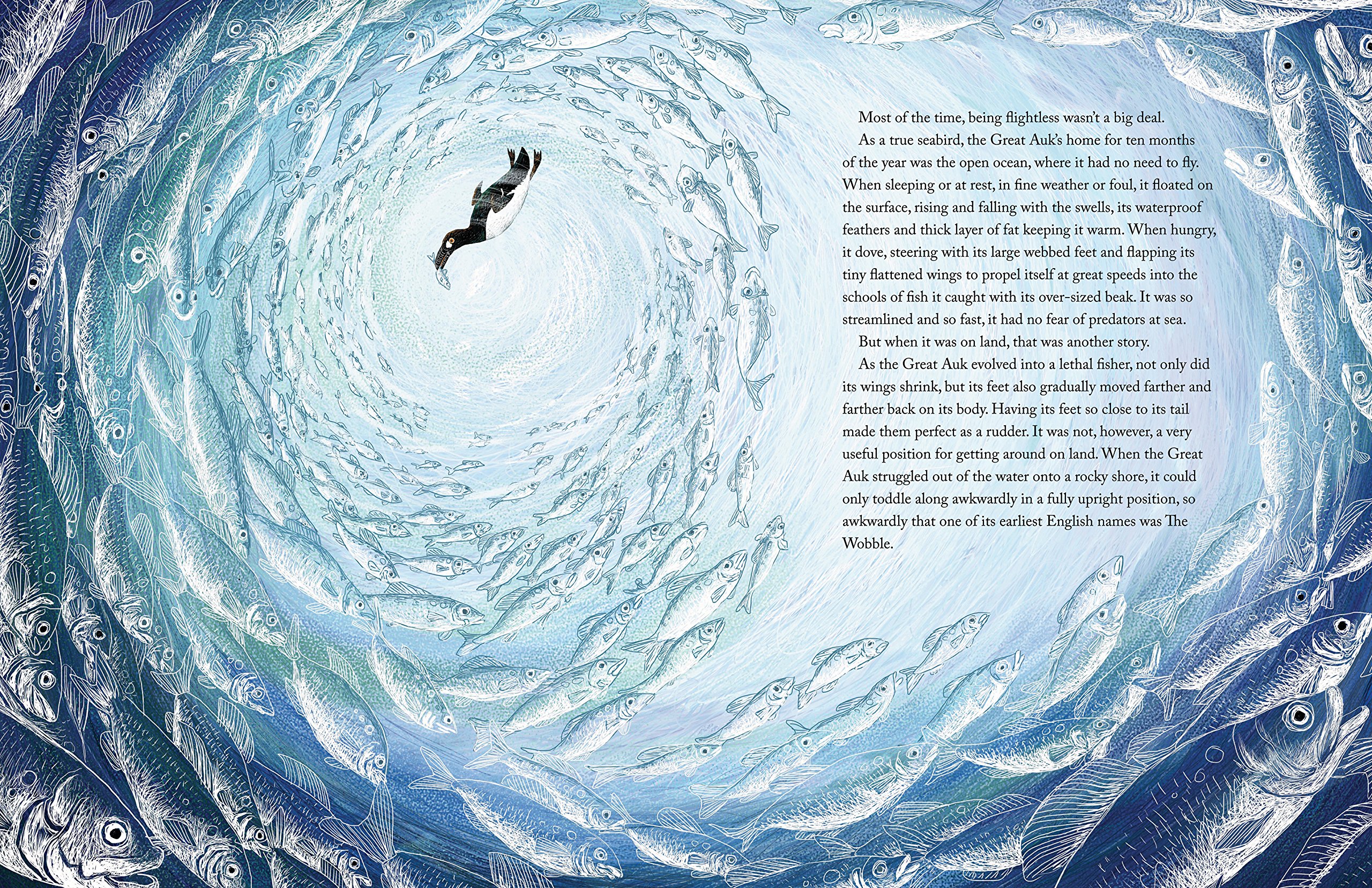
Summary:  For thousands of years, the Great Auk lived in northern seas.  It evolved to live in the water, only coming ashore to mate and lay a single egg once a year.  On land, it was slow and clumsy, but it nested in rocky places that were difficult for predators to reach.  Humans coexisted with the Great Auk for centuries.  The birds and their eggs were hunted, but not to excess.  When Europeans started traveling to North America, though, everything changed.  Ships’ crews were delighted to find fat, slow birds in great numbers to replenish their dwindling supplies of food during a long journey.  Eventually, the birds started dying off until entire colonies disappeared.  Later, birds and eggs were hunted by collectors, who would kill and stuff the birds for their displays.  In 1844, the last pair was killed by Icelandic hunters hired by a Danish collector.  This sad story ends on a few positive notes.  Funk Island, once home to many Great Auks is now a preserve for sea birds.  The decomposing bodies of the many Auks that were killed there turned into soil that covered the rocks, making the island hospitable to puffins.  The final page invites readers to join the ordinary people from around the world who are working to conserve other species before they, like the Great Auk, disappear.  44 pages; grades 2-6.

Pros:  Informational writing at its best; the Great Auk’s story is engagingly told and beautifully illustrated, touching on all kinds of topics from evolution to adaptation to conservation.  Readers will be horrified by the wasteful hunting of the birds, and hopefully inspired to help prevent other species’ extinctions.

Cons:  There’s a lot of text for a read-aloud.