Best in Snow by April Pulley Sayre

Published by Beach Lane Books 

Summary:  “A freeze. A breeze. A cloud. It snows.”  So begins this photo essay on snow, a follow-up to last year’s Raindrops Roll by Sayre.  Each page has a large photo or two of snowflakes in action, covering trees, animals, and the ground.  The sun comes out, the snow softens, and the ice begins to melt.  But before long, the snow begins again.  The final two pages give quite a bit of additional information on snow, along with a short list of books you can read to learn more.  40 pages; ages 3-8.

Pros:  A visually stunning science book which can be enjoyed by all ages.  Not only does it provide excellent information and beautiful photographs, but the writing would be a good mentor text on using strong verbs.

Cons:  Stopping after the thaw would have provided a happier ending.


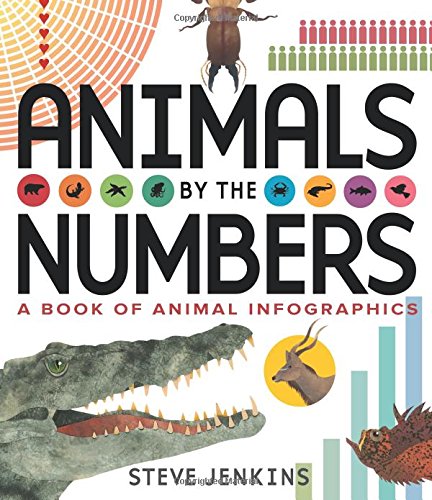
Animals by the Numbers: A Book of Animal Infographics by Steve Jenkins

Published by Houghton Mifflin Harcourt 

Summary:  Teaching kids how to read graphs and charts?  Want to wow kids (or adults) with amazing animal facts (the biomass of termites is twice that of humans; the pistol shrimp makes a sound that’s louder than a jet plane taking off)?  This book has you covered on all fronts.  Looking at many different aspects of animals, including life spans, speed, size, and deadliness, every page has a different infographic that brings the information to life.  The sobering last few pages graph the winners and losers of mass extinctions of the past, including one that is going on right now, and chart the numbers left of some of the most endangered species.  Additional books and websites are listed at the end.  48 pages; grades 2-6.

Pros:  You won’t hear much from any child you hand this book to; he or she will be way too absorbed studying the graphs and charts on every page.  That reader may emerge on occasion to share some fascinating fact with you (a koi fish can live 226 years!  There are 20 times more spider and scorpion species than mammals!).  I’ve already raved about Steve Jenkins’ cut-paper illustrations enough times to fill a pie chart, so I’ll spare you another round.

Cons:  It’s hard to believe those pesky squirrels in my backyard sleep twice as many hours as I do.

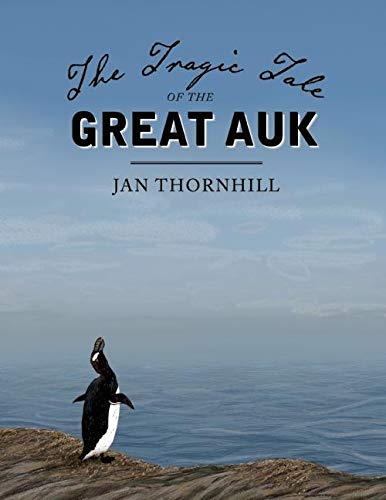
The Tragic Tale of the Great Auk by Jan Thornhill

Published by Groundwood Books

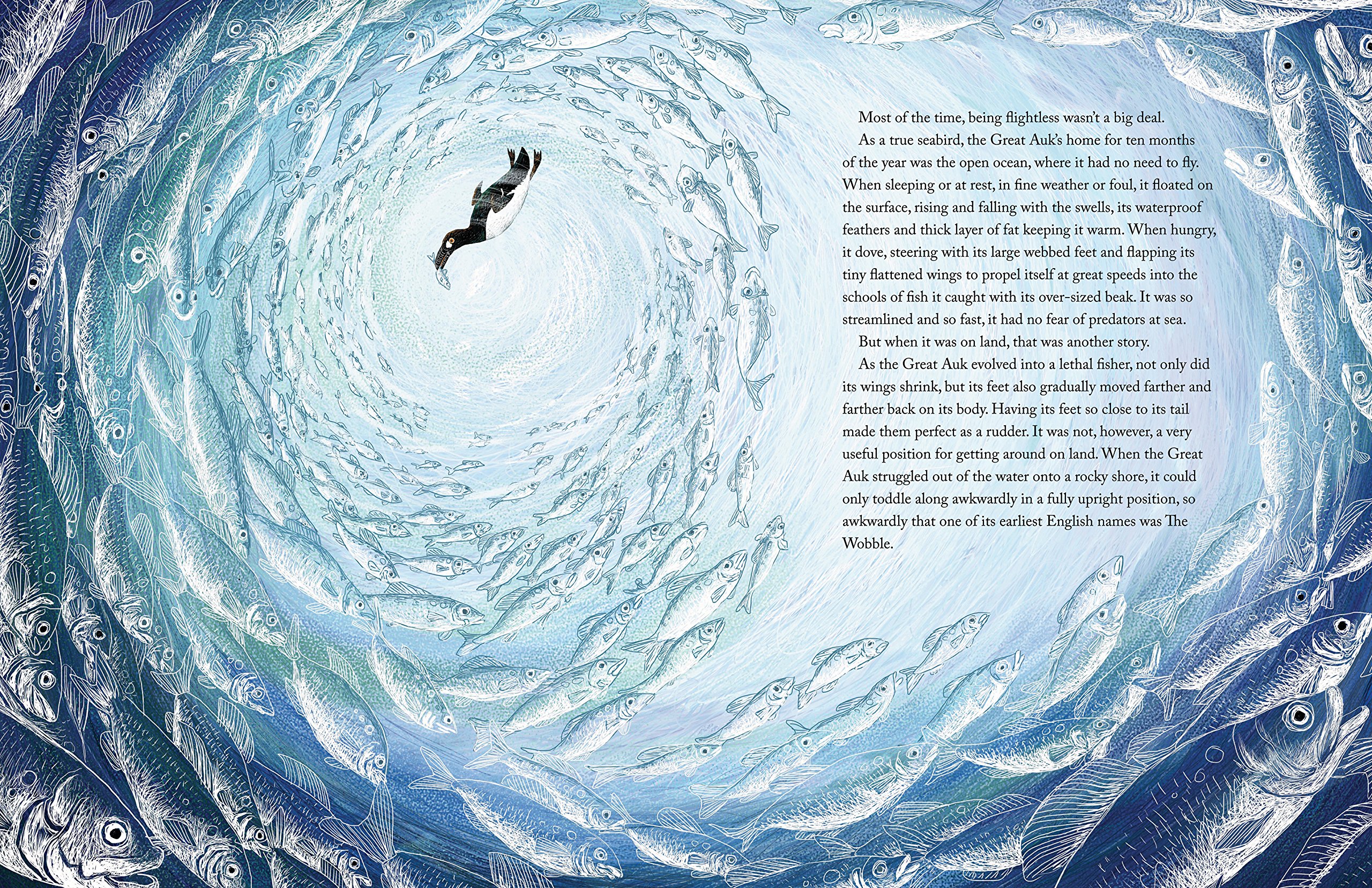
The Tragic Tale of the Great Auk: Thornhill, Jan: 9781554988655: Amazon.com:  Books

The Tragic Tale of the Great Auk: Thornhill, Jan: 9781554988655: Amazon.com:  Books

Summary:  For thousands of years, the Great Auk lived in northern seas.  It evolved to live in the water, only coming ashore to mate and lay a single egg once a year.  On land, it was slow and clumsy, but it nested in rocky places that were difficult for predators to reach.  Humans coexisted with the Great Auk for centuries.  The birds and their eggs were hunted, but not to excess.  When Europeans started traveling to North America, though, everything changed.  Ships’ crews were delighted to find fat, slow birds in great numbers to replenish their dwindling supplies of food during a long journey.  Eventually, the birds started dying off until entire colonies disappeared.  Later, birds and eggs were hunted by collectors, who would kill and stuff the birds for their displays.  In 1844, the last pair was killed by Icelandic hunters hired by a Danish collector.  This sad story ends on a few positive notes.  Funk Island, once home to many Great Auks is now a preserve for sea birds.  The decomposing bodies of the many Auks that were killed there turned into soil that covered the rocks, making the island hospitable to puffins.  The final page invites readers to join the ordinary people from around the world who are working to conserve other species before they, like the Great Auk, disappear.  44 pages; grades 2-6.

Pros:  Informational writing at its best; the Great Auk’s story is engagingly told and beautifully illustrated, touching on all kinds of topics from evolution to adaptation to conservation.  Readers will be horrified by the wasteful hunting of the birds, and hopefully inspired to help prevent other species’ extinctions.

Cons:  There’s a lot of text for a read-aloud.

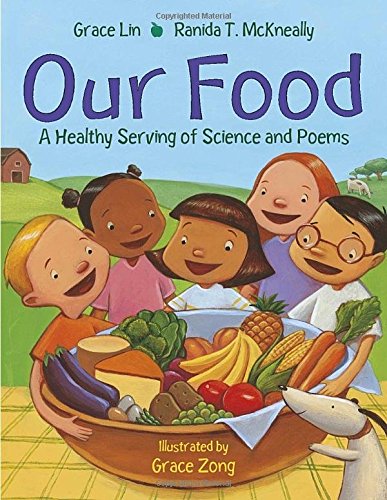
Our Food: A Healthy Serving of Science and Poems by Grace Lin and Ranida T. McKneally, illustrated by Grace Zong

Published by Charlesbridge 

Summary:  Each two-page spread includes a large, colorful illustration, a haiku poem, and a question such as “Why are so many vegetables green?” and “What makes a grain a grain?”  Each question is answered with several paragraphs of kid-friendly text.  Five food groups are covered: fruits, vegetables, dairy, protein foods, and grains.  The book supports the USDA recommendations for eating these different types of foods.  The last couple pages encourage eating a variety of healthy foods and explain a little more about the food groups.  Includes a glossary.  40 pages; grades K-3.

Pros:  A good basic introduction to food and nutrition.  The haikus and cheerful illustrations add fun touches.

Cons;  Food allergies receive a one-sentence mention at the bottom of the third-to-last page, and varieties on the USDA-recommended diet, such as vegetarianism or gluten-free, are not mentioned.  A list of additional resources could have addressed some of those topics.


Monster Science: Could Monsters Survive (And Thrive!) in the Real World? By Helaine Becker, illustrated by Phil McAndrew

Published by Kids Can Press

Summary:  Frankenstein, vampires, Bigfoot, zombies, werewolves, and sea monsters…each chapter starts with a labeled illustration of the monster in question, then gives a little history.  Then it’s on to science, and lots of it.  For instance, the first chapter—Frankenstein—covers electricity, the nervous system, organ transplants, genetic engineering, and robots.  There are plenty of humorous illustrations, sidebars, and “Monster Facts”.  Each chapter ends with a 10-question quiz that tests kids comprehension without taking itself too seriously.  For Frankenstein, a score of 0-2 earns you the title of Luigi Galvani; 3-6 is Isaac Newton; and 7-10 is Dr. Frankenstein himself.  An index is included, but no resources for further exploration.  96 pages; grades 3-7.

Pros: This could make a fun and fairly comprehensive science textbook.  There’s plenty of information, presented with lots of humor.  The monster aspect adds an extra element of interest for readers.

Cons:  It would take a keen interest in science to get through all the material here.

Wonderfall by Michael Hall

Published by Greenwillow Books 

Summary:  Each page has a picture of an oak tree and a poem about what is going on through the fall.  The poems are entitled with –fall words, such as thankfall, delightfall, and peacefall.  Gradually, the tree changes from green to multi colored to bare.  The school bus appears at the beginning, followed by a farmer’s market, an autumn parade, Halloween, Thanksgiving, and finally, clean-up of the fallen leaves.  The final word heralds a new season: snowfall.  Back matter includes information on how the animals pictured spend the winter (introducing the terms hibernation and migration), as well as the connection between squirrels and acorns, and how the tree will survive the cold weather.  40 pages; ages 4-8.

Pros:  A beautiful introduction to fall, with scenes kids will recognize from the season, illustrated with Michael Hall’s bright, simple creations.  The end matter will give readers more scientific information to appreciate the changing seasons.

Cons:  I couldn’t tell from the information given if some of the animals hibernate or stay awake in the winter.

Professor Astro Cat’s Atomic Adventure by Dr. Dominic Walliman and Ben Newman

Published by Flying Eye

Summary:  Professor Astro Cat takes readers on a tour through the world of physics.  After announcing that physics holds the answers to many questions (“Why is the sky blue?” “How does a boat float?”), he covers many of the basics of physics, including gravity, sound, light, atoms, matter, energy, and more.  Each two-page spread of this oversize book has a dizzying array of graphics giving facts, answers to questions, and real-life examples.  This is a British import, so there are some British spellings and measurements.   A glossary-index is included at the end.  56 pages; grades 2-6.

Pros:  A very complete introduction to physics, explained in a kid-friendly but not condescending way, with eye-catching illustrations throughout.

Cons:  It will take a dedicated science fan or some adult support to get through all the content here.

Bridge to the Wild: Behind the Scenes at the Zoo by Caitlin O’Connell, with photographs by Caitlin O’Connell and Timothy Rodwell

Published by HMH Books for Young Readers


Summary:  Caitlin O’Connell, elephant scientist and science writer, expands her horizons here to many other zoo animals.  Touring Zoo Atlanta in Atlanta, Georgia, she gives readers a behind-the-scenes look at how zoo staff study animal behavior.  Readers will learn how panda mothers interact with their babies, how hierarchies work with various social animals like elephants and gorillas, and how zoo staff handle deadly poisonous snakes.  Much of what is learned about animals in captivity can be applied to helping species survive in the wild.  The last chapter describes ways humans have been able to help endangered animals such as Brazil’s lion tamarin.  Includes extensive bibliography, source notes, and index.  208 pages, grades 5-7.

Pros:  Animal lovers will learn a lot from this book, and come away with a new appreciation for zoos and the people who work there.  Excellent photographs illustrate almost every page.  Chapters could be read in isolation by those interested in a specific animal.

Cons:  At 208 pages, it will take a pretty dedicated young zoologist to get through the whole book.

How Much Does a Ladybug Weigh? by Alison Limentani

Published by Boxer Books 

Summary:  “10 ants weigh the same as 1 ladybug.  9 ladybugs weigh the same as 1 grasshopper.”  And so this book goes, counting down from 10 to 1, with each page showing a progressively larger animal that weighs the same as that number of the animal from the preceding page.  The final, largest animal is a swan, which weighs the same as 362,880 ladybugs.  The last page shows all the animals with each one’s weight shown in ounces or pounds.  32 pages; ages 3-6.

Pros:  A fun introduction to weight and relative sizes for the youngest readers.  The simple, cute animal illustrations will make this an easy sell.

Cons:  You’ll need to look elsewhere for an introduction to units of measure and other information about weight.

Goodbye Summer, Hello Autumn by Kenard Pak

Published by Henry Holt and Company 

Summary:  A girl and her dog go for a walk through the fields and forests on a late summer day.  As they go, she greets everything she sees: “Hello, trees. Hello walking sticks and butterflies.  Hello, puddles.”  Each item responds to tell her how it is changing as summer turns into fall.  The trees are swaying in the breeze, the animals are looking for food, and the sun is setting earlier each evening.  After watching it set, the girl says goodbye to summer and goes into her house.  A wordless two-page spread shows a peaceful nighttime scene.  On the final page, the girl sits on her front step, the sun back in the sky, and greets the new season: “Hello, autumn!”  32 pages, ages 4-7.

Pros:  Perfect for this time of year, the text and the beautiful green and gold illustrations will get kids talking about the changes they see around them as summer moves into fall.

Cons:  That twinge of sadness I feel as the days shorten and the leaves start to change colors.