Poetry for scientists

A Planet Is a Poem by Amanda West Lewis, illustrated by Oliver Averill (Kids Can Press, 40 pages, grades 2-5). An introduction explains that a planet is a poem, and a poem is a planet, setting the stage for the integration of science and poetry. There’s a poem for each planet, as well as for the sun (but, surprisingly, not the moon), the Kuiper Belt, Arrokoth (an object located in the Kuiper Belt), and one for future astronomers. Each poem is on a page that unfolds to a gatefold that contains additional information on both the subject of the poem and the poetic form, with illustrations that expand as well. It’s a clever concept that educates about both planets and poetry, but I’m hesitant to get this for my library, knowing how even one gatefold page tends to get destroyed pretty quickly. Back matter includes information about writing your own poem, with facts about Planet X to serve as possible inspiration; a glossary of space terms; and a list of sources and resources.

The City Sings Green & Other Poems About Welcoming Wildlife by Erica Silverman, illustrated by Ginnie Hsu (Clarion Books, 40 pages, ages 4-8). In a dozen poems, Erica Silverman describes projects around the world where a single person or small group has made a difference with conservation. Each poem is spread over two or three pages, accompanied by colorful illustrations and a paragraph describing the project. From rewilding the playground in Los Angeles to cleaning a beach and restoring a sea turtle habitat in India to creating a bee “highway” in Norway, these projects will inspire kids to find ways to make a difference. With plenty of resources in the back, this would make a great starting place for a unit on ecology that might inspire hands-on projects.
Oh! 2 books about H2O

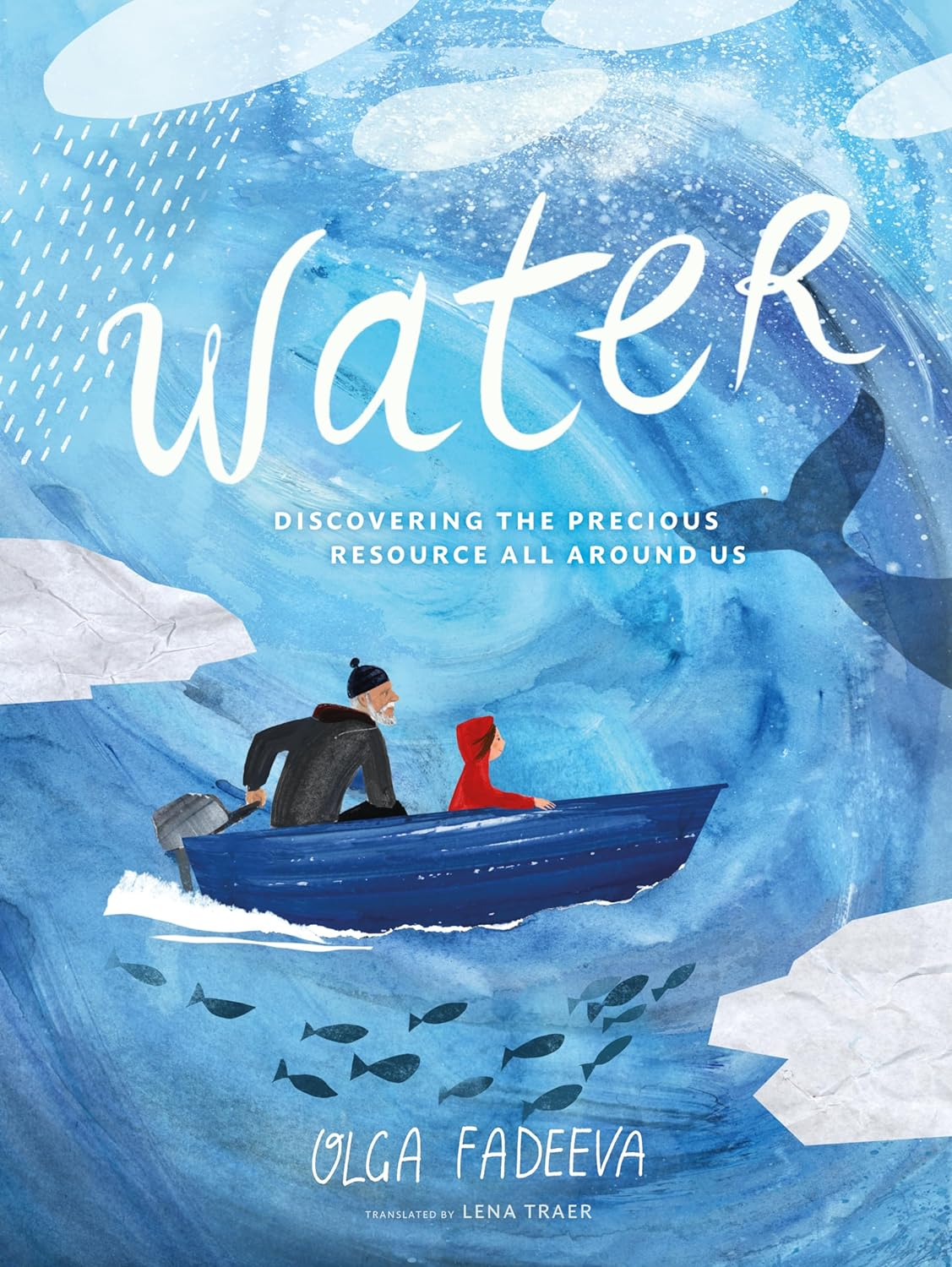
Water: Discovering the Precious Resource All Around Us by Olga Fadeeva, translated from Russian by Lena Traer (Eerdman’s Books for Young Readers, 56 pages, grades 2-5). Each spread in this book asks a question about water, covering a wide range of topics from weather to oceans to pollution. How much water is there on Earth? How do rivers form? How are seas and oceans different? How powerful is water? Each question is answered with a few straightforward, engaging paragraphs and illustrated with acrylics that emphasize the blues and browns of water. This is a fun book to browse and would make an excellent addition to any elementary unit on water, although there was a sad lack of additional resources at the end.

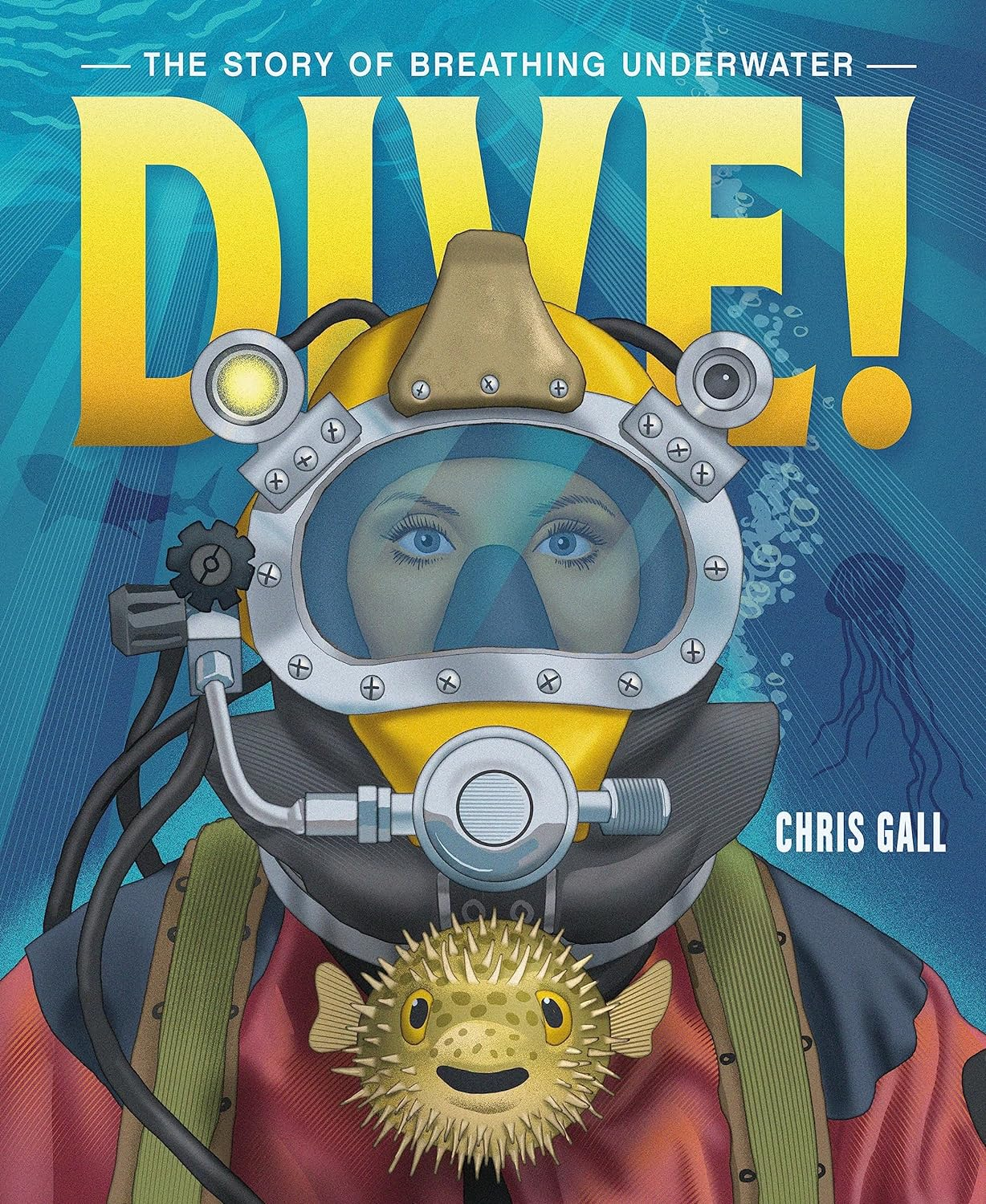
Dive! The Story of Breathing Underwater by Chris Gall (Roaring Brook Press, 48 pages, grades 1-5). As we learned in the first book, two-thirds of the Earth is covered in water, so it’s only natural that humans would seek out ways to explore the oceans. Beginning with the ancient Greeks who used hollow reeds that allowed them to breathe while harvesting undersea sponges, Chris Gall moves on to diving bells, the bathysphere, the Aqua-Lung, and robot-controlled submersibles. He also explains what happens when humans travel deep into the ocean, and the catastrophic effects returning to the surface too quickly can have. The narrative is told through a lens of problem-solving, as various inventors sought to overcome obstacles to allow divers to go deeper and explore longer. There’s more information at the end about the oceans, how to become a diver, and the author’s personal experience with diving, as well as a glossary and additional resources. Although this has the look of a picture book and is recommended by some reviewers for kids as young as 4, there’s a lot of somewhat technical information that would most likely be more interesting for older readers.

A unicorn boy and an ant girl

Unicorn Boy by Dave Ryan (First Second, 208 pages, grades 3-7). Brian leads a pretty ordinary life until the day a unicorn horn sprouts from his head. He tries to ignore, remove, or hide the horn, but there’s no getting around the fact that it’s there to say…and did I mention that the horn sings? A talking muffin turns out to be a cursed wizard who offers some help, and Brian’s best friend Avery is always a source of support, that is, until Avery is kidnapped by evil shadow creatures. Before long, Brian learns that his unicorn horn gives him superpowers, leading him on a quest to rescue Avery. There’s plenty of adventure along the way, and Avery discovers their own superpowers. The two friends look forward to additional adventures, as, no doubt, will the reader.

Ant Story by Jay Hosler (HarperAlley, 160 pages, grades 3-7). Rubi is a cartoon ant living in a colony of regular ants. She tells the other ants stories and talks to herself nonstop, but never gets to have a real conversation until she meets Miranda. At first Miranda seems to be a talking ant, but eventually they learn that she is a phorid, a parasitic insect who lays its eggs inside of ants’ heads, eventually destroying them. Despite their adversarial natures, the two become friends, and Rubi takes Miranda on a tour of the ant world, filled with dangers, adventures, and narrow escapes. The two fly off together on the last page (thanks to Miranda’s newly developed wings), hoping for a “happily ever after” life together.

Both of these are fun graphic novels that are sure to find an enthusiastic audience. As he did in The Way of the Hive, Jay Hosler brings entomology to life, portraying ants through exciting stories and a certain amount of gross-out factor that is sure to be appreciated. As for Unicorn Boy, I was literally laughing out loud all the way through, and I’m sure kids will be eagerly anticipating a sequel.

Science Friday

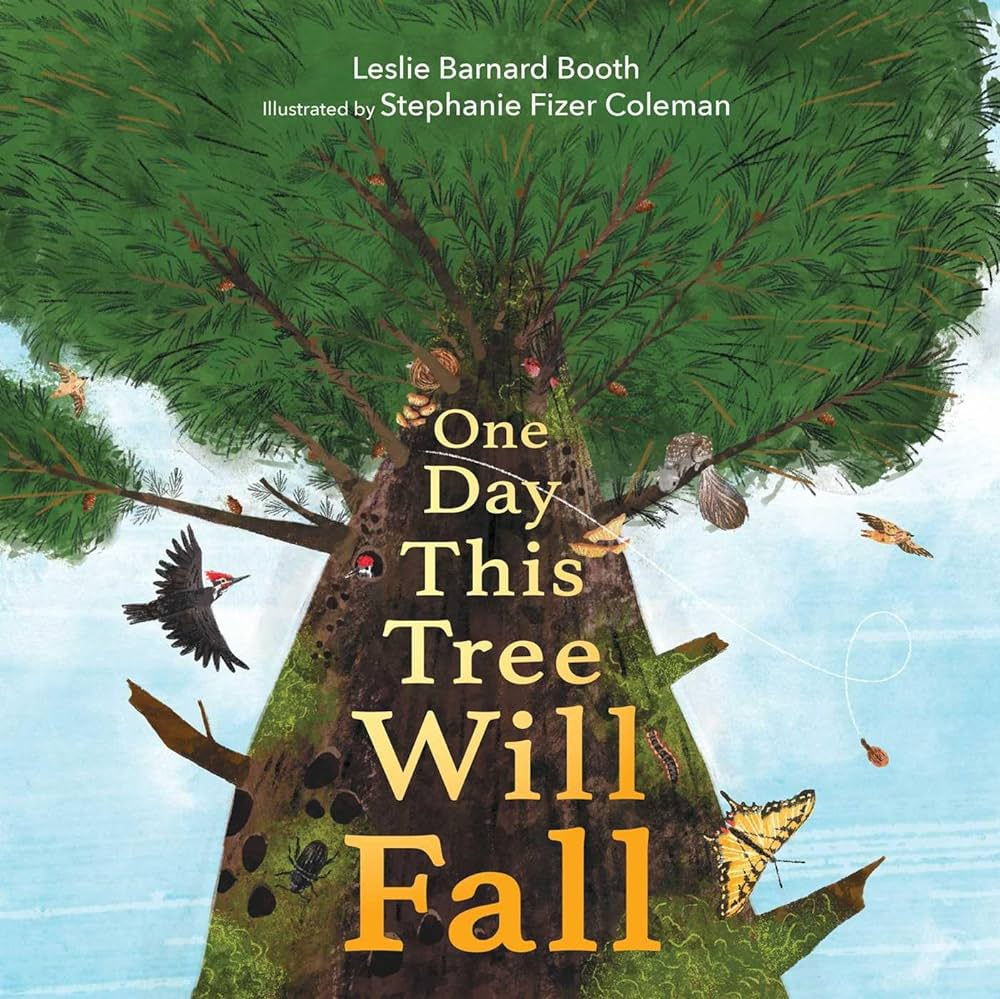
One Day This Tree Will Fall by Leslie Bernard Booth, illustrated by Stephanie Fizer Coleman (Margaret K. McElderry Books, 40 pages, grades K-4). “Wounded, worn, twisted, torn. One day this tree will fall and this story will end. Won’t it?” To learn the answer to this question posed on page 1, the narrative goes back to the beginning when a seed survives its journey to become a seedling. Its story could have ended before it began, and it could have also been ended by wind, ice, drought, and fire. But the tree survives, becoming a home to many creatures. Eventually, the tree does fall, but even when it’s lying on the forest floor, it provides food and homes to animals. Finally, it becomes part of the soil that supports a new tree seed. Includes additional information about trees and the interactions between trees and people, as well as a glossary and selected sources.

This Book Is Full of Holes: From Underground to Outer Space and Everywhere In Between by Nora Nickum, illustrated by Robert Meganck (Peachtree, 40 pages, grades 1-4). Maybe you haven’t thought a lot about holes, but you’ll start to notice them after reading this book. Whether tiny (a bleed hole in an airplane window) or enormous (the Bingham Canyon Mine in Utah), forming slowly (potholes) or quickly (sinkholes), mysterious (a wormhole) or annoyingly familiar (a hole in your sock), holes generally have interesting stories, many of which are told here. The last few pages cover English idioms that use the word hole (loophole, pigeonhole, a square peg in a round hole) and describe one last hole that’s not really a hole–a black hole. Includes a list for further reading.

Here are two STEM related titles for elementary readers to enjoy. This Book Is Full of Holes has a more unique premise, but I think I’d be less likely to use it as a read-aloud than the beautifully illustrated One Day This Tree Will Fall, which tells a fascinating story in a way that’s simple enough for kindergarteners and first graders to understand. This Book Is Full of Holes is a bit text-heavier and may lend itself better to reading on one’s own.

Birds and dinosaurs

Brave Baby Hummingbird by Sy Montgomery, illustrated by Tiffany Bozic (Simon and Schuster, 48 pages, ages 4-8). A hummingbird tells his story, beginning with his birth when he and his sister hatch from eggs the size of navy beans. They’re fed every twenty minutes until the day their mother doesn’t return to the nest. Fortunately, they’re rescued and taken to a place where a human, known only as the Voice, takes care of them until they are old enough to survive on their own. Woven into the story are facts about hummingbirds’ food, flight, bodies, and migrations, and more information is given at the end, including the author’s experience with a hummingbird rescue and ways that readers can help these birds. This lovely book provides plenty of information about hummingbirds, illuminated with beautiful illustrations of the birds at every stage of their lives and the colorful landscapes they inhabit.

The Iguanadon’s Horn: How Artists and Scientists Put a Dinosaur Back Together Again and Again…and Again! by Sean Rubin (Clarion Books, 48 pages, grades K-4). Ever since humans first realized that dinosaurs once existed, they’ve been trying to imagine what these creatures looked like. Using the dinosaurs’ fossilized remains, artists have painted and sculpted prehistoric depictions…and generally gotten things completely wrong. A case in point is the iguanodon’s horn, which turned out to be (we think) a thumb spike. Sean Rubin goes through the evolution of ideas about the iguanodon, showing how increased scientific knowledge changed perceptions about what the animal looks like. He speculates on what the next ideas may be, emphasizing the fact that, barring time travel, we will never know for sure. The endnotes give additional information about each two-page spread.

Dinosaur fanatics will love this book, both the fascinating story of how science works and the illustrations, which are at once informative and funny (I liked the cartoon bubbles showing the comments of the various wrong iguanodon models: “I DO look pretty terrible here,” “Seriously. This is embarrassing.” I felt a little bogged down reading the repeated wrong guesses, but I suspect a true paleo fan will find them captivating.

The art of science and the science of art

The Observologist by Giselle Clarkson (Gecko Press, 120 pages; grades 3-7). Giselle Clarkson defines observology as the study of looking and encourages kids to become observologists, closely examining the world around them. Following the introductory chapter, there are four sections, each focusing on a specific place to observe: a damp corner, pavement, a weedy patch, and behind the curtains. Each of these has several subsections that look at topics as diverse as how to relocate a spider, droppings and eggs, and things to spot at night.

Kids are encouraged to draw what they see, and the whole book has the look of a naturalist’s notebook, with lots of sketches and labels. The text and illustrations are both humorous and informative. It may take a dedicated naturalist to read this book from cover to cover, but it’s an easy one to browse. I could also see it being used as a textbook for a fun and fascinating observology class. The book concludes with a very complete index, in a font so small that this observologist was compelled to break out her magnifying glass to read it.

This Book Will Make You an Artist by Ruth Millington, illustrated by Ellen Surrey (Nosy Crow, 64 pages, grades 2-5). The title’s bold claim is supported by profiles of 25 different artists, with step-by-step instructions to make art projects based on each person’s work. It’s a diverse group of artists, starting with cave painters, and continuing through time to include famous artists like Leonardo da Vinci, Pablo Picasso, and Frida Kahlo, and those who may not be as well-known, such as Judith Scott, Liu Bolin, and Esther Mahlangu. There’s plenty of diversity in the art as well, allowing kids to create paintings, mosaics, collages, sculptures, and more. The introduction shows readers how to set up their own art studio, and the glossary will help with unfamiliar words that they may encounter throughout the book.

Just like The Observologist, this is a book that’s unlikely to be read from start to finish but could be used to teach a pretty awesome class combining art history and hands-on art. The projects all look like fun and are broken down into 4-6 easy-to-follow steps with illustrations. The pages felt kind of crowded, with information and illustrations about the artist taking up about 2/3 of each spread, and the directions crammed into the remaining portion of one page. The plus side of this is that each spread is chock full of information, ideas, and inspiration, and readers are likely to come away with some artwork they will feel proud of.

Two picture books that may inspire a family camping trip

Eclipse by Andy Rash (Scholastic Press, 40 pages, ages 4-8). ”Two months ago, I learned there would be a total solar eclipse,” the narrator begins. ”A month ago, I picked out the perfect place and time to watch the eclipse.” The countdown is on as he orders official eclipse glasses a week before the eclipse, travels with his dad a day before to a campsite near the big event, packs up to go to the perfect viewing site an hour before, and arrives a minute before. ”Now, Dad and I are in the dark.” Following this climactic moment, he and his dad will sit in traffic, finally get home, and savor their memories. 

I learned from reading this book that there’s a total solar eclipse in the United States on April 8! It looks like my school will be at about 90-95% totality, occurring right at dismissal, which could very well spell the end of the world. To prepare, I plan to read this fun and informative book to as many classes as I can. I liked the format of story, placing the eclipse as the central event, with the past and future referenced from the moment of totality. There’s additional information about different types of eclipses at the end, and the endpapers have a map showing annular and total eclipses in the US from now until 2048. I couldn’t see the path the April 8 one will take over Massachusetts, because it was hidden by the taped-down dust jacket.

Climbing the Volcano: A Journey in Haiku by Curtis Manley, illustrated by Jennifer K. Mann (Neal Porter Books, 48 pages, ages 4-8). A boy narrates his family’s adventure to climb South Sister, a dormant volcano in the Cascade Mountains of Oregon, using haiku poetry to tell the story. It’s an all-day hike, up past the tree line, into the snow, and finally to the summit! The descent is easier, and they finish the day back at their campsite for dinner and a well-earned rest. There’s additional information at the end about South Sister, the Cascades, what to bring on a hike, the flora and fauna encountered in the book, and haiku.

I love Jennifer Mann’s illustrations; just like in The Camping Trip, she makes you want to get out in nature. And of course, haiku is all about nature, making it an excellent format for describing the journey. This haiku doesn’t follow the 5-7-5 rule that’s often taught in schools, so read the end material to prepare if you’re reading with kids who know that format. 

Butt or Face? By Kari Lavelle

Published by Sourcebooks

Summary:  This guessing game style book shows a close-up photo of part of an animal, asking the reader: is it the animal’s butt or face?  Turn the page to find out the answer, see a full photograph of the animal, and learn some interesting facts and where in the world it lives.  The author’s note tells how she was inspired by an article she read about farmers in Botswana who painted eyes on the rear ends of their cattle to scare away predators.  Includes a map showing where each animal lives and a chart telling where each one rests its butt and what food goes in its face.  40 pages; grades K-3.

Pros:  I wasn’t sure how this book would be received by exhausted teachers the week before vacation, but so far, they have enjoyed it as much as the kids–which is a lot.  It’s an amazing introduction to animal adaptations.  Look for book 2 in the spring.

Cons:  The photos are pretty hard to figure out, and many of the animals aren’t well known.

Unseen Jungle by Eleanor Spicer Rice, illustrated by Rob Wilson

Published by MIT Kids Press

Summary: After an introduction to different types of microbes, the author looks at different places where these tiny creatures live. There are four parts: house, yard, food, and you, with several section in each. Whether it’s your pet, your bed, or your own body, it’s pretty much impossible to escape the microbes that are everywhere. Fortunately, most are benign or even beneficial to humans, but the ones that take over various creatures, turning their hosts into zombies, are pretty horrifying. In between the descriptions are interviews with scientists whose passion is learning more about the tiny creatures all around us. Includes a few pages at the end with some additional information and resources, as well as directions on how to draw E. coli; also an extensive bibliography. 176 pages; grades 3-6.

Pros: The lighthearted tone and funny illustrations make this a pretty entertaining reading, and kids will no doubt enjoy grossing out their peers, parents, and teachers with the information they learn here. The scientist profiles are a nice addition.

Cons: I may be in the minority here, but I felt like the section on microbes that live on humans was a bit too short. I want to know what I’m up against.

Creep, Leap, Crunch! A Food Chain Story by Jody Jensen Shaffer, illustrated by Christopher Silas Neal

Published by Knopf Books for Young Readers

Summary:  For the first part of this book, the rhyming text builds like The House That Jack Built, with the sun shining down on a cricket munching grass that’s eaten by a mouse, who’s swallowed by a snake, which is scooped up by a hawk, who gets trapped by a fox that gets chased by a bear.  But on some days things are different, and the story takes a twist as each animal escapes its predator, leaving the bear to munch on “flowers and seeds…all that she needs.”  Includes an illustrated glossary that gives more information about each of the animals.  48 pages; ages 4-8.

Pros:  A fun and clever introduction to food chains, with the second version of the story perhaps makes the case for vegetarianism.  

Cons:  Some of the main characters meet a gory end in the first version.