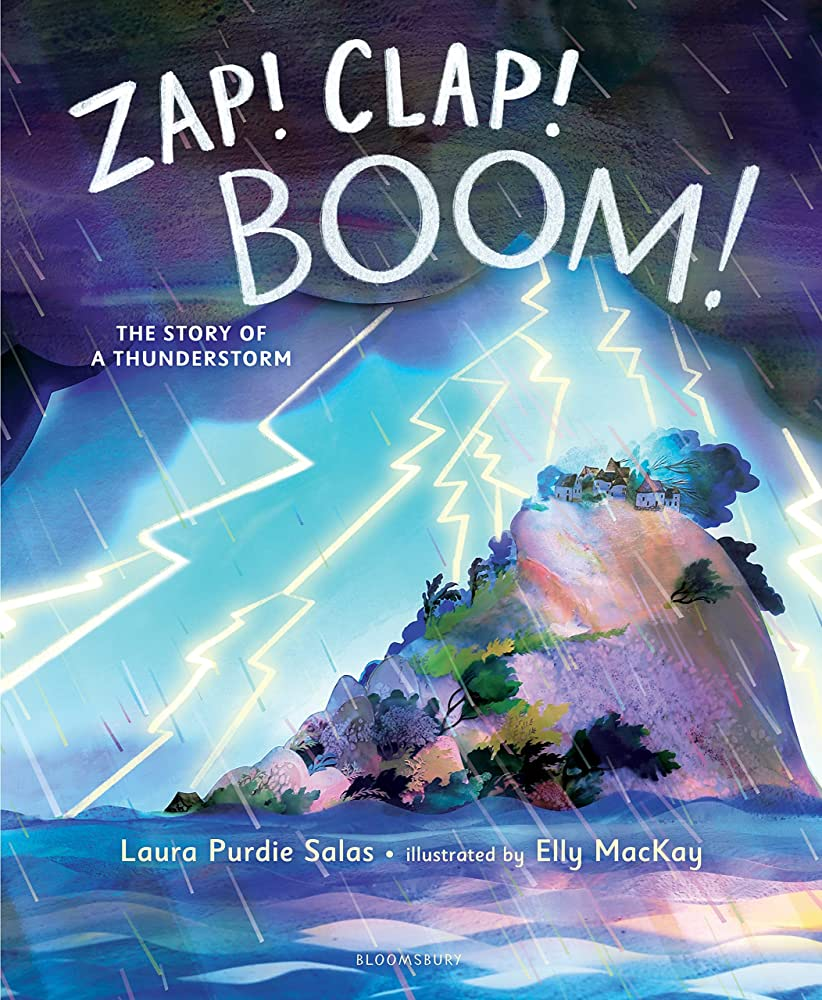
Zap! Clap! Boom! The Story of a Thunderstorm by Laura Purdie Salas, illustrated by Elly MacKay

Published by Bloomsbury Children’s Books

Summary:  Three children play on a sunny day.  Then dark clouds roll in, and suddenly, “ZAP! CLAP! BOOM!” there’s a clap of thunder and lightning is seen in the distance.  The children head for home and three goats run for shelter as the rain arrives.  Safe in their house, the kids watch the lightning and rain.  Then just as quickly, the storm moves on, and both sets of kids head outside again, as “the world now shines.”  Includes additional information on the science of thunderstorms, as well as a list of books and websites.  40 pages; ages 4-9.

Pros:  The rhyming text is very catchy, and kids will enjoy saying the repeated “Zap! Clap! Boom!” refrain.  The dramatic illustrations capture all the phases of a thunderstorm, and the back matter makes this a useful resource for older readers.

Cons:  I thought the kids could have moved toward home a little quicker when the storm arrived.

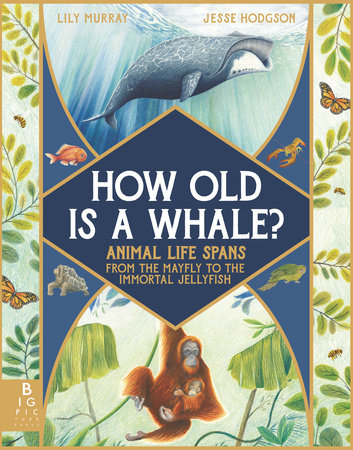
How Old Is a Whale? Animal Life Spans from the Mayfly to the Immortal Jellyfish by Lily Murray, illustrated by Jesse Hodgson

Published by Big Picture Press

Summary:  From the mayfly (5 minutes to 24 hours) and the honeybee (5 to 7 weeks) to the glass sponge (11,000 years) and the immortal jellyfish (in some sense, forever), this book takes a look at the lifespans of a wide variety of animals.  Each two-page spread shows the animal in its habitat with several paragraphs of information about the it over the course of its lifespan.  The introduction raises interesting questions about lifespans, and the final two pages show all the animals with a list of where to find them in the book.  64 pages; grades 1-5.

Pros:  This engaging book will intrigue all kinds of animal lovers.  I found the animals with the shortest and longest lifespans to be the most fascinating, but all of them had some pretty interesting information.

Cons:  One of my favorite books to read to kids is Steve Jenkins’s Biggest, Strongest, Fastest, which states that the animal that lives the longest is the Galapagos tortoise, with a lifespan of 150 years.  This book listed animals that live even longer.

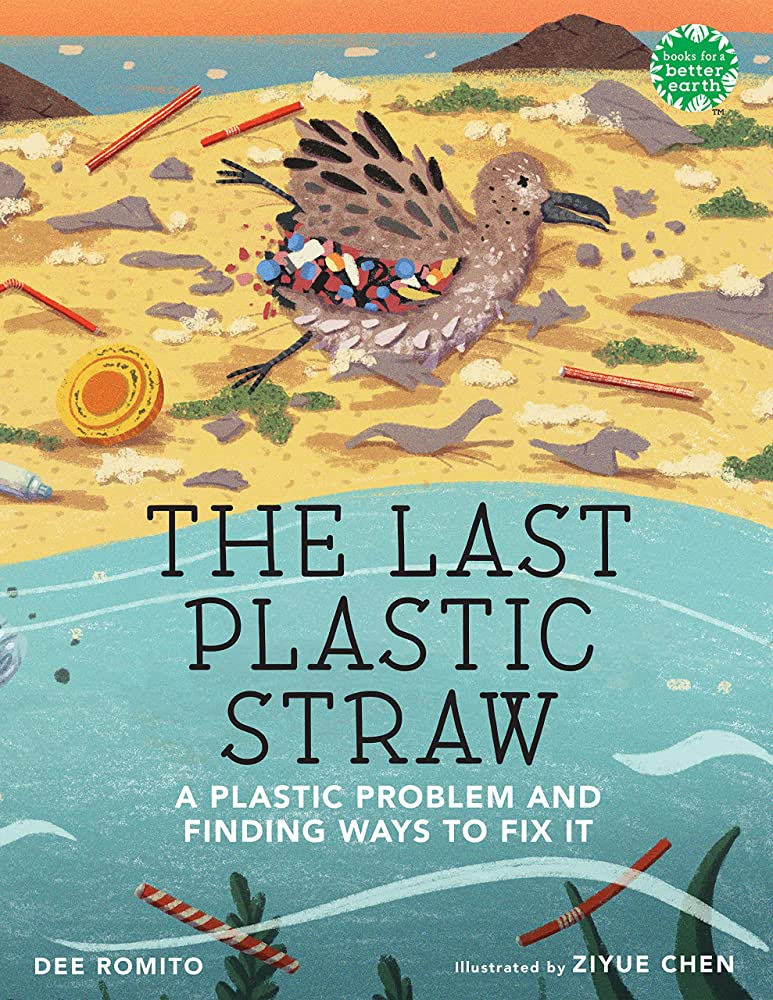
The Last Plastic Straw: A Plastic Problem and Finding Ways to Fix It by Dee Romito, illustrated by Ziyue Chen

Published by Holiday House

Summary:  Straws have been around since Queen Puabi, Queen of Ur, used a gold tube to slurp up the barley-based drink Sumerians were partial to 5,000 years ago (her subjects just used reeds).  Dr. Marvin Stone patented a paper straw in 1888, created to sip his mint julep, and Joseph Friedman invented the first bendy straw in 1937.  The post-World War II plastics boom led to the sturdier plastic straws that are still ubiquitous today and that are adding tons of microplastic pollution to the planet.  In 2011, 11-year-old Milo Cress started his “Be Straw Free” campaign to cut back on the 500 million straws Americans toss out each day.  It’s a small change, but an important one for all of us to make.  Includes an author’s note that gives additional information about straws and other single-use plastics, a list of sources, and an index.  40 pages; grades 1-5.

Pros:  A fascinating history of the straw that easily leads to a discussion of single-use plastics and how to cut back on your own personal use.  A great Earth Day read-aloud!

Cons:  I really enjoy using plastic straws.  Guess I will just have to suck it up.

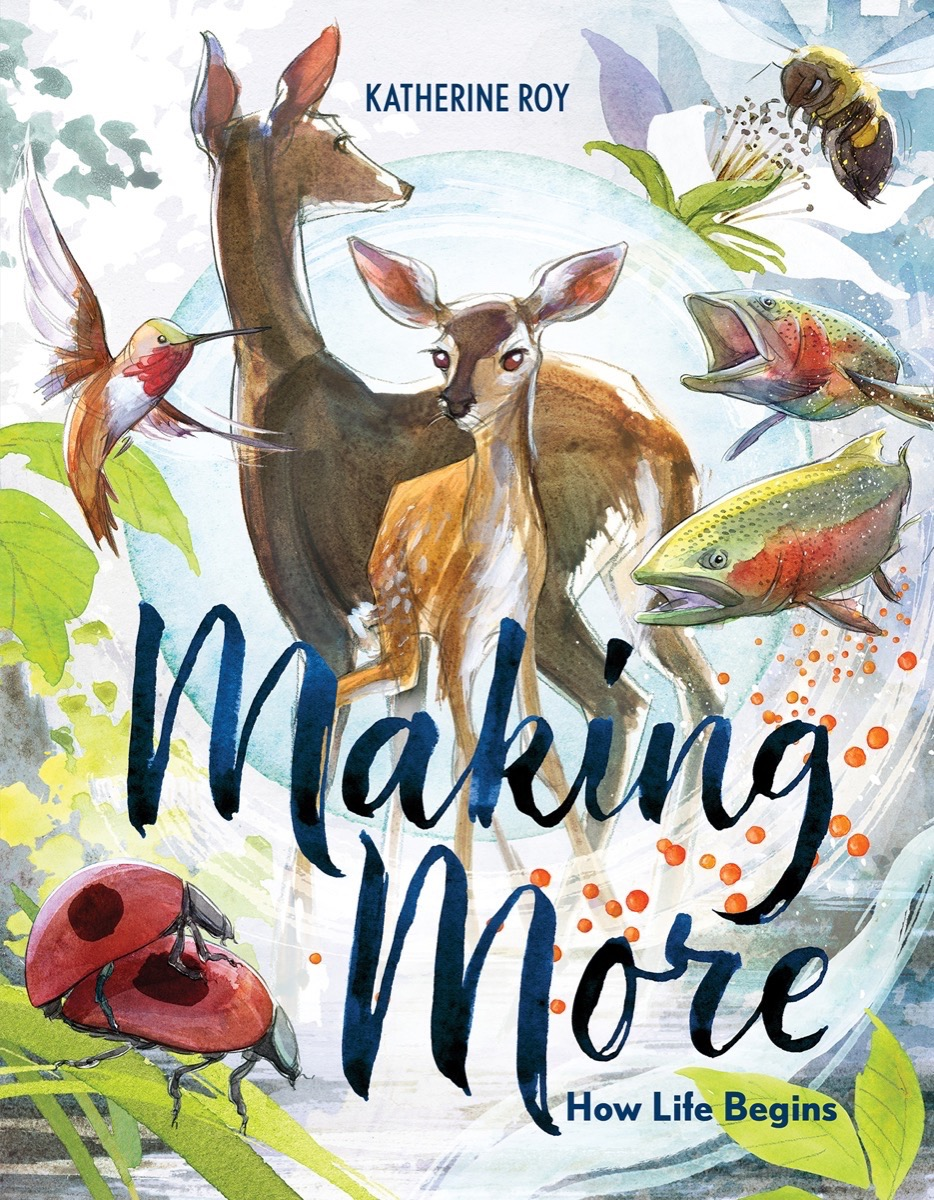
Making More: How Life Begins by Katherine Roy

Published by Norton Young Readers

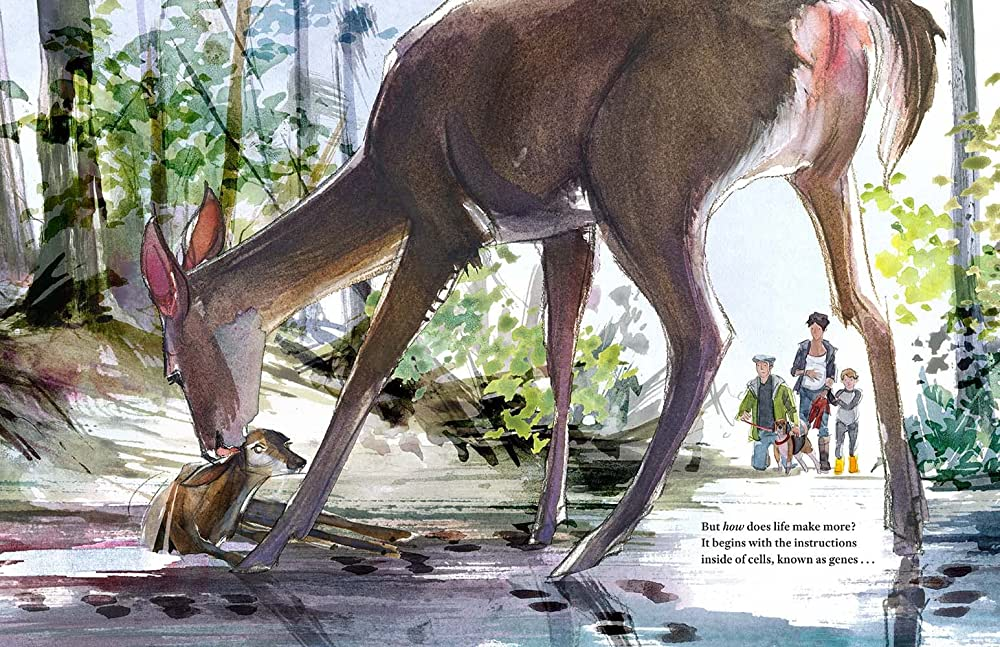
Summary:  A family that’s expecting a baby is out for a hike, where they see signs of reproduction all around them: a robin building a nest, two snakes mating, a deer with her fawn.  From there, the text and illustrations proceed to an explanation of reproduction that covers all sorts of living things, both animals and plants.  Beginning with the process of fertilizing an egg cell, the story moves to embryonic development, then birth.  There’s information on genes and how they create diversity within a species.  The final gatefold spread shows the human family celebrating their new baby at an outdoor party, with some of the animals from the text visible in the background.  72 pages; grades 3-6.

Pros:  An outstanding introduction to reproduction with a lot of technical information explained in terms that will be understandable to upper elementary and middle school readers.  The illustrations are excellent as well, celebrating the diversity of life on Earth.

Cons:  I’m sure the pictures of rabbits and snakes mating will cause some in the book censoring world to break into a sweat.

The Fire of Stars: The Life and Brilliance of the Woman Who Discovered What Stars Are Made Of by Kirsten W. Larson, illustrated by Katherine Roy

Published by Chronicle Books

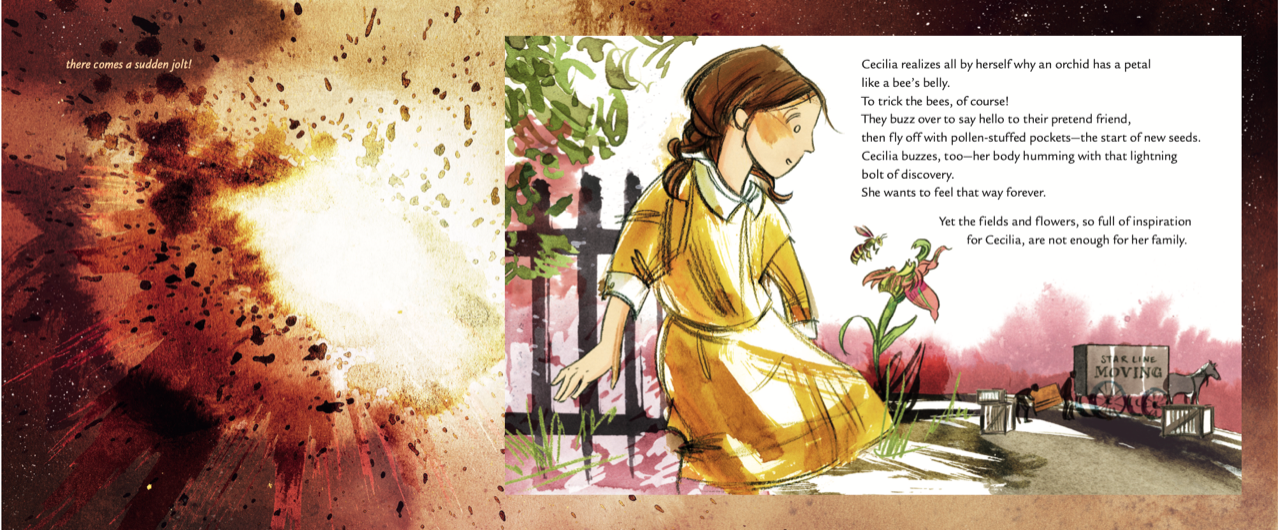
Summary:  Cecilia Payne’s curiosity about the natural world didn’t get much support when she was growing up in England.  Her family moved from the country, where she loved to explore nature, to London so her brother could go to school in the city.  Cecilia was sent to a religious school that didn’t offer any of the math and science classes that she loved.  She went on to study at Cambridge, where she switched her focus from botany to astronomy after hearing a talk by astronomer Arthur Eddington.  There was no place for her at Cambridge after graduation, so she moved to the other Cambridge (Harvard), where she was surrounded by like-minded women scientists.  Persistence with her research paid off as she made important discoveries about what the stars are made of, discoveries that fired up her imagination to ask even more questions.  Includes additional information about both Cecilia Payne and the birth of stars, as well as a timeline and a bibliography.  48 pages; grades 2-5.

Pros:  This fascinating biography is enhanced by the beautiful illustrations that show the parallels between Cecilia Payne’s life and the birth of a star.  A great read for Women’s History Month.

Cons:  There wasn’t much about Payne’s research after she discovered what stars are made of, a discovery she made at the age of 25.

The Sky Is Not the Limit by Jérémie Decalf

Published by Eerdmans Books for Young Readers

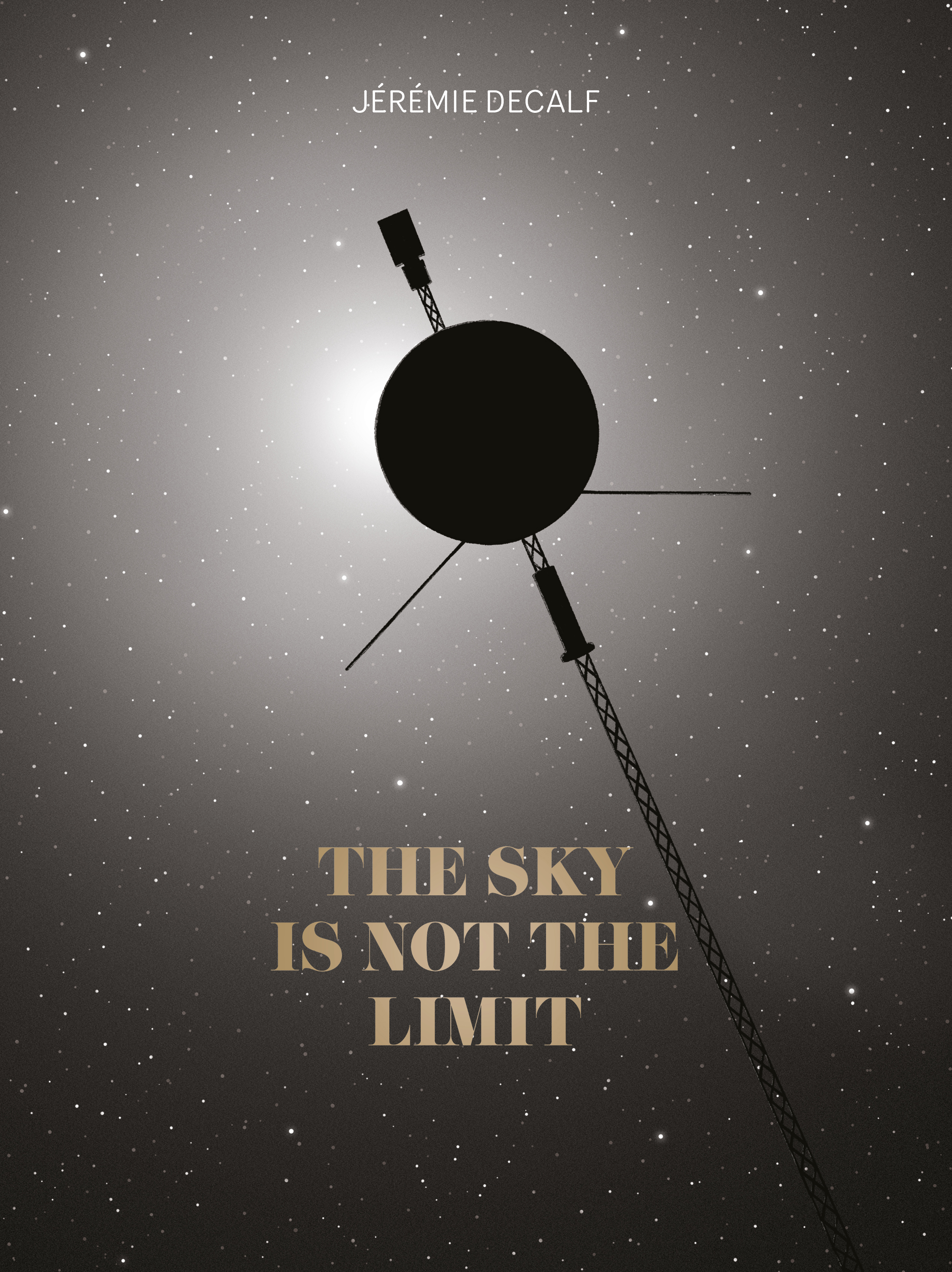
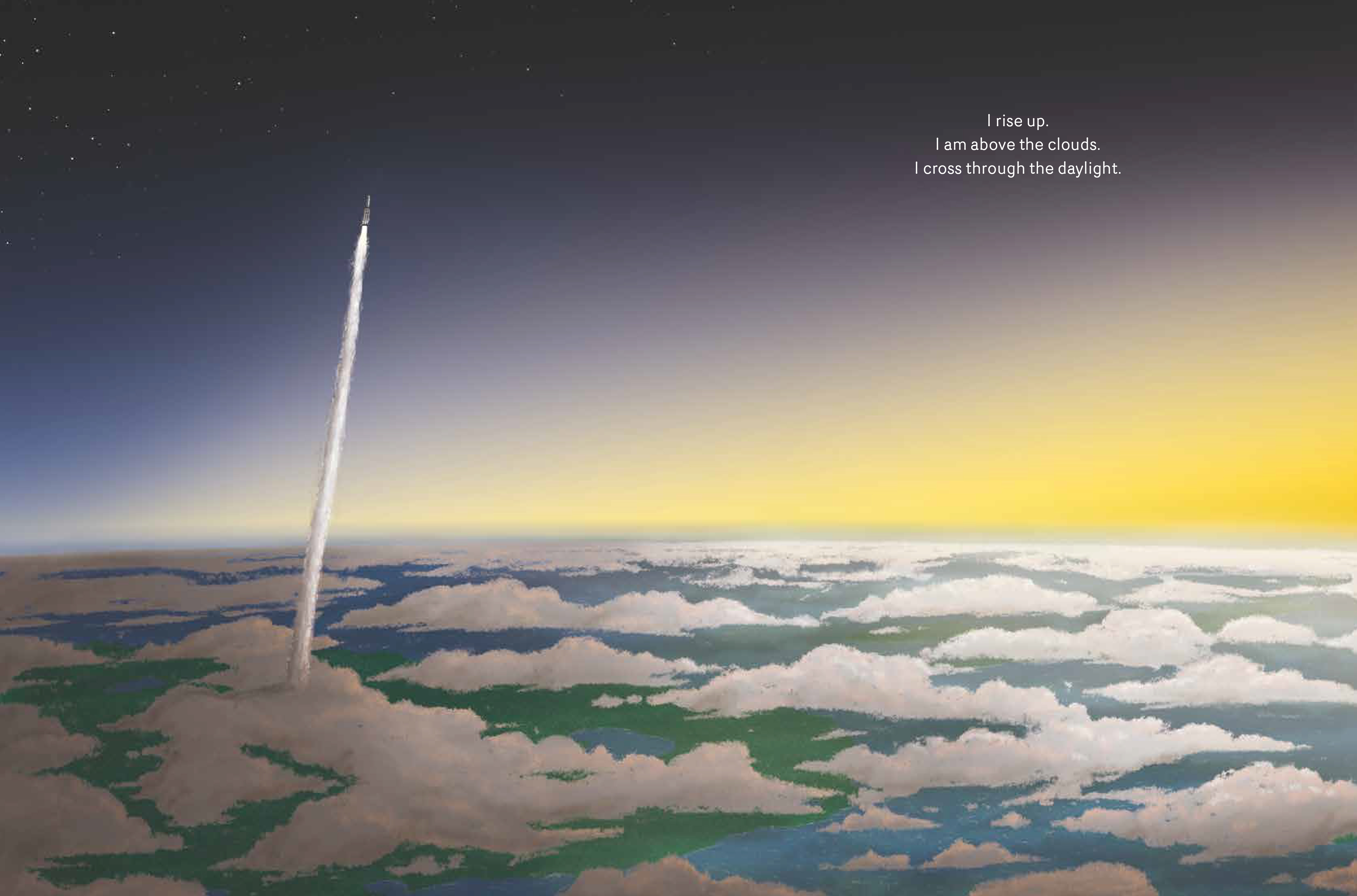
Summary:  The space probe Voyager 2 narrates its journey from assembly to rocket launch to outer space.  It flies by Jupiter, Saturn, Uranus, and Neptune, with pages of black, starry space to show the distance and time between planets.  Finally, it heads for interstellar space, where our sun is just another star.  Both Voyager 2 and its twin Voyager 1 carry a Golden Record filled with photographs and recordings from Earth.  Includes a page and a half of additional information, the NASA website where updates and photos can be seen, and a map of the solar system on both sets of endpapers. Translated from French. 64 pages; grades 1-4.

Pros:  The simple, lyrical text and incredible illustrations that beautifully capture the vastness and wonder of space.  

Cons:  Readers will no doubt be left with plenty of questions about this amazing journey, so it would have been nice to have more additional resources.

Black Beach: A Community, an Oil Spill, and the Origin of Earth Day by Shaunna and John Stith, illustrated by Maribel Lechuga

Published by little bee books

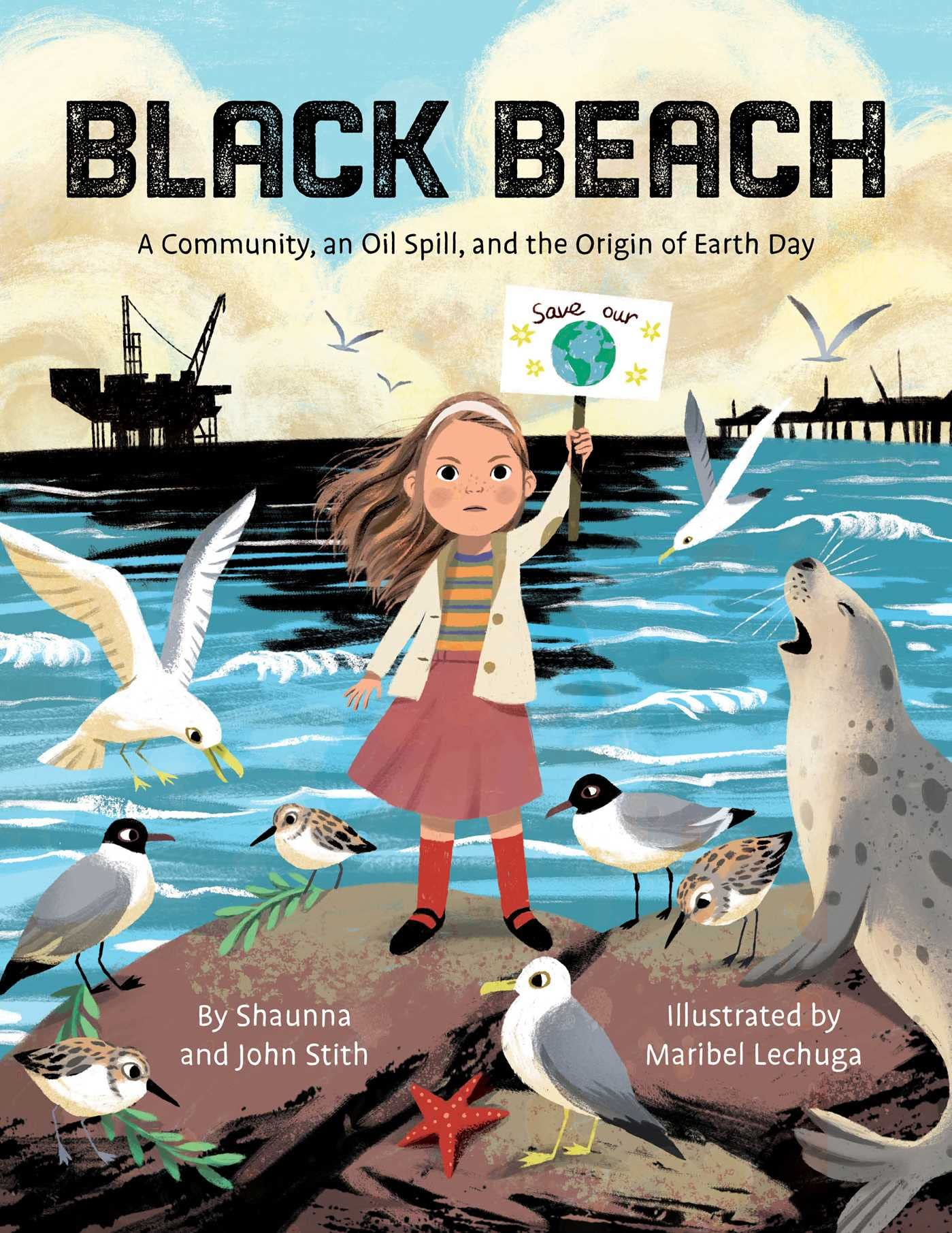
Summary:  Sam is in class drawing a picture of her favorite Santa Barbara beach when the principal walks in and whispers something to her teacher.  She finds out the news at home when her parents tell her about the oil spill that’s polluting her beloved beach.  As the oil starts to wash ashore, Sam feels sad, then angry, as she watches her parents and other volunteers try to clean up the damage.  She and her friends fill bottles with the oil and mail them to politicians.  News coverage increases, and several months later, U.S Senator and environmental activist Gaylord Nelson visits the beach, inspiring him to organize the first Earth Day.  On April 22, 1970, people around the world celebrated, protested, and taught about the environment, beginning a movement that continues today.  Includes an authors’ note, a bibliography, a timeline, additional information about Earth Day, and a list of ten ways to become an environmental activist.  40 pages; ages 4-8.

Pros:  An excellent read-aloud for Earth Day.  The perspective of the fictional Sam brings this true story to life for kids, and the additional information gives them concrete actions to take for the environment.

Cons:  Showing the damage wrought by the oil company, then urging kids to take shorter showers and turn off the lights feels like misplaced responsibility.

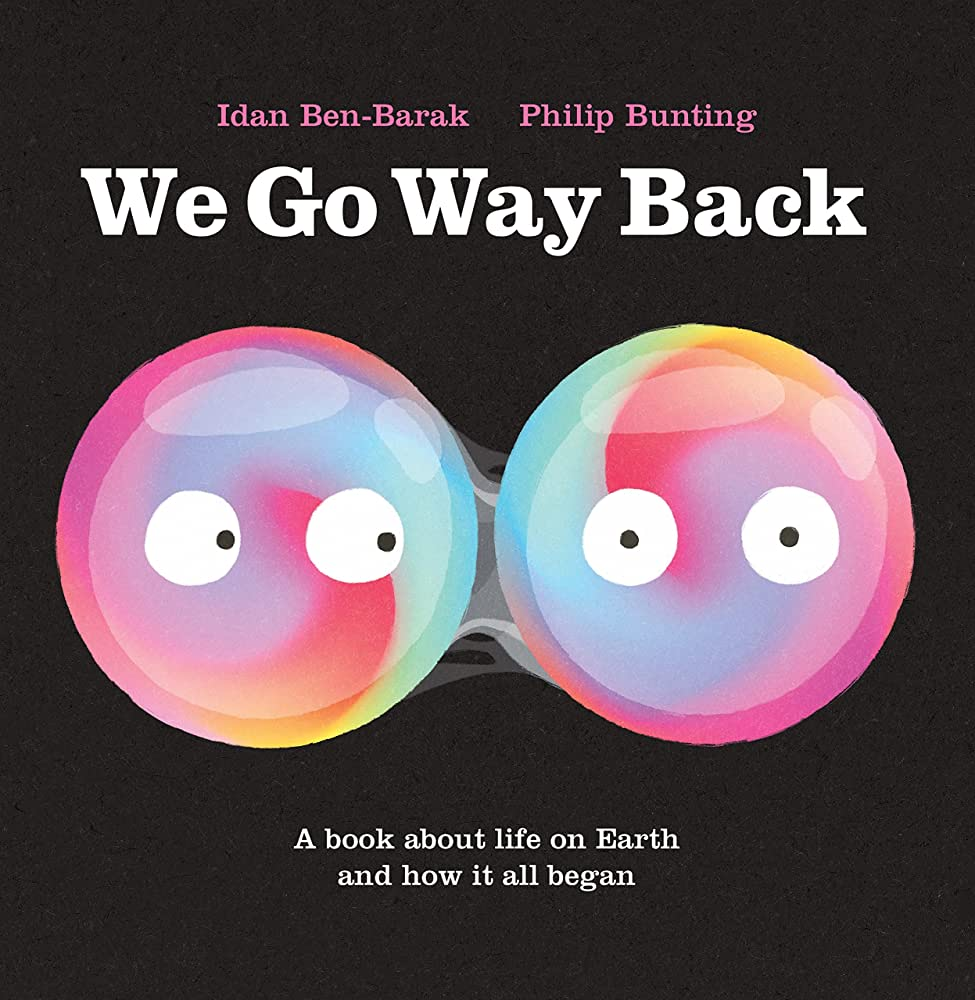
We Go Way Back: A Book About Life on Earth and How It All Began by Idan Ben-Barak, illustrated by Philip Bunting

Published by Roaring Brook Press

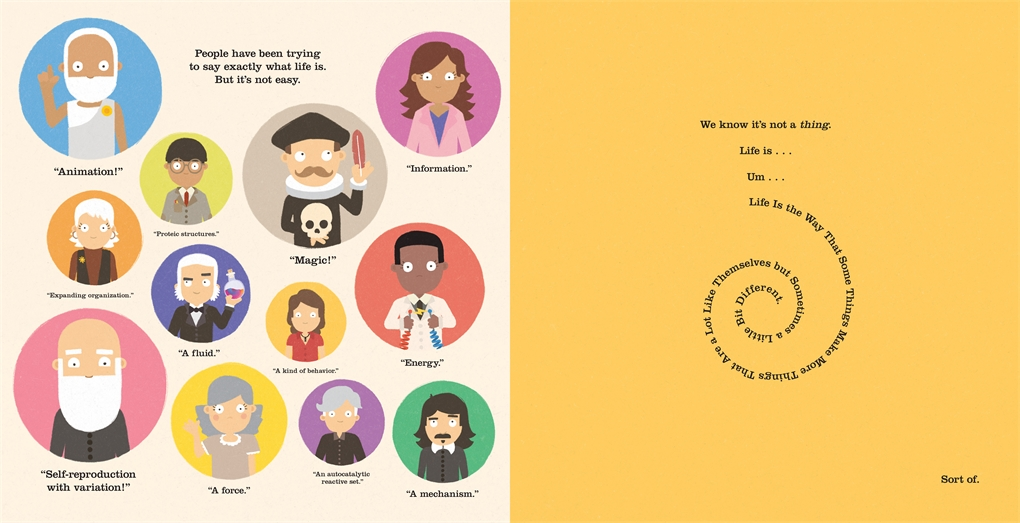
Summary:  Idan Ben-Barak and Philip Bunting have created a picture book about life on Earth and how it started.  Going back to a time when “there was a lot going on” on Earth (erupting volcanoes, raining meteors, lightning strikes), they explain how elements in Earth’s seas joined together to form molecules.  The molecules turned into bubbles until one day, a “special bubble” formed that could make copies of itself, each one just a little bit different.  From this process, all sorts of life forms began to evolve.  The final page is a three-part vertical gatefold that opens up to show the many branches on the tree of life.  40 pages; grades 1-4.

Pros:  This deceptively simple book takes on some enormously complex scientific concepts and manages to clearly explain them with the help of some pretty adorable illustrations.

Cons:  I would like to sit down and have a serious conversation with the editor who decided there was no need for back matter in this book.

The Gentle Genius of Trees by Philip Bunting

Published by Crown Books for Young Readers

Summary:  This friendly introduction to trees starts out with the ways humans benefit from them (wood, paper, food, shade), then moves on to the many amazing things trees can do.  Their roots sink deep into the earth, allowing trees to connect with and even communicate with each other.  The genius of trees extends to their growth, allowing them to optimize the location of branches and leaves for making food through photosynthesis.  The book ends with some lessons humans can learn from trees: be flexible, branch out (but look for the things that give you the most energy), look out for those around you, and grow slow to grow strong.  32 pages; grades 2-5.

Pros:  There’s a surprising amount of information about trees here, all presented with clear explanations, gentle humor, and cute yet informative illustrations. 

Cons:  No back matter.

Nell Plants a Tree by Anne Wynter, illustrated by Daniel Miyares

Published by Balzer + Bray

Summary:  Before children climbed the giant pecan tree, Nell planted a seed.  Before they ran races to the base of the tree, Nell watered a sprout and made sure it had sun.  Before grandchildren helped their grandmother Nell bake goodies with pecans from the tree, Nell dug a hole and planted her sapling.  Over the years, that sapling became a tree, putting down roots and spreading its branches as Nell grew up, too, and created a family in the house next to the tree.  At sunset, that family eats at a long table beneath the spreading branches of the giant pecan tree.  Includes notes from the author and illustrator.  40 pages; ages 4-8.

Pros:  A celebration of trees and families, and the long-term commitment needed to see both of them flourish, with beautiful illustrations that help tell the story.  I love the final spread with its gorgeous sunset colors and the tree sheltering the family.

Cons:  It looked like Nell had at least three kids, but only one made it back for the dinner under the tree.