Whale Fall: Exploring an Ocean-Floor Ecosystem by Melissa Stewart, illustrated by Rob Dunlavey

Published by Random House Studio

Summary:  When a whale dies, its massive body sinks to the bottom of the deep sea, beginning a 50-year process that supports all kinds of ocean life.  Hagfish, sleeper sharks, and other scavengers are the first to arrive, eventually picking the bones of the whale clean.  Zombie worms feed on the bones, and squat lobsters eat the zombie worms.  The process continues for decades, supporting millions of animals in the deep sea, until every trace of the whale has disappeared.  Includes additional information on the 22 animals included in the main text, a list of selected sources, and resources offering additional information.  40 pages; grades K-4.

Pros:  A fascinating look at a process scientists didn’t know occurred until 1987.  The illustrations perfectly capture the deep sea, with close-ups of some of the creatures featured in insets.  A unique topic that is sure to capture the interest of budding marine biologists.

Cons:  The picture of hungry hagfish descending on the whale carcass may be a bit disturbing to whale lovers. Circle of life, man.

Food for the Future: Sustainable Farms Around the World by Mia Wenjen, illustrated by Robert Sae-Heng

Published by Barefoot Books

Summary:  From a honey farm in Yemen to a circular garden in Senegal to an underwater biosphere in Italy, this book takes readers on a tour of innovative sustainable food production sites around the world.  Each two-page spread has a rhyming couplet about the farm or other site, with illustrations showing people at work.  A map at the end shows all the sites and provides information about sustainable farming and food justice.  There’s additional information about each place, including a description and why it’s sustainable.  Includes notes from the author and illustrator about how they were inspired to create this book.  40 pages; ages 4-8.

Pros:  An inspiring look at sustainable food production that includes both indigenous practices and new technology.  The built-in definitions and pronunciation guides make this a great resource for younger kids, who will also find the bright folk art style illustrations appealing.

Cons:  Some additional resources would have been nice.

Super Small: Miniature Marvels of the Natural World by Tiffany Stone, illustrated by Ashley Spires

Published by Greystone Kids

Summary:  Each of the fifteen tiny animals profiled here has a superpower. Whether it’s the pygmy seahorse’s ability to camouflage, the axolotl’s regenerative powers, or the black-footed cat’s lethal aim, each animal has something that allows it to survive despite being so small.  Each profile includes an illustration, a poem, and a comic strip that gives the animal the chance to show off its special abilities.  The final poem asks readers to consider what their superpowers might be.  36 pages; grades K-4.

Pros:  The cute poems, comics, and illustrations offer a fascinating look at some unique animal adaptations, and the last poem is a nice way to get kids thinking about what makes them unique as well.

Cons:  I would have loved some additional information at the end, particularly about how the hydra stays young forever.

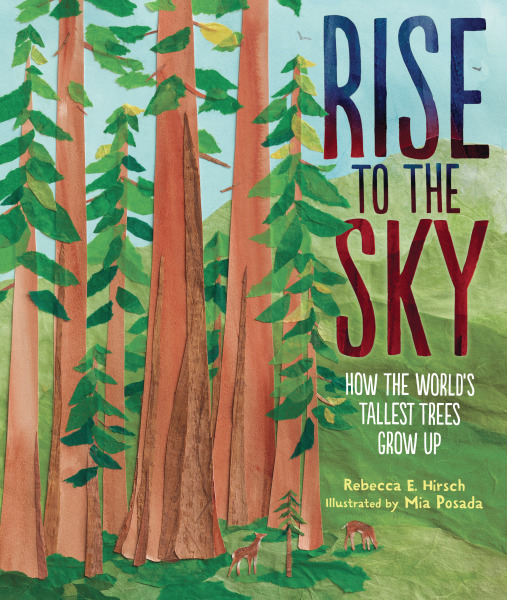
Rise to the Sky: How the World’s Tallest Trees Grow Up by Rebecca E. Hirsch, illustrated by Mia Posada

Published by Millbrook Press

Summary:  The tallest living thing isn’t an animal: it’s a tree.  Trees can grow taller than the Statue of Liberty or Big Ben, closing in on 400 feet.  Amazingly, they all start as a small seed, but the ideal conditions of sunlight and water can result in lots of growth and a long life, sometimes thousands of years, with protection from their bark and roots.  From their great height, the trees send down their seeds to the ground, beginning the process all over again.  Includes additional information about trees, photos and facts about some of the world’s tallest trees, a couple of tree activities, and a list of resources.  32 pages; grades K-4.

Pros:  An excellent informational book with beautiful illustrations and plenty of back matter.  Perfect for any unit on trees, plants, or seeds.

Cons:  It would have been nice to have a map showing where the tallest trees live, since they seem to be concentrated in just a few places in the world.

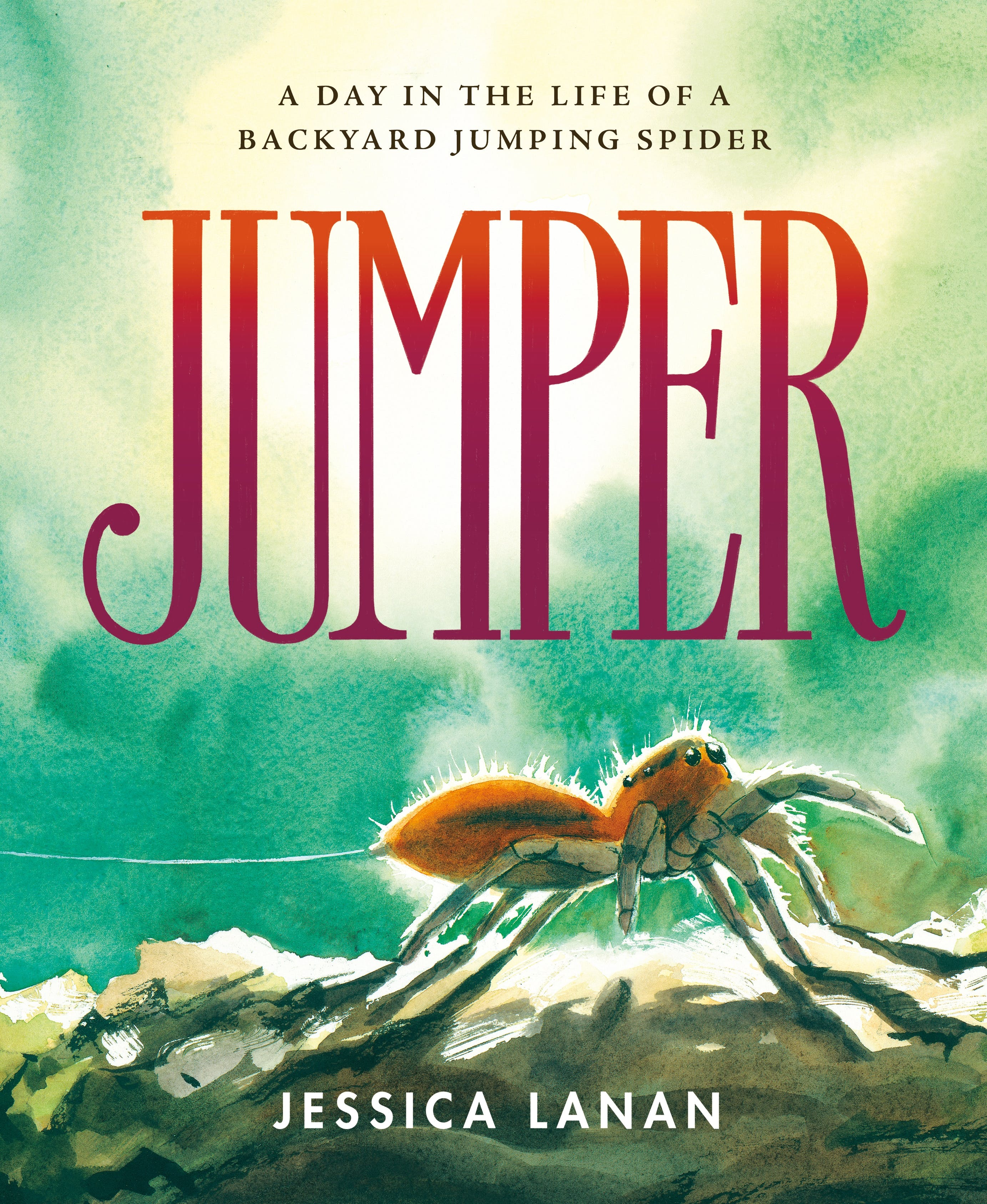
Jumper: A Day in the Life of a Backyard Jumping Spider by Jessica Lanan

Published by Roaring Brook Press

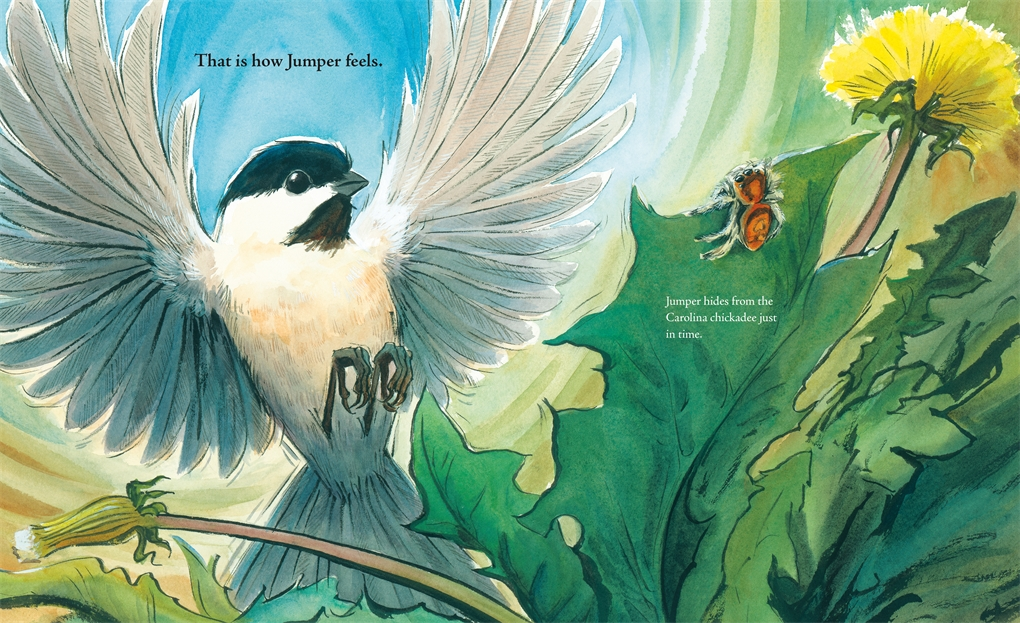
Summary:  As a young girl explores a backyard garden, a jumper spider engages in parallel activities.  They both have senses to explore the world around them, but Jumper’s senses are extra keen, with sound-detecting hairs all over her body and eight eyes that see in all directions.  These senses, plus her jumping abilities, keep her safe from predators like a chickadee and a wasp.  She also uses them for hunting, and the final pages show her successful capture of a fly as big as she is.  Includes four pages of additional information, a glossary, a list of resources, and steps for finding and identifying spiders.  48 pages; ages 4-8.

Pros:  Spectacular illustrations portray a spider’s-eye view of the world, including a gatefold illustration of what the garden looks like through eight eyes.  The extensive back matter makes this an excellent resource for research.  Could be a Caldecott or Sibert contender.

Cons:  The capture of the fly is not for the faint of heart.

Champion Chompers, Super Stinkers and Other Poems by Extraordinary Animals by Linda Ashman, illustrated by Aparna Varma

Published by Harry N. Abrams

Summary:  Using mask poems (poems in which the writer speaks in the voice of someone or something else), Linda Ashman has animals give hints as to what they are and what superlatives (fastest, biggest, stinkiest, etc.) they hold in the animal world.  Each poem has an illustration showing part of the animal to give an additional clue.  Turn the page, and the animal is pictured in full, along with a paragraph of information.  Opening and closing poems introduce the contest.  Includes additional information about protecting endangered animals, measurements, and mask poems, as well as a glossary, and lists of websites and books.  48 pages; grades 1-4.

Pros:  I do love a good guessing book to keep kids engaged, and this one lets readers guess both the animals and the records they hold.  The illustrations are cute and offer hints to go with each poem.  Kids can try their hands at mask poems after reading these.

Cons:  It may be a little long for primary kids to get through all of these in one sitting.

We Are Starlings: Inside the Mesmerizing Magic of a Murmuration by Robert Furrow and Donna Jo Napoli, illustrated by Marc Martin

Published by Random House Studio

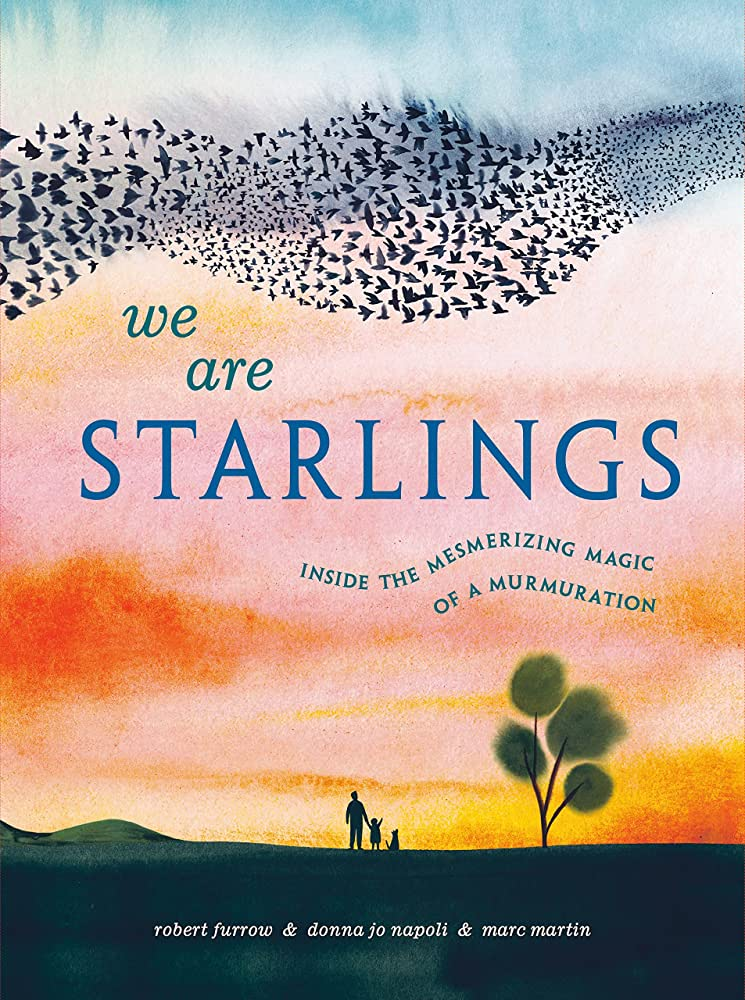
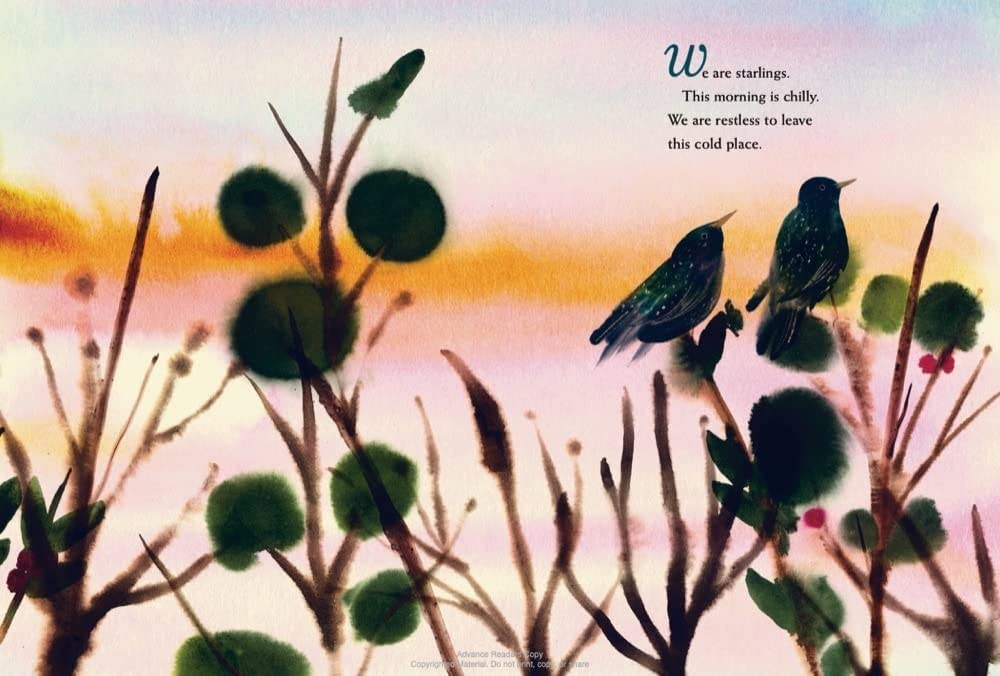
Summary:  Two starlings rest on a chilly morning, then fly away with others.  They travel for days, with more starlings joining them, until thousands of them are flying as a group, called a murmuration for the sound all those flapping wings make.  The huge flock provides warmth and protection, demonstrated when a peregrine falcon tries to attack.  After surviving that, the starlings are ready for some fun, diving and swooping in spectacular formations until they find a place to land and roost together.  Includes a two-page note about starlings.  40 pages; ages 4-8.

Pros:  The spectacular illustrations capture the movement of the murmuration, showing the black birds silhouetted against a beautiful sky at sunrise or sunset.  The poetic text gives just enough information to intrigue readers, with more offered in the note at the end.

Cons:  No additional resources.

Wings, Waves & Webs: Patterns in Nature by Robin Mitchell Cranfield

Published by Greystone Books

Summary:  Readers are invited to find patterns in nature, beginning with simple ones like spots (a ladybug and a guinea fowl feather) and stripes (a skunk and a sunflower seed).  The patterns become increasingly complex, moving on to mirror and radial symmetry, branching, and collective motion.  Each type is accompanied by one or two illustrations that show the pattern in nature.  The final spread of a flower garden invites the reader to look for the different patterns that have just been introduced.  36 pages; ages 4-8.

Pros:  A simple but thorough introduction to patterns that will have kids recognizing them in everyday life.  The beautiful graphics make this an eye-catching addition to STEM collections.

Cons:  I know the Oxford comma is optional, but I would have made the title Wings, Waves, & Webs.

Indigenous Ingenuity: A Celebration of Traditional North American Knowledge by Deidre Havrelock and Edward Kay

Published by Christy Ottaviano Books

Summary:  Before making contact with Europeans, indigenous people had technologies to assist them with communication, transportation, agriculture, health care, and more.  While these innovations were designed to help people, they were created in ways that didn’t hurt the environment.  As their lands were increasingly taken over, they often hid these technologies, but today, as the author says, they are often hidden in plain sight: when we eat maple sugar, paddle a kayak, or marvel at astronomical wonders.  The text is divided into eleven chapters, with a final chapter that looks at how indigenous knowledge can help create a sustainable future.  Each chapter has activities to let kids try some samples of the technologies written about.  Includes a map showing cultural areas and peoples referenced, a glossary, a list of contemporary indigenous science organizations, a bibliography, source notes, and an index.  272 pages; grades 4-8.

Pros:  This meticulously researched, engagingly written book provides a fascinating look at indigenous technology, some of which we can see around us today.  Anyone curious about indigenous history or creating a sustainable future will find something of interest here, and the activities make this an excellent text to use for STEM curriculum.

Cons:  The book is pretty text heavy, with some black and white photos.  I felt like color photos and a more engaging layout would have made it more appealing to a wider audience.

We Are Branches by Joyce Sidman, illustrated by Beth Krommes

Published by Clarion Books

Summary:  Branches may call to mind the tops of trees, but the bottoms, their roots, also have branches.  So do rivers and bolts of lightning.  Look closely, and you’ll notice branches in coral reefs and snowflake crystals.  There are branches in bodies, too: bones that branch into fingers and the veins and arteries that allow blood to circulate.  Branches are strong and brave!  Includes additional information about branching patterns.  40 pages; ages 4-8.

Pros:  A Joyce Sidman-Beth Krommes collaboration is always a treat, with beautiful poetic language and distinctive scratchboard illustrations.  This is a great addition to STEM collections, encouraging readers to look for patterns in nature.

Cons:  The last book on patterns this team did was Swirl by Swirl: Spirals in Nature, published in 2011. I hope they’ll create another pattern book before another dozen years go by.