A Girl Can Build Anything by e. E. Charlton-Trujillo and Pat Zietlow Miller, illustrated by Keisha Morris

Published by Viking Books for Young Readers

Summary:  Girls and women in these pages learn to build increasingly larger, more complex objects.  First, it’s a box or birdhouse, then they move on to designing a trellis, a table, and a treehouse for a new playground.  There can be setbacks when projects don’t go as planned, but taking a break and starting again can get you where you want to go.  By the end, a team of women has created a new building at the entrance of the playground.  32 pages; ages 4-8.

Pros:  The cheery text and illustrations provide an empowering introduction to get girls (and boys) excited about learning to use tools and building their own projects.  

Cons:  That it still seems like something of a novelty for girls and women to be using tools and building things.

The Book of Turtles by Sy Montgomery, illustrated by Matt Patterson

Published by Clarion Books

Summary:  Naturalist Sy Montgomery writes engagingly about turtles, starting with descriptions of their anatomy and evolution.  She describes turtle species who hold the records for most colorful, stinkiest, fastest, largest, and more.  There are celebrity turtle profiles and information on how turtles communicate.  Turtles, protected by their shells, have survived for more than 200 million years, but now many species are endangered due to human activities.  The final few pages tell readers different ways they can help them survive.  Includes a glossary, bibliography, and list of resources.  40 pages; grades K-4.

Pros:  Montgomery has a knack for focusing on facts and information that will be of most interest to readers.  The acrylic paintings look almost like photos and show incredible details of a wide variety of turtles.  Kids who already love turtles will be thrilled, and others may become fans after reading this book.

Cons:  I wish this book had been around during my daughter’s decade-long obsession with turtles.

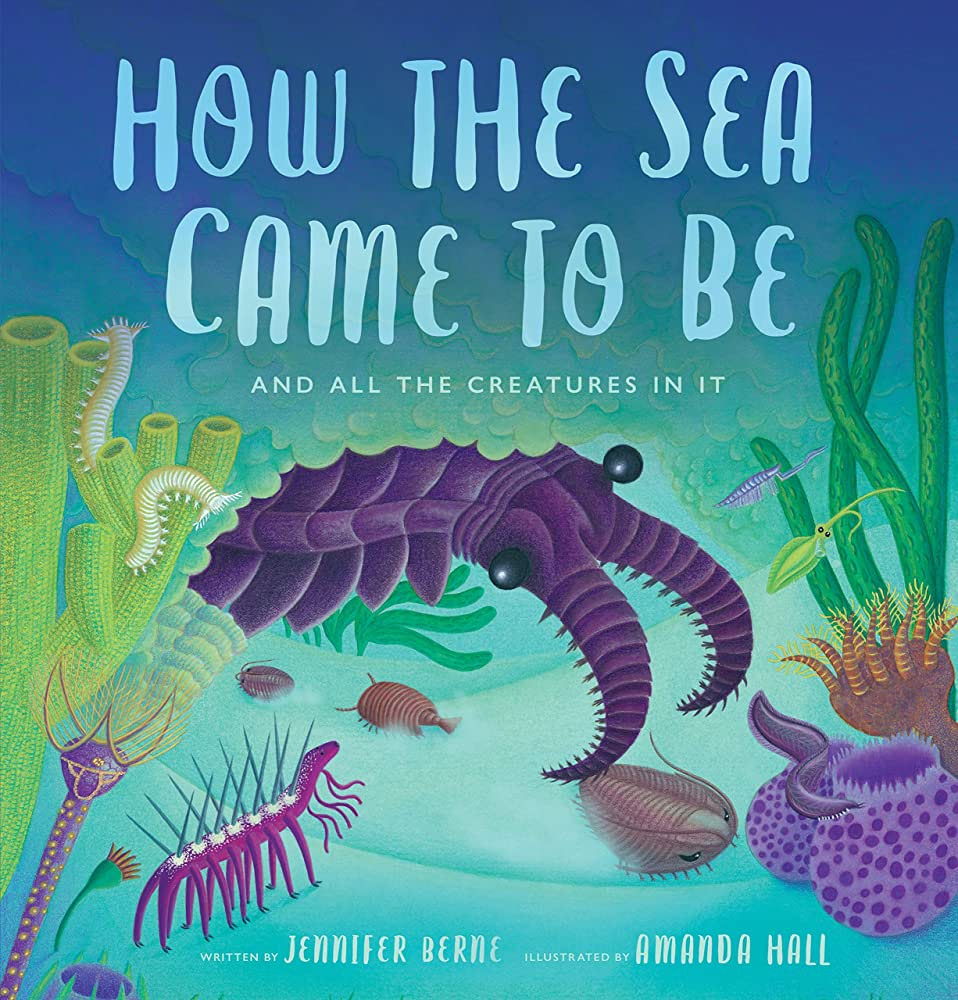
How the Sea Came to Be (And All the Creatures In It) by Jennifer Berne, illustrated by Amanda Hall

Published by Eerdmans Books for Young Readers

Summary:  Rhyming quatrains describe the history of the sea in three parts: the birth of the sea, the birth of life, and the sea from then until now.  All are accompanied by colorful illustrations that sometimes show the sun-dappled waters of the sea and other times take readers down into the black ocean depths.  Includes notes from the author and illustrator; two pages of ocean creatures that include illustrations and a paragraph of information about each; a four-panel gatefold timeline showing seven eras of the Earth’s history; key terms and concepts with definitions; and two pages of additional resources. 56 pages; grades 1-5.

Pros:  A spectacular nonfiction book that should be considered for a Sibert award.  The rhyming text is both catchy and impressive, making this a great choice to read aloud, and the illustrations are truly spectacular, conveying both the powerful forces that created the seas and the incredible diversity of life within them.  The timeline is a masterpiece, and the rest of the back matter makes this an excellent resource for research.

Cons:  I would have liked the timeline to have also been incorporated into the text to show the eras of each of the three parts.

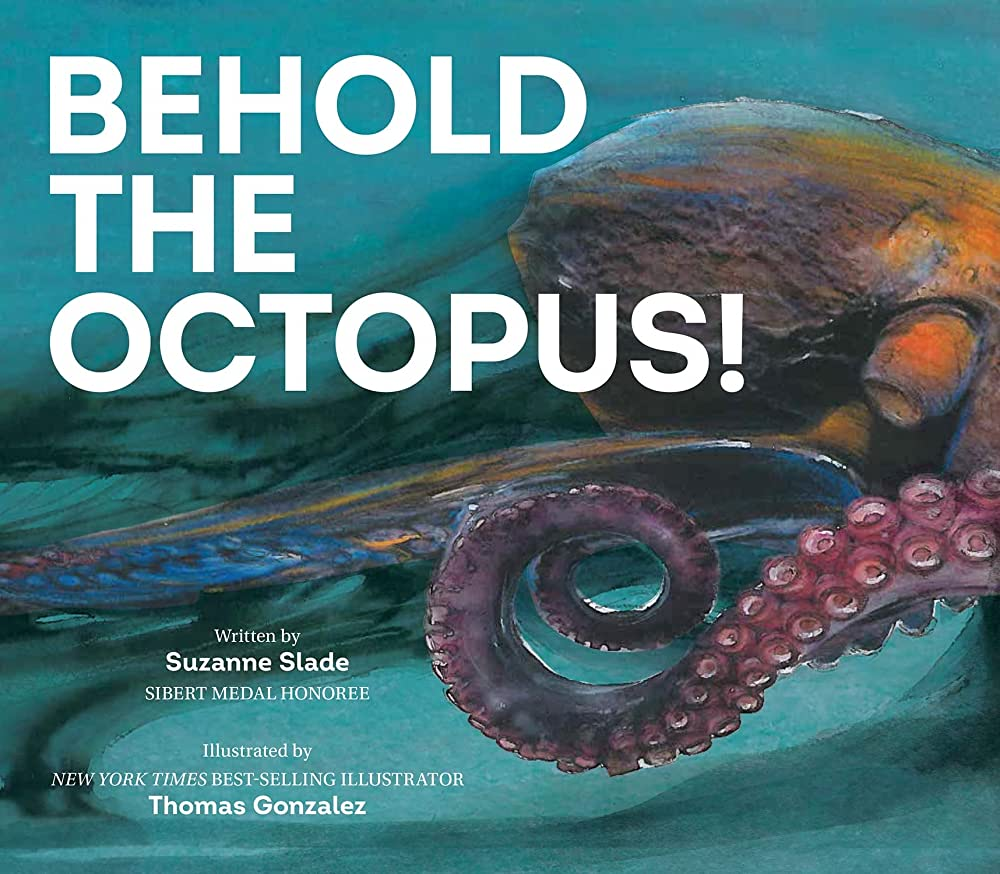
Behold the Octopus! By Suzanne Slade, illustrated by Thomas Gonzalez

Published by Peachtree

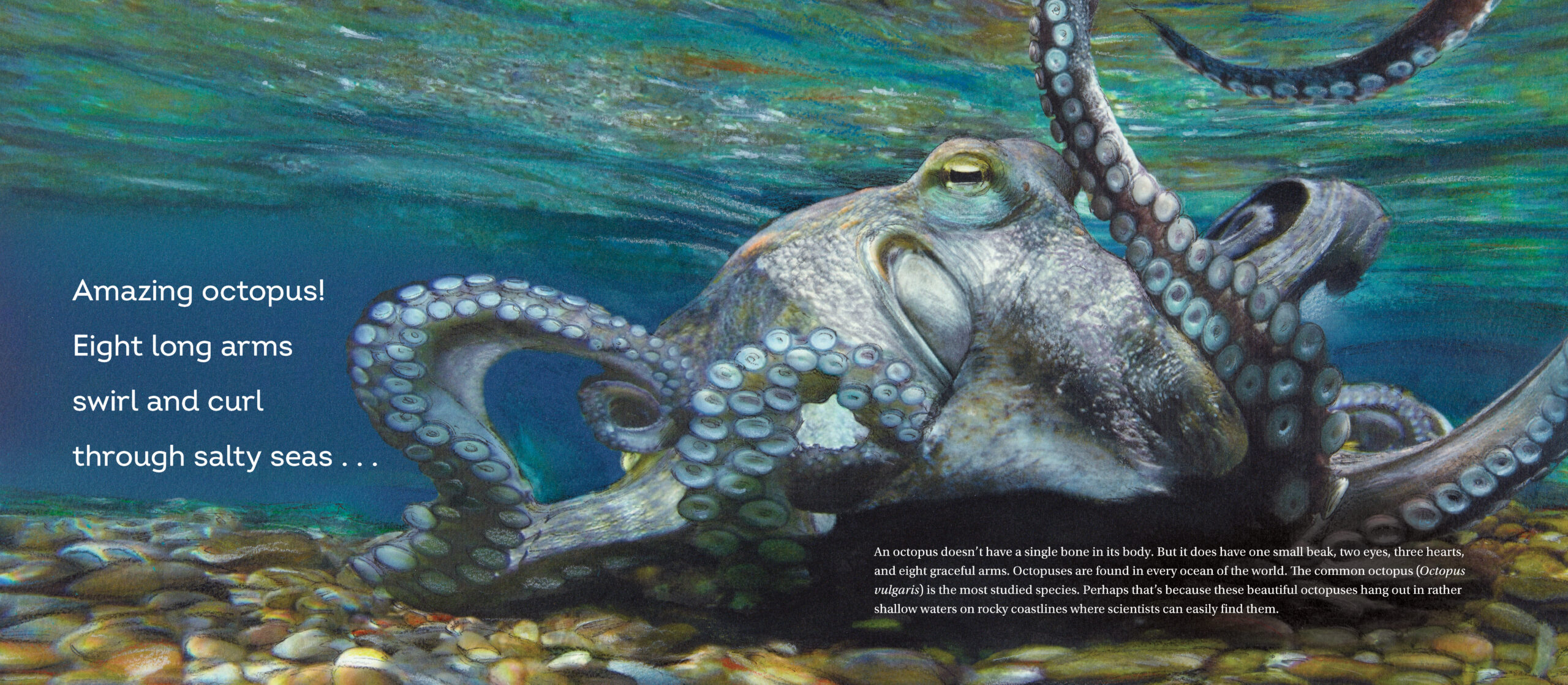
Summary:  The amazing octopus is introduced in a series of two-page spreads, each one portraying a different species of octopus with a verb (hunting, changing, graphing) or adjective (luminous, dangerous) and a paragraph of information inspired by that word.  Includes additional information about octopuses, several photos, a list of resources, and a bibliography.  32 pages; ages 4-8.

Pros:  This visually appealing book makes an excellent octopus introduction for preschoolers but provides enough information and back matter to make it a good research resource for older kids. Fans of the Candace Fleming/Eric Rohmann books, especially Giant Squid, will want to check this out.

Cons:  The last two very cool-looking octopuses in the photos at the end aren’t identified.

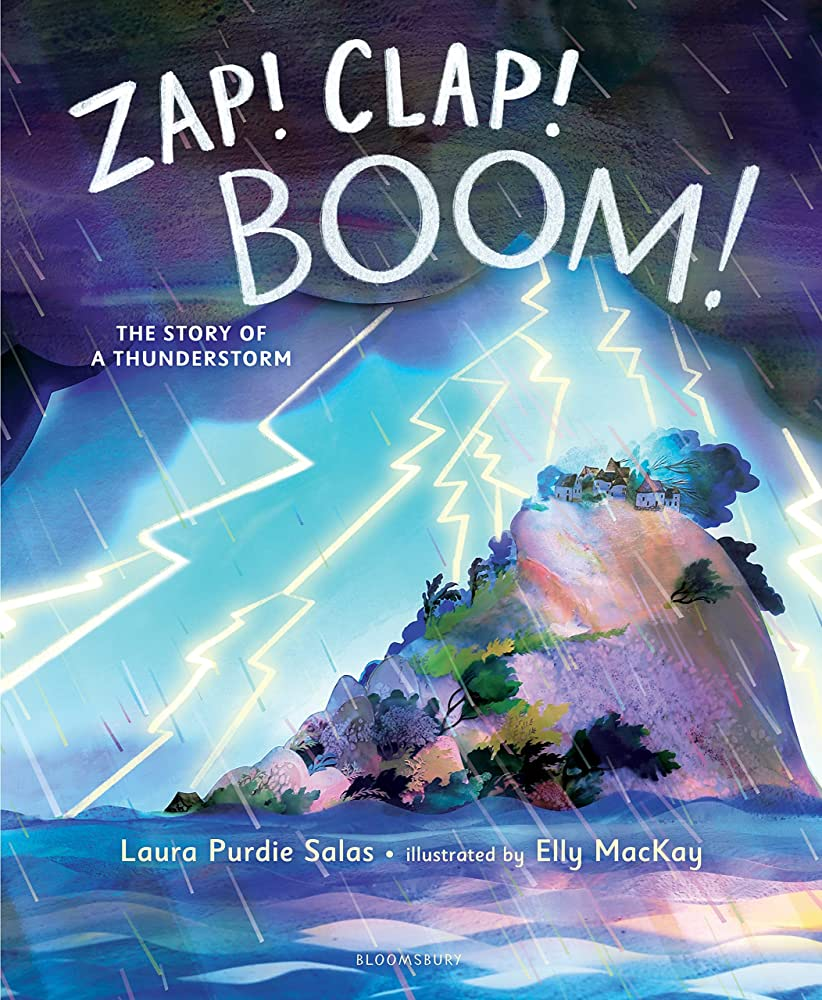
Zap! Clap! Boom! The Story of a Thunderstorm by Laura Purdie Salas, illustrated by Elly MacKay

Published by Bloomsbury Children’s Books

Summary:  Three children play on a sunny day.  Then dark clouds roll in, and suddenly, “ZAP! CLAP! BOOM!” there’s a clap of thunder and lightning is seen in the distance.  The children head for home and three goats run for shelter as the rain arrives.  Safe in their house, the kids watch the lightning and rain.  Then just as quickly, the storm moves on, and both sets of kids head outside again, as “the world now shines.”  Includes additional information on the science of thunderstorms, as well as a list of books and websites.  40 pages; ages 4-9.

Pros:  The rhyming text is very catchy, and kids will enjoy saying the repeated “Zap! Clap! Boom!” refrain.  The dramatic illustrations capture all the phases of a thunderstorm, and the back matter makes this a useful resource for older readers.

Cons:  I thought the kids could have moved toward home a little quicker when the storm arrived.

How Old Is a Whale? Animal Life Spans from the Mayfly to the Immortal Jellyfish by Lily Murray, illustrated by Jesse Hodgson

Published by Big Picture Press

Summary:  From the mayfly (5 minutes to 24 hours) and the honeybee (5 to 7 weeks) to the glass sponge (11,000 years) and the immortal jellyfish (in some sense, forever), this book takes a look at the lifespans of a wide variety of animals.  Each two-page spread shows the animal in its habitat with several paragraphs of information about the it over the course of its lifespan.  The introduction raises interesting questions about lifespans, and the final two pages show all the animals with a list of where to find them in the book.  64 pages; grades 1-5.

Pros:  This engaging book will intrigue all kinds of animal lovers.  I found the animals with the shortest and longest lifespans to be the most fascinating, but all of them had some pretty interesting information.

Cons:  One of my favorite books to read to kids is Steve Jenkins’s Biggest, Strongest, Fastest, which states that the animal that lives the longest is the Galapagos tortoise, with a lifespan of 150 years.  This book listed animals that live even longer.

The Last Plastic Straw: A Plastic Problem and Finding Ways to Fix It by Dee Romito, illustrated by Ziyue Chen

Published by Holiday House

Summary:  Straws have been around since Queen Puabi, Queen of Ur, used a gold tube to slurp up the barley-based drink Sumerians were partial to 5,000 years ago (her subjects just used reeds).  Dr. Marvin Stone patented a paper straw in 1888, created to sip his mint julep, and Joseph Friedman invented the first bendy straw in 1937.  The post-World War II plastics boom led to the sturdier plastic straws that are still ubiquitous today and that are adding tons of microplastic pollution to the planet.  In 2011, 11-year-old Milo Cress started his “Be Straw Free” campaign to cut back on the 500 million straws Americans toss out each day.  It’s a small change, but an important one for all of us to make.  Includes an author’s note that gives additional information about straws and other single-use plastics, a list of sources, and an index.  40 pages; grades 1-5.

Pros:  A fascinating history of the straw that easily leads to a discussion of single-use plastics and how to cut back on your own personal use.  A great Earth Day read-aloud!

Cons:  I really enjoy using plastic straws.  Guess I will just have to suck it up.

Making More: How Life Begins by Katherine Roy

Published by Norton Young Readers

Summary:  A family that’s expecting a baby is out for a hike, where they see signs of reproduction all around them: a robin building a nest, two snakes mating, a deer with her fawn.  From there, the text and illustrations proceed to an explanation of reproduction that covers all sorts of living things, both animals and plants.  Beginning with the process of fertilizing an egg cell, the story moves to embryonic development, then birth.  There’s information on genes and how they create diversity within a species.  The final gatefold spread shows the human family celebrating their new baby at an outdoor party, with some of the animals from the text visible in the background.  72 pages; grades 3-6.

Pros:  An outstanding introduction to reproduction with a lot of technical information explained in terms that will be understandable to upper elementary and middle school readers.  The illustrations are excellent as well, celebrating the diversity of life on Earth.

Cons:  I’m sure the pictures of rabbits and snakes mating will cause some in the book censoring world to break into a sweat.

The Fire of Stars: The Life and Brilliance of the Woman Who Discovered What Stars Are Made Of by Kirsten W. Larson, illustrated by Katherine Roy

Published by Chronicle Books

Summary:  Cecilia Payne’s curiosity about the natural world didn’t get much support when she was growing up in England.  Her family moved from the country, where she loved to explore nature, to London so her brother could go to school in the city.  Cecilia was sent to a religious school that didn’t offer any of the math and science classes that she loved.  She went on to study at Cambridge, where she switched her focus from botany to astronomy after hearing a talk by astronomer Arthur Eddington.  There was no place for her at Cambridge after graduation, so she moved to the other Cambridge (Harvard), where she was surrounded by like-minded women scientists.  Persistence with her research paid off as she made important discoveries about what the stars are made of, discoveries that fired up her imagination to ask even more questions.  Includes additional information about both Cecilia Payne and the birth of stars, as well as a timeline and a bibliography.  48 pages; grades 2-5.

Pros:  This fascinating biography is enhanced by the beautiful illustrations that show the parallels between Cecilia Payne’s life and the birth of a star.  A great read for Women’s History Month.

Cons:  There wasn’t much about Payne’s research after she discovered what stars are made of, a discovery she made at the age of 25.

The Sky Is Not the Limit by Jérémie Decalf

Published by Eerdmans Books for Young Readers

Summary:  The space probe Voyager 2 narrates its journey from assembly to rocket launch to outer space.  It flies by Jupiter, Saturn, Uranus, and Neptune, with pages of black, starry space to show the distance and time between planets.  Finally, it heads for interstellar space, where our sun is just another star.  Both Voyager 2 and its twin Voyager 1 carry a Golden Record filled with photographs and recordings from Earth.  Includes a page and a half of additional information, the NASA website where updates and photos can be seen, and a map of the solar system on both sets of endpapers. Translated from French. 64 pages; grades 1-4.

Pros:  The simple, lyrical text and incredible illustrations that beautifully capture the vastness and wonder of space.  

Cons:  Readers will no doubt be left with plenty of questions about this amazing journey, so it would have been nice to have more additional resources.