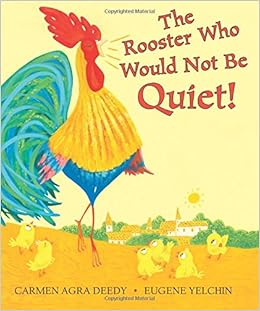
The Rooster Who Would Not Be Quiet! By Carmen Agra Deedy, illustrated by Eugene Yelchin

Published by Scholastic Press

Summary:  The village of La Paz is a very noisy place until the people, wanting some peace and quiet, fire the mayor.  The new mayor, Don Pepe, brings in peace and quiet all right, but his ban on singing makes the village as quiet as a tomb.  One day a rooster comes to town with his family, and at dawn delivers a loud, “Kee-kee-ree-kee!”  Don Pepe tries everything he can to shut up the rooster–putting him in jail, cutting off his food, and eventually threatening to kill him–but the rooster continues his song.  “A song is louder than one noisy little rooster and stronger than one bully of a mayor,” says the rooster, “and it will never die–as long as there is someone to sing it.”  The inspired townspeople burst into song, Don Pepe skulks out of town, and La Paz is a noisy, lively village once again.  48 pages; ages 4-8.

Pros:  A timely message in today’s world, celebrating those who will not be shut down by bullies. Kids will enjoy the colorful rooster and exaggerated evil-villain characteristics of Don Pepe.

Cons:  While I’ve seen this book on a few Caldecott lists, I found the illustrations a mixed bag; I liked the portrayals of the rooster and Don Pepe, but not so much the ones of the townspeople.

If you would like to buy this book on Amazon, click here.

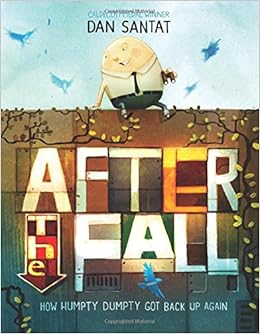
After the Fall (How Humpty Dumpty Got Back Up Again) by Dan Santat

Published by Roaring Brook Press
Summary:  Yes, Humpty Dumpty got put back together again, but “there were some parts that couldn’t be healed with bandages and glue.”  Humpty is now afraid of heights–he sleeps on the floor rather than in his top bunk, and is forced to buy Bo-Rings cereal rather than the enticing Sugar Bunny and Rainbow Bites that are stocked on the top shelves.  Worst of all, though, he misses the birds he used to watch from his perch atop the high wall.  Inspired by a paper airplane, Humpty creates a flying bird, but is dismayed when it lands on top of his old wall.  Determined, the egg overcomes his fear, and slowly climbs up the ladder on the side of the wall.  At the top, he cracks again…only this time, a beautiful bird emerges and soars into the air.  40 pages; ages 4-8.

Pros:  Dan Santat tells a remarkable story, making a fairy tale connection and using humor that preschoolers will enjoy, but conveying a message for all ages.  The illustrations may be worthy of another Caldecott for the illustrator.

Cons:  The “Sad Clown” cereal that is one of Humpty’s options on the grocery store’s lower shelf.

If you would like to buy this book from Amazon, click here.

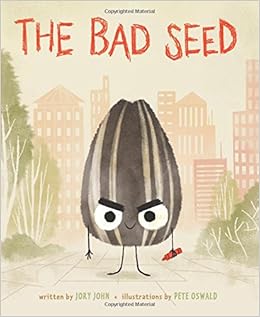
The Bad Seed by Jory John, illustrated by Pete Oswald

Published by HarperCollins

Summary:  That is one bad seed.  He never puts things back where they belong.  He tells long jokes with no punch line.  And he’s late to everything.  Why?  Well, it’s kind of a long story.  He started out okay, growing  up in a big family on a sunflower.  When the flower wilted, though, he lost his home, and eventually ended up in a bag.  A giant started to eat him, but he got spit out at the last minute.  It was pretty much downhill from there.  But now he’s made a decision to try to be good.  It isn’t always easy, and sometimes he slips back into his old ways, but he keeps going, and eventually starts to think maybe he’s not such a bad seed after all.  40 pages; ages 4-8.

Pros:  Pretty funny stuff that could open up discussion about why people do “bad” things, and how to help them do better.  It can’t be easy to personify different seeds, but Pete Oswald does a charming job.

Cons:  I’ve done just about all the “bad” things listed by the seed.  The picture of the abandoned shopping cart in the parking lot really hit home for me.

If you’d like to buy this book on Amazon, click here.

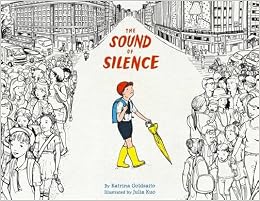
The Sound of Silence by Katrina Goldsaito, illustrated by Julia Kuo

Published by Little, Brown Books for Young Readers 

Summary:  Yoshio enjoys hearing the sounds of his Tokyo neighborhood: rain falling on his umbrella, his boots squishing in puddles, his own delighted giggles.  One day he hears a new sound, a woman playing a koto with twinkling, twangy notes.  When she’s through, he asks her what her favorite sound is.  She replies, “The sound of ma, or silence.”  From then on, Yoshio tries to hear the sound of silence, but at home, outside, or in school, there are always other sounds.  Finally, arriving early at school one morning, he sits down and begins to read.  Suddenly, in the middle of a page, he realizes that he is surrounded by silence!  He notices how peaceful it makes him feel, and realizes that the sound of silence has been there all along, running underneath all the other sounds.  An afterword explains the concept of ma and how it has influenced Japanese music and other culture.  40 pages; grades K-3. 

Pros:  A beautiful introduction to some aspects of mindfulness and meditation, and a way to help kids relax and focus on the present moment.  The illustrations show many details of a Tokyo home and neighborhood, and a note at the end explains how they were created using a combination of pen drawings and digital coloring. 

Cons:  This could be a tough concept for young kids to understand.

More-igami by Dori Kleber, illustrated by G. Brian Karas

Published by Candlewick Press 

Summary:  Joey loves things that fold—tacos, road maps, his foldaway bed—so when Sarah Takimoto’s mother comes to his school one day to demonstrate origami, Joey is captivated.  He asks Mrs. Takimoto to teach him, to which she wisely replies, “I can show you the folds.  But if you want to be an origami master, you’ll need practice and patience.”  So Joey goes home and folds everything in sight.  After going through his homework, his sister’s sheet music, Aunt Vivian’s recipe, and the $38 in his mother’s purse, his family has had enough.  Discouraged, Joey wanders into the neighboring Mexican restaurant, where the sympathetic owner gives him a job folding napkins.  He starts simply, but doesn’t give up, and after months of practice, he is finally able to create a masterpiece. Includes instructions for an origami ladybug.  40 pages; ages 4-8.

Pros:  A charming story about the importance of persistence when learning a new skill.  Joey, who appears to be African-American, is taught by a Japanese American woman and helped by his Mexican American neighbor in a multicultural friendly community.

Cons:  Apparently I lack the “grit” necessary to master origami, because even the ladybug looks a bit challenging to me.

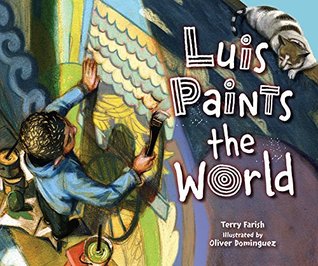
Luis Paints the World by Terry Farish, illustrated by Oliver Dominguez

Published by Carolrhoda 

Summary:  Luis is sad because his brother Nico is leaving to join the army and go overseas.  When Nico tells Luis he is going to see the world, Luis begins painting a mural trying to capture the world so Nico will want to come home again.  After Nico leaves, Luis incorporates photos that Nico texts him into his mural.  Gradually, their mother and others from the neighborhood join in to make the mural a community effort.  The seasons pass, and finally, one warm summer day, Nico comes home again.  A note from the author explains that Luis, Nico, and the mural are based on her experiences working in Lawrence, Massachusetts.  32 pages; ages 4-9.

Pros:  The rich, colorful illustrations capture Luis’s mural beautifully, and the story is real and heartfelt.

Cons:  A few of the Spanish words and phrases aren’t translated.


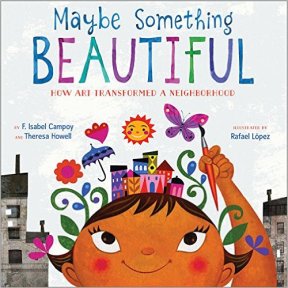
Maybe Something Beautiful: How Art Transformed a Neighborhood by F. Isabel Campoy and Theresa Howell, illustrated by Rafael Lopez

Published by Houghton Mifflin Harcourt 

Summary: Mira is an artist. She loves to draw what she sees around her, and give her pictures to family, friends, and neighbors. One day, a man comes to her neighborhood who loves art as much as she does. He starts to paint murals around the community, and he invites Mira and her neighbors to join him. The bright colors are like magic, and when the murals are done, the painters don’t stop. They paint sidewalks, utility boxes, and benches. The man who started it all unites everyone with a wave of his paintbrush. Pages at the end tell about Rafael Lopez, who is both the man in the story and the illustrator of this book, and how he transformed San Diego’s East Village, and has since moved on to other communities around the world. 40 pages; ages 4-8.

Pros: An inspiring true story about one man who made a difference. Not only did he beautify his own community, but his work has raised money to help talented artists get more education, and his movement has spread around the world. His illustrations convey the magical transformations of his art, and should put Lopez in contention (again) for some Caldecott recognition.

Cons: I would have loved to have seen more photos of the real murals and other artwork.

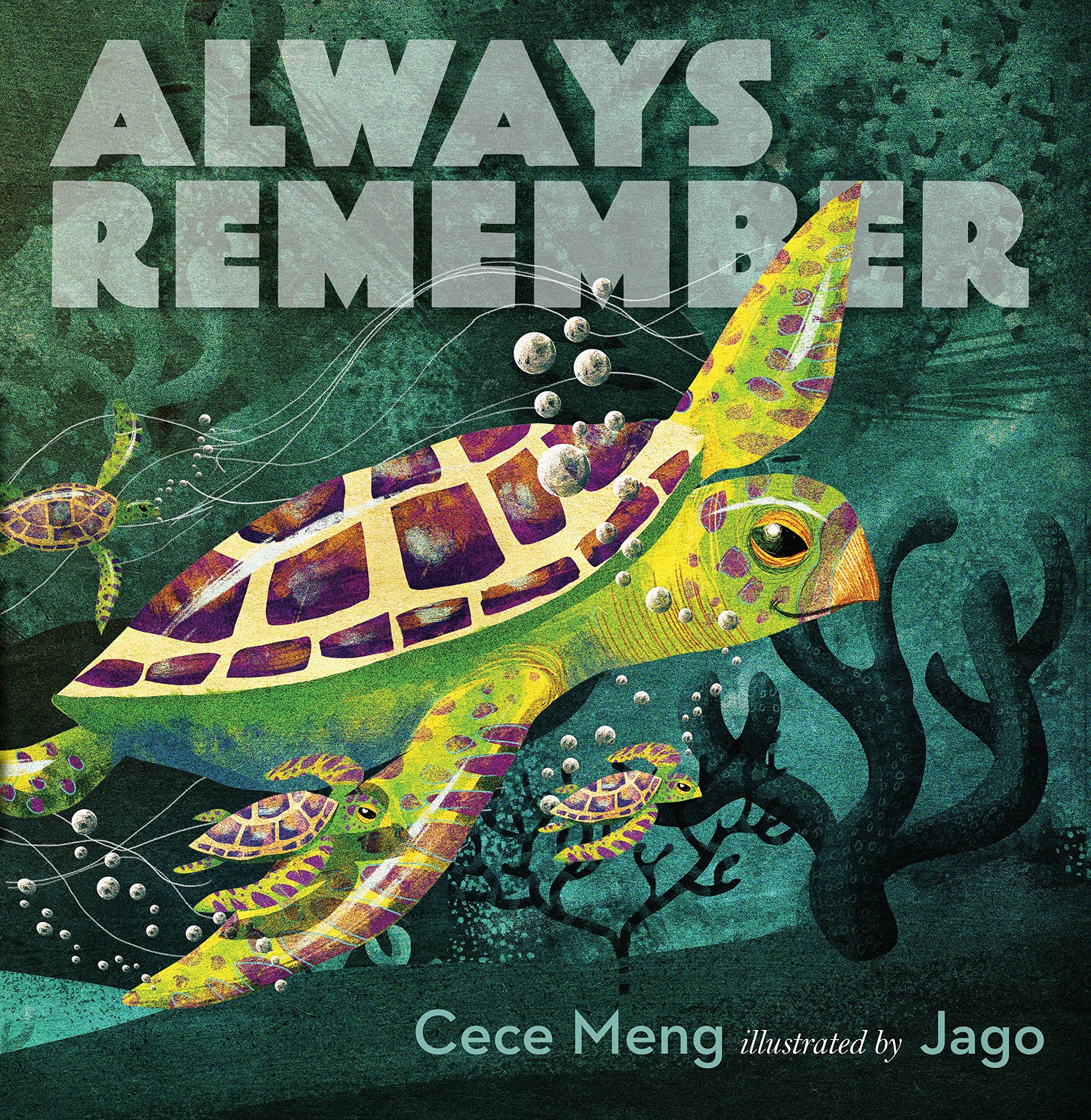
Always Remember by Cece Meng, illustrated by Jago

Published by Philomel Books

Always Remember: Meng, Cece, Jago: 9780399168093: Amazon.com: Books

Summary:  When Old Turtle takes his last breath and swims his last swim, the waves carry him away, and his friends remember him.  The young turtles remember how he taught them how to swim; the otters remember how he loved to play and have fun; the manatee remembers how he rescued him when he was tangled in a fishing net.  At the end, they conclude that Old Turtle lived a life filled with kindness, love, and helpfulness, and his legacy will live on through their own lives.  32 pages; ages 3-7.

Pros:  A beautifully illustrated simple story that celebrates a life well-lived and gives children a way to look at death as the completion of life.

Cons:  Another three-Kleenex read-aloud.

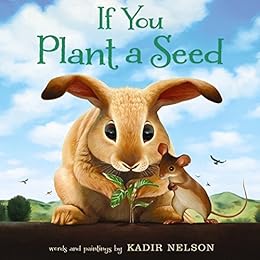
If You Plant a Seed by Kadir Nelson

Published by HarperCollins 

If You Plant a Seed - Kindle edition by Nelson, Kadir, Nelson, Kadir.  Children Kindle eBooks @ Amazon.com.

Summary:  If you plant carrot, tomato, and cabbage seeds, Bunny and Mouse discover, you get carrots, tomatoes, and cabbage.  They’re just about to enjoy the fruits of their labor when a flock of birds shows up, clearly wanting to sample the veggies.  If you plant the seeds of selfishness, they grow, too…into a heap of trouble.  And, in this case, a food fight.  Ready for a different approach, Bunny and Mouse try sharing, planting seeds of kindness.  The birds reciprocate by flying overhead, dumping bags of seeds.  The resultant garden makes everybody happy.  32 pages; ages 4-8.

Pros:  The big, beautiful pictures of really, really cute animals complement the simple text and message.

Cons:  The message may be a bit heavy-handed.

New Shoes by Susan Lynn Meyer, illustrated by Eric Velasquez

Published by Holiday House

Summary:  When Ella Mae’s family scrapes together enough money to buy her a new pair of shoes, she is dismayed to learn that black people can’t try on shoes at the store.  She watches a white girl try on her shoes, while Ella Mae’s mother has to trace around her foot to figure out her size.  The first day she wears her shoes to school, she feels bad about her experience at the shoe store all day.  Then she and her friend Charlotte come up with a brilliant plan.  For weeks, they do chores for people, asking for payment in used shoes.  Finally, they display all the shoes in their barn, then put a sign up announcing people can buy a pair for ten cents and another used pair of shoes.  The people in their community are thrilled that they’ll never have to use the shoe store again.

Pros:  I loved this powerful story about segregation.  Instead of the girls feeling victimized by it, they come up with a solution and work hard to make it happen.

Cons:  The solution is inspiring but a bit simplistic, and a larger conversation about segregation would be helpful when reading this.