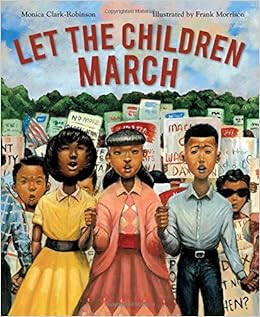
Let the Children March by Monica Clark-Robinson; illustrated by Frank Morrison

The majority of books I have read in 2018 have been about African-Americans and the Civil Rights Movement.  I will be sharing reviews of these for the next week, beginning today.

Published by Houghton Mifflin Harcourt

Summary:  A girl tells about her participation in the Birmingham Children’s March of 1963, starting with a family trip to church to hear Dr. Martin Luther King, Jr.  When he urges the congregation to march, many of the adults are afraid of losing jobs, so young people offer to go.  On May 2, she and other children and teens begin their protest, only to be met with dogs, fire hoses, and arrest.  On the third day, she is sent to jail.  When their story is broadcast around the world, changes begin to happen, and within two months, the girl is playing on a playground she’s never been allowed to use before.  Back matter includes an afterword, an artist’s statement, a bibliography, and three photos from the march.  40 pages; grades 1-4.

Pros:  A compelling story, made even more so by the first-person narration and the large, realistic oil paintings.  The message that one person can make a difference is inspiring.

Cons:  The desegregation process seemed overly simplified.

If you would like to buy this book on Amazon, click here.

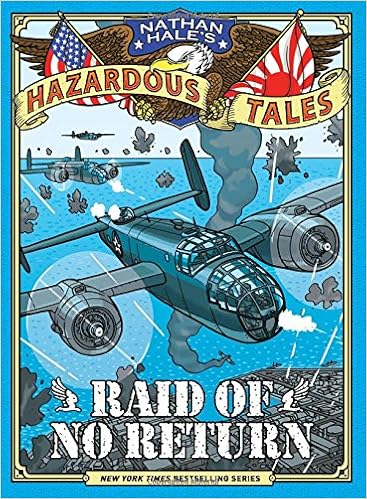
Raid of No Return: A World War II Tale of the Doolittle Raid by Nathan Hale

Published by Amulet Books

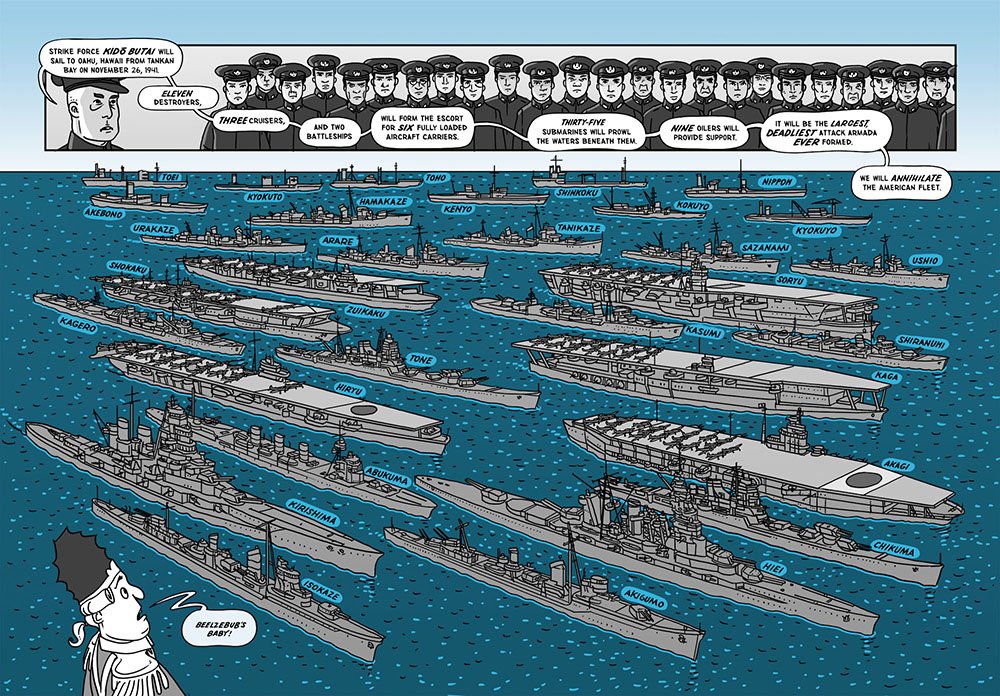
Summary:  In 1942, at a time when the Japanese empire seemed invulnerable, the U.S. government came up with a plan to bomb Tokyo.  Famed aviator James “Jimmy” Doolittle was chosen to lead the raid.  The men who were chosen to join him prepared without knowing anything about the top-secret mission they would be going on.  On April 18, 1942, sixteen bombers, each with a five-man crew, flew off an aircraft carrier, dropped bombs on their targets, then attempted to fly to China.  Fifteen made it, but crashed short of their destinations; the sixteenth landed in Russia.  Most of the men survived, although some were taken prisoner by the Japanese, and three of them were executed.  Although the mission didn’t do much damage, it was an important morale-booster for the United States that led to more military successes in the Pacific.  128 pages; grades 4-8.

Pros:  It’s difficult for me to find superlatives to express how much I love Nathan Hale’s Hazardous Tales.  For those who dismiss graphic works as “trash”, I would invite them to peruse this book and see how the graphics enhance the information.  Pages 20-24 show an aerial view of Pearl Harbor before and after Japan’s attack, demonstrating how devastating that was to America in a way words alone couldn’t do.  I love all the books; this particular one tells an exciting adventure story placed in the context of the early days of World War II.  There is plenty of humor without any disrespect to the heroic men whose stories are told.

Cons:  There were a lot of characters and planes (80 men and 16 bombers) to keep track of.

If you would like to buy this book through Amazon, click here.

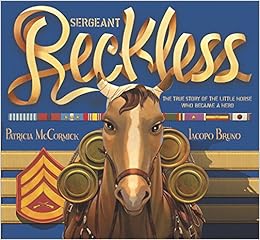
Sergeant Reckless: The True Story of the Little Horse Who Became a Hero by Patricia McCormick, illustrated by Iacopo Bruno

Published by Balzer + Bray

Summary:  When a group of U.S. Marines was looking for a pack animal to haul ammunition in the Korean War, they ended up buying a scrawny abandoned horse from a nearby racetrack.  She was given a military rank, and became known as Private Reckless.  The men trained her to duck incoming fire and to retreat, using her insatiable appetite for just about any kind of food to get her to do what they needed.  She learned to stay calm in battle, carrying heavy loads of ammunition on her back.  In one day-long battle, she made 51 trips, totaling 35 miles up and down hills, to carry 9,000 pounds of ammunition.  That earned her a promotion to sergeant, and her Marine friends started a campaign to send her to the United States.  They were successful, and she was able to retire with full military honors and two Purple Hearts, the only animal to ever hold military rank.  An author’s note tells more of Reckless’s story, including a photo and a brief bibliography.  40 pages; grades 1-5.

Pros:  Animal lovers and military history buffs will enjoy this story about a unique horse who won the hearts of the U.S. Marines with her humor, hard work, and bravery.

Cons:  Reckless’s diet of coffee, Coca-Cola, and chocolate.

If you would like to buy this book on Amazon, click here.


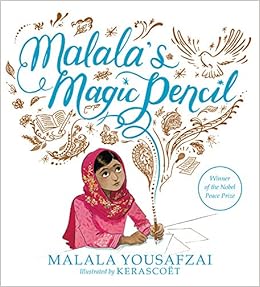
Malala’s Magic Pencil by Malala Yousafzai, illustrated by Kerascoet

Published by Little, Brown Books for Young Readers

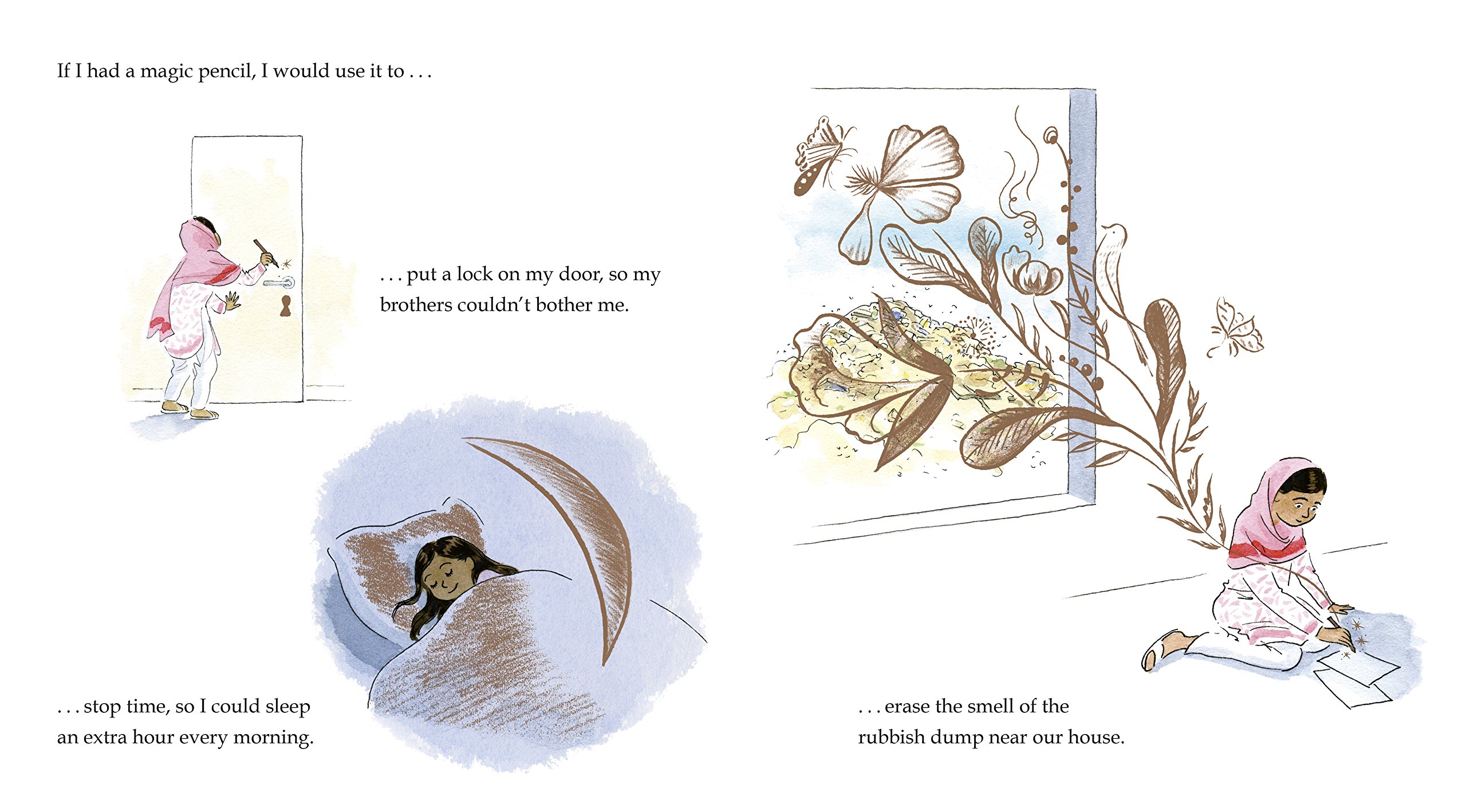
Summary:  Malala Yousafzai describes how she used to watch a TV show about a boy who had a magic pencil that could create whatever he drew.  She wished she could have one so she could draw a lock on her bedroom door, new dresses for her mother, and a soccer ball for her brothers.  As she grew older, her dreams grew too, and soon she wished she could use her magic pencil to erase the poverty she saw around her.  She worked hard at school, and when “powerful and dangerous men” took over her country, she started speaking out about the importance of letting girls attend school.  With white letters on a black page, Malala states, “My voice became so powerful that the dangerous men tried to silence me. But they failed.”  The accompanying illustration shows her looking out a hospital window.  The last few pages show her continuing her work today, writing, demonstrating, and speaking at the United Nations.  Back matter includes a letter from Malala, a page of biographical information, and three photos of her at different stages of her life.  48 pages; ages 5-8.

Pros:  A moving introduction to Malala Yousafzai’s courageous story, beautifully illustrated with ink and watercolor drawings.  Kids looking for more information can move on to the young reader’s edition of I Am Malala.

Cons:  You didn’t really think I was going to write something negative about a book by Malala on Thanksgiving Day, did you?

If you would like to buy this book on Amazon, click here.

Before She Was Harriet by Lesa Cline-Ransome, illustrated by James E. Ransome

Published by Holiday House

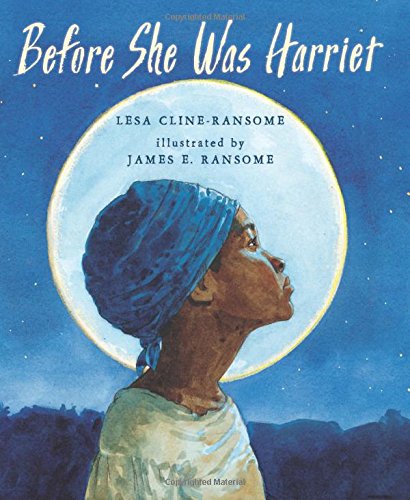
Summary:  Harriet Tubman’s story is told in reverse, beginning when she is “an old woman/tired and worn/her legs stiff/her back achy”.  Before that, she was a suffragist, and before that, a Union spy.  The narrative continues back in time, showing Harriet as Moses, conducting slaves to freedom on the Underground Railroad, and finally, all the way back to a child named Araminta, “who dreamed/of living long enough/to one day/be old/stiff and achy/tired and worn and wrinkled/and free”.  32 pages; grades 1-4.

Pros: A brief, poetic look at Harriet Tubman’s life and many achievements, beautifully illustrated by Coretta Scott King medalist James Ransome.

Cons:  I was disappointed that there was no back matter giving more biographical information.

If you would like to buy this book on Amazon, click here.

Her Right Foot by Dave Eggers, illustrated by Shawn Harris

Published by Chronicle Books

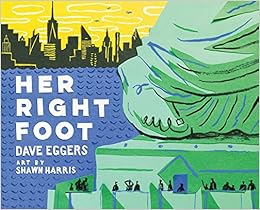
Summary:  Think you know about the Statue of Liberty?  Chances are, you will learn something new if you read this book.  It starts in France, where the Statue herself started, and describes the creation and construction of it, first in France and then again in the United States.  It was brown for about 35 years until the copper turned its current shade of green.  The author relates some quirky details about different parts of the statue, then focuses on one specific part: her right foot, which is lifted as though she is walking away.  Where is she going?  He concludes that she is an immigrant, like all the other immigrants she has welcomed over the years.  Immigrants don’t stand still.  They are always moving forward, and like them, the Statue of Liberty is moving toward the ocean to greet the people who continue to come to the United States.  Includes a page of sources for further reading.  104 pages; grades 2-6.

Pros:  A quirky, moving book that is part history and part celebration of immigration, told in a conversational tone and beautifully illuminated with unique cut-paper illustrations.

Cons:  Nonfiction? 104-page picture books?  About the Statue of Liberty?  Or immigration?  It’s hard to know how to categorize this 104-page picture book that jumps from one topic to the next.

If you’d like to buy this book on Amazon, click here.

The Red Bandanna (Young Readers Adaptation) by Tom Rinaldi

Published by Viking

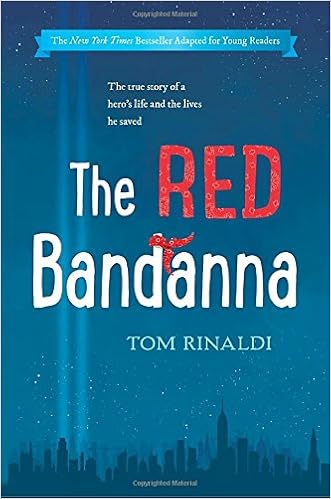
Summary:  On September 11, 2001, as people were struggling to evacuate the Twin Towers, some were led out by a young man with a strong, clear voice and a red bandanna over his face.  Although he helped many people to safety, he himself did not survive.  This book tells the story of Welles Crowther, a 24-year-old Wall Street trader who had worked as a volunteer firefighter, and was considering a career change to FDNY.  From a young age, Welles was fascinated with firefighting, and was a compassionate and exuberant boy who often helped his friends.  He always carried that red bandanna, and it later helped identify him, allowing the survivors he helped to connect with his family.  A feature on ESPN spread his story around the world, and continues to remind others to follow Welles Crowther’s inspiration to help.  176 pages; grades 5-8.

Pros:  Keep the tissues handy for this moving story of a young man whose brief life has touched many, many others around the world.

Cons:  “Bandanna” just looks wrong, but apparently “bandana” and “bandanna” are both correct.

If you’d like to buy this book on Amazon, click here.

Ben Franklin’s In My Bathroom! By Candace Fleming, illustrated by Mark Fearing

Published by Schwartz & Wade

Summary:  When Nolan and his younger sister Olivia receive a package containing an antique crystal radio set, they’re unsure about how it works.  They try twisting dials and flipping switches, and before they know it, they have conjured up Benjamin Franklin from the year 1789.  Ben is quite taken with the 21st century, and insists on going on a tour to see how some of his creations, like the public library and fire station, are faring.  Along the way, he shares stories from his life, told in comic book style.  People are startled, but charmed, by the eccentric old man wandering around town with the two children, and Franklin thoroughly enjoys himself until he starts contemplating the possibility of never seeing his 18th-century friends and family again.  Nolan, who is dealing with an absent father, is sympathetic and finds a way to send his new friend back home.  Billed as Book 1 in the History Pals series, the illustration of the radio offers some hints about what other times in history are planned for the rest of the series. Includes a 10-page section at the end with more information about Franklin, including a bibliography and websites.  272 pages; grades 2-5.

Pros:  Readers won’t realize they’re getting a dose of history education in this fast and funny tale.  A large font, plenty of illustrations, and frequent comic book page inserts make this a good choice for reluctant readers.

Cons:  The bathroom/toilet front cover may turn off some adults; there’s actually very little bathroom humor.

If you’d like to buy this book on Amazon, click here.

Schomburg: The Man Who Built a Library by Carole Boston Weatherford, illustrated by Eric Velasquez

Published by Candlewick

Summary:  Arturo Schomburg grew up in Puerto Rico, where he loved reading and history.  When his fifth grade teacher told him that people from Africa had no history, he began a lifelong quest to prove her wrong.  At age 17, he moved to New York and became a bank clerk, but his real passion was collecting books, papers, and pamphlets having to do with African and African-American history.  Eventually, his collection grew to such a size that his wife said she was leaving if he didn’t sell it.  The New York Public Library purchased it, and it became the cornerstone of their Negro History, Literature, and Prints collection.  Schomburg also served as curator for the Negro Collection at Fisk University Library in Tennessee.  Includes a timeline and bibliography. 38 pages; grades 3-6.

Pros:  The free verse poems that make up the text tell the story of Arturo Schomburg, but also of many of the people whose stories he collected, including Phillis Wheatley, Frederick Douglass, and Toussaint Louverture.  A poem called “Whitewash” explores the African heritage, mostly ignored, of such famous people as John James Audubon, Alexandre Dumas, and Beethoven.  The large oil paintings that illustrate this oversized book bring all these subjects to life.

Cons:  From the outside, this looks like a picture book biography of Arturo Schomberg, but there is much more to it.  It would be doing a disservice to try to get through it all in a single sitting.

If you’d like to buy this book on Amazon, click here.

Dazzle Ships: World War I and the Art of Confusion by Chris Barton, illustrated by Victo Ngai

Published by Millbrook Press

Summary:  During World War I, Great Britain was desperate to find a way to protect its ships from German torpedoes.  Desperate enough to consider training seagulls or sea lions to spot submarines, or to have swimmers try to smash the subs’ periscopes.  But then a Royal Navy officer had an idea to camouflage the ships.  The camouflage, however, wasn’t to make the ships blend in with their surroundings, but rather to use brilliant patterns to break up the shape of the boats and confuse the Germans looking at them through their periscopes.  The Navy hired teams of women to come in and “dazzle” many of its ships.  The U.S. copied the idea, and over 4,000 ships were painted before the end of the war in 1918.  Did this method really work?  The verdict is still out; more ships did avoid torpedoes, but there were other tactics used like convoys and depth charges that might have been more effective.  The dazzle ships do celebrate, in an eye-catching way, the power of creative thinking and problem solving.  Includes notes from the author and illustrator with more history and a description of how they created this book, as well as a timeline of WWI events, and some photos of Wilkinson, his team of painters, and one of their ships.  36 pages; grades 2-5.

Pros:  An fascinating bit of little-known military history, illustrated with amazing art nouveau paintings that celebrate patterns and the art of the time.  I would love to see this considered for a Caldecott.

Cons:  It was disappointing to learn that the dazzle ships might not have actually prevented any torpedo attacks.