America’s Tea Parties: Not One But Four! Boston, Charleston, New York, Philadelphia by Marissa Moss

Published by Abrams 

Summary:  Everyone knows about the Boston Tea Party, but it turns out that event was just the beginning.  After word got around to the other colonies, Sons of Liberty groups in Charleston, New York, and Philadelphia had their own tea parties to prevent British tea from getting into colonial shops and to protest the hated tax on tea.  The four tea parties are put into context with a thorough look at the events leading up to them, as well as the various players in each colony.  Plentiful illustrations and sidebars add even more information.  End matter includes a six-page author’s note, a timeline covering events from fall of 1773 to the end of 1774, an extensive bibliography, and an index.  48 pages; grades 3-7.

Pros:  Middle grade social studies curricula will be given a boost with this well-written history of the period leading up to the American Revolution.  Thorough research, an engaging writing style, and plenty of illustrations make this an excellent nonfiction choice.

Cons:  There’s a lot of information here for the average fifth or sixth grader to wade through.

Two Friends: Susan B. Anthony and Frederick Douglass by Dean Robbins, illustrated by Sean Qualls and Selina Alko

Published by Orchard Books 

Summary:  Imagine Susan B. Anthony and Frederick Douglass, both civil rights activists who lived in Rochester, New York, sitting down to tea and cake together.  That’s the starting point of Two Friends, which then takes a look back at the early life of both Anthony and Douglass and how they became involved in the struggles to end slavery and give women the right to vote.  An author’s note gives a bit more information, as well as dates when both goals were achieved in the United States.  32 pages; grades K-3.

Pros:  An interesting introduction to two important 19th century activists whose civil rights struggles are still relevant today.  The colorful folk-artsy illustrations nicely portray Anthony, Douglass, and their homes in Rochester.

Cons:  A pretty brief introduction with only a little biographical information.

The Hole Story of the Doughnut by Pat Miller, illustrated by Vincent X. Kirsch

Published by Houghton Mifflin Harcourt 

Summary:  Hanson Gregory left his family’s farm for a life at sea in 1844 at the age of 13.  He quickly rose from cook’s assistant to become captain of a clipper ship.  By all accounts, he became an excellent commander, even receiving a medal for heroism from the queen of Spain after rescuing seven Spanish sailors.  But what Hanson Gregory is remembered for today is inventing the doughnut.  As cook’s assistant, he was charged with making breakfast cakes of fried dough.  Because the centers of these cakes remained raw and heavy, they were called sinkers.  One day Gregory had the brilliant idea to cut out the centers with the top of the pepper shaker.  The rest is baking history.  Over the years, legends arose about the genesis of the doughnut, and others even claimed to have invented it, but this book lays these rumors to rest once and for all.  An author’s note gives a bit more information about Gregory.  A timeline and bibliography are also included.  32 pages; grades K-3.

Pros:  An excellent introduction to the invention of ordinary items, told with plenty of humor in both the text and the illustrations.

Cons:  Does not really address the question, Dunkin’ or Krispy Kreme?


We Came to America by Faith Ringgold

Published by Alfred A. Knopf 

Summary:  An illustrated poem celebrating immigration.  Ringgold starts with the lines, “We came to America/Every color, race, and religion/From every country in the world” then repeats them several times through the book.  In between, she mentions those who were here already, those who came in chains, those who came to escape from a dangerous situation, and other ways immigrants came to America.  She celebrates the contributions each culture made to American culture.  All the people are depicted with simple, brightly colored illustrations.  The entire poem is printed on the last page.  32 pages; grades K-3.

Pros:  A perfect introduction to immigration for the primary grades (although a little context would be needed before reading).  The illustrations are eye-catching, and the repeating text invites kids to chant along.

Cons:  Every time I saw this book sitting on my desk, Neil Diamond’s “Coming to America” got stuck in my head.

Diana’s White House Garden by Elisa Carbone, illustrated by Jen Hill

Published by Viking 

Summary:  World War II is raging, and Diana Hopkins, the 10-year-old daughter of Presidential advisor Harry Hopkins wants to do her part.  Spying and trying to scare off enemies by sticking pins in the couch don’t work out too well, but she’s delighted when she overhears her father and Franklin Roosevelt talking about a new plan to encourage Americans to grow victory gardens.  The first demonstration garden is to be planted right on the White House lawn.  Diana teams up with First Lady Eleanor Roosevelt to create it.  Before long, Diana is outside watering and weeding almost every day, and even gets her picture in the paper, standing in front of her thriving Victory Garden.  On the last page, the Hopkinses and the Roosevelts sit down to a feast that includes beans, carrots, lettuce, and tomatoes from the new garden.  Notes from both the author and illustrator give a bit more information about Diana Hopkins and Victory Gardens, and the research that went into the creation of the book.  44 pages; grades K-4.

Pros:  A nice bit of World War II historical fiction.  Diana is a likeable character, with both a mischievous side and an admirable desire to contribute to the war effort.  My mother, just a bit younger than Diana in 1940, would love this book.

Cons:  Diana’s life looks like it was a lot sadder than portrayed in this book…her mother died before this story takes place and her father, just a few years after.


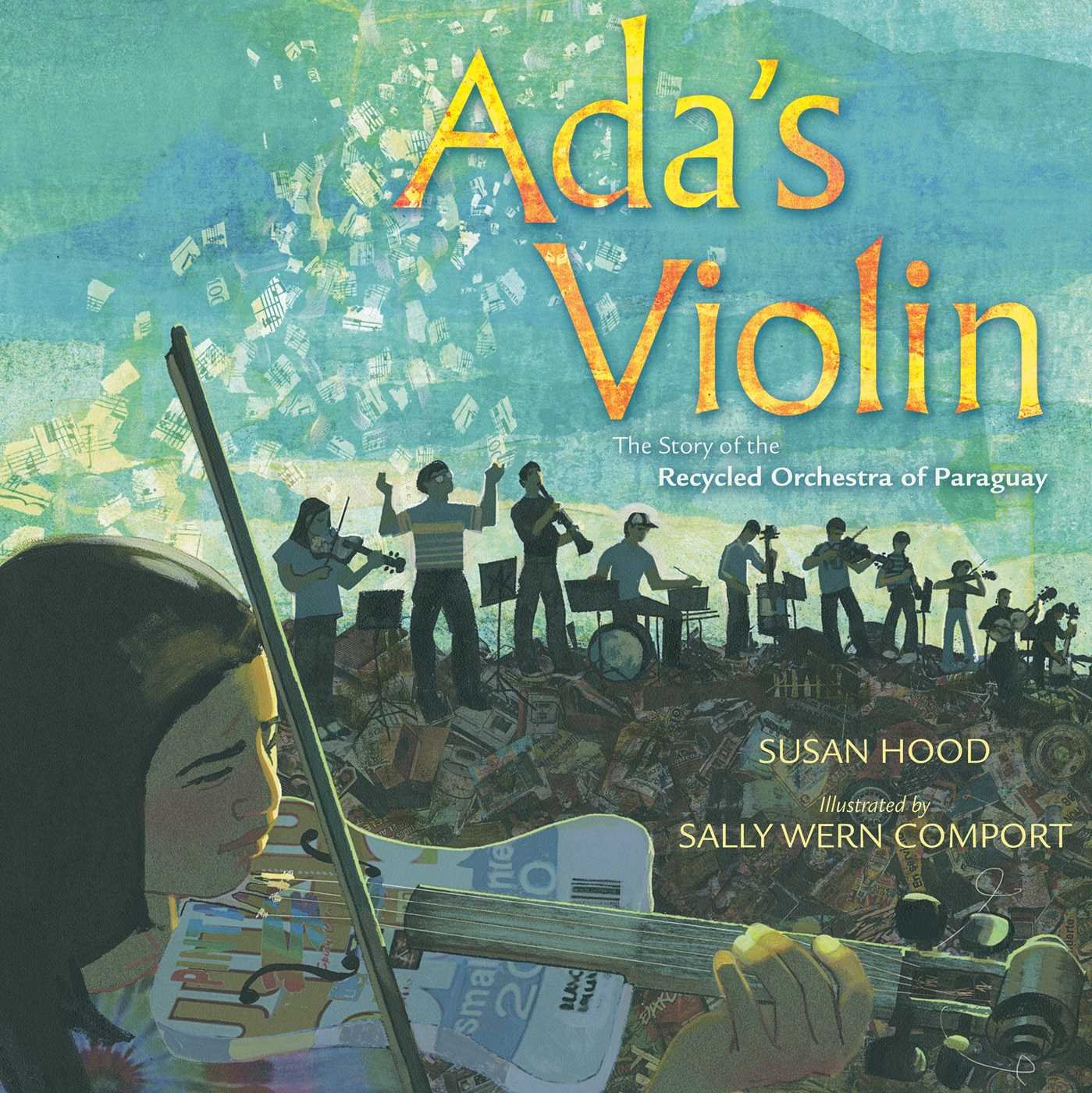
Ada’s Violin: The Story of the Recycled Orchestra of Paraguay by Susan Hood, illustrated by Sally Ward Comport

Published by Simon & Schuster Books for Young Readers

Summary:  Ada lived in one of the poorest places on earth, Cateura, Paraguay, home of the garbage dump for the capital city of Asuncion.  Most adults there survive by picking through trash, finding items they can recycle and resell to make a bare subsistence living.  Ada and her classmates appeared to be heading for the same lives as their parents, until a man named Favio Chavez came to town and offered music lessons.  The problem was, he only has a few instruments, and they were so valuable that the kids were afraid to carry them home.  So Chavez got to work making instruments from objects he found in the trash.  Before long, there were enough kids playing to form an orchestra.  Ada loved music and worked so hard that she became first violin.  The orchestra has traveled all over the world, and even opened for a Metallica concert.  Back matter includes an author’s note, sources, and photos of the orchestra and some of their instruments.  40 pages; grades 1-4.

Pros:  An inspiring story of how one man has made an amazing difference in the lives of an entire community. The illustrations do a great job of capturing the designs of the different instruments, as well as the emotions of their players.

Cons:  I wanted to hear the music!  Fortunately, YouTube helped me out.  Just search for “Recycled Orchestra of Paraguay” to learn more and to see and hear these amazing instruments in action.

The Mummy Makers of Egypt written and illustrated by Tamara Bower

Published by Seven Stories Press 

Summary:  Paneb is the head of a family of embalmers; his young son Ipy is being trained to follow in his footsteps.  When Yuya, father of Queen Tiye, dies, Paneb and Ipy oversee a lengthy process of embalming and burial.  Each step is important in preserving the body for the afterlife, and there are many rituals that go with each part of the process.  The Egyptian religion is described, with beliefs about what happened to people after they died.  There’s also a section on the embalming process, with pictures of the tools and the people performing their jobs drawn in ancient Egyptian style.  A lengthy endnote describes the discovery of Yuya’s tomb in the early 20th century; there are also a few photos and drawings of items found in the tomb.  40 pages; grades 3-8.

Pros:  Written and illustrated by an expert on ancient Egypt, this book is clearly a labor of love designed to impart a great deal of information about many aspects of Egyptian culture, both through the text and the illustrations.  The end note, three pages of small type, is a bit daunting, but very interesting and informative.

Cons:  The section on the embalming process (e.g., brain removal through the nose) may not be everyone’s cup of tea.

An Armadillo in New York by Julie Kraulis

Published by Tundra Books 

Summary: Arlo, an armadillo based in Brazil, knows that when he feels a twitch in his left claw, it’s time for him to start planning an adventure. His grandfather Augustin gave him a set of travel journals about all his favorite places, and the one about New York City guides Arlo on his journey. Making stops at the Brooklyn Bridge, Yankee Stadium, Central Park, and many other well-known landmarks in the Big Apple, Arlo marvels at all that he sees. He’s also puzzled by his grandfather’s many references to Lady Liberty. It isn’t until his last stop, a trip on the ferry to Liberty Island, that he finally figures out who Lady Liberty really is. Arlo looks forward to return visits to the Statue of Liberty and other places in New York City. The last page gives additional facts about the Statue of Liberty. 32 pages; grades K-3.

Pros: The beautiful, slightly dreamy illustrations and the adorable armadillo will make readers want to take a trip to NYC. This is a sequel to An Armadillo in Paris; we can hope that Arlo will be doing more traveling in the future.

Cons: The story line is pretty thin.

On the Farm, At the Market by G. Brian Karas

Published by Henry Holt and Company

Summary:  Where does all that yummy food at the farmers’ market come from?  This book goes behind the scenes to a farm, a dairy, and a mushroom grower to see what happens the night before market day.  Everyone is busy into the night, harvesting, cooking, and packing.  Early in the morning, the food is transported and unpacked, and then the fun begins.  Chef Amy from the Busy Bee Cafe makes her usual rounds, selecting fresh food for the evening’s special.  At the end of the day, all of the farmers and their helpers head over to the cafe to relax and enjoy the fruits (and veggies) of their labors.  40 pages; grades K-3.

Pros:  Kids who have never gone to a farmers’ market will want to check one out after reading this book; those who are regulars will want to thank the farmers for their hard work creating all that delicious food.

Cons:  The Amazing Cheese Dairy Farm seems to be flirting with some child labor law violations.

Green City: How One Community Survived a Tornado and Rebuilt for a Sustainable Future by Allan Drummond

Published by Farrar Straus Giroux 

Summary: When a tornado hit Greensburg, Kansas in 2007, so much of the city was destroyed that  townspeople questioned whether it should be rebuilt at all.  But some forward-thinking residents decided to create a new community.  Not only would the houses and commercial buildings be tornado-proof, but they would be as energy efficient and green as possible.  Donations came in from all across the country, and people in neighboring communities helped design and build the new town.  It took a few years, and some former residents didn’t want to wait, or couldn’t afford to.  But about 800 of the 1400 townspeople stuck it out, and today they live in one of America’s greenest cities.  Back matter includes an author’s note and tips for going green.  40 pages; grades K-4.

Pros:  Busy, colorful illustrations show the many steps of planning and creating a new town.  The anonymous child narrator tells the story in a chatty, optimistic voice.  Sidebars give more information on green living and construction.

Cons:  The idea of an entire town being destroyed in just a few minutes.