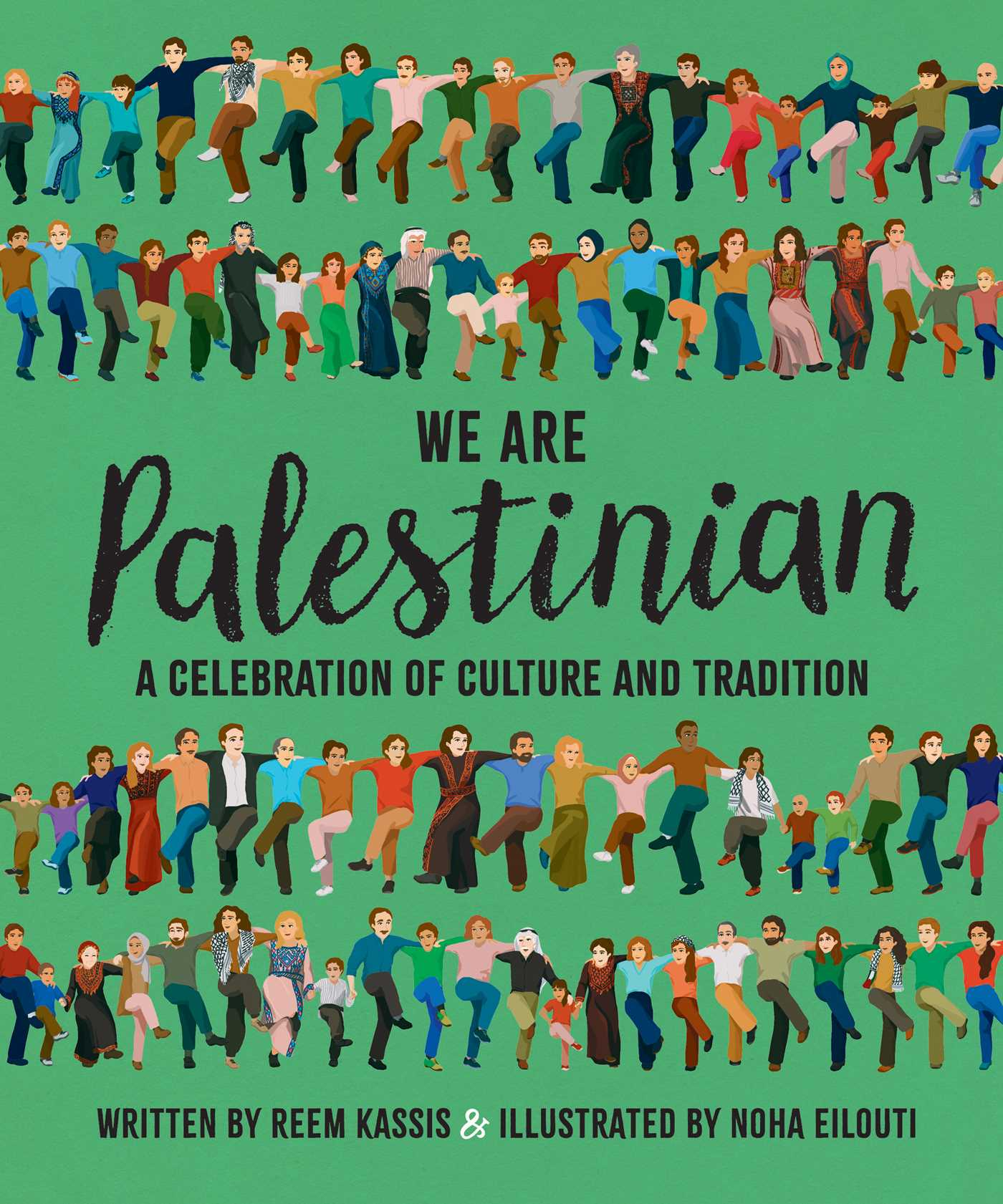
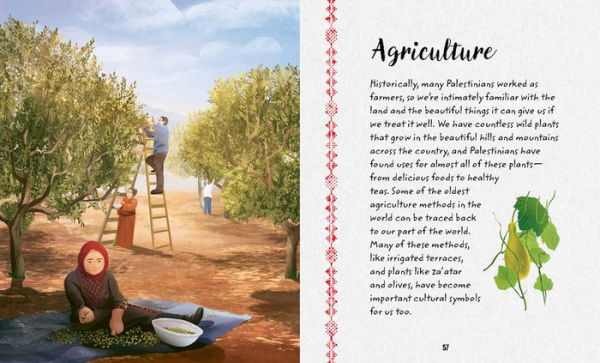
We Are Palestinian: A Celebration of Culture and Tradition by Reem Kassis, illustrated by Noha Eilouti

Published by Crocodile Books

Summary:  This introduction to Palestine and Palestinian culture includes chapters on geography, cultural symbols, creative minds, agriculture, cuisine, performing arts, and history and religion.  The author has written cookbooks (the food section is particularly strong) and seeks to preserve her Palestinian culture for her daughters.  Each section contains “Did you know?” and “Fun fact” sidebars, as well as an illustration or two. The difficult history of Palestine is woven throughout the text, not only in the history section.  Includes an index.  112 pages; grades 3-7.

Pros:  I enjoyed learning more about Palestine, which, of course, is all over the news, but is probably a culture that is not well known to most Americans, including myself.

Cons:  I would have liked more back matter, especially additional resources.

Come and Join Us! 18 Holidays Celebrated All Year Long by Liz Kleinrock, illustrated by Chaaya Prabhat

Published by HarperCollins

Summary:  Throughout the year, a class learns about the holidays different kids celebrate as part of their cultures.  Each child describes the holiday in a paragraph, with colorful illustrations showing a family celebration.  There are sure to be some new ones to many readers, including Obon, Makahiki, and Vesak, as well as some that may be familiar like the Jewish High Holidays, Kwanzaa, and Día de Los Muertos.  At the end of each holiday description is a question for discussion, like “What kinds of stories do you tell on your holiday?” and “Do you gather with family to celebrate your holidays?”  Includes an author’s note about her own childhood experience celebrating Jewish holidays and not observing Christmas, as well as a glossary.  40 pages; grades K-5

Pros:  A fascinating look at other cultures and the special days they observe with appealing illustrations and interesting questions that will help make connections with readers’ own experiences.

Cons:  This felt like kind of a lot to read all at once; it might be better to do a little at a time, or to use it as a resource for learning about specific holidays.

National Monuments of the U.S.A. by Cameron Walker, illustrated by Chris Turnham

Published by Wide Eyed Editions

Summary:  It all began in 1906 when Theodore Roosevelt made Devil’s Tower in Wyoming a National Monument.  Now there are over 130 such places, given the designation of National Monument for their historical, cultural, or scientific significance.  This book looks at some of them, divided geographically, with a map at the beginning of each section showing where they are located.  Two-page spreads offer additional facts presented in ways that invite readers to explore, whether it’s with a visit or additional research.  Includes a list of National Monuments by state and a conclusion that invites readers to think about creating their own monuments.  112 pages; grades 2-5.

Pros:  A fun book to browse with inviting text and retro style illustrations that will have kids making lists of places to visit across the United States.

Cons:  The font on the spreads was a little too small.

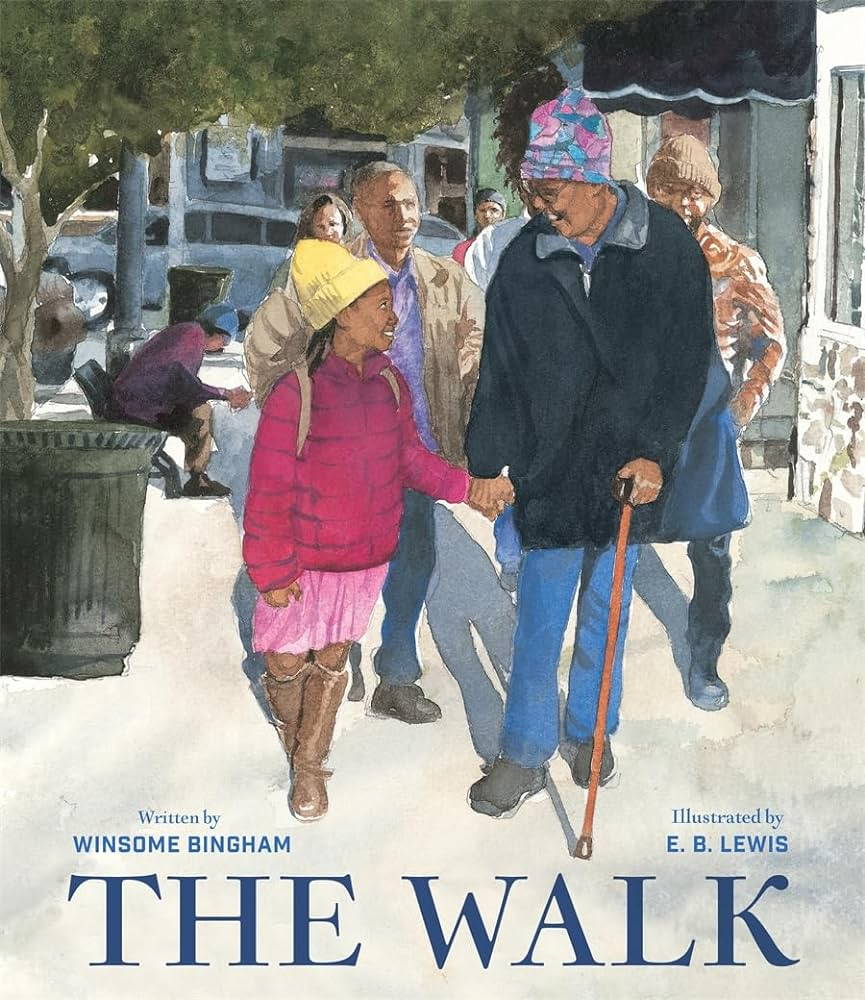
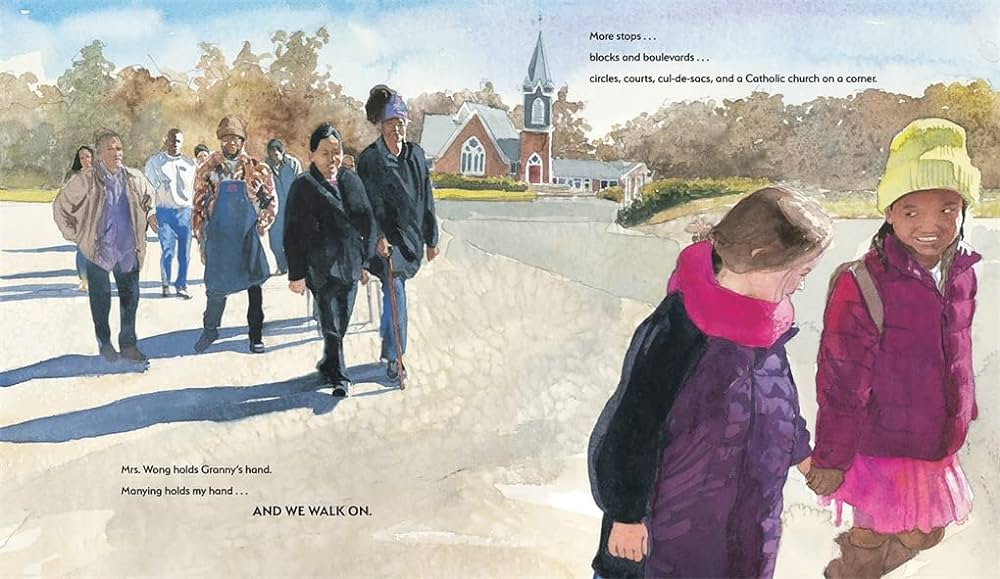
The Walk by Winsome Bingham, illustrated by E. B. Lewis

Published by Harry N. Abrams

Summary:  A girl and her granny are headed out for a walk to an undisclosed destination.  As they travel through the neighborhood, more and more people join them.  Comments give some hints about their journey: “I thought after 2008, I could skip a few of these walks. But I see we need them more than ever.”  “The walk wasn’t always this long, but folks keep making it longer.”  Finally, the group arrives at the girl’s school.  “You’re silly, Granny,” says the girl.  “There’s no school today.”  The school is closed for Election Day, but open for voting.  Everyone marks their ballots, then the group heads home, reversing the walk until it’s just the girl and her granny once again.  40 pages; ages 4-8.

Pros:  An excellent read-aloud for Election Day, emphasizing the importance of voting and the attempts to limit it, particularly in communities of color.

Cons:  An unfortunate lack of back matter that could have given some context to comments made by people about the history of voting.

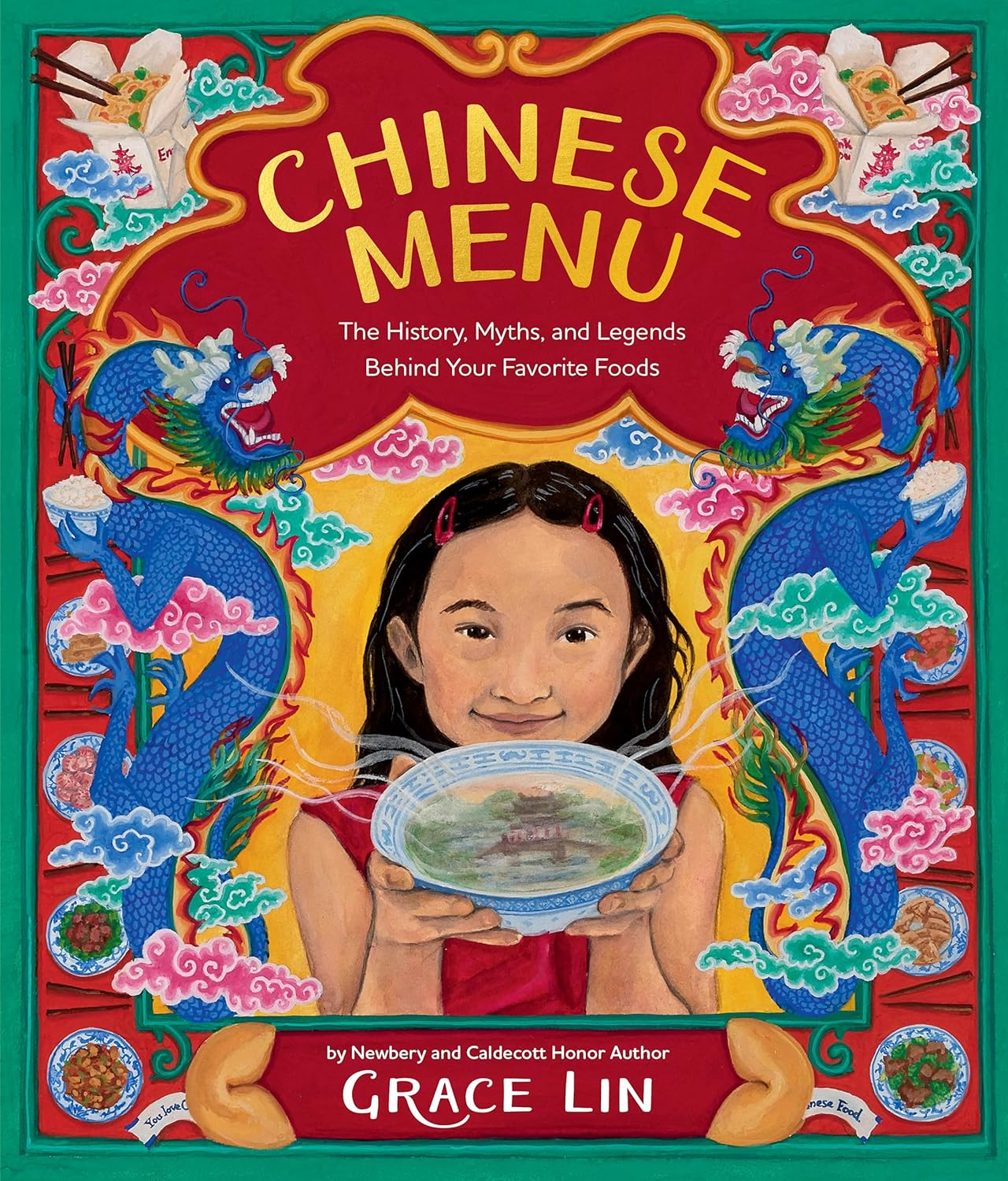
Chinese Menu: The History, Myths, and Legends Behind Your Favorite Foods by Grace Lin

Published by Little, Brown Books for Young Readers

Summary:  Grace Lin traces the history of many foods from a Chinese menu with facts, personal anecdotes, and folklore.  Beginning with a map of China and a timeline that shows where each food fits into Chinese history, the narrative then dives into the food, which is arranged the way it might be on a menu.  From chopsticks to tea to soup, main dishes, and desserts, each section begins with an introduction, followed by different foods within the category, with an illustrated story or two about each one.  Includes an author’s note about the difficult history of Chinese immigrants in the U.S. and how their cuisine has sustained them and been adapted to American tastes; a recipe for Lin’s mother’s scallion pancakes; endnotes with additional information about each food; and a bibliography.  288 pages; grades 3-7.

Pros:  A fascinating, meticulously researched, beautifully illustrated collection of folklore that’s connected to cuisine familiar to many readers.  If you ever wondered who General Tso was or how egg rolls came to be, you will find all the answers here.

Cons:  This feels like it will appeal more to adults than to kids.

Veo, Veo, I See You by Lulu Delacre

Published by Atheneum Books for Young Readers

Summary:  During the pandemic, a girl and her mother and brother play a game of Veo, Veo, or I Spy, to spot essential workers in their community.  Mami lost her job as a cook, so she cooks at home now, and the family takes food and medicine to some older relatives before stopping at the food pantry on the way home.  In the course of their errands, they see trash collectors, a nurse, a pharmacist, a bus driver, and other workers who are keeping their city going so that others can safely stay at home.  Back at home, the girl makes a collage sign saying, “I see you!” that includes pictures of many of the workers, leading to cheers and applause from the community.  Includes an author’s note about the pandemic, and how it brought essential workers, and the fact that many of them are Black or Brown, to people’s attention.  40 pages; ages 4-8.

Pros:  Although the setting is the Covid pandemic, this book could be used to introduce lots of different community helpers.  The illustrations are bright and appealing, with cartoon bubbles for dialog: Spanish for Mami and English for the kids.

Cons:  The pandemic setting makes this already feel a little dated, as many of the kids reading the book will have little or no memory of that time.

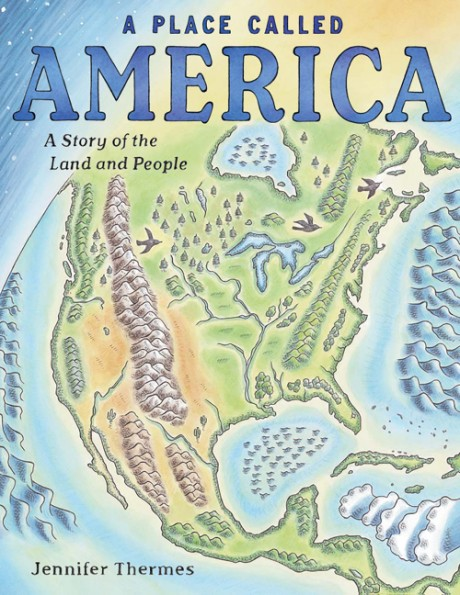
A Place Called America: A Story of the Land and People by Jennifer Thermes

Published by Harry N. Abrams

Summary:  Beginning with a global view of the Earth when “the land was owned by no one,” Jennifer Thermes dives into American history and the drive to acquire its land, shown by illustrated maps.  She focuses on marginalized people–indigenous, enslaved, immigrants–and how they helped shape history.  The two-page spreads look at a specific year or an era, portraying people and/or maps that show important events and movements of that time.  Includes an afterword about maps and history, a list of sources, and a timeline on the endpapers.  64 pages; grades 3-6.

Pros:  I am always thrilled to learn of a new Jennifer Thermes book featuring her amazing maps. You could use this one to cover a whole school year of American history, beginning with the author’s note with the assertion that “the stories we tell ourselves about what is happening make us who we are.”  Readers will spend hours poring over her beautiful maps and other complex illustrations of the people who made up the various eras that she writes about so engagingly.

Cons:  Except for a spread about 9/11, the history pretty much ends in the middle of the 20th century.

A Long Time Coming: A Lyrical Biography of Race in America from Ona Judge to Barack Obama by Ray Anthony Shepard, illustrated by R. Gregory Christie

Published by Calkins Creek

Summary:  Six Black Americans are profiled in five chapters: Ona Judge, Harriet Tubman and Frederick Douglass together, Ida B. Wells, Martin Luther King, Jr., and Barack Obama.  Their stories are told in verse, weaving together scenes from their lives to paint engaging portraits of their work, their dreams, their discouragements, and their successes and failures.  Each section begins with an illustration and a bit of personal history from the author, connecting his life to his subjects’.  Includes a timeline, additional resources, a bibliography and source notes for each section, and an index.  336 pages; ages 12 and up.

Pros:  Ray Anthony Shepard has written a masterful poetry collection, telling stories that will immediately engage readers.  He doesn’t shy away from telling both the terrible events his subjects witnessed and the less-than-great choices they sometimes made to fully portray their humanity.  Definitely deserving of some serious Coretta Scott King Award recognition.

Cons:  I wish there had been some information on the poetry and poetic forms used.

What a Map Can Do by Gabrielle Balkan, illustrated by Alberto Lot

Published by Rise x Penguin Workshop

Summary:  An adventurous raccoon narrates its travels by showing kids a series of maps, beginning with its bedroom and continuing to the neighborhood, a museum, a road map, and more (12 altogether).  Each map has questions for kids to answer and introduces concepts like a compass rose and a map key with symbols.  There are maps that show things other than geography, like the stars and the weather.  Includes an index of all the maps with thumbnail drawings, definitions, and the pages where each can be found.  48 pages; grades K-2.

Pros:  Kindergarteners at my school learn about maps, so I have read quite a few picture books on the subject, and this is the best that I have seen.  I love how interactive it is, with the questions the kids can answer using the maps.  It’s lots of fun, but also a pretty thorough introduction to all kinds of maps.

Cons:  It felt a little long to maintain a kindergartener’s attention.  You might want to break it into two or three reading sessions.

Food for the Future: Sustainable Farms Around the World by Mia Wenjen, illustrated by Robert Sae-Heng

Published by Barefoot Books

Summary:  From a honey farm in Yemen to a circular garden in Senegal to an underwater biosphere in Italy, this book takes readers on a tour of innovative sustainable food production sites around the world.  Each two-page spread has a rhyming couplet about the farm or other site, with illustrations showing people at work.  A map at the end shows all the sites and provides information about sustainable farming and food justice.  There’s additional information about each place, including a description and why it’s sustainable.  Includes notes from the author and illustrator about how they were inspired to create this book.  40 pages; ages 4-8.

Pros:  An inspiring look at sustainable food production that includes both indigenous practices and new technology.  The built-in definitions and pronunciation guides make this a great resource for younger kids, who will also find the bright folk art style illustrations appealing.

Cons:  Some additional resources would have been nice.