Indigenous history

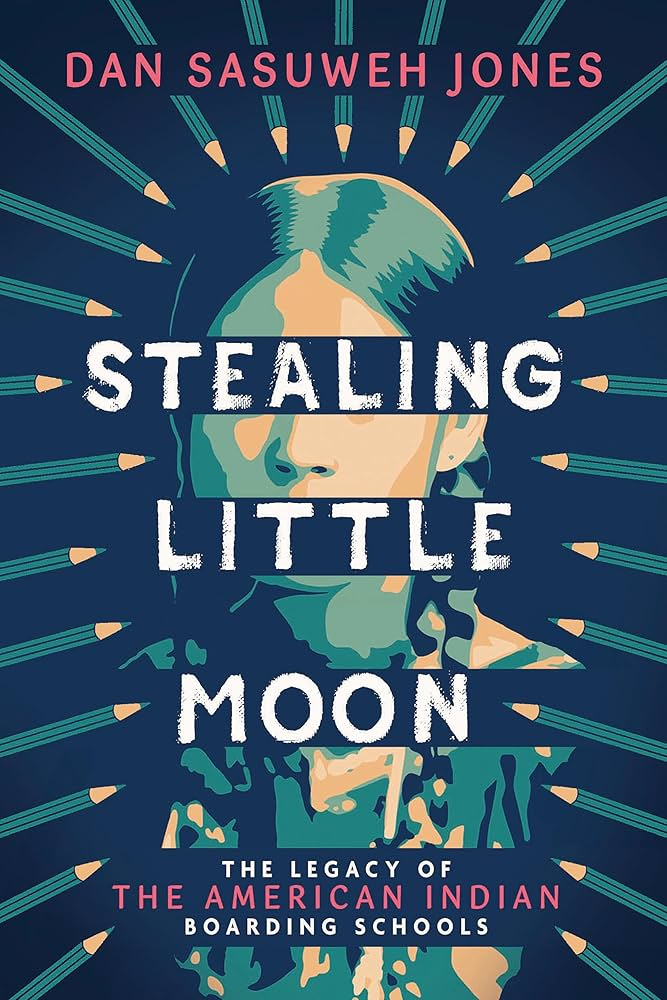
Stealing Little Moon: The Legacy of the American Indian Boarding Schools by Dan SaSuWeh Jones (Scholastic Focus, 304 Pages, grades 5-8). Dan SaSuWeh Jones tells the story of his family’s history with the Chilocco Indian Agricultural (boarding) School, beginning with the forcible capture of his grandmother Little Moon There Are No Stars from the Ponca reservation in 1885 at the age of four. The Chilocco school, run by Quakers, did not condone the physical abuse found at other Indian boarding schools, but it did use strict, military-inspired practices to force the students to assimilate to white culture. Little Moon There Are No Stars, renamed Elizabeth, stayed on for several years after her graduation to work as a school matron, and sent her own daughter there as well. By the time the author’s sister attended the school in the 1950’s, there had been many changes, becoming a vocational school that provided a positive experience for many (although certainly not all) of the students. The 1960’s and 1970’s saw political movements that helped the school and its students embrace their various cultures and languages. While the author didn’t attend the school, he worked there after it closed in 1985 as part of a maintenance crew trying to preserve the buildings and grounds. In his final chapter, he writes of the appropriateness that those buildings have crumbled, leaving the land to its natural state, a metaphor for the enduring nature of Indigenous cultures that have survived so much trauma yet still continue to live on. Includes an introduction by Denise K. Lajimodiere (Turtle Mountain Band, Chippewa), photos throughout the text, and a long list of additional resources.

Reading this book caused me to reflect on how much this blog has educated me and changed my views on American history. I’m not sure I knew anything about Indian boarding schools ten years ago, but I’ve learned from children’s books over the years, and this one added a lot to that knowledge. It’s masterfully written, weaving together a personal family memoir and the history of boarding schools in North America. The author writes unflinchingly about a multitude of abuses and deaths of children at many different schools, while at the same time acknowledging that some students had positive experiences and learned to embrace their heritage, particularly in the later years of the schools’ histories. The final chapters give hope that some of the many, many crimes and trauma committed against indigenous people are finally being at least brought to light and possibly, in some cases, addressed and healed. There are some horrific descriptions of child abuse, so be aware of that element when sharing this book with kids. I hope this book will be considered for awards, especially by the Sibert committee.

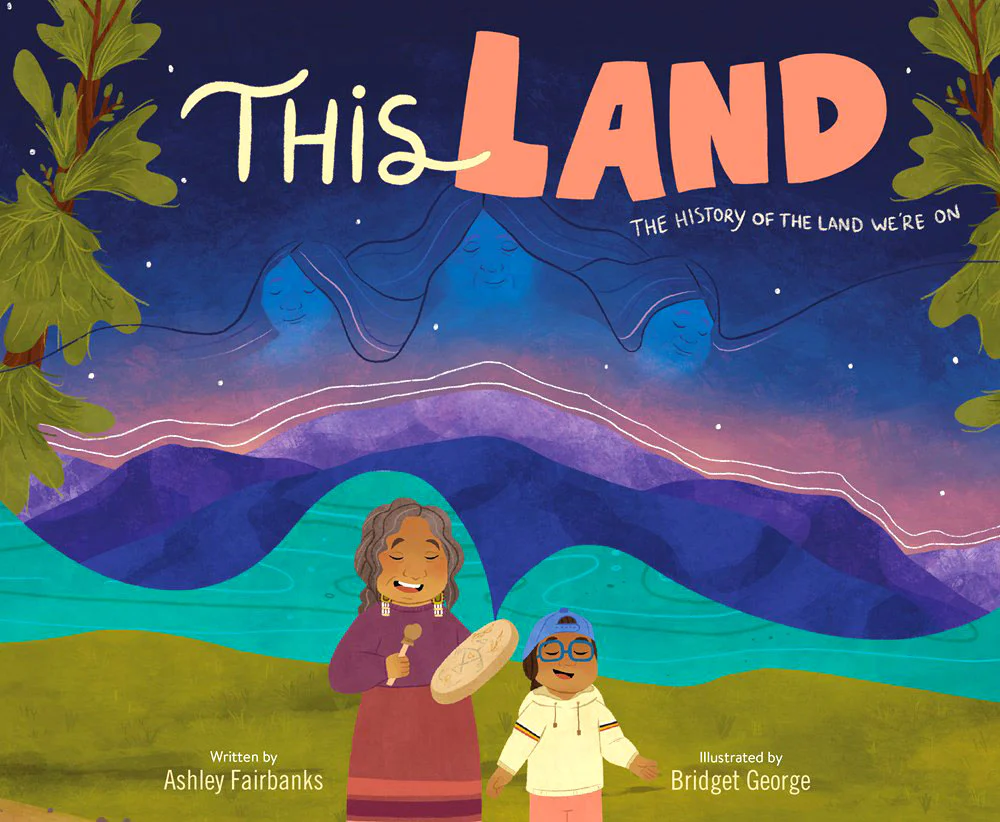
This Land: A History of the Land We’re On by Ashley Fairbanks, illustrated by Bridget George (Crown Books for Young Readers, 40 pages, ages 4-8). “This is my house. I live here with my family,” the narrator begins. “Before us, another family lived here.” Other families lived there, too, but further back in time, a whole community lived on the land before they were forced off by Europeans, something that happened all across the country. The narrator has a friend who is Anishinaabe (like the author and illustrator), and he and his grandma remind the boy of the Indigenous people who once lived there: their food, their songs, and mostly, the way they considered the land to be sacred. Now, as he travels around the U.S. with his family, the boy learns about different Indigenous groups who lived in those places and remembers how they once honored the land they were on. Includes additional information about land acknowledgement, discussion questions, and ideas for learning more about local Native people.

This straightforward story reminds readers to learn about the history of the land they now call home and recall that it once belonged to people who were forced to leave their homes. I really liked how the book acknowledges those who lived on the land of well-known sites like Mount Rushmore and New York City. I read in a review that the title calls to mind the controversy around the song “This Land Is Your Land,” a song that is considered problematic by many Indigenous people. I wasn’t aware of this and was reminded once again of how much I have learned from reading books for this blog.

Election Day

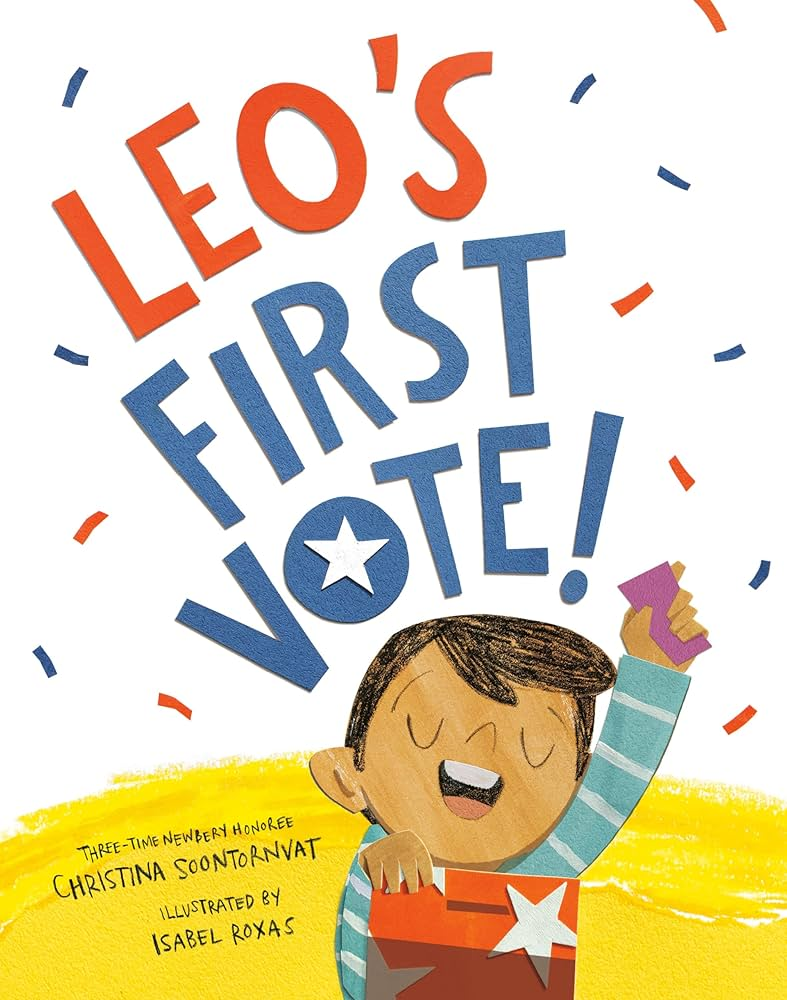
Leo’s First Vote by Christina Soontornvat, illustrated by Isabel Roxas (Knopf Books for Young Readers, 48 pages, ages 4-8). Leo’s excited that his dad has recently become a naturalized U.S. citizen, which means Dad gets to vote in the upcoming presidential election. Leo plans to go with him to the polls, but in the meantime, his class is having a mock presidential election. The kids learn about elections, and at home, Leo watches conventions and debates with his family. Everyone’s talking about the upcoming election, and when Leo hears a cousin say he’s not going to vote (“What’s the point?”), he feels deflated. But when his class’s mock election is determined by one vote, Leo finds his enthusiasm again. The last page shows Dad reading a newspaper with a headline declaring, “Historic turnout!” Also available in a Spanish language edition, ¡El primer voto de Leo!

Lots of facts about elections are woven into Leo’s story, and the excitement around voting will have kids eagerly anticipating Election Day. Personally, I am feeling so jaded about the day (Leo’s cousin really spoke to me) that I almost didn’t write this review, but good for Leo and his dad (and Christina Soontornvat) for having such enthusiasm about it.

Presidential Elections and Other Cool Facts: Understanding How Our Country Picks Its President by Syl Sobel, J.D. (Sourcebooks Explore, 5th edition, 48 pages, grades 2-5). This straightforward introduction to the presidency tells how elections work, as well as giving interesting facts about campaigns, the electoral college, First Ladies, and the order of succession should the President die or become disabled. There’s a list of all the U.S. Presidents, along with the years of their terms, and party affiliations. Includes a glossary, index, and lists of resources.

Rumor has it there’s an updated version of this book, but interlibrary loan has only been able to send me older ones, so I got to travel back to a time when Barack Obama was President, and Ronald Reagan was the oldest person to have been elected President at age 73. It’s a good introduction to the presidency and the election process, and although the writing and illustrations aren’t particularly exciting, it includes the kinds of facts and trivia kids (and adults) enjoy learning.

A pair of award contenders

Barrio Rising: The Protest That Built Chicano Park by María Dolores Águila, illustrated by Magdalena Mora (Dial Books, 40 pages, grades 1-4). The narrator lives in a neighborhood called Barrio Logan, one of San Diego’s oldest Chicano neighborhoods, where residents have been looking forward to finally getting the park they’ve been promised for years. When they find out that the new construction being done is for a police station, they’ve had enough. Neighbors band together to take over the land and protest, despite orders from the police to disperse. For twelve days, the crowd grows, drawing protesters from nearby barrios. Finally, the city council holds a meeting, led by Leon Williams, San Diego’s first Black councilman, and announces they’ve changed the plan from a police station to a park. Everyone celebrates and pitches in to create Chicano Park. Includes additional information about the park, which is now a National Historic Landmark. Also available in a Spanish language edition, El barrio se levanta: La protesta que construyó el Parque Chicano.

Keep this book in mind when Hispanic Heritage kicks off on September 15. The story about this 1970 event is inspiring, and the illustrations juxtapose birds, butterflies, and purple flowers with the gritty urban setting. I’d love to see it get some Belpré Award recognition for either the story or the illustrations.

Before the Ships: The Birth of Black Excellence by Maisha Oso, illustrated by Candice Bradley (Orchard Books, 40 pages, grades K-5). Instead of starting with the slave trade, as is often the case with Black history in America, this book begins “before the ships” when civilizations flourished across Africa. There were kings and queens, doctors, scribes, artisans, and merchants. Impressive buildings were created, as were stories and music, while scientists and mathematicians studied the world. A wordless page showing a slave ship sailing through the darkness divides the book between the past and the present, “after the ships.” The descendants of those Africans now live different lives, but they are still warriors, scholars, and leaders, or, as the final page says, “We are the light.” Includes an author’s note telling how her time in Africa showed her the cultures of Ethiopia, South Africa, Kenya, and Nigeria.

I’ll be surprised if this doesn’t get a Coretta Scott King award or honor. I love the focus, all too rare, on the civilizations that existed before African people were captured and sold into slavery, and I will definitely be sharing this book with teachers at my school. I would have enjoyed even more back matter, including a map or two.

Finding their voices

Ida B. Wells Marches for the Vote by Dinah Johnson, illustrated by Jerry Jordan (Christy Ottaviano Books, 48 pages, grades 1-5). Although this book tells the story of Ida B. Wells’s life, starting with her birth in Mississippi and continuing with some of her activism in Tennessee and Chicago, the main event is a march in Washington DC in 1913 for women’s right to vote. Many of the organizers felt that this march should be for white women only, or at least segregated (Alice Paul is specifically mentioned as expressing that view). Despite these protests and the suggestions that Ida march at the back of the line with her sorority, she made her way to the Illinois delegation and joined the white women in that group to march for their right to vote. Includes an author’s note, photos, a timeline of Ida B. Wells-Barnett’s life, and a list of sources.

The author does a masterful job of giving readers an overview of Ida’s life but focusing on one specific event that demonstrates the way she stood up for herself and other Black people. The back matter adds a lot and makes this a great resource for research.

Ode to Grapefruit: How James Earl Jones Found His Voice by Kari Lavelle, illustrated by Bryan Collier (Knopf Books for Young Readers, 48 pages, grades 1-5). Young James loved words, especially poetry, but when asked to read in front of the class or to say hello to a visitor at home, the words stuck in his throat. He finally stopped talking and just listened, paying close attention to his teachers, especially Professor Crouch who taught him poetry. James recited the poetry when he was alone, and sometimes he tried writing his own, but sharing it with the class was out of the question for him. One day, a shipment of grapefruit to his house inspired him to write a poem, and with Professor Crouch’s encouragement, James read “Ode to Grapefruit” to the class. This recitation opened the door for him, and he began performing on stage, as a debater and an actor, and eventually the distinctive voice of James Earl Jones became known around the world. Includes notes from the author (a speech pathologist) and the illustrator, as well as information and resources on stuttering and a list of sources.

This would make an excellent read-aloud, since the text is pretty short, and James’s issues are something most kids would relate to. I did wonder about the illustrations with all the kids having a slice of grapefruit in their mouths–did James hand them out, or was he just imagining them? But it would be fun to reveal at the end that the story is about the man who became the voice of both Darth Vader and The Lion King’s Mufasa.

Seeker of Truth: Kailash Satyarthi’s Fight to End Child Labor by Srividhya Venkat, illustrated by Danica da Silva Pereira (little bee books, 40 pages, grades 2-5). As a child in India, Kailash Satyarthi was inspired by the story of how a hummingbird stopped a forest fire by carrying drops of water in its beak. When he saw a boy working as a cobbler by the side of the road, Kailash wondered how he could help him go to school. Like the hummingbird, Kailash started with small deeds to make a difference–raising money and collecting books to help kids who couldn’t afford to go to school. As an adult, Kailash started his career as a teacher, but he wanted to do more. He quit his job and began rescue missions to free children forced to work in factories, mines, and quarries. His work gained international recognition, including the 2014 Nobel Peace Prize, which he shared with Malala Yousafzi, and resulted in worldwide changes to child labor laws. Includes an author’s note with additional information and a couple of photos, and a list for further reading.

This excellent picture book biography tells the story of Kailash Satyarthi’s life in a way that will easily be understandable to kids and will show them the power of a single individual to make a difference in the world. I liked that it tells the story of his entire life, so the reader can see how his ideas evolved, yet keeps the text brief enough for a good read-aloud.

Labor pains

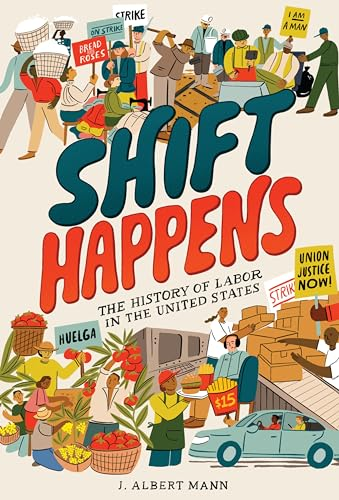
Shift Happens: The History of Labor in the United States by J. Albert Mann (HarperCollins, 416 pages, grades 8-12). Low wages, long hours, wealth inequality, immigrants accused of “stealing” jobs: issues workers face today have in fact been around since the earliest days of United States history. This breezy but thoroughly researched account tells the painful story of American labor, in which actions for improved conditions have all too often been met with resistance, violence, and even murder. There are occasional hard-won victories for workers, and the twentieth century brought substantial legislation and improvements for labor–until they were eroded during the backlash of the Reagan years and beyond. The media is also implicated here for telling stories that favor capitalists and demonize labor organizers and unions. Teens looking for the truth about labor’s history will find plenty to think about, presented with short chapters and irreverent humor that will keep them engaged.

It’s taken me weeks to work my way through this book, but it was well worth it, with fascinating and disheartening stories that make it a good companion to Lies My Teacher Told Me. I was hoping to be able to recommend this for younger kids, but there’s definitely some language that might raise a few middle school eyebrows (starting with the title), and I think that, and the complexity of the topic make it more appropriate for high school.

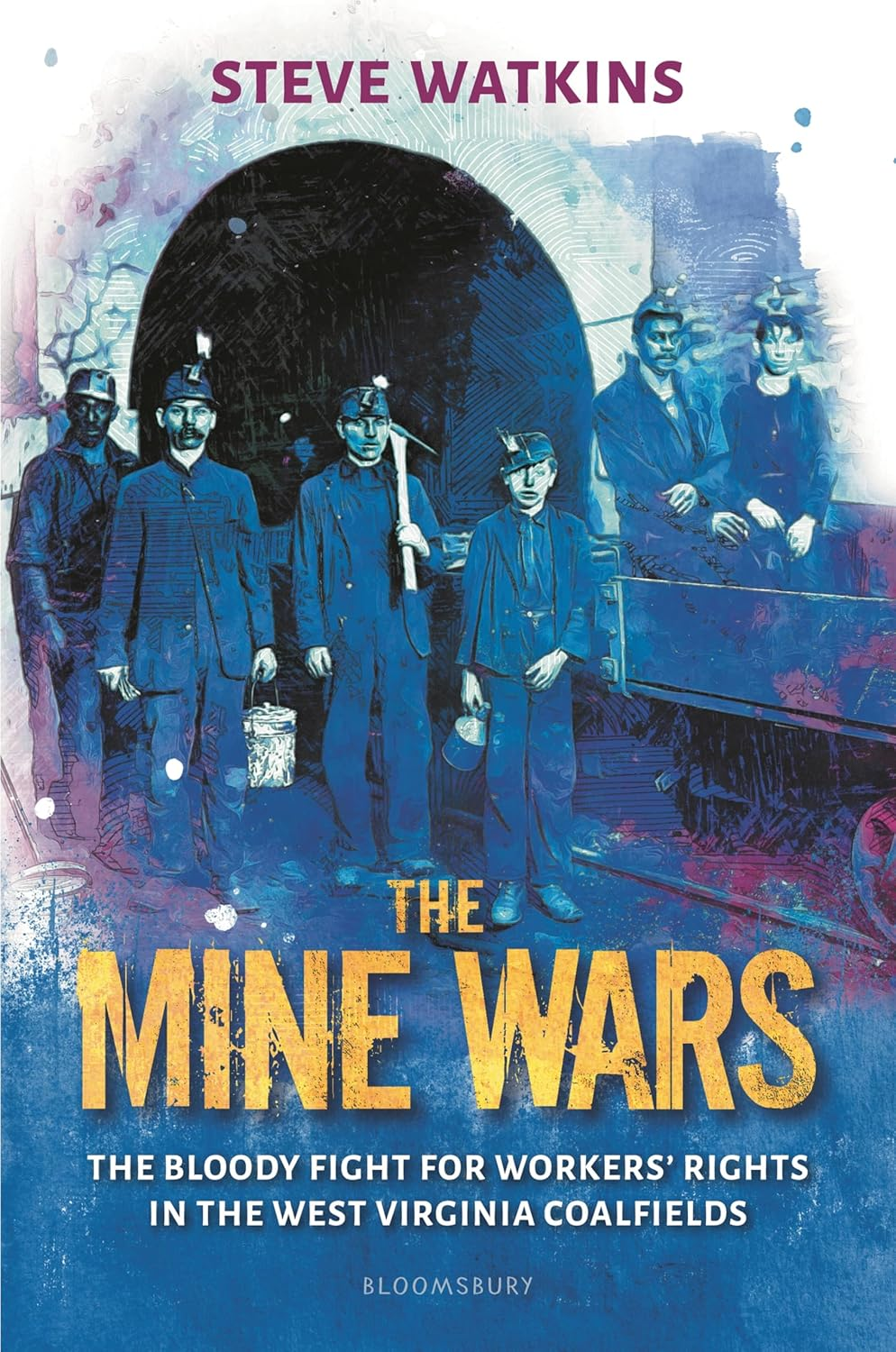
For a more in-depth look at a single incident in U.S. labor history, try The Mine Wars: The Bloody Fight for Workers’ Rights in the West Virginia Coalfields by Steve Watkins (Bloomsbury Children’s Books, 272 pages, grades 6-10). I was too saturated on labor history from Mann’s book to read this one, but it looks like it includes many of the elements I read about: workers paid paltry wages in scrip for long hours of dangerous and back-breaking labor, and a strike that ultimately resulted in several killings. This particular story takes place in West Virginia in the early 1920’s, an era when it was particularly dangerous to be part of a union. This might be a better choice for a middle school introduction to labor history and will potentially appeal to fans of Steve Sheinkin.

Celebrating Asian American and Pacific Islander Heritage Month

Made In Asian America: A History for Young People by Erika Lee and Christina Soontornvat (Quill Tree Books, 320 pages, grades 5-8. This young readers’ adaptation of Erika Lee’s The Making of Asian America (2015) begins with an introduction that details the absence of Asian American history in most schools and some of the kids who have worked to bring attention to that. The main narrative covers American history from Columbus to Covid, relating the stories of people who immigrated to the U.S. from many Asian countries, including China, Japan, Korea, Vietnam, India, the Philippines, and more. Different people had different reasons for coming, depending on their country’s history and political situation, but almost all experienced racism, discrimination, and broken promises when they arrived. Like many other immigrants, they worked hard doing backbreaking labor to survive and to try to build a better future for their children. In more recent times, Asian Americans have become known as the “model minority,” a label which carries its own baggage. The Covid era showed that racism still simmers right beneath the surface of American society, as it exploded with the news that the virus originated in China. Asian Americans have a history of fighting for civil rights, both for themselves and for other groups experiencing discrimination, and that fight continues today, as explained in the last chapter. Includes notes from both authors as well as almost 30 pages of source notes and an index.

I learned so much from this book, which really drove home the point that Asian Americans are largely missing from American history. The writing is clear and engaging, and many of the profiles describe ordinary people whose stories are often both heartbreaking and inspiring. It was fascinating to get a brief history of so many different countries and to learn why different groups immigrated to the United States.

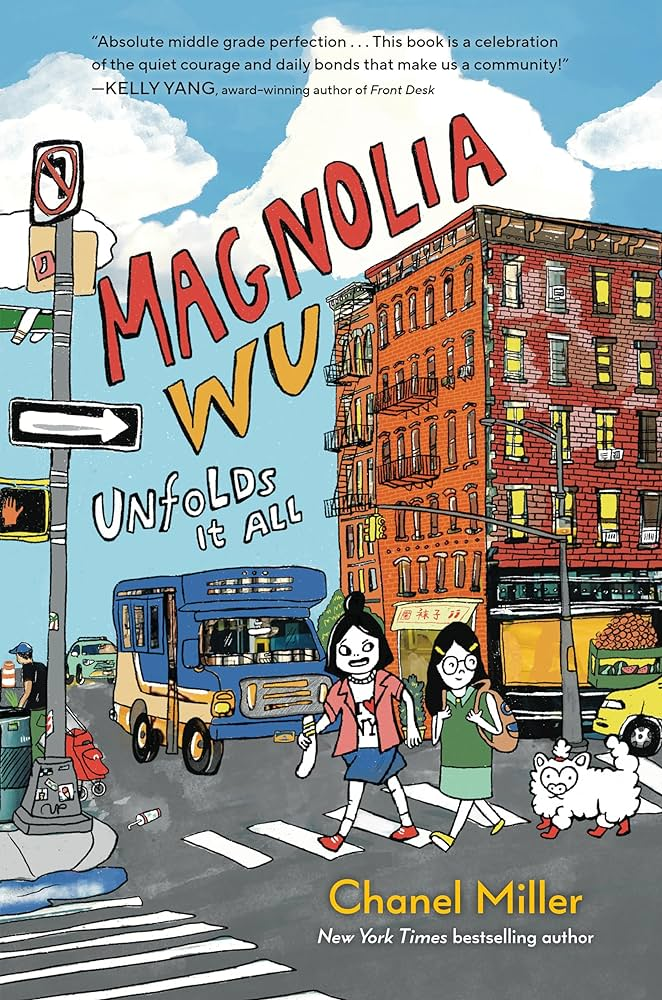
Magnolia Wu Unfolds It All by Chanel Miller (Philomel Books, 160 pages, grades 2-5). While Magnolia is looking forward to turning 10, she’s less excited about the summer ahead, which will mostly be spent at her family’s Bing Qi Ling Laundromat. When her mom’s friend moves to New York City from California, she brings along her daughter Iris, who is just Magnolia’s age. At first the girls feel strange around each other, but soon they bond over the sock board, where Magnolia has displayed all the stray socks that have been left behind at the laundromat. They decide to canvass the neighborhood to find each sock’s owners, using clues from the socks themselves to help them. As they solve each mystery, the girls learn more about their neighbors and hear some interesting stories about Magnolia’s parents, who turn out to have a fun and adventurous side that Magnolia hasn’t been aware of. A major fight threatens to destroy their new friendship, but Magnolia finds a way to repair things and, in the process, gains a deeper understanding of her new best friend.

With a 10-year-old protagonist, a larger font, and plenty of illustrations, this would make a good introductory chapter book. It was interesting to read this right after finishing Made in Asian America, as Magnolia’s and Iris’s families, from China and Vietnam respectively, are working hard to give their kids a better life in America and experience racism at various points in the story. Their resilience and close family ties make this a warm and engaging story with a fun and quirky cast of characters.

Lies My Teacher Told Me

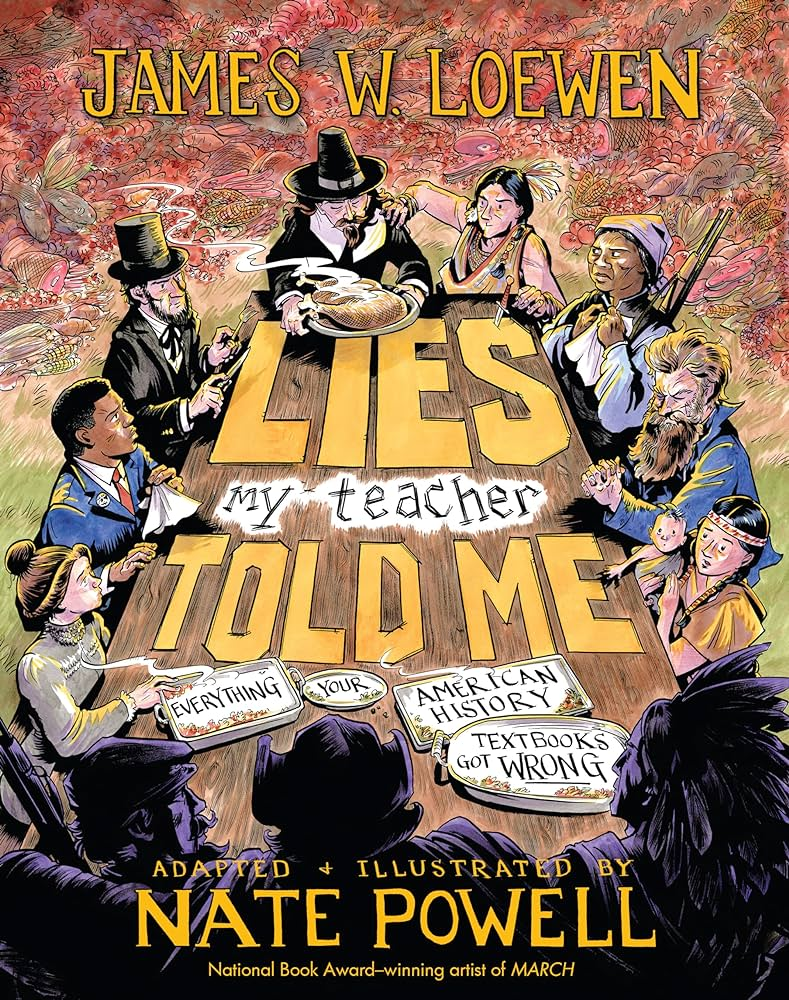
Lies My Teacher Told Me: A Graphic Adaptation by James W. Loewen, adapted and illustrated by Nate Powell (The New Press, 272 pages, grades 9-12). James W. Loewen’s 1995 book (updated in 2007 and 2018) examined twelve high school American history textbooks and how they present the history of the United States. His conclusions are fascinating, showing how the narrative presents a patriotic view of steady progress over time, with Americans defending freedom and democracy around the world. Racism, genocides, corporate greed, and government secrecy are pretty much excluded from this version of history. He also investigated how and why textbooks are written like this, which turns out to be in large part because the committees that adopt the books for their states demand it. Loewen concludes by emphasizing the importance of telling the truth to students, presenting American history in a way that makes them think critically about events from the past and how they shape the future, in order to help them become active and engaged citizens.

I’ve heard of this book but never read it, and I am grateful for Nate Powell’s amazing graphic adaptation (Powell worked with John Lewis to create his March trilogy). I found it compelling reading, with so much of the history relevant to today’s current events at home and abroad. I can usually zip through graphic novels in a few days, but this took me quite a bit longer, with text-heavy pages and lots of fascinating ideas to consider. There were times that I wish I knew more about the topics being discussed, and many readers will want to consult the original work to get a fuller picture.

Mythology

The Monster and the Maze (Monkey King and the World of Myths) by Maple Lam (G. P. Putnam’s Sons Books for Young Readers, 240 pages, grades 3-7). Sun Wukong, or the Monkey King, comes to life in a graphic tale combining Chinese and Greek mythologies. Bold, confident and fearless, the Monkey King sneaks into heaven where he confronts the gods with his request to become one of them. Although he’s a lowly beast, he’s told his wish will be considered if he can go on a quest to slay a monster. Sun Wukong ends up in Crete, on a quest to destroy the legendary Minotaur. When he finds the monster, tough, he learns that he’s not evil and is suffering at the hands of his father, King Aegeus. The Monkey King discovers the problem–an evil spirit has possessed Aegeus–and is able to convince the king to release the spirit and return to his kindly ways, making an impassioned case for beasts and monsters in the process. Sun Wukong’s work may be done in Crete, but it looks like there will be more adventures for him ahead. The two mythologies are woven together seamlessly, making a fun and extremely engaging story. Includes additional information about the mythical characters and an author’s note.

Amazing Immortals: A Guide to Gods and Goddesses Around the World by Dinah Williams (Harry N. Abrams, 208 pages, grades 4-8). Arranged by categories of power (creation, weather, tricksters, etc.), this collection of myths focuses on cultures other than the familiar Greek and Roman ones. Each two-page spread contains a brief retelling of the myth, along with gorgeous color art, created by 17 different artists. The left-hand margin contains information about the country (or region), culture, and era of each myth, which is unfortunately small enough that it took some diligent searching for me to discover. Each myth includes a fun fact or a tie-in to modern times, like Marvel movies or Rick Riordan books. The back matter includes information about the author and artists, as well as an index, a list for further reading, and an extensive bibliography, making this a great starting place for more research. It’s an amazing and visually appealing resource for upper elementary and middle school mythology fans.

Three books about immigration

Finding Home: Words from Kids Seeking Sanctuary by Gwen Agna and Shelley Rotner, photographed by Shelley Rotner (Clarion Books, 32 pages, ages 4-8). Children and their families from around the world come to the United States seeking sanctuary from war, famine, natural disasters, and other dangers. Many of the photos have cartoon bubbles with kids describing in their own words how they felt when they had to leave their countries, what they miss, and the difficulties and joys in their new homes. There’s additional narrative at the end about how some of the families got to the United States, as well as resources for kids, adults, and parents, caregivers, and educators about how to make families feel welcome.

This book has some personal connections to me, because: 1. the author and photographer live near me, and I have met Shelley Rotner, 2. my Quaker meeting is part of a Circle of Care for one of the families in this book, and 3. my school in Springfield has three classes of refugee kids who have missed at least two years of school due to their circumstances. This book is at just the right level for helping kids (and adults) understand what these families have gone through and to help make them welcome in the U.S.

The Circuit: Graphic Novel by Francisco Jiménez, illustrated by Celia Jacobs (Clarion Books, 240 pages, grades 4-8). Francisco Jiménez’s memoir has been adapted as a graphic novel, telling the story of Francisco as a child, moving with his family from Mexico to California, where they became migrant workers, traveling from one farm to the next to pick cotton, strawberries, grapes, and other crops. Francisco loves to learn, but school is sandwiched between jobs, and his story is a series of losses, as he befriends kids he’ll never see again and loses his precious journal in a fire. There’s enough humor and joy to prevent the story from getting too bleak, and the story feels somewhat timeless, although I think it takes place in the 1940’s. The heart stopping cliffhanger on the last few pages will leave readers like me fervently hoping that more of Jiménez’s books will be published in graphic format.

Lost & Found: Based on a True Story by Mei Yu (Union Square Kids, 128 pages, grades 2-5). Mei Yu recounts her memories of moving from China to Canada at a young age (probably six or seven). With English words in a green font, readers can see how few words she understands at school and the scary situations that ensue: using the wrong bathroom, thinking kids are laughing at her, losing her beloved sketchbook. Mei eventually uses the sketchbook to create a collection of English words, and before long, she is able to communicate and begin to make friends. An author’s note gives more information about her experience, as well as a simple glossary of Chinese words. There’s a funny bonus story about how Mei got her beloved toy cat, who appears real to her, a la Calvin and Hobbes.

It’s a pretty simple story, but the difficulties of immigration are presented in a way that beginning readers will be able to understand, and everyone is sure to love the manga-style artwork.

World War II in fact and fiction

Max in the House of Spies: A Tale of World War II by Adam Gidwitz (Dutton Books for Young Readers, 336 pages, grades 4-7). “Once there was a boy who had two immortal creatures living on his shoulders. This was the fourth most interesting thing about him.” The other things about Max are that he’s a genius, particularly in the mechanical realm, that his parents send him from Berlin to England as part of the Kindertransport in 1939, and that he falls in with some spies, even though he’s only 11. The immortal creatures, a kobold named Berg and a dybbuk named Stein are invisible and inaudible to everyone but Max, which proves both huge help and a terrific nuisance.

Max wants nothing more than to return home and save his parents. Much to his surprise, he ends up living with a Jewish family in London, giving him the chance to observe British antisemitism up close. It’s this family that brings him into contact with the spies, allowing Max to use his genius to get them to agree to send him back to Berlin as a British spy. First there’s an intense training, where it takes every bit of Max’s brains, as well as help from Berg and Stein, to pass to the next level. Finally, Max is ready to go, assigned to be carried in by a paratrooper in the dead of night. That’s as much as I can tell you now, except to assure you that the cliffhanger ending will have you praying that Adam Gidwitz is a speedy writer who can produce book 2 ASAP.

The Enigma Girls: How Ten Teenagers Broke Ciphers, Kept Secrets, and Helped Win World War II by Candace Fleming (Scholastic Focus, 384 pages, grades 5-9). If you’ve seen The Imitation Game, you’re familiar with Bletchley Park, the top-secret British facility where thousands of men and women worked day and night to crack German codes. This book focuses on ten of the young women, many still in their teens, who came to work in various jobs there. Each one had a very specialized task, whether it was translating, indexing, or keeping machines running. The work was absolutely grueling, with rotating eight-hour shifts to keep a 24-hour schedule, and it was top, top secret. Workers couldn’t even discuss what they were doing with those in a different department.

All were motivated by a desire to save lives and win the war, although at one point, one of the women reflects on the fact that saving British lives meant losing German lives. They all put their lives on hold, some for years, to do their important work. When the war ended, the girls went their separate ways, never telling anyone, including spouses and family members, what they had done. It wasn’t until the late 1970’s that some of the secrecy was lifted and stories started to be told. In the 1990’s, what was left of Bletchley Park was restored and opened as a museum. An author’s note and extensive source notes and index are a testament to the research done by Candace Fleming.

Reading these two books caused me to reflect on how World War II is still being mined for stories for all ages, more than any other time period I can think of. It seems like an era that easily lends itself to unambiguous tales of good versus evil. I appreciate how Adam Gidwitz subtly points out the racism and antisemitism that was prevalent in Britain, as well as making a point of England’s centuries of colonialism and empire building that preceded the war, with little concern for indigenous people in the conquered lands. The Enigma Girls is a more straightforward war story, with an interesting emphasis on the importance of women’s work that is often missing (e.g., Christopher Nolan’s Oppenheimer). Ten enigma girls were a lot for me to keep track of, especially since their stories were all woven together, and, although I would have liked to have known each one better, it did emphasize the diversity of backgrounds of those who ended up at Bletchley Park. It’s also unfortunate, although understandable, that not many photos exist of the facility, and Candace Fleming made the decision not to include any of the women’s photos, since she couldn’t find pictures of all of them.