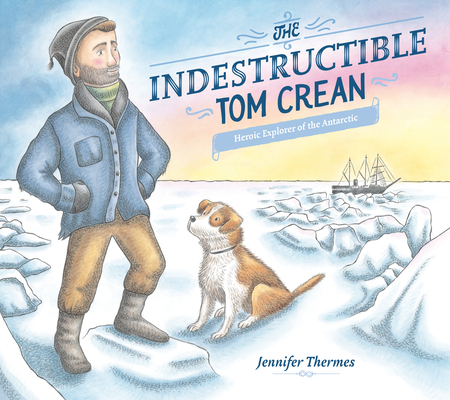
The Indestructible Tom Crean: Heroic Explorer of the Antarctic by Jennifer Thermes

Published by Viking Books for Young Readers

Summary:  Tom Crean grew up on the coast of Ireland and went to sea like most of the other young men around him.  But his fate took an unusual turn when he volunteered to be a last-minute replacement on board Robert Scott’s ship Discovery sailing for Antarctica.  This was the first of three trips Tom took to Antarctica: he was also part of Captain Scott’s attempt to be the first to reach the South Pole and was on board the ill-fated Endurance with Ernest Shackleton.  In fact, Tom was one of three men responsible for the rescue for the rest of the Endurance crew.  Shackleton tried to convince Tom to go on one more Antarctic exploration, but by then Tom had settled down in Ireland, opening the South Pole Pub (still operating today) with his wife, and raising three children.  Includes an afterword with additional information, a timeline, and a list of sources.  56 pages; grades 2-5.

Pros:  I love Jennifer Thermes’ illustrations, especially her maps, and am delighted to see on Amazon that she has a book about the history of America coming out this summer.  The illustrations are delightful, and the story is riveting, with plenty of back matter to make it a pretty complete biography.

Cons: Made Antarctica seem unappealing as a travel destination.

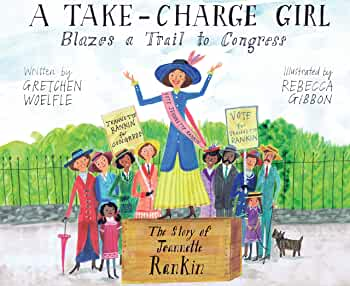
A Take-Charge Girl Blazes a Trail to Congress: The Story of Jeannette Rankin by Gretchen Woelfle, illustrated by Rebecca Gibbon

Published by Calkins Creek

Summary:  Jeannette Rankin was a take-charge girl from the start, helping out on her Montana ranch wherever she could.  Traditional female roles didn’t appeal to her, but social justice did, and she moved from working at a settlement house to campaigning for women’s suffrage.  After a victory for the cause in Montana, Jeannette decided to expand her influence by running for Congress.  On November 7, 1916, Jeannette won the election, becoming the first U.S. Congresswoman.  Five months later, she took her seat in the House of Representatives as a representative from Montana, declaring, “I may be the first woman member of Congress, but I won’t be the last.”  40 pages; grades 1-5.  Includes additional information about Jeannette Rankin, a timeline of her life, and additional resources.

Pros:  I’ve been working on a picture book biography of Jeannette Rankin off and on for the last few years, and this book is far better than anything I’ve been able to come up with.  The writing and illustrations are lively and capture Jeannette’s can-do spirit.

Cons:  To me, one of the most interesting things about Jeannette is that she voted against both World War I and World War II (the only member of Congress to do so for WWII), which was political suicide but supported her pacifist beliefs.  This part of her career is relegated to the back matter.

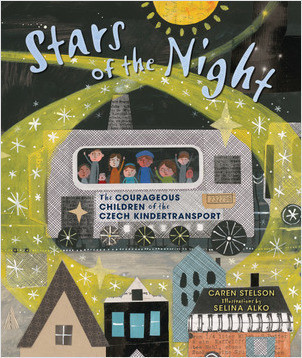
Stars of the Night: The Courageous Children of the Czech Kindertransport by Caren Stelson, illustrated by Selina Alko

Published by Carolrhoda Books

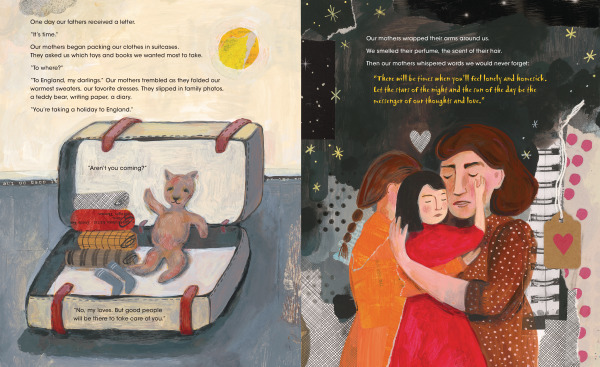
Summary:  Beginning in Czechoslovakia in 1938, the story follows five children from a peaceful happy life to a period of increasing restrictions and hardships for Jews.  When Germany occupies Czechoslovakia in March 1939, the children’s parents have a difficult decision to make. The kids are only vaguely aware of the man who’s offering them the chance to escape to safety. Before long, the families are at the Prague railway station, saying good-bye to their children as they board trains that will take them to England.  The children soon learn that the man has made arrangements with British families to take them in.  As the years pass, they grow more comfortable in their new homes, but worry as they hear news of Czechoslovakia.  Their fears are confirmed at the end of the war when most learn that their parents have not survived.  Fifty years later, they finally learn the identity of the man who saved them–Nicholas Winton, the British man who rescued 669 children.  Includes a timeline and extensive information on the Kindertransport Movement, Nicholas Winton, the five children, and The Children’s Memorial in Jerusalem, as well as additional resources, and notes from the author and illustrator.  40 pages; grades 3-6.

Pros:  The beautiful illustrations, riveting story, and extensive back matter make this a compelling nonfiction book that anyone with an interest in World War II or the Holocaust will want to get their hands on.  

Cons:  This story is told from the children’s perspective, so Nicholas Winton is simply a mysterious man, as he would have been to them.  His story is so interesting, though, that it seems a shame to relegate him to the back matter.  For a different perspective, be sure to check out Peter Sis’s Nicky and Vera.

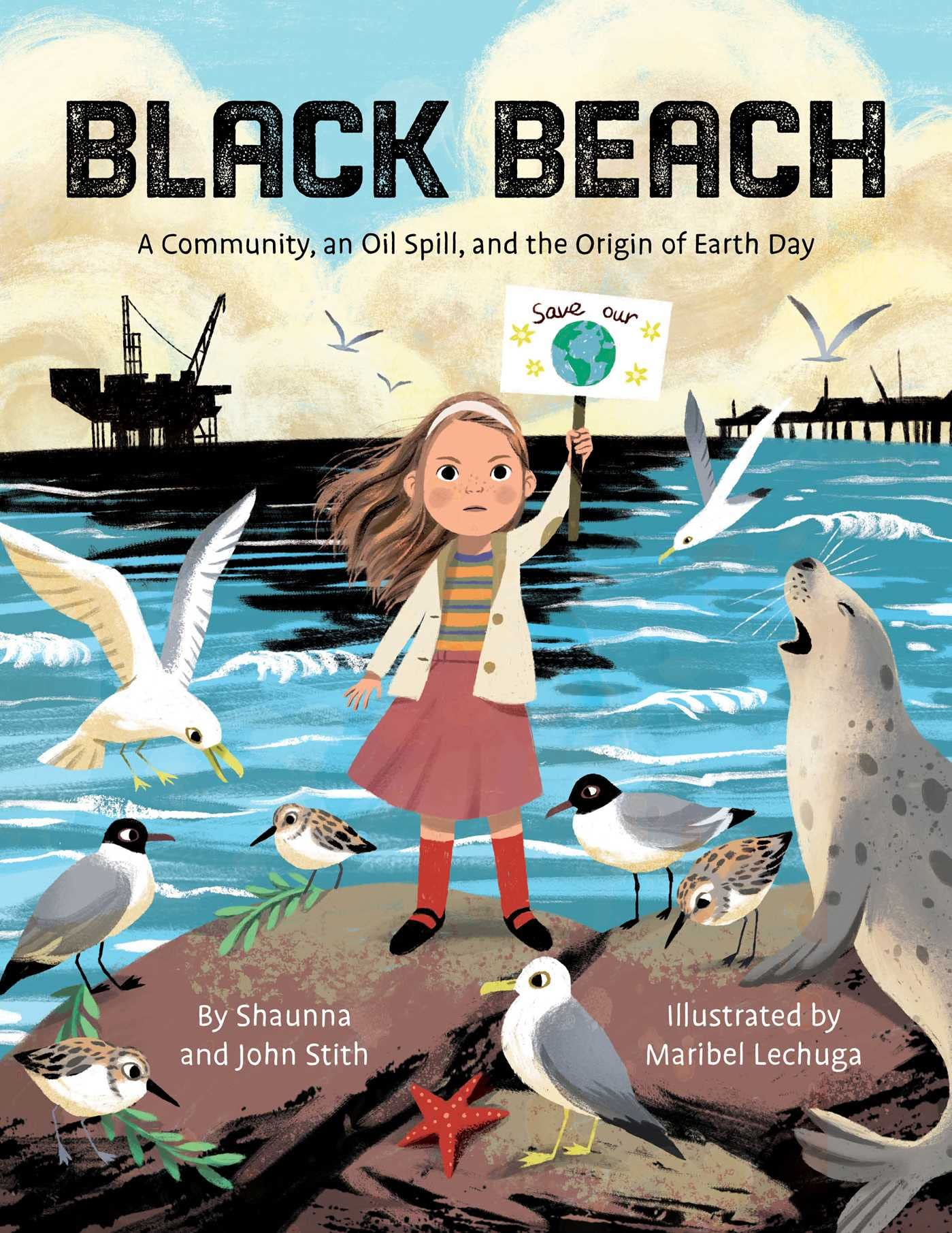
Black Beach: A Community, an Oil Spill, and the Origin of Earth Day by Shaunna and John Stith, illustrated by Maribel Lechuga

Published by little bee books

Summary:  Sam is in class drawing a picture of her favorite Santa Barbara beach when the principal walks in and whispers something to her teacher.  She finds out the news at home when her parents tell her about the oil spill that’s polluting her beloved beach.  As the oil starts to wash ashore, Sam feels sad, then angry, as she watches her parents and other volunteers try to clean up the damage.  She and her friends fill bottles with the oil and mail them to politicians.  News coverage increases, and several months later, U.S Senator and environmental activist Gaylord Nelson visits the beach, inspiring him to organize the first Earth Day.  On April 22, 1970, people around the world celebrated, protested, and taught about the environment, beginning a movement that continues today.  Includes an authors’ note, a bibliography, a timeline, additional information about Earth Day, and a list of ten ways to become an environmental activist.  40 pages; ages 4-8.

Pros:  An excellent read-aloud for Earth Day.  The perspective of the fictional Sam brings this true story to life for kids, and the additional information gives them concrete actions to take for the environment.

Cons:  Showing the damage wrought by the oil company, then urging kids to take shorter showers and turn off the lights feels like misplaced responsibility.

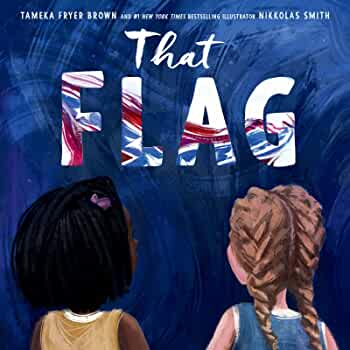
That Flag by Tameka Fryer Brown illustrated by Nikkolas Smith

Published by HarperCollins

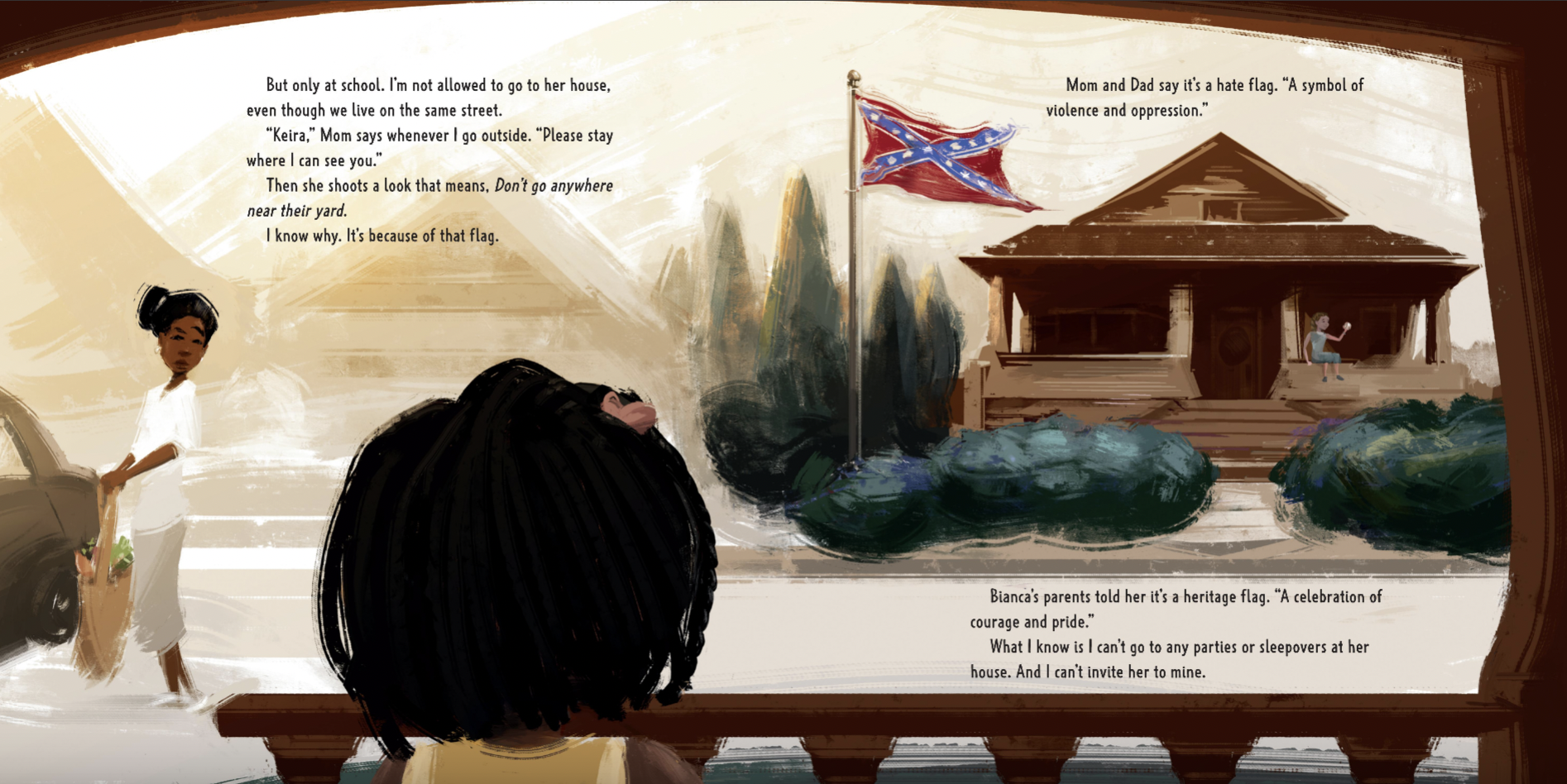
Summary:  Although Kiera considers Bianca her best friend, she’s not allowed to go over to Bianca’s because of the Confederate flag that flies outside their house.  While Kiera’s parents tell her that the flag is a symbol of violence and oppression, Bianca’s family describes it as a celebration of courage and pride.  Kiera is confused until a class trip to the Legacy Museum where she learns a history of racism that she didn’t know about. That night her family shares stories about their own experiences of racism that Kiera has never heard about before.  The stories leave her feeling scared and angry, and she finds that she no longer wants to be friends with Bianca, who seems unaffected by the museum trip.  A few days later, both girls see news reports of two Black people shot by three white men wielding a Confederate flag.  When Kiera and her parents go to a candlelight vigil, she’s surprised to see Bianca there with her family, and even more surprised on the drive home when she sees that they’ve taken down their flag.  The next day, Bianca passes Kiera a note saying, “You were right,” and Kiera wonders if they might be able to be friends after all.  Includes additional information about the Confederate flag, a list of sources, and notes from the author and illustrator.  40 pages; grades 1-4.

Pros:  This story addresses some difficult topics in a way that elementary students will understand, offering hope for friendship between the two girls while explaining why this is difficult for Kiera.  The additional information adds context to the story.  An excellent choice for teaching Black history and how it continues to affect us today.

Cons:  Be sure to block out plenty of time to share this book…there’s a lot to unpack.

An American Story by Kwame Alexander, illustrated by Dare Coulter

Published by Little, Brown Books for Young Readers

Summary:  “How do you tell a story that starts in Africa and ends in horror?”  Kwame Alexander was moved to write this poem after he realized his daughter’s fourth-grade teacher wasn’t teaching students about slavery, because she was anxious and hadn’t been trained in how to teach that piece of the American story.  With distinctive illustrations that combine sculptures and paintings, the book portrays life in Africa, people being captured, the Middle Passage, and the horrors of slavery once they arrived in America.  The narrative is interspersed with pictures of a class learning from a teacher who is somewhat hesitant to teach the story, but who is encouraged by her students to tell them the truth.  How do you tell the story? “You do it/by being brave enough/to lift your voice,/by holding/history/in one hand/and clenching/hope/in the other.”  56 pages; grades 3-7.

Pros:  I have been sharing Kwame Alexander’s The Undefeated with fourth and fifth graders this week, and I think this book is even more powerful.  I know I can feel uncomfortable talking to elementary students about racism and slavery, but they are ready to hear about it, and this is an important book for making sure that happens.  The illustrations are equally powerful and mark my first Caldecott prediction for 2024.

Cons:  I saw recommendations in several places for ages 4-8, but I think it’s more appropriate for older elementary kids.


If You Were a Princess: True Stories of Brave Leaders from Around the World by Hillary Homzie, illustrated by Udayana Lugo

Published by Aladdin

Summary:  If you were a princess, what would you do?  These real-life princesses are smart and brave, standing up for human and animal rights, competing in sports, and earning advanced degrees in various arts and sciences.  Since ancient times, princesses have studied the stars, led others into battle, and made important discoveries and inventions.  You may not be a princess, but you can be inspired by royalty to stand up for yourself and others and to dazzle the world. Includes a paragraph of additional information about each princess and a list of works cited.  40 pages; ages 4-8.

Pros:  Cinderella, step aside to make way for these amazing real-life princesses from all over the world.  I cannot tell you how many times I’ve had requests for princess books, and I can’t wait to have this one on hand to teach kids some unexpected princess facts.

Cons:  Forced me to rethink my anti-royalist tendencies.

The Tower of Life: How Yaffa Eliach Rebuilt Her Town in Stories and Photographs by Chana Stiefel, illustrated by Susan Gal

Published by Scholastic Press

Summary:  Yaffa Eliach had a happy childhood in the Jewish town (shtetl) of Eishyshok, playing with her friends and older brother and helping her grandmother in her photography studio.  But when Yaffa was six years old, German tanks rolled in and the village, along with most of its inhabitants, was destroyed.  Yaffa’s family managed to flee and lived in hiding for the next several years.  They left their possessions behind except for a few photographs Yaffa hid in her shoe.  After the war, Yaffa moved first to Israel, and then to the United States, where she became a history professor specializing in the Holocaust.  When the Holocaust Museum was built in Washington, DC, President Jimmy Carter asked Yaffa to create an exhibit to show the lives of people who were lost.  Yaffa searched all over the world for photographs of people who had lived in Eishyshok.  Over the course of 17 years, she traveled to six continents to collect over 1,000 photos that were turned into the “Tower of Life” exhibit at the Holocaust Museum.  Includes a timeline of Yaffa’s life, a bibliography, and a brief author’s note.  40 pages; grades 1-4.

Pros:  An inspiring story of an amazing woman who emerged from tragedy to create a beautiful tribute that celebrates the lives of those who died in the Holocaust.  The illustrations capture those lives as well, incorporating photos into the paintings.

Cons:  I would have liked more information about Yaffa in the back matter.

Going Places: Victor Hugo Green and His Glorious Book by Tonya Bolden, illustrated by Eric Velasquez

Published by Quill Tree Books

Summary:  Victor Hugo Green had a successful career as a mail carrier in Leonia, New Jersey, but he also liked to travel.  In the 1930’s, more people were buying cars and using them to visit new places.  Black travelers were less hassled in their cars than on trains, but they also faced Jim Crow laws that prevented them from using certain hotels, restaurants, and other establishments, and sundown laws that prohibited them from being in certain towns after dark.  Green used newspaper ads and articles and the knowledge of friends and co-workers to put together a directory of places that were safe to go.  Known as the Green Book, it started as a pamphlet in 1936, covering the New York City area, but continued to grow to cover the entire U.S. as well as Mexico and Canada.  In 1953, Victor Hugo Green retired from his postal career to spend his time running a travel agency and keeping up with the Green Book.  He died in 1960, a few years before the Civil Rights Act of 1964 made much of the Green Book obsolete.  Includes a timeline, selected sources, and a list of places to learn more about the Green Book.  40 pages; grades 2-5.

Pros:  This fascinating look at the man behind the Green Book weaves in plenty of details about the ways racism affected Black travelers for much of the twentieth century.  The vivid oil paintings bring traveling to life with their colorful postcards, reproductions of black-and-white photos, and maps.  Worthy of a consideration for a Coretta Scott King award or honor.

Cons:  While I was hoping to see a page from the actual Green Book, the illustrations offer only tantalizing glimpses.  Guess I will have to peruse the digital editions listed in the back matter.

Standing in the Need of Prayer: A Modern Retelling of the Classic Spiritual by Carole Boston Weatherford, illustrated by Frank Morrison

Published by Crown Books for Young Readers

Summary:  Carole Boston Weatherford has created new words based on the traditional spiritual to trace the history of Black people in America.  Beginning with slavery, the verses and illustrations continue through Emancipation, the Great Migration, and the fights for integration.  The last few pages reflect the recent past and present: Florence Griffith Joyner, Colin, Kaepernick, and the Black Lives Matter Movement.  Includes additional information on each of the subjects, a list of online resources, and an author’s note.  32 pages; grades 1-5.

Pros:  Another beautiful resource for teaching Black history, with gorgeous thought-provoking oil illustrations.  The text, including the back matter, could serve as an excellent introduction to a variety of topics; readers can use the excellent list of online resources for further research.

Cons:  I wasn’t familiar with this spiritual and would have liked to have had the traditional words included somewhere.