That Neighbor Kid by Daniel Miyares

Published by Simon and Schuster Books for Young Readers
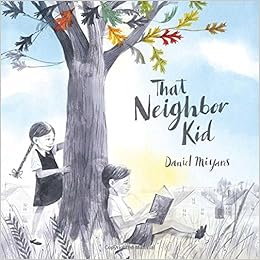
Summary:  In this almost wordless book, a girl starts spying on the boy who’s just moved in next door.  She sees him reading a book, then removing part of the wooden fence between their houses to nail rungs on to a tree.  Stealthily following him up the ladder, she discovers him scratching his head over plans for a tree house.  She pulls a hammer out, and the only words in the book appear.  “Hi.”  “Hi.”  The two of them get to work, and before long, a house begins to emerge.  As they build, splashes of color appear in the previously black-and-white illustrations.  On the last page, they wave from the yellow-lighted windows of their houses, the completed treehouse standing between them.  32 pages; ages 4-8.

Pros:  A simple story of friendship, told entirely in the beautiful watercolors of Daniel Miyares.

Cons:  Kids, don’t try unsupervised hammering and sawing at home!
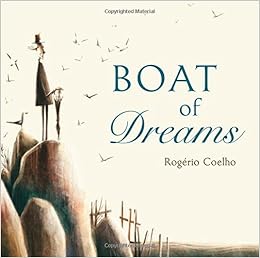
Boat of Dreams by Rogerio Coelho

Published by Tilbury House Publishers

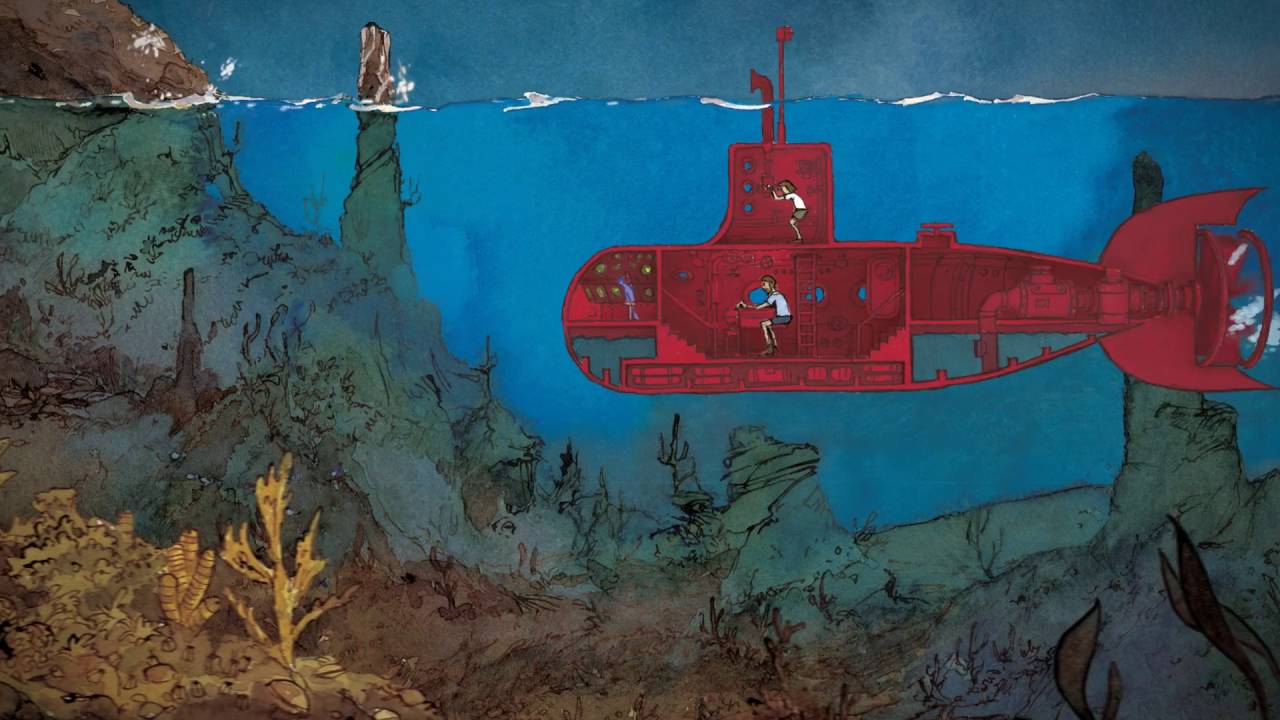
Summary:  An old man wakes up in his house on an island.  He sees a bottle bobbing in the sea with a piece of paper inside.  Removing the paper, he begins to draw, creating a picture of a magical-looking flying ship.  He puts the picture back in the bottle and returns it to the ocean.  A boy walks to his home in the city, where he finds an envelope outside the door.  Inside is the old man’s picture.  He draws himself and his cat in the ship, then goes to bed.  Next, he and the cat are on the ship flying toward the island.  When they get there, he and the man embrace, then the boy gives him the picture with his additions.  The man waves as they fly away.  The man gazes at the picture of the boy as his candle slowly goes out.  In the morning, the boy awakens to a new day.  80 pages; grades 2+

Pros:  Wow!  What does it mean? This lengthy wordless picture book could be interpreted in many different ways.  Kids and adults alike will enjoy puzzling over the illustrations to create their own stories.

Cons:  It looks like a picture book, but this will be appreciated more by an older audience.

Wolf in the Snow by Matthew Cordell

Published by Feiwel and Friends

Summary:  Before the title page of this wordless winter tale, a girl and a wolf pup are each shown safe at home with their families.  As the story begins, snow is starting to fall as the girl leaves school, wrapped up in a red coat and hood, a scarf around her face. The wolves are also traveling through the snow.  The heavy white curtain causes both girl and pup to lose their way, and they cross paths.  When the girl hears howling, she heads in that direction, hoping to reunite the pup with its family.  She succeeds, but the long detour exhausts her, and she collapses in the snow.  The wolves stay with her, howling to alert her dog to her whereabouts, and at last she is rescued by her parents.  The wolves howl in the distance as she heads home at last.  48 pages; ages 3-8.

Pros:  I do enjoy a good wordless book, and this one satisfies, with a fairly straightforward tale of friendship told through beautiful, snowy illustrations, and a few howls, huffs, and barks.

Cons:  The wolves are much better looking than the humans.

Return by Aaron Becker

Published by Candlewick Press 

Summary:  In this third and final volume of a wordless trilogy, a girl travels once again into the magical world she discovered in Journey and continued to explore in Quest.  This time, though, her father finally looks up from his work and follows her.  She meets up with the boy, the king, and the bird from the previous books, and as usual, the bad guys make an appearance.  They have a box that draws the magical crayons and their creations inside of it.  The boy, girl, and king are powerless to stop it, but Dad turns out to have a magical crayon of his own, and figures out a way to save the day.  40 pages; grades K-5.

Pros:  Caldecott honoree Aaron Becker has risen to the occasion of creating a third amazing book in this trilogy.  I just spent quite a while with a 9-year-old who moved from one book to the other, finding all kinds of details I had missed (“Did you notice the boy always draws animals and the girl always draws machines?”).  Some of the best, most beautifully illustrated wordless picture books I have ever seen.

Cons:  If you hurry through these books, you will miss a lot!

Fish by Liam Francis Walsh

Published by Roaring Brook Press 

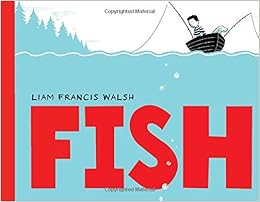
Summary: A boy and his dog are on an unusual fishing expedition in this wordless book. Instead of fish, he pulls letters in from the sea; first an F, then an I, then an S. But the H is more elusive. As he catches and tosses back a Q, a giant C looms out of the water. Finally, there’s a tug on his hook, but it’s a pretty strong tug, and he’s pulled out of the boat, deep into the ocean, where he pulls an H from a huge swarm of letters. Safely back in the boat, the boy and his dog are ready to head for shore, but the letters have a different idea. They surround the boat, and the giant C almost capsizes them. Fortunately, the dog hangs on to the letters, and at last they are able to make a safe return. The purpose of their mission becomes clear as they approach a couple of workmen puzzling over the sign they’re hanging that reads “IN”. The FISH is what they need to create a FINISH line, just in time for the huge group of runners that’s ready to cross it.

Pros: New Yorker cartoonist Walsh has created a fun story with his comic-style black, white, red, and turquoise illustrations. Readers will enjoy the “A-ha!” moment of discovering what the FISH is really for. And the dog is pretty darn cute.

Cons: As in so many wordless books, there were some puzzling elements, like the underwater letters and the giant C. Make sure you have your imagination fired up before tackling this story.

The Whale by Ethan Murrow and Vita Murrow

Published by Templar Books 

Summary: “Giant whale or giant hoax?” screams the headline of the Cape Chronicle. It’s been 50 years since two children claim to have spotted a giant whale. Two kids read all about it and decide, individually, to explore the issue themselves. When their boats collide, they are forced to join forces. Putting their scientific minds together, they collect amazing evidence of the Great Spotted Whale. Upon their return, they find themselves featured in their own Cape Chronicle article…and discover an interesting connection to the first team of whale spotters from half a century ago. 32 pages; grades 1-4.

Pros: This almost-wordless book (the only text is in the two newspaper articles at the beginning and end) tells the story through realistically detailed black-and-white illustrations. Readers will almost feel the salty spray and hear the whale songs coming from the beautiful renditions of the ocean.

Cons: Like many books without words, the story may be a little confusing.

Spot, the Cat by Henry Cole

Published by Simon and Schuster 

Can you spot the cat?

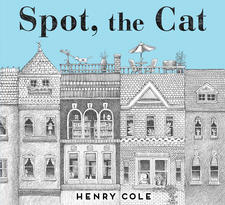
Summary:  Spot the Cat sees a bird through the open window.  The temptation is too great; he jumps out and is off, into the city.  His boy discovers he’s missing and makes flyers on his computer while Spot continues his adventures.  The boy goes out looking for him.  Connections are missed.  Finally, the boy gives up and comes home only to discover, to his delight, that Spot is at his window, home again.  32 pages; ages 4-8.

Pros:  The title of this wordless picture book has a double meaning.  Readers must spot Spot the cat on every page of detailed black and white illustrations.  There is often a spotted dog or some other decoy.  The pictures are beautifully drawn, and children will enjoy studying them.

Cons:  Be sure to allow plenty of time with this book.  I tried to rush it a little, and my heart would sink every time I turned a page and felt compelled to stop until I had spotted Spot.

The Typewriter by Bill Thomson

Published by Two Lions 

Summary: Two boys and a girl are riding their bicycles past a closed amusement park, when they spy something on top of a bee ride. It’s an old typewriter case.  These three members of the iPhone generation are intrigued by the old machine.  The girl puts a piece of paper in the roller and types “Beach”.  Instantly a beach appears.  The kids take turns creating a beach ball, ice cream, and, mistakenly, a giant crab.  Fortunately, they have the presence of mind to type “Big wave”, which takes care of the monster crustacean.  Finally, the girl types “The End”, and the kids find themselves back at the amusement park on the same wintry day.  They box up the typewriter and put it back where they found it, then continue on their way.  40 pages; ages 4-8.

Pros:  The author of Chalk and Fossil has created another wordless tour de force with gorgeous life-like illustrations telling a story of creativity and imagination.

Cons:  The plot seemed a bit too derivative of Chalk.

ABC Dream by Kim Krans

Published by Random House 

Summary:  A wordless alphabet book.  Each page has a letter with two to eight objects that start with that letter.  For instance the A has an argyle pattern; on its peak is an apple with two arrows shot through it.  Lying next to it is an apple core crawling with ants.  Illustrations are predominantly black and white ink with splashes of color.  The last two pages list all the objects by letter so the reader can check and make sure all were found.  48 pages; ages 3-7.

Pros:  Kids will love seeing how many of the objects they can find in these gorgeous illustrations.

Cons:  I wasn’t all that good at finding everything.

Bird by Beatriz Martin Vidal

Published by Simply Read Books


Summary:  A series of pictures show a flock of birds starting at 10:05.  As the hour moves on, the pictures zoom in, until a single bird is pictured at 11:00.  Starting at 11:00, the bird is shown on one page, and a girl on the facing page.  The girl is clearly getting ready to attempt a flight of her own, dressed in a white flight suit, adjusting her goggles, wings strapped to her back.  As the time moves close to 12:00, the bird appears fatigued and his feathers start to fall out.  By noon, he has transformed into a boy.  He gently alights on one end of a seesaw; the girl waits on the other end.  As soon as he lands, she is off.  The final page shows her metamorphosis into a bird, and the last picture is the same flock that appeared in the first one.  Ages 8 and up.

Pros:  A wordless picture book full of wonder.  Who are the children?  Why do they turn into birds?  What do the times signify?  Children will have to call on their imaginations to guess what is happening in the pictures.

Cons:  No easy answers.