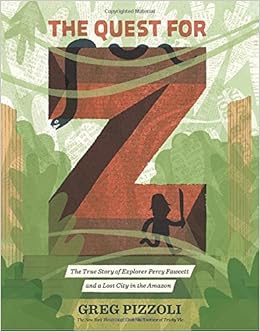
The Quest for Z: The True Story of Percy Fawcett and a Lost City in the Amazon by Greg Pizzoli

Published by Viking

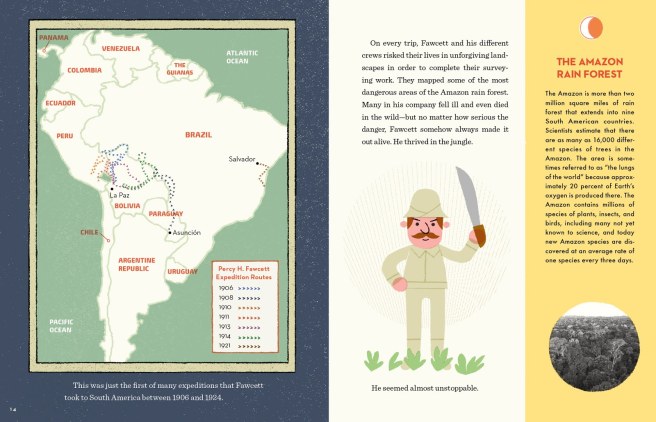
Summary:  British explorer Percy Fawcett was fascinated by stories of a mythical city that had thrived in the Amazon rain forest, then mysteriously disappeared.  He called the city “Z”, and he was determined to find it.  For many years, he worked as a member of the Royal Geographic Society, surveying areas in Bolivia, Brazil, and Peru. He had many dangerous adventures on these expeditions, including a close encounter with a huge anaconda and the discovery of a missing member of his party with 42 arrows in his body (he was dead).  He heard more stories from the locals about the lost city of Z, and became obsessed with finding it.  The Royal Geographic Society wouldn’t support such a wild goose chase, so Fawcett organized a trip himself, taking only his son Jack and Jack’s friend Raleigh.  They set off for unknown territory in the Brazilian jungles, and (spoiler alert) were never seen again.  To this day, other explorers have tried to find out what happened to them, but their fate remains a mystery, and the city of Z has never been discovered.  Includes an author’s note, a page of “Fawcett hunters” describing other explorers who have tried to find out what happened to Percy Fawcett, a glossary, and a page of sources.  48 pages; grades 2-5.

Pros:  A perfect addition to a unit on explorers.  Fawcett’s story is compelling, but ultimately tragic, not unlike some of the better-known European explorers.  The cartoon-inspired illustrations add some fun, and sidebars provide context to the explorer’s life.

Cons:  Fawcett definitely seems to be a product of his time, with his stiff upper lip British Empire approach to exploration.
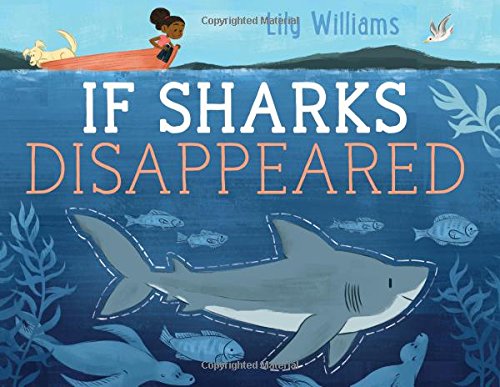
If Sharks Disappeared by Lily Williams

Published by Roaring Brook Press

Summary:  Sharks can seem scary, but a world without sharks is even scarier.  Because they’re at the top of the food chain, they keep the populations of their prey in balance.  By feeding on weaker animals, they allow the stronger ones to reproduce and survive.  Williams makes the case that removing sharks from the ecosystem could ultimately destroy the oceans and all the animals that depend on it for life–including humans.  The final two pages include additional information on why sharks are in trouble and what kids can do to help save them.  Also includes a glossary and bibliography; labeled drawings of a variety of shark species are included on the endpapers.  40 pages; ages 4-8.

Pros:  A simple yet scientific explanation of the interconnectedness of all species.  The focus on sharks will make this a popular choice for kids.

Cons:  The destruction of all life on earth is kind of a downer.

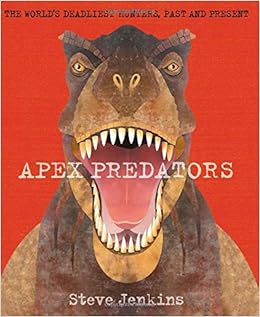
Apex Predators by Steve Jenkins

Published by Houghton Mifflin Harcourt

Summary:  After a one-page explanation of what an apex predator is (animals at the top of their food chain), Jenkins launches into his trademark cut-paper illustrations with facts about various apex predators, past and present.  He starts with several modern-day animals, then works his way backward through time, from the giant short-faced bear (extinct 11,000 years ago) to the Anomalacaris (strange shrimp) that’s been extinct for 500 million years.  On the last two pages, he shows a couple imagined face-offs between living and extinct animals.  Who would win–the Siberian tiger or the Utahraptor?  The great white shark or the Dunkleasteus?  There’s also a sidebar about the deadliest predator of all times; bet you can guess what that is.  Includes a brief bibliography and a list of websites.  32 pages; grades 1-5.

Pros:  Jenkins has produced another collection of amazing illustrations and kid-friendly facts.  Readers will wish for more of the “Who would win?” scenarios…maybe they could learn about some of the apex predators and create their own.

Cons:  After reading many Steve Jenkins books, some of his facts sound familiar.

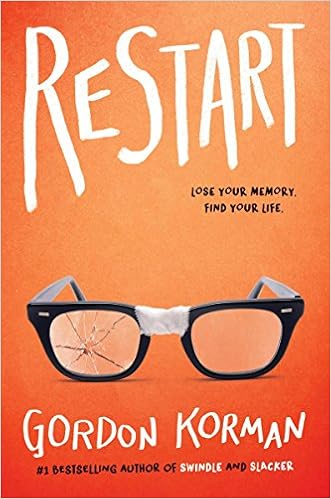
Restart by Gordon Korman

Published by Scholastic

Summary:  When Chase Ambrose falls of the roof of his house, the blow to his head causes complete amnesia.  After getting reacquainted with his family, he starts back to school, where he discovers he has been a superstar athlete and the biggest bully in the eighth grade.  The kids in the video club that he now wants as friends were once his biggest victims.  His old friends Aaron and Bear can’t understand why he’s turned into such a goody-two-shoes.  The three of them are doing community service at a retirement home as punishment for one of their worst misdeeds, and Chase befriends a crotchety war veteran there who may hold a clue to more of Chase’s former life.  As his memory begins to return in brief flashbacks, Chase has to make a choice between who he used to be and who he wants to become.  256 pages; grades 3-7.

Pros:  Told in the usual Gordon Korman style of short chapters from many different points of view, this funny and thought-provoking look at the middle school social hierarchy will definitely be a popular choice for many readers.

Cons:  Chase’s complete transformation was occasionally difficult to believe.

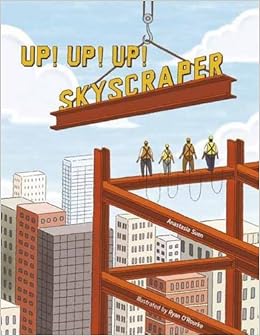
Up, Up, Up, Skyscraper! by Anastasia Suen, illustrated by Ryan O’Rourke

Published by Charlesbridge

Summary:  What’s going on behind that fence?  A group of kids gets to put on hard hats and take a look at every step of the construction of a skyscraper. Each two-page spread has four lines of rhyming text, supplemented with a few sentences explaining the process.  The illustrations have labels to identify machines used, as well as different parts of the structure.  A small inset picture gives a macro view of what the building looks like at each step.  The last page unfolds upward to show the finished skyscraper.  32 pages; ages 3-8.

Pros:  A fun and accessible introduction to building a skyscraper.  Construction enthusiasts will love studying the pictures, while those less familiar with the process will learn a lot.

Cons:  The fold-out page seemed a little ill-fitting and was already starting to rip a bit when I unfolded it.

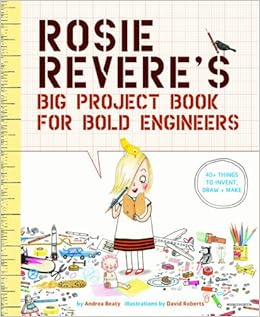
Rosie Revere’s Big Project Book for Bold Engineers by Andrea Beaty, illustrated by David Roberts

Published by Harry N. Abrams

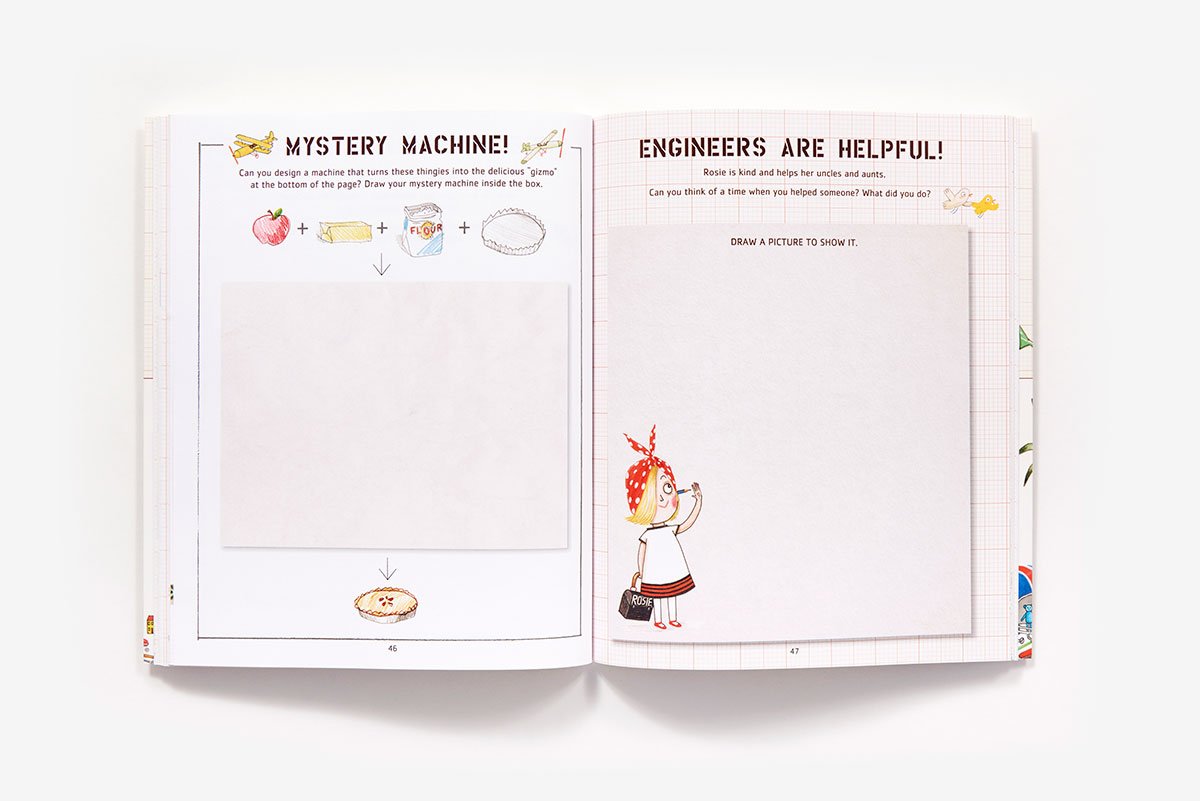
Summary:  In this companion workbook to Rosie Revere, Engineer, Rosie advises kids about how to start being an engineer.  On the first few pages, Rosie introduces herself and the different types of engineering.  Much of the rest of the book is design challenges, including several “Real-World Problems”, such as thinking of ways to save water, and “Make-It” activities like building and testing a catapult for marshmallows.  There are several “Super-Duper Engineering Challenges”, like designing a cane for Great-Great-Aunt Rosie that will allow her to carry her tools; kids are encouraged to draw a design for these, rather than to build the actual item.  There are many blank pages for writing and drawing.  On the final page, young engineers can design a stamp to identify their work.  96 pages; grades 1-5.

Pros:  A good introduction to engineering with lots of activities to inspire creative thinking.

Cons:  Kids and teachers might be looking for less drawing and writing and more hands-on activities to build.

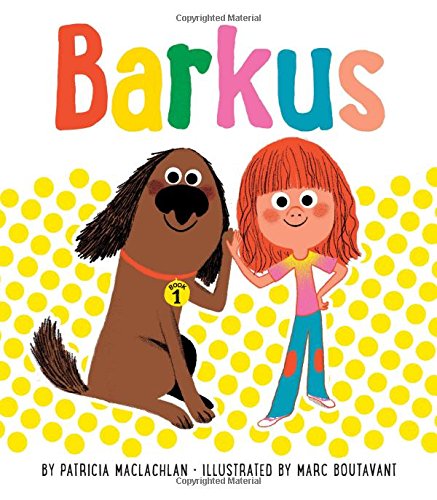
Barkus by Patricia MacLachlan, illustrated by Marc Boutavant

Published by Chronicle Books

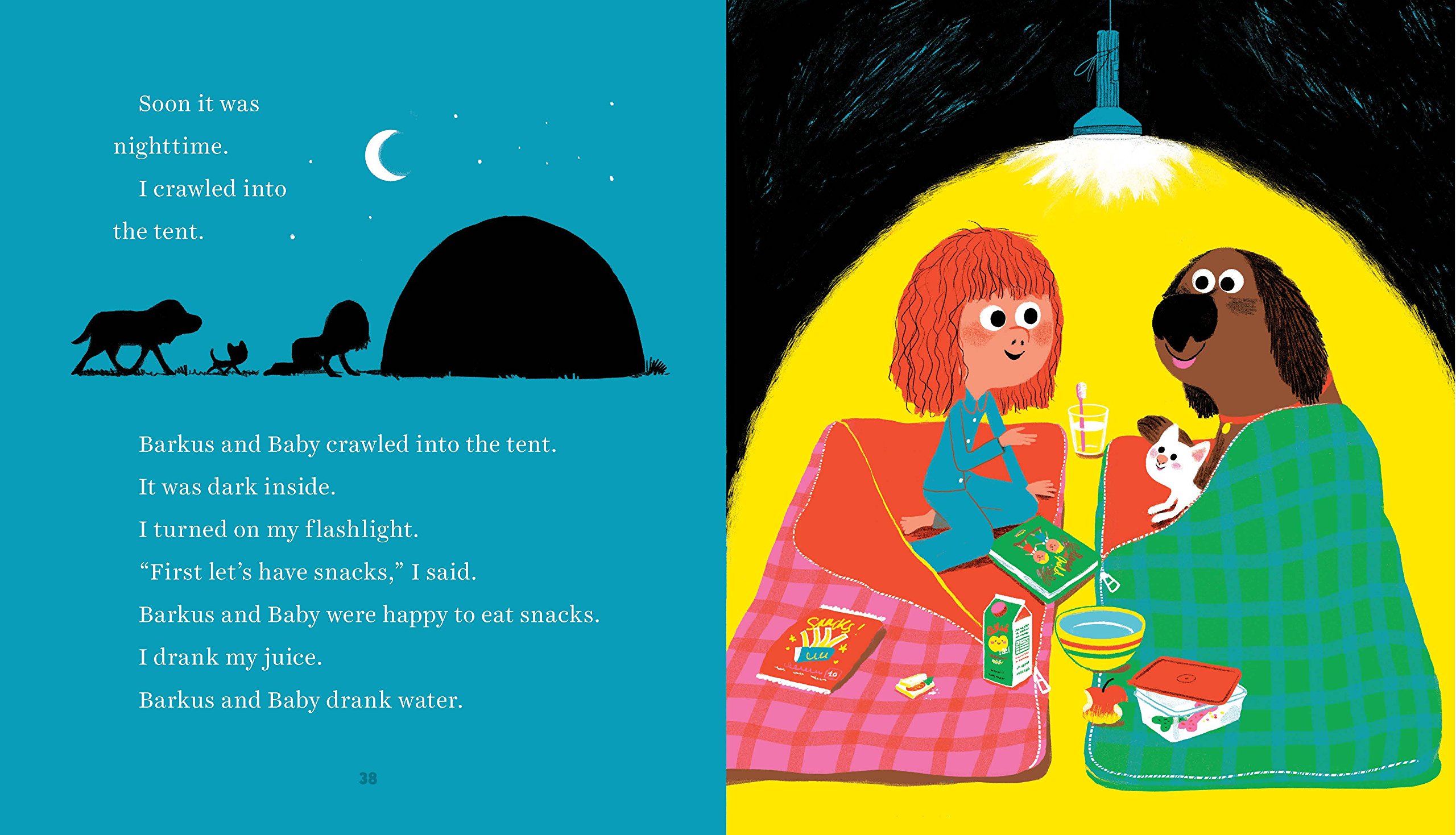
Summary:  When Nicky’s Uncle Everton leaves for some around-the-world travel, he drops of his dog Barkus for the family to look after.  It’s love at first sight for Nicky, and  each short chapter tells a humorous tale about the girl and her dog: Barkus sneaks into school, throws himself a birthday party, and adopts a kitten.  In the final chapter, the family goes camping, and Nicky tells them a bedtime story about their family as they snuggle together in their tent.  This book is billed as book #1, so readers can look forward to more Barkus tales ahead.  56 pages; grades K-3.

Pros:  A perfect choice for beginning or reluctant readers, written by Newbery Medalist Patricia MacLachlan, and illustrated with bright cartoon-style pictures.

Cons:  Librarians may have a tough time deciding if this belongs with the easy readers or chapter books.

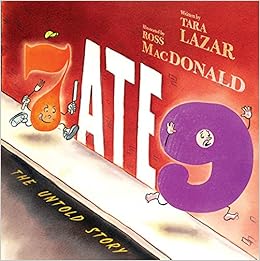
7 Ate 9: The Untold Story by Tara Lazar, illustrated by Ross MacDonald

Published by Disney-Hyperion

Summary:  Why is 6 afraid of 7?  Because 7 ate 9.  In this takeoff on that old joke, a Private I (who really is an I) is confronted by a frightened 6 claiming that 7 is coming to get him.  The detective is off, questioning numbers and letters about the whereabouts of 7, with punny humor on every page.  B the waitress serves I a slice of pi (which, of course, costs $3.14).  A sighting of 6 tips off the private I, and back he goes to reveal the true identity of the 6 waiting back in his office (hint: that 6 gets turned upside down).  The whole thing is enough to get I to forsake number cases forever and stick with letters…they may be wordy, but they’re A-OK in his book!  32 pages; ages 3-6.

Pros:  A fun and unusual introduction to numbers that kids will enjoy hearing over and over again.

Cons:  1 and 3 seem to be MIA.


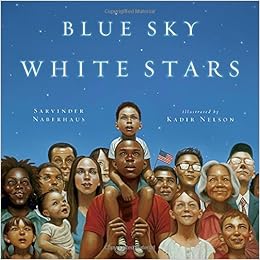
Blue Sky White Stars by Sarvinder Naberhaus, illustrated by Kadir Nelson

Published by Dial Books

Summary:  A few words of text on each page celebrate the American flag and the people of the United States.  On the left-hand side of each spread is a picture depicting an American landscape or icon; the facing page has to do with the flag, or has a flag as part of a picture.  For instance, “white rows” shows a line of covered wagons traveling west on the left, and the white stripes on the flag on the right.  Some of the phrases are homophones, such as Betsy Ross sewing the flag, described as “Sew together/won nation”, accompanied by “So together/one nation” showing a diverse group of Americans.  Includes notes from the author and illustrator.  40 pages; for all ages on the Fourth of July.

Pros:  A beautiful and patriotic tribute to patriotism, with gorgeous, multicultural illustrations by award-winning Kadir Nelson.

Cons:  Even this lovely book couldn’t quite pry the CNN-wrestling tweet out of my head.

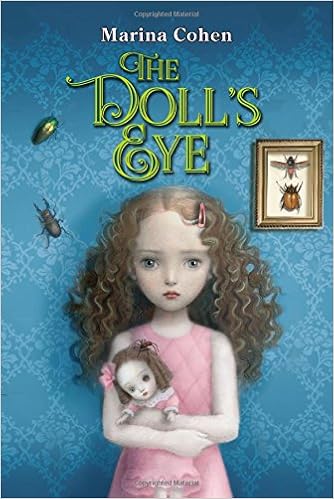
The Doll’s Eye by Marina Cohen

Published by Roaring Brook Press

Summary:  Hadley’s not too excited about moving into a new house, particularly since the move includes her new stepfather and stepbrother.  She’s excited about the discovery of a beautiful dollhouse in the attic, though, and intrigued by the glass doll’s eye that seems to appear out of nowhere.  The old lady living over the garage seems like the grandmother she never had, and the boy next door is a little peculiar, but nice enough.  Events take a sinister turn, however, when Hadley accidentally wishes her stepfather and stepbrother away, and her mother starts acting like a Stepford wife.  These incidents seem tied to the dollhouse and its occupants, and Hadley becomes increasingly desperate to learn how to control her wishes and return things to normal.  Interspersed through the main narrative are chapters told by the first girl who lived in the house with hints of how her life may be tied to the present.  The old lady (ominously named Althea de Mone) shows her true colors as events come together in a creepy conclusion.  208 pages; grades 4-7.

Pros:  The menacing details start on page one and don’t let up much right through the end.  Horror fans will find this hard to put down.

Cons:  There’s a happy ending for everyone…except the reader.