Ribbit by Jorey Hurley

Published by Simon and Schuster
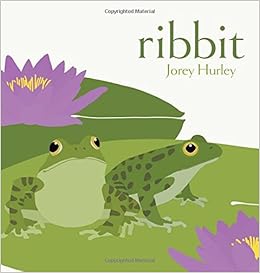
Summary:  The life cycle of a frog is described through illustrations and one word of text per page.  It begins with “Wait”, as two frogs swim near a mass of eggs, and ends with “Ribbit”, as one of the hatchlings, now an adult, finds a mate. In between, the eggs hatch, a tadpole transforms into a frog, and that frog catches an insect and hibernates in the mud.  An author’s note gives more information about frogs and their life cycles.  40 pages; ages 3-7.

Pros:  Young children will love the bright, clean illustrations depicting the frog and its environment around a pond.  The single words convey a lot of information.

Cons:  A list of books and/or websites about frogs would have been a nice addition.
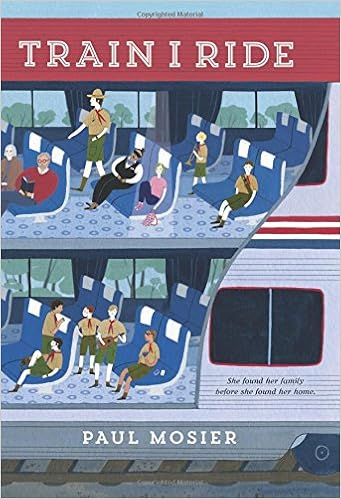
Train I Ride by Paul Mosier

Published by HarperCollins

Summary:  Rydr is traveling from California to Chicago, and toward an unknown future.  Traveling as an unaccompanied minor, she wears a nametag reading “Rider”, and that’s the name she uses on her trip (part way through the book, she changes the spelling).  As the journey goes on, Rydr slowly reveals her past.  Her mother was a drug addict who tried to raise her daughter, but had to frequently send her to live with her grandmother in California.  Ryder discovered her mother dead of an overdose, then a short time later, she was the one to find her grandmother’s body.  A great uncle in Chicago whom she has never met is the only person keeping her out of foster care. On the train, she feels safe, befriending Dorothea, the Amtrak employee assigned to look after her, and Neal, the snack bar attendant.  She has a bit of a romance with a boy from a scout troop traveling on the same train.  By the end of the trip, she is ready to spread her mother’s ashes, with the help of Dorothea and Neal, and she has made some discoveries about who she is and how she can create her own future.  192 pages; grades 4-7.

Pros:  A beautifully written novel about a girl who has seen too much in her 13 years, but has gained a wisdom and strength which will hopefully serve her well moving into an unknown future.

Cons:  This book is recommended for third or fourth grade and up, but there’s some pretty mature subject matter for most elementary students.

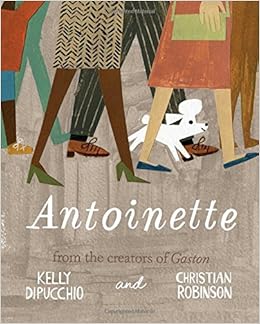
Antoinette by Kelly DiPucchio, illustrated by Christian Robinson

Published by Atheneum Books for Young Readers

Summary:  Antoinette, the precious poodle from Gaston, is happy living with her bulldog brothers.  Rocky is clever, Ricky is fast, and Bruno is strong.  But Antoinette hasn’t discovered any special gift of her own.  Every day, Antoinette’s family meets up with Gaston’s to play in the park.  One day, a problem arises: young Ooh-La-La has gone missing, last seen chasing a butterfly.  All the dogs join in the search, but it is Antoinette who refuses to give up, following the scent all the way to the museum.  Even when a guard yells, “No dogs allowed!”, Antoinette persists, and arrives just in time to save Ooh-La-La from chasing the butterfly off the edge of a high statue.  Antoinette has discovered her gift, and she continues to use it into adulthood, becoming one of Paris’s most famous police dogs.  40 pages; ages 4-8.

Pros:  Kids who have loved Gaston will not be the slightest bit disappointed with this sequel.  It’s billed as part of the series Gaston and Friends; we can only hope for more to come in the near future.

Cons:  Ooh-La-La = not too bright.

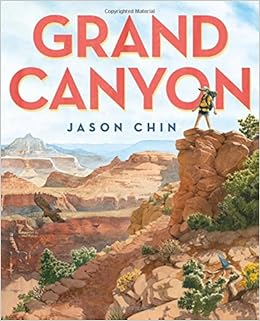
Grand Canyon by Jason Chin

Published by Roaring Brook Press

Summary:  A man and his daughter take a backpacking trip through the Grand Canyon, learning about the geological history as they go.  Starting at the bottom, they study the rocks and fossils of each layer traveling upward to discover what Earth was like in the past.  The girl imagines herself in different eras, with illustrations showing what the canyon looked like in those times.  Small cutouts in some pages give preview peeks as to what’s ahead on the next page.  Borders of many of the main illustrations show the flora and fauna that live at the different levels within the canyon.  The final two pages of the main text open up into an amazing four-page spread of the “the grandest canyon on Earth.”  Back matter includes quite a bit more information on the Grand Canyon, as well as a long list of sources and some books for further reading.  56 pages; grades 2-7.

Pros:  Jason Chin produces another natural history masterpiece, with illustrations so lifelike they almost look like photographs.  The pages are packed with information, both in the text and the pictures and diagrams.  Readers will want to be on the next flight out to Arizona to experience the Grand Canyon for themselves.

Cons:  While extremely informative, the text isn’t always quite as engaging as the illustrations.

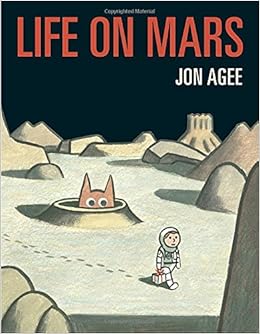
Life on Mars by Jon Agee

Published by Dial Books

Summary:  The narrator has arrived on Mars, where he is looking for signs of life.  By the third page, a giant creature has peeked out of his hole, but the young astronaut never sees it.  He bemoans Mars’s bleak landscape, while the beast follows close behind.  He leaves behind a chocolate cupcake in a box that he brought to offer any living beings he might find.  Thinking he has lost his spaceship, he climbs a mountain (the creature’s head) to get a better view.  Right before boarding, he finds the cupcake box he had discarded.  When he decides to have a treat on the way home, he discovers the cupcake has mysteriously disappeared.  32 pages; ages 3-8.

Pros:  This would be great to pair with Sam and Dave Dig a Hole, as both have visual clues that allow the reader to know more than the characters in the story.  The story is simple, but the illustrations will have kids laughing.

Cons:  The creature seems lonely.

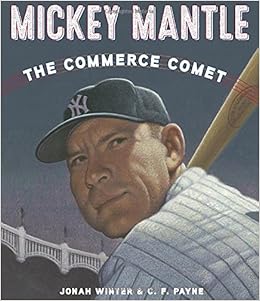
Mickey Mantle: The Commerce Comet by Jonah Winter, illustrated by C. F. Payne

Published by Schwartz and Wade

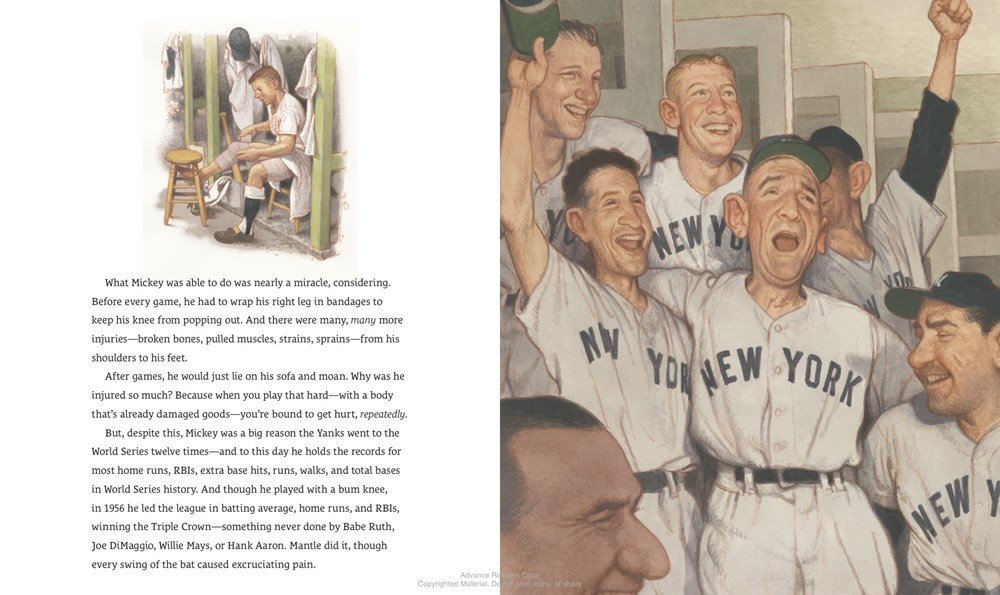
Summary:  Right from the author’s note before the title page, it is clear that Mickey Mantle was a flawed character.  The note mentions the poverty and abuse that marred his childhood, as well as the alcoholism that led to his death at the age of 63.  But it is equally clear that Mantle was an amazing baseball player, chosen to replace the legendary Joe DiMaggio on the New York Yankees, and a winner of baseball’s Triple Crown in 1956 (league leader in batting average, home runs, and RBI’s), a feat not achieved by DiMaggio, Willie Mays, Babe Ruth, or Hank Aaron.  He could belt powerful home runs from either the left or the right, and could run from home plate to first base in 2.9 seconds…until a debilitating knee injury raised his time to 3.1.  Plagued by injuries, he still led his team to the World Series 12 times, and, although fans knew he wasn’t perfect, they cheered him on for 17 years.  40 pages; grades 2-5.

Pros:  The large full-color illustrations bring Mantle’s story to life, told in a conversational voice with a slight Oklahoma (Mantle’s home state) twang.

Cons:  I could have enjoyed a seeing a photo or two.

Hatching Chicks in Room 6 by Caroline Arnold

Published by Charlesbridge

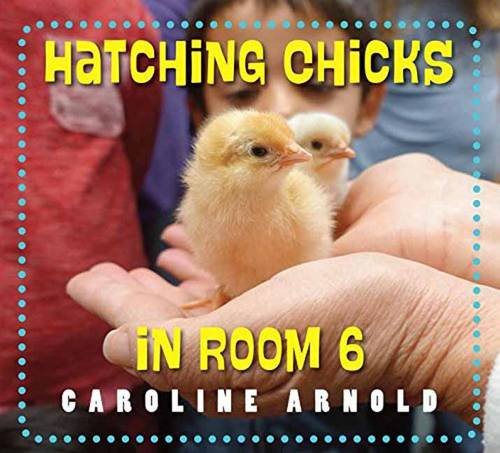
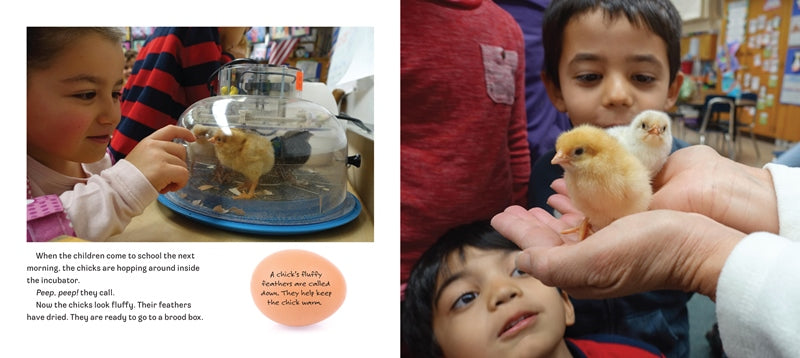
Summary:  Mrs. Best raises chickens in her backyard, and she brings in some eggs for her kindergarten class to observe.  The class keeps the eggs in two incubators and counts down the 21 days it will take for them to hatch.  They–and the reader–learn about chickens and what is going on inside the egg.  Excitement grows as day 21 arrives, and cracks start appearing in the shells.  Pretty soon, there are 14 baby chicks in the incubators.  From there they move into a brood box, then an outdoor pen, and finally, when they are a month old, back to Mrs. Best’s house to join the rest of her chickens.  Includes questions and answers, a glossary, and books and websites with additional information.  40 pages; ages 4-8.

Pros:  This is a must-have for any classroom that embarks on an egg-hatching project.  Even if you’re not that ambitious, it is an engaging introduction to the life cycle of the chicken, with plenty of great photos of Mrs. Best, her class, and the eggs and chicks at various stages.

Cons:  The list of books at the end doesn’t include the awesome A Chicken Followed Me Home by Robin Page (2015).


The Castle in the Mist by Amy Ephron

Published by Philomel Boks

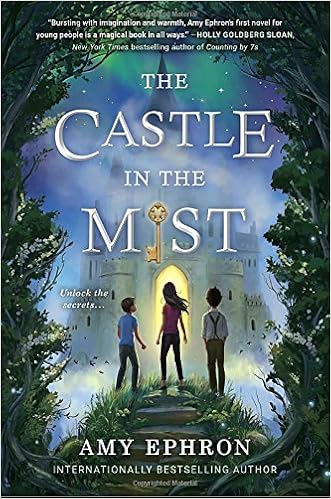
Summary:  Tess and her brother Max have just finished up a year at a Swiss boarding school, and are spending the summer with their Aunt Evie in the English countryside.  They were sent abroad because their father is a journalist on assignment in Afghanistan and their mother is being treated for an undisclosed but life-threatening illness.  Tess accidentally stumbles into the neighbor’s backyard, and meets William, a charming but seemingly otherworldly boy about her own age.  She brings Max along to their next meeting, and William invites them for dinner.  Aunt Evie is baffled by the invitation, certain that the house has long been abandoned.  During their visit, Max accidentally falls into some hawthorn trees that William has warned them to stay away from, and all three children find themselves in grave danger.  Tess is able to find courage and strength within herself to help them.  By the end of the story, Dad has returned, William and his servants and family have disappeared, and the mystery of who he was is cleared up with a visit to the castle, now turned into a secluded museum.  167 pages; grades 3-6.

Pros:  A quick read for fans of magic realism.  The story unfolds at a good pace, dropping clues about William that reveal just enough to keep things interesting.

Cons:  The book is too brief to really create an interesting magical story.  Reviews have compared it to E. Nesbit and Edward Eager.  Please.

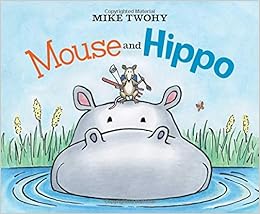
Mouse and Hippo by Mike Twohy

Published by Simon and Schuster/Paula Wiseman Books

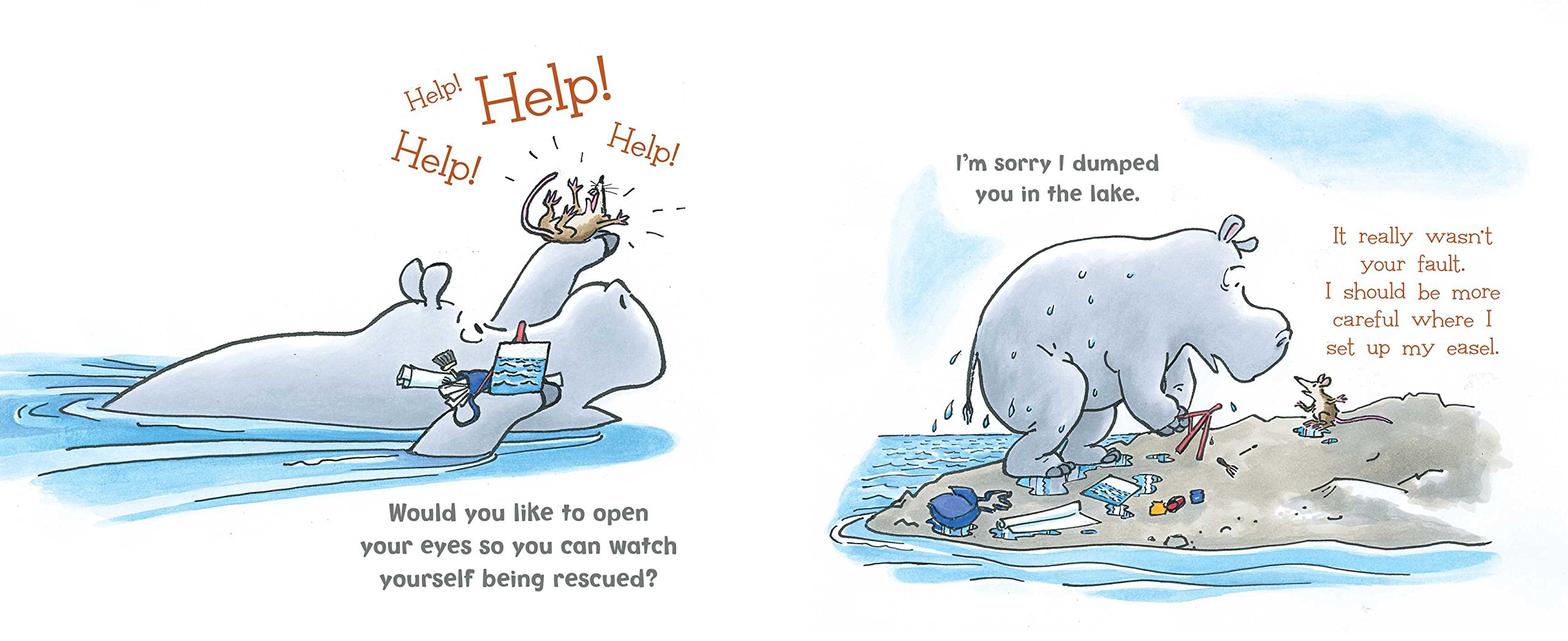
Summary:  Mouse and Hippo meet unexpectedly:  Hippo has an itch on his back, which turns out to be Mouse, who thought Hippo was a rock.  Mouse has set up an easel and is painting the water, but everything is upset when Hippo tries to scratch.  Hippo rescues Mouse, and admires the painting; Mouse offers to do a portrait in return for getting saved  Using his biggest brush to paint such a huge animal, Mouse can only fit a large swath of gray on his paper.  But Hippo loves it, using his imagination to see the rest of himself.  In return, he paints a microscopic picture of Mouse, which Mouse cuts down to size to hang over his fireplace.  It looks like the beginning of a beautiful friendship.  32 pages; ages 3-8.

Pros:  This book could be used to talk about friendship, kindness, perspective, or using your imagination.  The whole story is told in dialogue, with different colors and fonts for the two animals.  Lots of humor, cute animals, and a happy ending make a winning combination.

Cons:  Don’t tell Hippo and Mouse, but their portraits really aren’t that good.

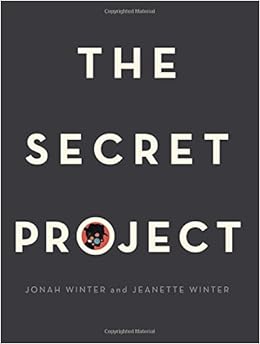
The Secret Project by Jonah Winter, illustrated by Jeanette Winter

Published by Beach Lane Books

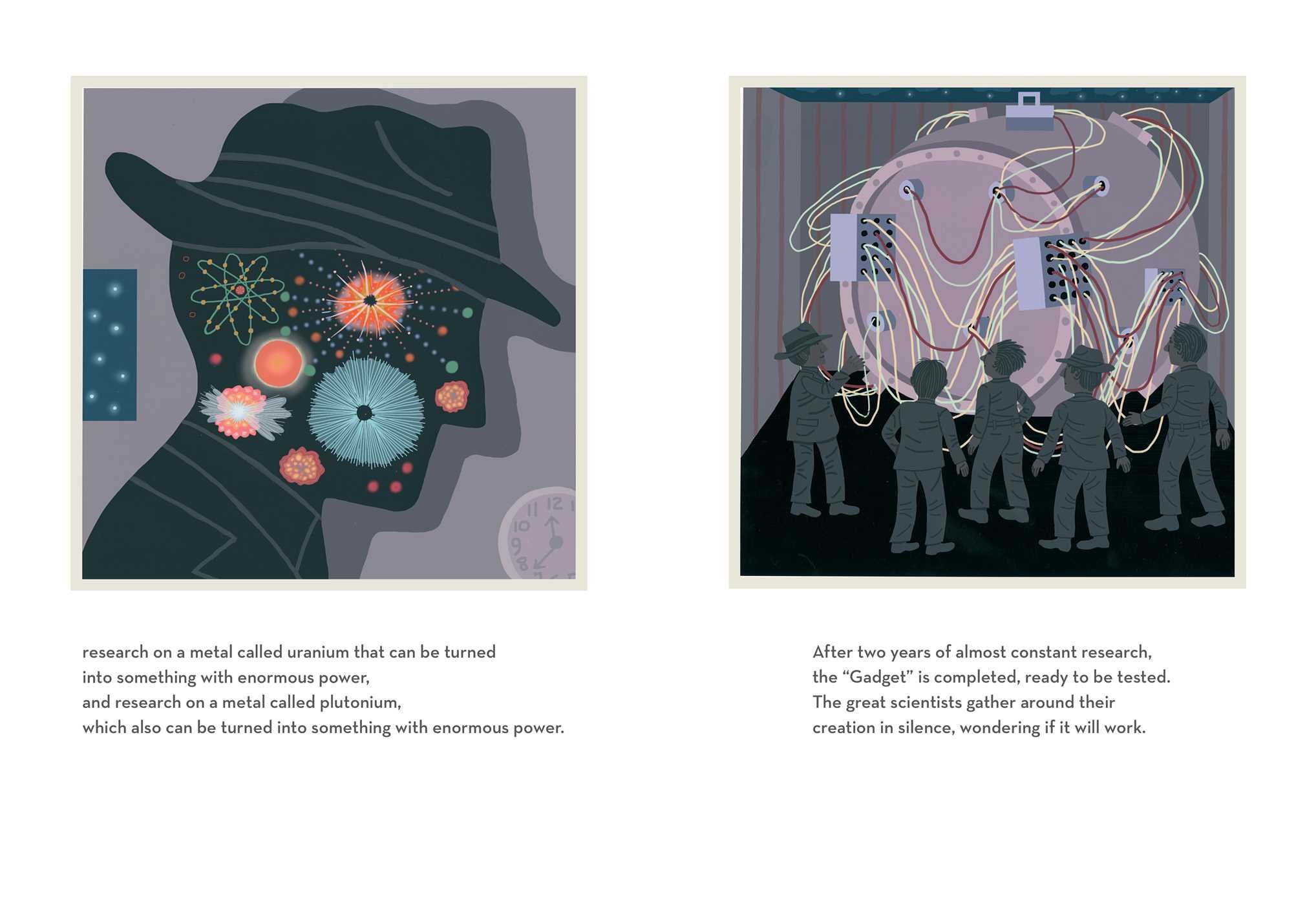
Summary:  A peaceful boys’ school in the New Mexican desert is suddenly ordered closed by the U.S. government.  Scientists arrive from all over the country to work on a top-secret project known simply as “The Gadget”.  Other workers don’t know what the scientists are working on, and the outside world has no idea their project even exists.  The scientists work long at hard, trying to figure out how to split atoms from uranium and plutonium.  At last, The Gadget is ready.  It’s placed on a stand in the middle of the desert, then the scientists drive far away.  The countdown begins…10, 9, 8, 7, 6, 5, 4, 3, 2, 1.  A huge fireball erupts, turning into a gigantic orange mushroom cloud .  The text ends with  two blank black pages.  Includes an author’s note giving more history of the Manhattan Project, and a list for further reading.  40 pages; grades 2-5.

Pros:  Mother-son team Jeanette and Jonah Winter have created a remarkable book, giving a brief history of the Manhattan Project in a way that is accessible for elementary school kids.  The illustrations convey the air of secrecy about the project, showing the scientists as black shadows throughout the story.  

Cons:  All the scientists portrayed are men. In reality, quite a few women scientists and mathematicians worked on the Manhattan Project.