Full of Beans by Jennifer L. Holm

Published by Random House Books for Young Readers 
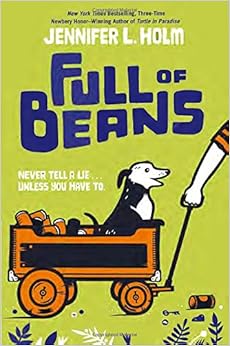
Summary:  Beans and his family are down on their luck.  It’s 1934, and Key West, Florida has been hit hard by the Great Depression.   Beans’ mother takes in laundry, while his father has left for New Jersey, hoping to find a factory job.  When local bootlegger Johnny Cakes offers Beans a job pulling fire alarms to distract the townspeople while Johnny smuggles out his whiskey, it’s hard to say no.  But when a real fire ravages his best friend’s house, the fire department thinks it’s another false alarm and doesn’t show up.  Tortured by guilt, Beans leaves behind his life of crime and starts focusing on some of the New Dealers who are trying to turn Key West into a tourist resort.  It seems like a crazy plan at first, but Beans and the rest of the Key West kids pitch in to clean up and fix up their town.  Before long, movie stars and other rich and famous types are flocking to Key West, and it looks like Beans’ luck may have turned around at last.  An author’s note tells more about Key West and President Franklin Roosevelt’s New Deal plans to transform it.  208 pages; grades 3-6.

Pros:  A sequel to Newbery honor book Turtle in Paradise, this story follows Turtle’s cousin Beans and his family and friends.  The pages are crowded with memorable characters, including cameos by Robert Frost and Ernest Hemingway.  Beans provides a funny, tough-guy narration to the events of his town that will transport readers to a slice of life in the 1930’s.

Cons:  I haven’t read Turtle in Paradise, and am pretty sure I would have had a greater appreciation for some of the characters and incidents in this book if I had.
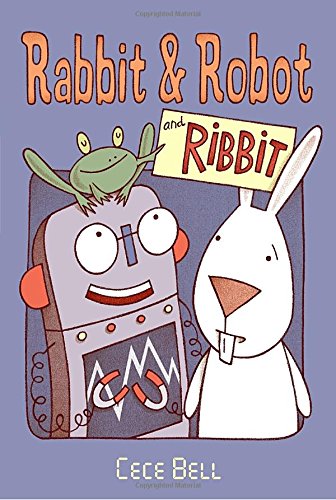
Rabbit & Robot and Ribbit by Cece Bell

Published by Candlewick Press 

Summary:  When Rabbit goes to visit Robot, he’s dismayed to find that Robot has another friend over, a frog named Ribbit.  Ribbit’s vocabulary is limited to a single word, “Ribbit”, which Robot is able to understand using his frog translation software.  Rabbit starts feeling jealous, and pretty soon Rabbit’s and Ribbit’s emotions are running so high that Robot overheats himself trying to interpret them all.  When Robot collapses, Rabbit and Ribbit have to work together to learn how to revive him.  In the end, the three friends discover that three isn’t really a crowd and learn to play together.  48 pages; grades K-3.

Pros:  The sequel to Rabbit and Robot: The Sleepover, this long easy reader/short chapter book with cartoon illustrations and silly dialogue is just right for emerging independent readers.

Cons:  Let’s hope Cece Bell doesn’t wait another 2 ½ years before writing another Rabbit and Robot book.

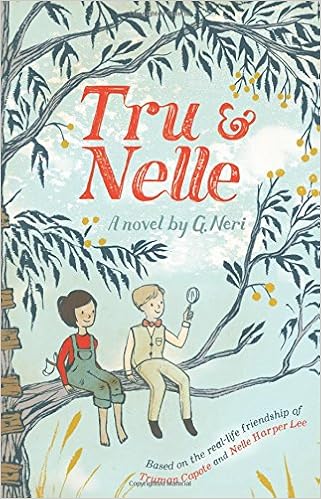
Tru and Nelle by G. Neri

Published by HMH Books for Young Readers 

Summary:  When Tru and Nelle first meet, he thinks she is a boy and she thinks he is a girl.  After exchanging a few rounds of insults, the two become fast friends.  Both live in Monroeville, Alabama, a sleepy little town in the throes of the Great Depression, but their combined imaginations create a force to be reckoned with.  They love to read, and Sherlock Holmes becomes a favorite.  Before long, Tru is Sherlock and Nelle is Watson, and they’re on the prowl for a real mystery.  A break-in at the local drugstore provides one, but it ends in disaster, and the two decide it’s safer to write their stories than to act them out in real life.  Eventually, Tru’s socialite mother remarries and sends for him to join her in New York City, but first he throws a blow-out farewell party that results in a confrontation with the local Ku Klux Klan.  The writing, the friendship, the wild party…all foreshadow what would happen to these two children who grew up to become Truman Capote and (Nelle) Harper Lee. 336 pages; grades 3-5.

Pros:  Fans of To Kill a Mockingbird will enjoy learning more about the real-life Scout and Dill.  The writing beautifully captures the Depression-era South.  Modeled on Capote’s Breakfast at Tiffany’s, the book ends with a few short stories which are flesh out the longer novel.

Cons:  Readers in the targeted age range aren’t likely to be familiar with Harper Lee or Truman Capote, making this a much less appealing choice for the younger crowd.

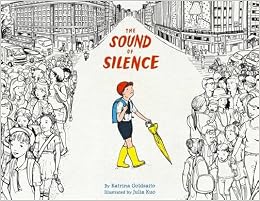
The Sound of Silence by Katrina Goldsaito, illustrated by Julia Kuo

Published by Little, Brown Books for Young Readers 

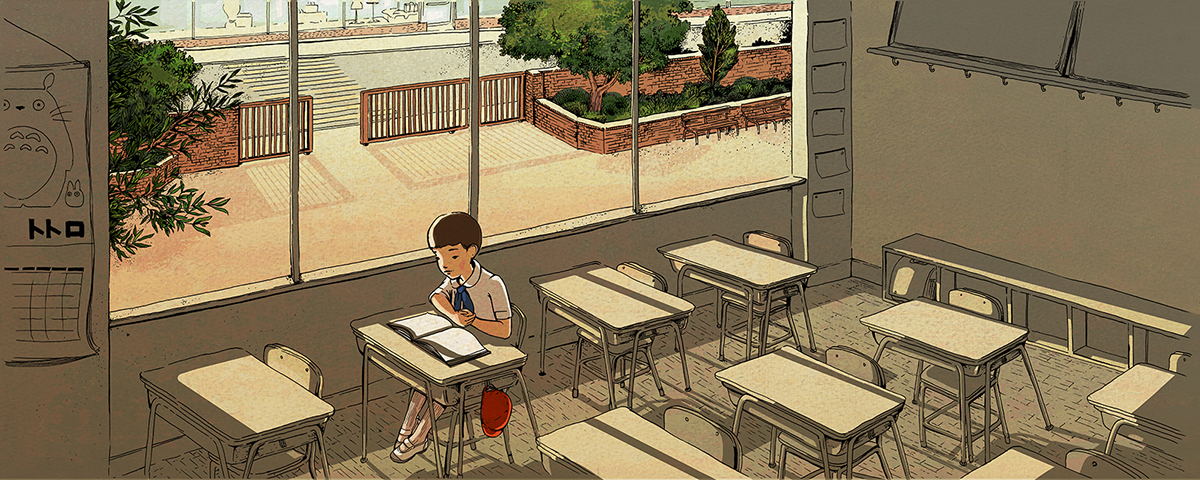
Summary:  Yoshio enjoys hearing the sounds of his Tokyo neighborhood: rain falling on his umbrella, his boots squishing in puddles, his own delighted giggles.  One day he hears a new sound, a woman playing a koto with twinkling, twangy notes.  When she’s through, he asks her what her favorite sound is.  She replies, “The sound of ma, or silence.”  From then on, Yoshio tries to hear the sound of silence, but at home, outside, or in school, there are always other sounds.  Finally, arriving early at school one morning, he sits down and begins to read.  Suddenly, in the middle of a page, he realizes that he is surrounded by silence!  He notices how peaceful it makes him feel, and realizes that the sound of silence has been there all along, running underneath all the other sounds.  An afterword explains the concept of ma and how it has influenced Japanese music and other culture.  40 pages; grades K-3. 

Pros:  A beautiful introduction to some aspects of mindfulness and meditation, and a way to help kids relax and focus on the present moment.  The illustrations show many details of a Tokyo home and neighborhood, and a note at the end explains how they were created using a combination of pen drawings and digital coloring. 

Cons:  This could be a tough concept for young kids to understand.

Mother-Daughter Book Camp by Heather Vogel Fredrickson

Published by Simon and Schuster Books for Young Readers 

Summary:  The Mother-Daughter Book Club makes one final appearance before its members go their separate ways.  It’s the summer after high school, and Emma, Jess, Megan, Becca, and Cassidy have all been hired to work as counselors at Camp Lovejoy in New Hampshire.  As in the other books in the series, the story is told in chapters narrated by each of the girls.  When camp begins, homesickness is rampant in the girls’ cabins, and they decide on a cure—start their own Counselor-Camper book club, reading the classic Understood Betsy by Dorothy Canfield Fisher.  As the summer progresses, both the campers and the counselors stretch themselves to learn new skills and try new challenges.  By the time parents come for pick-up, homesickness is forgotten, and the five girls are ready to head off to college.  336 pages; grades 4-7. 

Pros:  Fans of the series will enjoy learning what’s happened to the five girls from Concord, Massachusetts since sophomore year when the last book took place.  There’s lots of good clean fun, and the romance is pretty G-rated, making this a good choice for upper elementary as well as middle school. 

Cons:  There’s not a lot of diversity in life paths, as everyone in the book seems to be going to a top-notch four-year college.

Guess Who, Haiku by Deanna Caswell, illustrated by Bob Shea

Published by Harry N. Abrams 

Summary:  Ten haiku poems are offered as riddles for the reader to guess:  “new day on the farm/muffled mooing announces/a fresh pail of milk”.  The next page shows the cow, who has her own haiku to offer.  So it goes, until the final poem, “two hands hold a book/guessing animals’ puzzles/written in haiku…It’s YOU!”  The final page explains a little about haiku, including defining what a syllable is, and invites readers to explore the playfulness of the form.  24 pages; ages 4-8.
Pros:  An excellent introduction to haiku for the very young.

Cons:  The “riddles” aren’t particularly challenging.

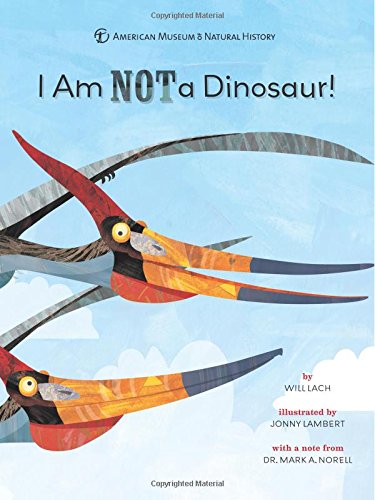
I Am NOT a Dinosaur! by Will Lach, illustrated by Jonny Lambert

Published by Sterling Children’s Books 

Summary:  Sure, we all know T-Rex, Stegosaurus, and Triceratops, but they weren’t the only vertebrates around in prehistoric times, not by a long shot.  The rhyming text introduces some of the other key players, like the familiar saber-tooth cat and woolly mammoth, and the less-well known dunkleosteus and glyptodont.  An introductory note from Dr. Mark A. Norrell, paleontologist at the American Museum of Natural History starts things off, and a final author’s note puts the prehistoric eras into some perspective, comparing the 170 million years of dinosaurs with 200,000 years of modern humans.  There’s also a bit more information on each animal and a timeline showing the different geologic time periods and which of the animals lived in each one.  40 pages; grades K-3.

Pros:  There’s more to this book than meets the eye.  Young dinosaur fans will enjoy learning about some new animals, but the front and end notes add a lot more information.  If you’ve followed this blog for a while, you may know what a fan I am of cut-paper illustrations, and these are right up there with Steve Jenkins’ work.

Cons:  You might be sorry if you don’t glance at the pronunciation guides in the end matter before attempting a read aloud.

Rattlestiltskin by Eric A. Kimmel, illustrated by Erin Camarca

Published by WestWinds Press 

Summary:  The classic fairy tale Rumpelstiltskin is given a Spanish twist.  Senora Gonzales brags that her daughter Rosalia can make tortillas light enough to float.  When wealthy Don Ignacio challenges her to come make some for him, Rosalia fears she’s in trouble.  She gets to work, hoping for the best, but her tortillas don’t float.  Just when she is about to despair, a strange little man dressed in rattlesnake skins pops out of the oven.  He gives her the secret for making floating tortillas in exchange for Rosalia’s promise that she’ll do anything he asks, then disappears back into his oven.  Don Ignnacio is impressed enough to invite her to come live on the hacienda and cook for him.  All is well for a while, but one day the little man reappears and demands that Rosalia comes to work as a maid for him and his friends.  Just like in Rumpelstiltskin, the deal will be off if she can guess his name, and after two sets of three guesses, she manages to learn that his real name is Rattlestiltskin.  She gets it in three the next day, Rattlestiltskin self-destructs, and Rosalia, Don Ignacio, and even Senora Gonzales live happily ever after.  Includes a recipe for homemade tortillas.  32 pages; grades K-4.

Pros:  A fun compare and contrast with a classic retelling like Paul O. Zelinsky’s Rumpelstiltkin.  The mood of this version is definitely lighter, and the Spanish setting , characters, and language add an interesting twist.

Cons:  I missed some of the ominous bizarreness that characterizes more tradition versions.

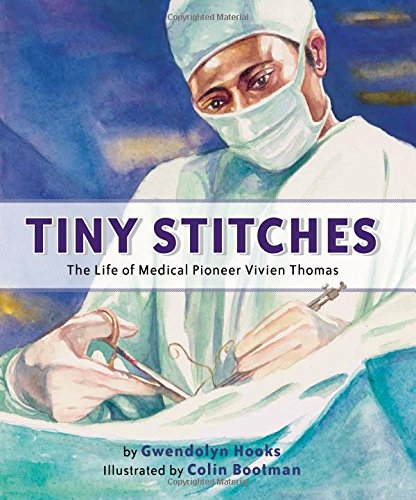
Tiny Stitches: The Life of Medical Pioneer Vivien Thomas by Gwendolyn Hooks, illustrated by Colin Bootman

Published by Lee & Low Books 

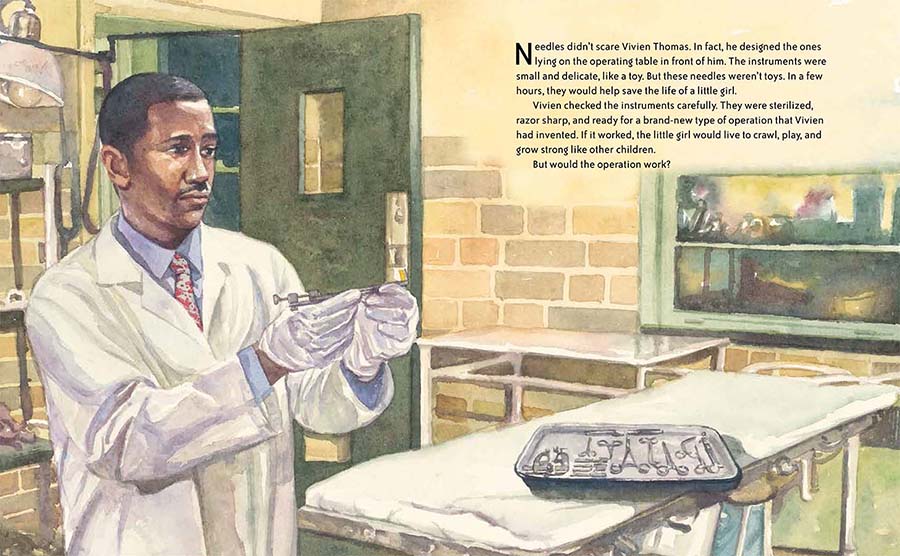
Summary:  Vivien Thomas dreamed of becoming a doctor, but when the Great Depression hit, he lost all his college savings.  Determined to pursue a medical career, he found a job as a research assistant for Dr. Alfred Blalock at Vanderbilt University.  Vivien proved to be a quick study and soon was conducting his own experiments and mastering surgical skills like suturing blood vessels.  In 1941, Dr. Blalock was offered a job at Johns Hopkins University.  He accepted it on the condition that Vivien would go with him.  At Johns Hopkins, the two men met Dr. Helen Taussig, a pediatric cardiologist who was trying to find a cure for so-called “blue-babies” whose skin turned blue because of a heart defect.  Vivien Thomas ended up doing a large portion of the research, developing a procedure, and designing a needle tiny enough to do the surgery.  When Dr. Blalock performed the ground-breaking surgery in 1944, it was Vivien who stood behind him and coached him, a role he would continue to play after the first surgery was a success.  More than a quarter of a century went by before Vivien finally got the recognition he deserved, having his portrait hung in Johns Hopkins Hospital and being awarded an honorary doctorate.  Back matter includes more information about the surgical procedure and Vivien Thomas, as well as a medical glossary and sources.  32 pages; grades 2-5.

Pros:  A compelling story of a little-known African-American scientist who overcame a myriad of prejudices to make an important contribution to medicine.  Kids who find this book interesting may want to read last year’s Breakthrough! How Three People Saved “Blue Babies” and Changed Medicine Forever by Jim Murphy.

Cons:  There is a lot of text and somewhat technical information for a picture book.

The King of Kazoo by Norm Feut

Published by GRAPHIX 

Summary:  Cornelius, king of Kazoo, is a good deal more concerned with his legacy than with actually ruling his kingdom.  When a mysterious volcanic eruption occurs, his daughter Bing convinces him that the two of them, plus inventor Torq, should go explore a tunnel she’s discovered in the volcano.  They head off in Torq’s latest invention, a car.  There are plenty of adventures along the way, but they make it at last, only to discover an evil plot hatched by the ancient alchemist Quaf.  All would be lost if it were up to Cornelius, but fortunately, Bing and Torq are able to put their heads together, combining magic with science, to save the kingdom.  208 pages; grades 3-6.

Pros:  Another winning entry from Scholastic’s GRAPHIX graphic novel imprint.  Kids will appreciate both the adventure and the goofy humor, and will undoubtedly be hoping for another installment.

Cons:  Neither the artwork nor the storyline are as sophisticated as some other GRAPHIX offerings like Bone or Amulet