Good Night Owl by Greg Pizzoli

Published by Disney Hyperion 

Summary:  Owl is trying to go to sleep, but every time he lies down, he hears a squeak.  Could it be coming from the cupboard?  He empties out every shelf, but finds nothing.  Is it in the floor? Removing all the floorboards doesn’t help.  The roof? The walls?  Before long, Owl is lying in his bed under the stars.  That’s when he finally sees the mouse whose squeaking has been keeping him awake.  With the mystery solved, both animals are able to happily fall asleep.  40 pages; ages 3-7.

Pros:  A simple and funny bedtime story, with large, child-like illustrations.

Cons:  Why is Owl sleeping at night?

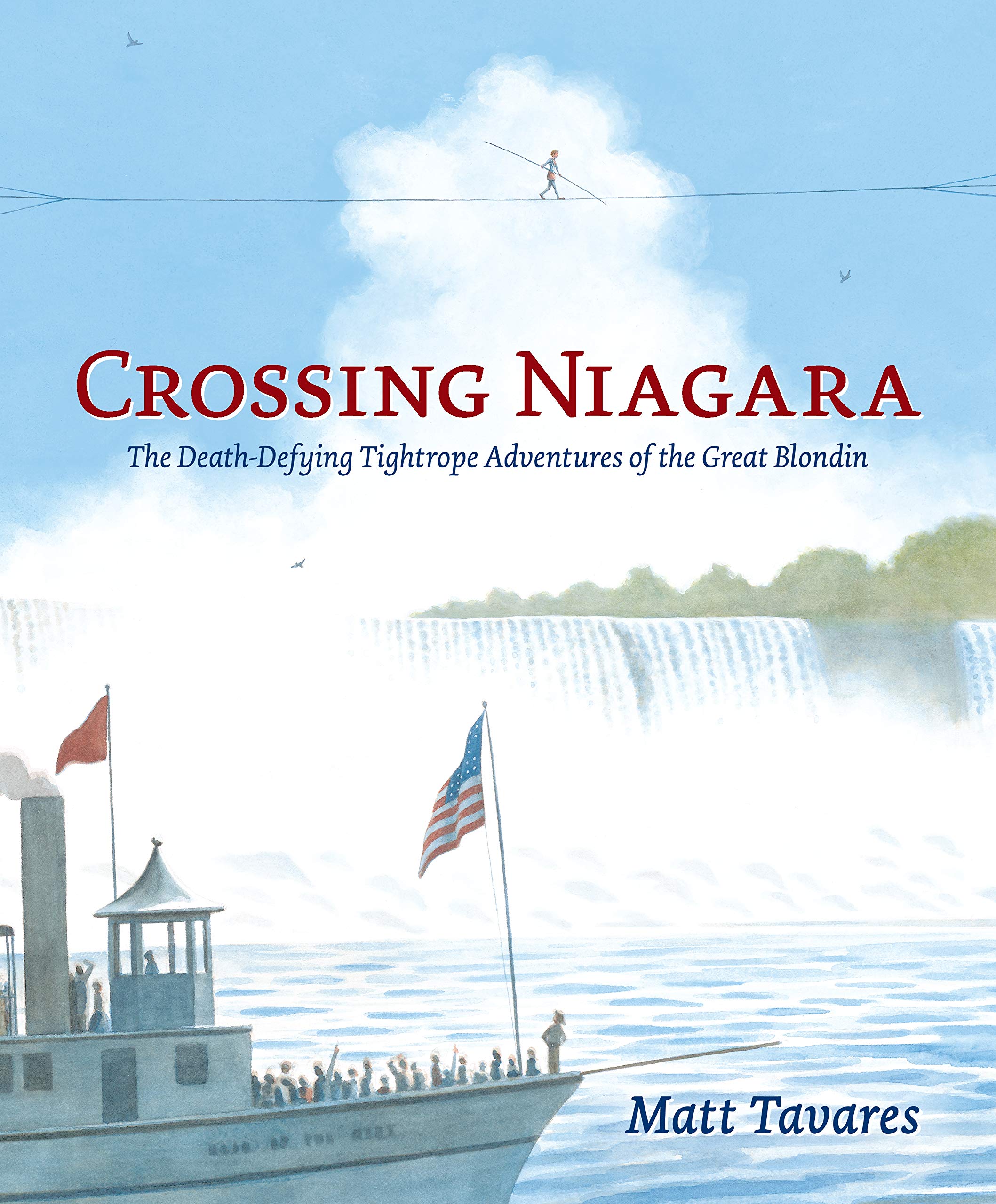
Crossing Niagara: The Death-Defying Tightrope Adventures of the Great Blondin by Matt Tavares

Published by Candlewick Press

Crossing Niagara: The Death-Defying Tightrope Adventures of the Great  Blondin: Tavares, Matt, Tavares, Matt: 9780763668235: Amazon.com: Books

Summary:  Jean Francois Gravelet, a.k.a. The Great Blondin was just five years old when he first performed on the tightrope.  Although he loved his circus career, he longed to do something even more daring.  When he first laid eyes on Niagara Falls, he knew what he wanted to do.  He set up a rope, contacted the newspapers, and on June 30, 1859, he made his first successful crossing, stopping along the way to perform a few tricks, including retrieving a bottle from the Maid of the Mist below and toasting the crowd.  He promised to return on July 4, and this time, he crossed the falls blindfolded.  Over the next two summers, he made many crossings, trying all kinds of stunts.  His ultimate challenge was carrying his manager across on his back (a trick his manager wasn’t terribly enthusiastic about).  When the crowds began to thin, The Great Blondin moved on, but he was forever remembered for his Niagara Falls crossings.  End matter includes a brief author’s note and a bibliography.  36 pages; grades 1-5.

Pros:  The storytelling and large, detailed illustrations combine to make a pulse-pounding tale of daring.

Cons:  I could have enjoyed a little more biographical detail about The Great Blondin.

Danger! Tiger Crossing (Fantastic Frame series) by Lin Oliver, illustrated by Samantha Kallis

Published by Grosset and Dunlap 

Summary:  Tiger’s exploring his new neighborhood when he sees an orange pig in a hat and tie.  Pursuing this unusual neighbor, he meets a girl named Luna, and the two of them trace Chives the Pig to an old haunted-looking house.  Boldly making their way inside, they meet ancient Viola Dots, who hasn’t left her house in 50 years, ever since her son David disappeared into a picture frame, and Chives popped out in his place.  Upon close examination of the frame, Tiger discovers a clock, which he sets back an hour.  Almost immediately, the picture opens up, and he and Luna are sucked inside.  There they meet David, who is still 13, and have to outrun the hungry tiger that was in the painting.  They manage to find their way back, but David is left behind once again, leaving the reader ready for book #2, Splat! Another Messy Sunday, now available at a library or bookstore near you.  Back matter includes information about the painting the kids go into, Surprised! By Henri Rousseau. 128 pages; grades 2-4.

Pros:  A reasonably exciting adventure for early chapter book readers, with lots of illustrations, black and white for the times outside of the picture and color inside of it.

Cons:  It didn’t seem realistic that 50 years had gone by since David disappeared.  Viola Dots would have to be closing in on 90, yet looked and acted about 60.

There Is a Tribe of Kids by Lane Smith

 Published by Roaring Brook Press 

Summary:  A boy travels through the world alone.  He starts off with a tribe of kids—goats—then has fun with a colony of penguins and a pod of whales. He climbs on a formation of rocks, then falls down into a pile of rubble. He hangs out with an army of caterpillars, then marvels at a flight of butterflies.  Finally, he finds the tribe of kids…his tribe, and he is no longer alone.  40 pages; grades K-4.

Pros:  There is more than meets the eye to this simple but gorgeously illustrated book by Caldecott honoree Lane Smith.  It’s not a story so much as a meditation on adventure, coming home, and finding where you belong.  And the collective nouns are always fun, as well.

Cons:  Kids may not appreciate this if they hurry through it.  It’s a book that requires a slow, careful look…maybe more than one.

The Last Fifth Grade of Emerson Elementary by Laura Shodd

Published by Wendy Lamb Books 

Summary:  Emerson Elementary School will be razed and replaced by a supermarket at the end of the year.  The eighteen fifth graders in Ms. Hill’s class have a range of emotions about this.  To express them, their teacher has them write poems which will be placed in a time capsule inside the wall of the new store.  The class is diverse in ethnic and family backgrounds, and their individual struggles at school and at home show up in their poetry.  Each one grows through the year, making and losing friends, accepting changing family situations, and learning about themselves.  By the end of the year, they are ready to accept the inevitable, and find their own ways into middle school.  End matter includes several pages about the different forms of poetry and the prompts the students had to work from, as well as a glossary.  256 pages; grades 3-7.

Pros:  This first-time author does an amazing job of creating 18 distinct, likeable characters.  Although this could be a quick read, it pays to take it slowly, going back to see other poems written by each student to really get to know them.  The extra information on different poetic forms would make this an excellent and accessible introduction to poetry.

Cons:  It’s pretty difficult at the beginning to keep track of who’s who in the class.

Raymie Nightingale by Kate DiCamillo

Published by Candlewick 

Summary:  Raymie Clarke has a plan to win the 1975 Miss Central Florida Tire contest.  In addition to the $1,975 prize money, she wants her father to see her picture in the paper.  Then maybe he will change his mind about running away with a dental hygienist and come back to his family.  Part of Raymie’s plan is to take baton lessons, and it’s here she meets Louisiana and Beverly.  Louisiana is an orphan living with her impoverished grandmother, looking for Archie, her cat that she was forced to give to a shelter.  Beverly, whose father has moved to New York and whose mother is responsible for the bruise on Beverly’s face, is already an expert twirler.  Her motivation for entering the pageant is to sabotage it.  Slowly, unpredictably, these three girls form a bond that results in a wild night together, culminating in Raymie Clarke, renamed Raymie Nightingale by Louisiana, saving her friend’s life.  272 pages; grades 4-7.

Pros:  A bittersweet story about three girls trying to find their way in a world of sad, lonely, and angry adults.  By the end of the book, a friendship has been formed, and each girl has grown up a little in her own unique way.

Cons:  Clearly I’m in the minority, but I just don’t get the appeal of Kate DiCamillo.  Her characters are so quirky they don’t even seem real to me.  The first half of this book seemed like a random string of bizarre occurrences; there is a “look-at-how-clever-I-am” quality to her writing..  However, my opinion notwithstanding, I’m sure by this time next year, the cover of Raymie Nightingale will be sporting a shiny silver or gold Newbery sticker.

Olinguito, de la A a la Z! by Lulu Delacre

Published by Lee and Low Books 

Summary: Never heard of the olinguito? Don’t worry, scientists have only known about it since 2006. Lulu Delacre has created an alphabet book with text in both Spanish and English that follows zoologist Dr. Kristofer Helgen through the cloud forest of Ecuador as he looks for and finally finds this little animal. The olinguito doesn’t make an appearance until “W”, though, so the reader gets introduced to many other flora and fauna of the rainforest. Extensive back matter includes information about the discovery of the olinguito, the cloud forest, the illustrations, plus a lengthy glossary…all in both English and Spanish. 40 pages; grades K-4.

Pros: The illustrations are as lush and colorful as the cloud forest. The text could be used as a simple alphabet book or as a resource for research, depending on which parts are used.

Cons: The English is sometimes not as alliterative as the Spanish in the alphabet portion of the book.

You’re Doing THAT in the Talent Show?! By Lynn Plourde, illustrated by Sue Cornelison.

Published by Disney Hyperion 

Summary:  Penelope and Tiny are best friends, but when it comes to the talent show, they can’t agree.  Penelope wants to be front and center, whether it’s dancing, acting, singing, or a combination of all three.  Tiny can’t imagine being in the spotlight, and advocates for a performance with the chorus.  Finally, they come up with the perfect solution: to perform separately, but cheer each other on enthusiastically.  The plan goes off without a hitch, and Tiny even gets a chance to save Penelope’s act from a potential disaster.  The last page lists tips for a spectacular performance.  32 pages; ages 4-8.

Pros:  The classic story of an introvert and extrovert trying to work together.  Bright, cheerful illustrations and a friendship with a perfect ending will keep readers happy.

Cons:  The text got a little repetitious.

Cloth Lullaby: The Woven Life of Louise Bourgeois by Amy Novesky, pictures by Isabelle Aresenault

Published by Abrams Books for Young Readers 

Summary:  Louise Bourgeois (1911-2010) spent her childhood along the banks of a river in France.  Her mother repaired tapestries, and Louise learned the art of weaving from her.  Although she studied math at the Sorbonne, Louise ultimately became an artist.  After her mother died, she made a giant sculpture of a spider, famous for its weaving, and spiders appeared in a lot of her other works.  Later in life, she gathered fabric from many different people and places in her past and created works of art with the different textiles.  She continued to create art right up until the time of her death at age 98.  End matter includes additional biographical information.  40 pages; grades 2-6.

Pros:  The illustrations are exquisite and really capture Louise’s life and art.  The text is almost poetic.

Cons:  This is not a straightforward biography, and kids may find some of the text difficult to understand.  The biographical information at the end is helpful; it may be useful to present it before reading the story.

When Green Becomes Tomatoes: Poems for All Seasons by Julie Fogliano, illustrated by Julie Morstad

Published by Roaring Brook Press 

Summary:

march 22

just like a tiny, blue hello

a crocus blooming

in the snow

Starting with the spring solstice (March 20), these poems wind their way through the seasons, finishing up on March 20 of the following year.  In between are poems about flowers and strawberries, the beach, pumpkins, and frost and snow.  The title of each poem is a date, and all are illustrated with simple but evocative pictures.

Pros:  This year of poems would make an excellent introduction to poetry and may inspire young writers to try to capture the various seasons through their own words.

Cons:  There was no poem for my birthday.  Or for my half-birthday, for that matter, which happens to be today.