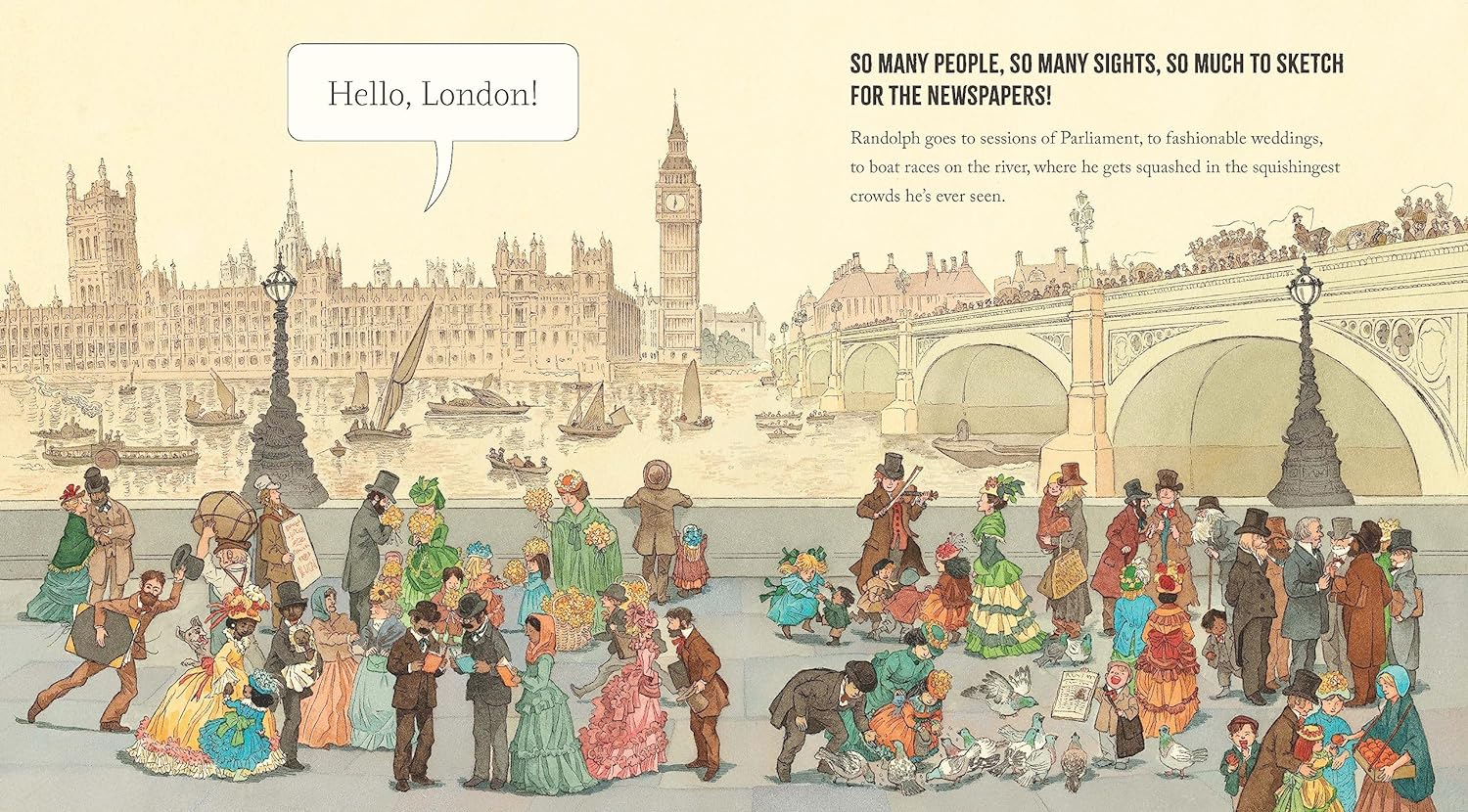
The Mona Lisa Vanishes: A Legendary Painter, A Shocking Heist, and the Birth of a Global Celebrity by Nicholas Day, illustrated by Brett Helquist

Published by Random House Studio

Summary:  When the Mona Lisa was stolen on August 21, 1911, the Louvre was a sleepy museum where guards sometimes left their posts to take naps or get a snack, and the Mona Lisa was just another Renaissance portrait.  The theft changed everything, becoming a detective story that captivated a global audience, and making the Mona Lisa the most famous painting in the world.  Alternating between the 20th-century whodunit and the 16th-century tale of Leonardo da Vinci and Lisa Gherardini, the story captures many details of both pre-World War I Europe and the Renaissance.  Includes 16 pages of sources and an index.  288 pages; grades 5 and up.

Pros:  Holy Isabella Stewart Gardner Museum!  I was engaged immediately by this impeccably researched and humorous tale that takes readers on a roller coaster ride of (botched) detective work and life with the original Renaissance man.  Complemented perfectly with art by–Lemony Snicket!–Brett Helquist, this is sure to be a serious contender for some awards.

Cons:  I struggled to keep straight the many characters with unfamiliar French and Italian names.


Two books about mindfulness

Enlighten Me by Minh Lê, illustrated by Chan Chau

Published by Little Brown Ink

Slowly Slowly by Toni Yuly

Published by Atheneum Books for Young Readers

Summary: Binh and his family are off to a silent Buddhist retreat in Enlighten Me. During meditation times, Binh struggles with a recent memory of racist bullying at school. When he fought back, he ended up being the one to get in trouble. In between meditation sessions, a monk named Sister Peace shares stories about the Buddha with the kids that teach Binh some lessons about dealing with his issues. Those issues don’t get resolved, but by the time the family is heading for home, it’s clear that Binh is seeing things in a new light.

“When you slow down…you see more,” begins Slowly Slowly, as a child and dog explore the natural world. They observe winter turning to spring, and a persimmon tree slowly, slowly, slowly, slowly, slowly, slowly, slowly, slowly makes persimmons. With each page of “slowly”, readers can look for other changes going on in the child’s world. Enlighten Me is 140 pages; grades 4-7; Slowly Slowly is 40 pages; ages 4-8.

Pros: Both books focus on mindfulness through beautiful artwork and kids’ experiences. Minh Lê uses Binh’s story and love of video games to tell some tales of the Buddha while offering some kid-friendly insights Binh has about meditation and enlightenment. Readers of Slowly Slowly will want to take the time to notice all that is happening in the busy yet peaceful illustrations and to reflect on how slowing down can help us notice the world around us.

Cons: Both books are pretty spare, offering more of an opportunity for reflection than a fleshed-out story.

National Monuments of the U.S.A. by Cameron Walker, illustrated by Chris Turnham

Published by Wide Eyed Editions

Summary:  It all began in 1906 when Theodore Roosevelt made Devil’s Tower in Wyoming a National Monument.  Now there are over 130 such places, given the designation of National Monument for their historical, cultural, or scientific significance.  This book looks at some of them, divided geographically, with a map at the beginning of each section showing where they are located.  Two-page spreads offer additional facts presented in ways that invite readers to explore, whether it’s with a visit or additional research.  Includes a list of National Monuments by state and a conclusion that invites readers to think about creating their own monuments.  112 pages; grades 2-5.

Pros:  A fun book to browse with inviting text and retro style illustrations that will have kids making lists of places to visit across the United States.

Cons:  The font on the spreads was a little too small.

Mascot by Charles Waters and Traci Sorell

Published by Charlesbridge

Summary:  Six eighth graders and their teacher take on the topic of racist mascots when they are assigned to a debate about their town’s Braves mascot, which often inspires face paint and tomahawk chopping at sports events.  At first, only the girls are opposed: Callie, a member of the Cherokee nation and Black; Priya, the Indian American editor of the school paper; and Tessa, a White girl who has been homeschooled through seventh grade.  The boys mostly just want to enjoy the local teams, but eventually Franklin, who is Black, joins the girls in their campaign and loses Luis’s friendship in the process.  Sean’s family is struggling with poverty but has long supported the Braves and opposes changing tradition.  As the school year draws to a close, tensions mount as the anti-mascot campaign kicks into gear and the kids learn more about what is most important to them and to their families.  Includes lists of Cherokee and Salvadoran Spanish words used in the text and additional information about mascots and taking action.  256 pages; grades 4-8.  

Pros:  A timely issue is explored through the voices of a diverse group of middle school kids, all of whom are presented sympathetically with realistic reasons for their various points of view.  A quick read that could easily inspire students to look around them to see what might need to change in their own communities.

Cons:  The story was extremely agenda-driven; the novel-in-verse format didn’t allow for much character or plot development outside of the mascot issue.

Two books about Christmas and teamwork

Otto the Ornament by Troy Cummings

Published by Random House Books for Young Readers

Elves Are the Worst! by Alex Willian

Published by Simon and Schuster Books for Young Readers

Summary: Otto the Ornament knows his dazzling looks should earn him a front and center position on the Christmas tree. When the other ornaments try to take him down a notch, Otto goes looking for another tree. His journey into the world leaves him battered, without his former shine and glitter. A chance encounter with a familiar ornament sends Otto back home where he’s happy to find a place on the tree and simply reflect some of the holiday light onto the other ornaments.

The goblin from Elves Are the Worst! may be familiar to those who have read Alex Willian’s books declaring unicorns, dragons, and yetis as the worst. Elves, he tells the reader, may seem hard-working and perfect, but in reality, they hang out in trees baking cookies, pour bowls of the world’s loudest cereal, or just sit on a shelf all day. When he stops by the North Pole to show that a goblin can do what the elves there do, he learns that caring for reindeer and making toys are actually pretty tough tasks. Elves aren’t perfect, after all, just good at the teamwork needed to get everything ready for Santa’s big night. Both books 40 pages; ages 4-8.

Pros: Two fun, cartoon-style books for the holidays that deliver their message about playing well with others with plenty of humor. Kids will be delighted to find either Otto or a bunch of elves under the tree.

Cons: Probably not destined to become holiday classics.

Coretta’s Journey: The Life and Times of Coretta Scott King by Alice Faye Duncan, illustrated by R. Gregory Christie

Published by Calkins Creek

Summary:  With alternating pages of poetry and prose, Alice Faye Duncan tells the story of Coretta Scott King, starting with her childhood in Alabama.  Her parents were determined to give their children an education and worked hard as farmers and small business owners, starting over again when both their home and their lumber mill were burned by segregationists who didn’t want to see them succeed.  Coretta went on to study education at Antioch College, then to Boston to pursue her love of music.  It was there that she met Martin Luther King, Jr.  The two of them found much in common with their passion for justice, and even after they were married with four children, they supported each other’s work.  After Martin’s death, Coretta continued this work, focusing on the establishment of the King Center in Atlanta to teach nonviolence and the campaign to get Martin’s birthday made a national holiday.  Includes a timeline, author’s note, photos, and bibliography.  48 pages; grades 2-5.

Pros:  Duncan writes in the introduction that she chose to tell some of Coretta Scott King’s story in poetry because of Coretta’s love of music and lyrical voice.  It works well, interspersed with the lengthy prose pieces.  There were a lot of rich details about her early life which showed how she got her love of justice and her determination to work for it.

Cons:  Although this has the look of a picture book, the prose pages are so long that this would be difficult to do as a read-aloud.

Ali the Great and the Market Mishap by Saadia Faruqi, illustrated by Debby Rahmalia

Published by Picture Window Books

Summary:  Like Yasmin from another series by Saadia Faruqi, Ali is part of a Pakistani-American family, introduced on the first page.  When Dada, Ali’s grandfather, takes Ali and his little brother Fateh to the South Asian market to shop for snacks, Ali has his hands full keeping Fateh out of trouble.  The story unfolds in three chapters, with the three returning home safely with Dada’s favorite spicy chips by the end.  A few Urdu words are introduced with pronunciations and definitions before the story starts, and the back matter includes some jokes, a list of Dada’s favorite Pakistani snacks, and three questions/writing (and drawing) prompts about the story.  Three other books about Ali were published simultaneously.  32 pages; grades K-3.

Pros:  A cheerful early chapter book that introduces another Pakistani-American family and their everyday activities in a way that kids will connect to while learning a little bit about another culture.

Cons:  The plot was pretty mundane.

I’m From by Gary R. Gray, Jr., illustrated by Oge Mora

Published by Balzer + Bray

Summary:  “I come from early morning wake-ups, handcrafted blankets, knitted with memories.”  A boy goes through his day, recounting the people, places, foods, and events that make him who he is.  Some are good, like the pancakes and fried bologna for breakfast and the four square and hoop dreams on the playground.  Others, like long school days and racist comments (“Can I touch your hair?” “You don’t sound Black!”) are tougher to deal with.  At the end of the day, there’s dinner, family fun, and a cozy tuck-in: “Sleep tight and remember where you’re from…our dreams, hopes, ambitions, lionlike traditions.”  40 pages; ages 4-8.

Pros:  I’m always thrilled to see a new book from Oge Mora, and this one is a beautiful meditation from poet Gary Gray in his picture book debut.  It could serve as a prompt for kids to write and/or illustrate their own “I’m From” stories. Another Caldecott contender.

Cons:  I wish I had some pancakes and fried bologna right now.

The Christmassy Cactus by Beth Ferry, illustrated by A. N. Kang

Published by HarperCollins

Summary:  Tiny Cactus has a special place in her family, especially with the little girl who greets her every morning with, “Hello, my little cupcake,” and tucks her in each evening saying, “Who’s the sweetest bonbon?”  When it’s time to decorate for Christmas, Tiny Cactus is as excited as the little girl, but as the weeks go by, there are more distractions–especially the big shimmery Christmas tree–and less time for a little cactus.  Tiny Cactus wishes that she could have some sort of decorations, and she keeps making her wish as the holiday draws nearer.  On Christmas Eve, a window blows open and snowflakes swirl in on top of the cactus.  As they melt away, the cactus can still feel their magic.  The next morning, there’s a surprise…Tiny Cactus turns out to be a Christmas cactus who has found a way to make her own decorations.  40 pages; ages 4-8.

Pros:  A cute and slightly quirky Christmas story with a subtle message about making your own wishes come true.

Cons:  I would have enjoyed a photo of an actual Christmas cactus.

Barely Floating by Lillian Rivera

Published by Kokila

Summary:  Nat has grown up in a very progressive household, always encouraged to stand up for herself and to see herself as beautiful.  Her mom doesn’t understand Nat’s love of fancy clothes and make-up, and when Nat sees the L.A. Mermaids perform a synchronized swimming routine, she knows her parents won’t get why she wants to become part of the team.  They do, in fact, deny her request to join, so Nat enlists her older cousin Sheila to help her sneak off to practices and competitions, hoping that when she’s good enough she’ll be able to reveal her secret and persuade her parents.  But soon she’s entangled in a web of lies, hurting Sheila, her best friend Joanne, and herself.  When Nat’s deceptions catch up with her, she and her mother are finally able to communicate about their differences and to find a compromise that works for both of them.  240 pages; grades 4-7.

Pros:  A fun introduction to synchronized swimming with a memorable narrator who is both confident and vulnerable about putting herself out there.  The Mermaids are a gutsy group of kids who defy the stereotypes of thin white girls participating in the sport and really make it their own.

Cons:  I can generally get behind a good social justice warrior, but Nat’s mom’s constant outspokenness to various family members about progressive causes started to wear on me after a while.