The Talk by Alicia D. Williams, illustrated by Briana Mukodiri Uchendu

Published by Atheneum/Caitlyn Dlouhy Books
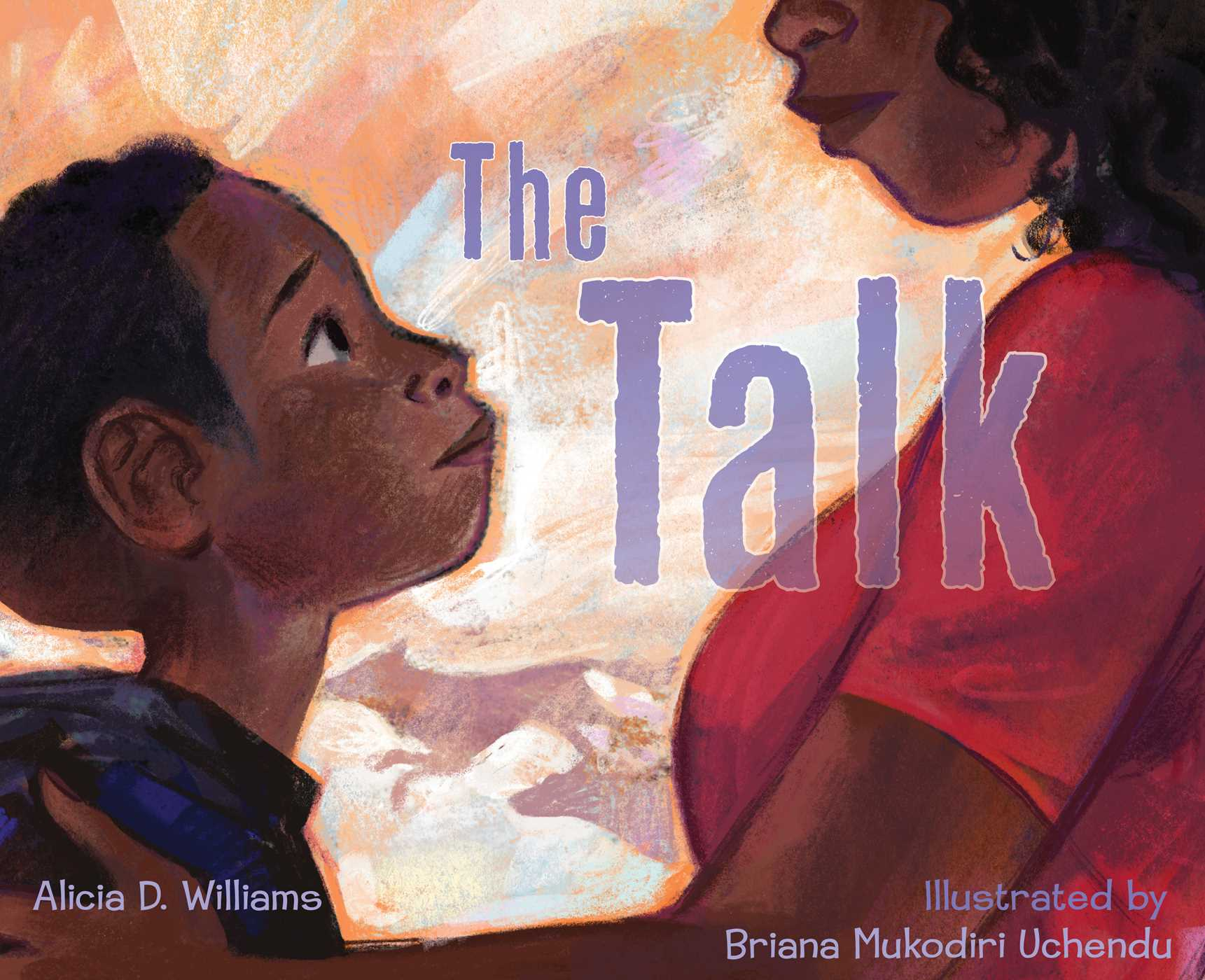
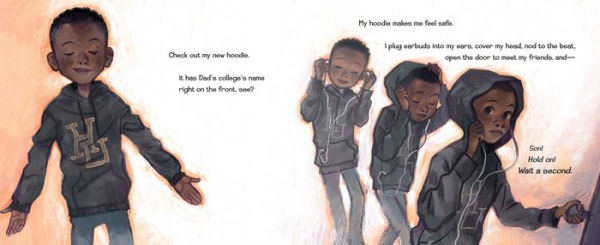
Summary:  A young boy tells of his happy life with his parents, grandparents, and three best friends.  He is clearly loved by all and enjoys being a kid while also dreaming of what he’ll do when he grows up.  As he gets older, his parents and grandparents start to tell him things like not to hang out in groups of four or more and to be quiet and keep his hands out of his pockets in the store.  One day, he’s heading out to meet his friends in his new college hoodie when his parents stop him.  It’s time to have The Talk. The book doesn’t share what they tell him, but two pages of illustrations show young Black men and women experiencing racism from white adults, including a police officer.  At the end, he’s embraced by his parents and grandparents, reminding him he’s done nothing wrong.  “This is me and my friends,” he concludes. “We want to hang and run, joke and laugh…race and soar, skate and flip, be chill and wild…and just be us.”  40 pages; all ages.

Pros:  This book amazed me in the way the text and illustrations worked together to capture the young boy’s joy, but to also show hints of what his parents and grandparents worry about and their bittersweet emotions watching him grow up.  The way the actual talk was presented was brilliant, with a realistically empowering finale.

Cons:  Obviously, that this book needs to even exist.

Hazel Hill Is Gonna Win This One by Maggie Horne

Published by Clarion Books

Summary:  Hazel has accepted her friendless state in seventh grade and is focusing on winning the speech contest to avenge last year’s loss to Ella Quinn.  She doesn’t pay much attention to popular boy Tyler, who insists on telling her about his many crushes.  But one morning, his gossip is a bit different: Ella, his former girlfriend, told him she didn’t want to get back together because she has a crush on Hazel.  Hazel is out as gay, and she’s not happy that Ella’s using her this way.  When she confronts Ella, though, she learns that Ella’s been receiving sexually harassing messages from someone who may or may not be Tyler.  Hazel discovers an important clue linking Tyler to the messages, but when the girls try to report what’s going on, they end up being the ones to get in trouble.  Desperate times call for desperate measures, and Hazel decides to use her public platform in the speech competition to bring attention to what is happening.  240 pages; grades 4-7.

Pros:  Hazel’s funny and distinctive voice tells a story of middle school sexual harrassment that may, unfortunately, be all too familiar to many readers.  Hazel, Ella, and Ella’s best friend Riley courageously join forces to speak out for justice.  The unexpected friendship Hazel finds with Ella and Riley (with a possible romance with Riley) adds a sweet dimension to the story.

Cons:  I like to see villains have some redeeming traits or at least an explanation for their terrible behavior, but this was not the case for either the principal or Tyler’s mother.

Mama and Mommy and Me in the Middle by Nina LaCour, illustrated by Kaylani Juanita

Published by Candlewick

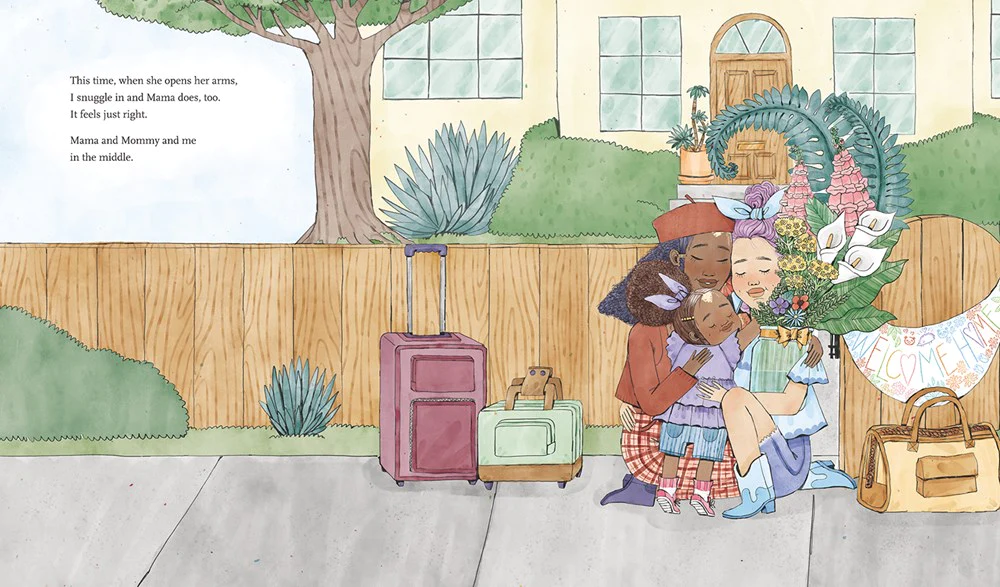
Summary:  A girl misses her mother, Mommy, when she goes on a week-long trip.  Her other mother, Mama, stays home with her and helps make things easier with special treats like a movie night and goodies at the local café.  A phone call and a snuggle with Mama help, but things aren’t really right until Saturday when Mommy finally returns to a welcome banner and a bouquet of flowers that the girl has picked herself.  It takes a few minutes to reconnect, but finally things feel right again: “Mama and Mommy and me in the middle.”  32 pages; ages 3-7.

Pros:  A great discussion starter about missing people; the girl has several classmates who are missing family members and pets.  The illustrations are beautiful–clearly this is a family who values fashion and style–and the representation of a biracial family with two moms makes a valuable addition to kids’ literature.

Cons:  Some additional resources would have made this even more valuable for a social emotional learning book.

Moonlight by Stephen Savage

Published by Neal Porter Books

Summary:  “Something is on the move.”  Hiding, hopping, swirling, drifting, each page gives an action with blue, black, and white illustrations that show moonlight but not the moon.  The light ends up in a child’s bedroom, where she sits up and looks out the window to see the full moon.  32 pages; ages 3-7.

Pros:  I will definitely be sharing this book with my pre-K classes during the week they learn about what’s in the sky.  The lush nighttime illustrations and brief text filled with action words would make a great pairing with The Moon Is Going to Addy’s House by Ida Pearle.

Cons:  The cover and title page make it look like Moon Light, but it’s actually Moonlight.  Just in case you’re searching in Amazon or Titlewave.

A Journey Under the Sea by Craig Foster and Ross Frylinck

Published by Clarion Books

Summary:  The narrator takes readers on a dive into the ocean at the tip of South Africa.  Underwater, they observe all kinds of animals including a seal, an octopus, a cuttlefish, and a couple of different sharks.  On the way back, they see tiny snail eggs and a whale, which likes to snack on the sea snails, an example of how ocean animals are all connected.  Includes a note from the authors and additional information about each photo in the book.  56 pages; grades K-5.

Pros:  A gorgeous picture book from the creators of The Octopus Teacher, now streaming on Netflix. Their joy and enthusiasm for diving and exploring the ocean really shines through in both the photos and the text.  From the eye-catching cover to the farewell from the dolphins, kids will be captivated by this journey.

Cons:  There’s just a little bit of information about each animal, so some additional resources would have been nice.

Song In the City by Daniel Bernstrom, illustrated by Jenin Mohammed

Published by Amistad Books for Young Readers

Summary:  Emmalene is blind, but as she walks with her grandmother to church, she hears the song of the city: the pitter-patter of water falling, the sizzle-sizzle of a hot dog cooking, the honky-honk of a car.  She keeps trying to get her grandmother to stop and listen, but Grandma Jean is in too much of a hurry.  At church, Grandma enjoys the music of the choir, but Emmalene gets frustrated that she can’t hear the other music that Emmalene hears.  Finally, she puts her hand over her grandmother’s eyes, so that Grandma is forced to use only her ears.  Finally. Grandma hears the song of the city, and with tears in her eyes, hugs her granddaughter, and they listen together.  40 pages; ages 4-8.

Pros:  A story that will encourage kids to listen mindfully to the sounds around them.  Emmalene is a happy and independent girl who finds her way through the city with a cane.  The illustrations are a riot of colors, and the ones that show Grandma listening without using her eyes (black with streaks of color) capture the moment perfectly.

Cons:  Grandma is annoyingly stubborn about listening to her wise granddaughter.

If You Were a Princess: True Stories of Brave Leaders from Around the World by Hillary Homzie, illustrated by Udayana Lugo

Published by Aladdin

Summary:  If you were a princess, what would you do?  These real-life princesses are smart and brave, standing up for human and animal rights, competing in sports, and earning advanced degrees in various arts and sciences.  Since ancient times, princesses have studied the stars, led others into battle, and made important discoveries and inventions.  You may not be a princess, but you can be inspired by royalty to stand up for yourself and others and to dazzle the world. Includes a paragraph of additional information about each princess and a list of works cited.  40 pages; ages 4-8.

Pros:  Cinderella, step aside to make way for these amazing real-life princesses from all over the world.  I cannot tell you how many times I’ve had requests for princess books, and I can’t wait to have this one on hand to teach kids some unexpected princess facts.

Cons:  Forced me to rethink my anti-royalist tendencies.

Digestion: The Musical by Adam Rex, illustrated by Laura Park

Published by Chronicle Books

Summary:  Digestion: The Musical unfolds in three acts, featuring Your Body, L’il Candy, Gum, and the Baby Carrot Singers.  Starting from the moment the brain gets the signal to open the mouth and let in L’il Candy, the story continues down the esophagus and into the stomach, where Candy meets up with Gum (has he really been stuck there for years? “Nah, that’s a myth.”).  She’s consistently dismissed as junk food by the heart, lungs, gallbladder, and even the seemingly useless appendix.  But Candy persists and is eventually shown to have a nutritional core that can be used by the body.  The final number [two], “Let’s Get This Potty Started”, will leave audiences with a smile on their faces.  Includes a glossary and a literal appendix, which it turns out, is actually useful for storing good bacteria. 76 pages; grades 2-6.

Pros:  I laughed, I cried, I gasped aloud at this fascinating and hilarious mix of fiction and nonfiction that’s presented in both horizontal and vertical spreads.  You’ll probably want to supplement this with other material, but the basic facts are here and likely to stick in kids’ heads due to the high entertainment factor of the presentation.

Cons:  It’s tough to let yourself get too attached to a protagonist that you know is about to be pulverized by the digestive system.

Odder by Katherine Applegate, illustrated by Charles Santoso

Published by Feiwel and Friends

Summary:  Odder is a sea otter who loves to play in the ocean, frolicking with her friend Kairi off the coast of California.  She’s a lot more daring than Kairi, and one day her adventurousness leads them right into the path of a hungry shark.  Both are attacked, but Odder sustains the worst injuries, landing herself at an aquarium under the care of humans. It turns out she’s been there before, and the second part of the book goes back to her early days when she was separated from her mother, rehabilitated by the aquarium staff, and released back into the wild.  Her second time there ends differently, and both she and Kairi end up as permanent residents, becoming surrogate mothers to rescued pups.  Includes an author’s note about the Monterey Bay Aquarium and the real-life otters who were the inspiration for Odder and Kairi; also a bibliography and a list of additional resources.  288 pages; grades 3-7.  

Pros:  Katherine Applegate’s legion of fans will be pleased to see a new heartwarming animal book on the shelves.  The verse format makes for a quick read, with interesting additional information for budding marine biologists and cute illustrations.

Cons:  I wish there had been even more cute illustrations.

The First Notes: The Story of Do, Re, Mi by Julie Andrews and Emma Walton Hamilton, illustrated by Chiara Fedele

Published by Little, Brown Books for Young Readers

Summary:  It’s hard to imagine music without written notes, but that was the world Guido d’Arezzo lived in at the beginning of the eleventh century.  He loved the music of his monastery, but the monks had to laboriously practice long hours to master each piece.  One day, Guido realized that the songs were made up of just five tones.  He named them from the first two letters of each line of a favorite song: ut, re, mi, fa, sol, and la (ut became do and ti was added many years later).  The other monks were unimpressed, but Guido later found a more receptive audience at a cathedral where he led the choir, and eventually with Pope John XIX.  Do-re-mi spread, eventually leading to the famous song from The Sound of Music, an illustrated version of which is included at the end of the book.  Also includes a glossary and additional information about Guido d’Arezzo and the song “Do-Re-Mi”.  48 pages, ages 4-8.

Pros:  Aww, a book about do-re-mi by Julie Andrews and her daughter!  It’s a pretty fascinating and well-told tale about something that many of us take for granted.  The illustrations made me want to go live in a medieval Benedictine monastery, no easy feat.

Cons:  Look closely at the cover or you might think, as I did at first, that it’s Maria von Trapp, not Brother Guido, singing and dancing his way through the mountains.