The Moon Is Going to Addy’s House by Ida Pearle

Published by Dial Books 

Summary: Addy’s parents come to pick up Addy and her sister from a play date. All the way home, the two girls look for the moon. Sometimes it’s high in the sky, sometimes low, sometimes it’s behind them, and sometimes up front. The sky changes, too, from pink to deep blue, to purple. The moon follows the family all the way home, where it illuminates Addy’s nighttime dance on the lawn. Ages 3-8.

Pros: Children will relate to this quiet story about a phenomenon they’ve undoubtedly observed themselves. The illustrations are the real magic of this book, though. I’ll admit I have a thing for cut paper illustrations, but these are exquisite, with a perfect palette of colors to show the changing sky of evening.

Cons: You may get a few tee-hee’s from readers on the page where the girls are depicted taking a bath.

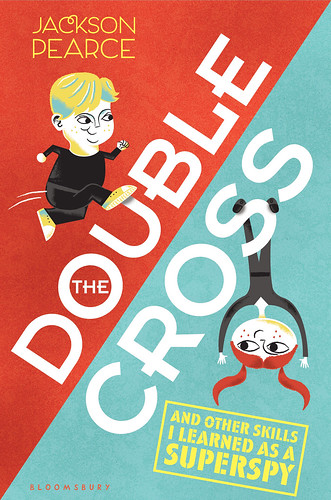
The Double Cross and Other Skills I Learned as a Superspy by Jackson Pearce

Published by Bloomsbury Children’s Books

Summary: Hale Jordan has grown up at the Sub Rosa Society (SRS) where his parents both work as spies, and he and his younger sister Kennedy are being trained to follow in their footsteps. Unfortunately, Hale is a bit slow and out of shape, and he hasn’t been able to pass the physical exam to become a junior agent. What he lacks in brawn, he makes up for in brains, which comes in handy when his parents disappear. When Hale starts to investigate their last mission, he discovers the shocking truth about SRS. Teaming up with Kennedy and the allegedly villainous League agents, Hale has to not only rescue his parents, but prevent SRS from taking over the world. Right before they left, Hale’s parents told him, “Heroes don’t always look like heroes, and villains don’t always look like villains.” Hale discovers the truth of this over and over in a plot filled with twists and counter twists. Grades 4-7.

Pros: Told in Hale’s smart and laugh-out-loud funny book, this action-packed adventure will appeal to reluctant readers.

Cons: The ending seems to set up a sequel possibility, but no mention of it yet in the book or on Amazon

My Three Best Friends and Me, Zulay by Cari Best, pictures by Vanessa Brantley-Newton

Published by Farrar, Straus, and Giroux

Summary: Zulay enjoys first grade with her three best friends. Even though she’s blind, she can do almost everything the other kids do. She doesn’t like it when she has to leave the class to work with Ms. Turner, who helps her learn to use a cane. But she does like writing on her Braille typewriter, learning math with manipulatives, and singing and dancing on the playground with Maya, Nancy, and Chyng. When the teacher announces an upcoming field day, Zulay is as enthusiastic as her classmates, and decides she wants to run a race. The class is silent when she makes that announcement, but Ms. Turner is confident Zulay can do it and works with her every day to get her ready. When the big day comes, Zulay runs around the track with Ms. Turner and joyfully breaks through the ribbon at the finish line. Ages 4-9

Pros: Readers will be interested to see how this exuberant girl participates in everything that interests her even though she can’t see. The author wrote this story after seeing a visually impaired girl thriving in a first-grade classroom at a New York City public school.

Cons: The title doesn’t exactly roll right off your tongue.

How to Spy on a Shark by Leslie Haskins Houran, illustrated by Francisca Marquez

Published by Albert Whitman and Co.

Summary: In brief rhyming text, this little book describes how scientists use robots to track mako sharks (“The mako twists! The robot turns! They dart and dip and dive/The robot shoots a video and sends it to you live!”). The last two pages give a more complete, but still very simple, explanation of how the scientists study these sharks.  Ages 3-7.

Pros: Even very young children will enjoy learning about the work these scientists do. The illustrations do a nice job of portraying people who may not fit the stereotype of “scientist”. Look for two other books in this series, about space and dinosaurs.

Cons: Those looking for a more “Jaws”-like book about sharks will be disappointed.

The Most Amazing Creature in the Sea by Brenda Z. Guiberson, illustrated by Gennady Spirin.

Published by Henry Holt and Company

Summary: Who is the most amazing creature in the sea? Is it the ocean sunfish who can hold up to 300 million eggs in its body? The blue whale with its tongue that weighs as much as an elephant? Or the box jellyfish with its 24 eyes and deadly venom? Every animal makes a brief case for why it is the most amazing. Each two-page spread is beautifully illustrated with life-like paintings. Grades K-4.

Pros: Readers will love reading about the bizarre features and behaviors of these diverse sea creatures. The pictures will amaze and delight, as well.

Cons: This book is so perfect to use for researching sea creatures that I’m afraid the third grade teachers in my school will grab it before I have a chance to use it with their classes.

Escape from Baxters’ Barn written and illustrated by Rebecca Bond

Published by Houghton Mifflin Harcourt Publishing Company

Summary: Burdock the barn cat hasn’t had the easiest life, but he’s always been able to look out for himself. Then one night, he overhears Dewey, the farmer, discussing his plan to burn down the barn and collect the insurance money. Burdock realizes that, even though he can get away, the lives of the other barn animals are in danger. He shares the news, and the animals begin to look for a way to escape before Dewey can carry out his dastardly plot. As their plan grows more complicated, Burdock finds himself increasingly participating in it. Should he continue to go his independent way and save himself, or allow himself to be drawn into becoming part of the barn family? Grades 2-5

Pros: With its memorable animal characters, exciting storyline, and expressive illustrations, this would be a great read-aloud for kids as young as first grade. The story of the animals conspiring to outwit the humans’ deadly plans, the warm friendships, and the realistic pen-and-ink drawings invite comparisons to Charlotte’s Web.

Cons: Dewey’s extreme and potentially deadly plan to burn down a barn full of animals may be a little much for younger readers.

Wrap-Up Wednesday: Books for Wimpy Kid Fans

Okay, I’ll admit to a little Wimpy Kid burnout (I actually hid the books in my library for a brief period last winter to get kids to check out something else).  But my literary tastes can be pretty low-brow, and I actually enjoy many of the books in the whole genre that seems to have spun out from this series.  Good news: every book on the list is part of a series (or is the first book in a new series):

The Rat With the Human Face by Tom Angleberger.  Published by Harry N. Abrams.

Lyle, Marilla, and Dave go on their second adventure as the Qwikpick Adventure Society, a quest to see the rat with the human face rumored to live in the basement of an old research facility.  There are just enough quirky details to make this story seem realistic.  By the author of the Origami Yoda series.

The Terrible Two by Mac Barnett, illustrated by Kevin Cornell.  Published by Harry N. Abrams.

Miles hopes to keep his prankster reputation when he moves to a new school.  Little does he know his school already has a prankster with capabilities far exceeding Miles’.  The mystery trickster turns out to be the last person Miles would have suspected, and the two of them join forces to pull off the biggest prank ever.

The Worst Class Trip Ever by Dave Barry.  Published by Disney-Hyperion.

On the flight to Washington, D.C., Wyatt and his best friend Matt witness two men acting like terrorists, and decide to take matters into their own hands.  There are plenty of laughs, but also a pretty good adventure story with a number of twists and turns.

Katie Friedman Gives Up Texting (And Lives to Tell About It!) by Tommy Greenwald, illustrated by J. P. Coovert.  Published by Roaring Brook Press.

When Katie Friedman accidentally sends a nasty text about her boyfriend to the boyfriend himself, she vows to give up texting.  On top of that, she gets an offer she can’t refuse if she can get ten friends to join her for a week.  Can she really pull it off?

My Life As A Gamer by Janet Tashjian, illustrated by Jake Tashjian.  Published by Henry Holt and Co.

Derek and his friends get an amazing opportunity to test a hot new video game before it’s released.  He breaks the rules by telling his new tutor some things about the game.  When details about it are leaked to the gaming world, Derek finds himself in hot water.

The Red Bicycle: The Extraordinary Story of One Ordinary Bicycle by Jude Isabella, illustrated by Simone Shin

Published by Kids Can Press

Summary: Leo works hard to save money to buy himself a red bicycle. When he outgrows it, he doesn’t want to just throw it away. The owner of the bike shop tells Leo about an organization that sends bikes to Africa. Leo puts in a full day packing bikes into a shipping crate, finishing with his own. The crate is shipped to Burkina Faso, where a girl named Alisetta uses it to help her family move goods to market and make more money. A few years later, a pig tramples the spokes of one of the wheels, and Alisetta must get a new bike. Fortunately, a man from a health clinic rescues the bike and fixes it up to use as an ambulance. At the end of the story, the bike has come to the end of that journey as well, but we can hope it will find a new incarnation. The last couple pages tell readers about organizations that will use their old bikes in this way, and gives some information about Burkina Faso. Grades 3-7.

Pros: This book is part of the Citizen Kid series of books, which claims to “inform children about the world and inspire them to be better global citizens”.  The Red Bicycle succeeds on both counts by showing kids how the simple act of donating a bike can make a big difference in the lives of many people around the world.

Cons: Okay, this is the third book this month whose font seemed too small to me. Guess it’s time to get that bifocal prescription taken care of.

Katie Friedman Gives Up Texting! (And Lives to Tell About It) by Tommy Greenwald, illustrations by J. P. Coovert

Published by Roaring Brook Press


Summary: After Katie Friedman accidentally sends a snarky text about her boyfriend Nareem to Nareem himself, she vows to give up texting. Her favorite singer, Plain Jane, has spoken out about too much phone time, and when Katie has a chance to meet her, Jane offers her a deal. If Katie can get ten of her friends to join her in giving up their phones for a week, Jane will perform one of Katie’s songs at her concert and give the whole group a backstage tour. The only catch is, Katie can’t tell anyone about the reward. It seems like an impossible task, but Katie’s lifelong dream is to a rock star. Can she possibly find a way to pull this off? Grades 4-7.

Pros: This latest installment in the Charlie Joe Jackson series is the first to be told from a girl’s perspective. Katie is a likeable narrator, and the plot is fast-paced and (aside from meeting your favorite singer) pretty realistic. The arguments for and against texting are interesting and potentially discussion-provoking.

Cons: Some of the heart-to-heart talks between the kids who give up their phones seemed a little unlikely to happen in middle school.

Amazon

Boats for Papa by Jessixa Bagley

Published by Roaring Brook Press

Summary: “Buckley and his mama lived in a small wooden house by the sea. They didn’t have much, but they always had each other.” Buckley’s dad is absent, and Buckley misses him. He likes to make boats, and one day he gets the idea to send a boat with a note on it, “For Papa, Love, Buckley”. For a whole year, starting on his birthday, he designs, builds, and sends boats to sea, all for Papa. On his next birthday, he has a boat all ready when he realizes he hasn’t written a note. He goes inside to get paper from his mother’s desk. When he looks inside, he finds all the boats he has ever sent. That evening, when his mother goes to retrieve the most recent boat from the seaweed where it has drifted, she finds a note reading, “For Mama, Love, Buckley”. Ages 4-9.

Pros: This book deals with loss and love with a beautiful simplicity. Papa’s absence is never explained, which makes the story relevant to any child who has lost someone they love. The beautiful watercolors of the beach are worthy of Caldecott consideration.

Cons: This is not a book to rush. Allow plenty of time for discussion.