Pizza Day by Melissa Iwai

Published by Henry Holt

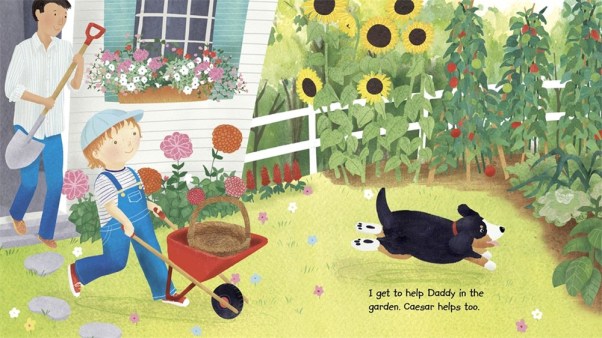
Summary:  A boy and his father spend a day at home making pizza.  They start in the garden, picking tomatoes, carrots, onions, basil, and a pepper.  Then it’s into the kitchen to make the dough and the sauce.  Both items have to rest awhile, so father and son head outside to play.  Later, the boy “wakes up” the pizza ingredients, and he and his dad put them together, add some toppings, and send their dinner to the oven to bake.  While they’re cleaning up, Mom gets home from work, and the day ends with a delicious dinner.  Includes recipes for dough and sauce, and instructions on how to assemble and bake your own pizza.  40 pages; ages 3-6.

Pros:  A companion to Melissa Iwai’s Soup Day (which may be more appropriate for this time of year), this simple story celebrates family and fresh food.  The acrylic illustrations have plenty of kid appeal, and will whet appetites to try the recipes at the end.

Cons:  That pizza definitely needed more cheese.
If you would like to buy this book on Amazon, click here.

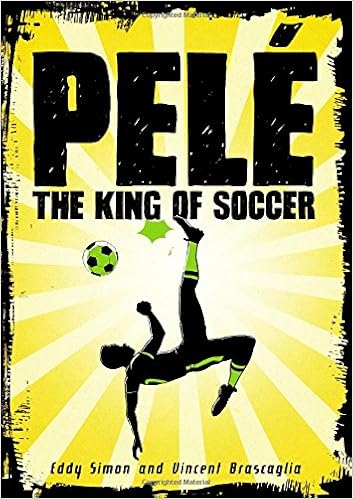
Pele: The King of Soccer by Eddy Simon, illustrated by Vincent Bascaglia

Published by First Second

Summary:  Edson Arantes de Nascimento grew up poor in Brazil, tutored in soccer by his father who had missed out on a professional career because of a knee injury.  From a young age, Edson adopted the nickname Pele, and that was how he was known to millions of fans as he rose to the top in the soccer world.  As a member of the Santos team, he became unstoppable, becoming the only player to ever win three World Cups.  He retired from Brazilian soccer in 1974, but financial difficulties led him to sign with the New York Cosmos two years later, causing a brief rise in the popularity of the game in the U.S.  Since his final retirement, he has traveled the world as a goodwill ambassador and worked with the Brazilian government to improve sports in his own country.  144 pages; grades 4-8.

Pros:  A fast-paced graphic novel that will grab the attention of sports fans.  There’s plenty of soccer action, as well as biographical information that doesn’t shy away from some of Pele’s less admirable traits, including adultery, but ultimately portrays him as a positive role model.

Cons:  The font for some of the footnotes is so tiny as to be almost invisible to the naked eye.

If you would like to buy this book on Amazon, click here.

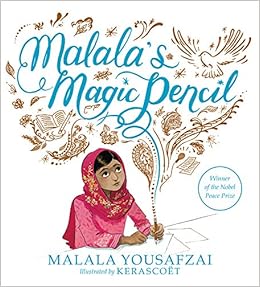
Malala’s Magic Pencil by Malala Yousafzai, illustrated by Kerascoet

Published by Little, Brown Books for Young Readers

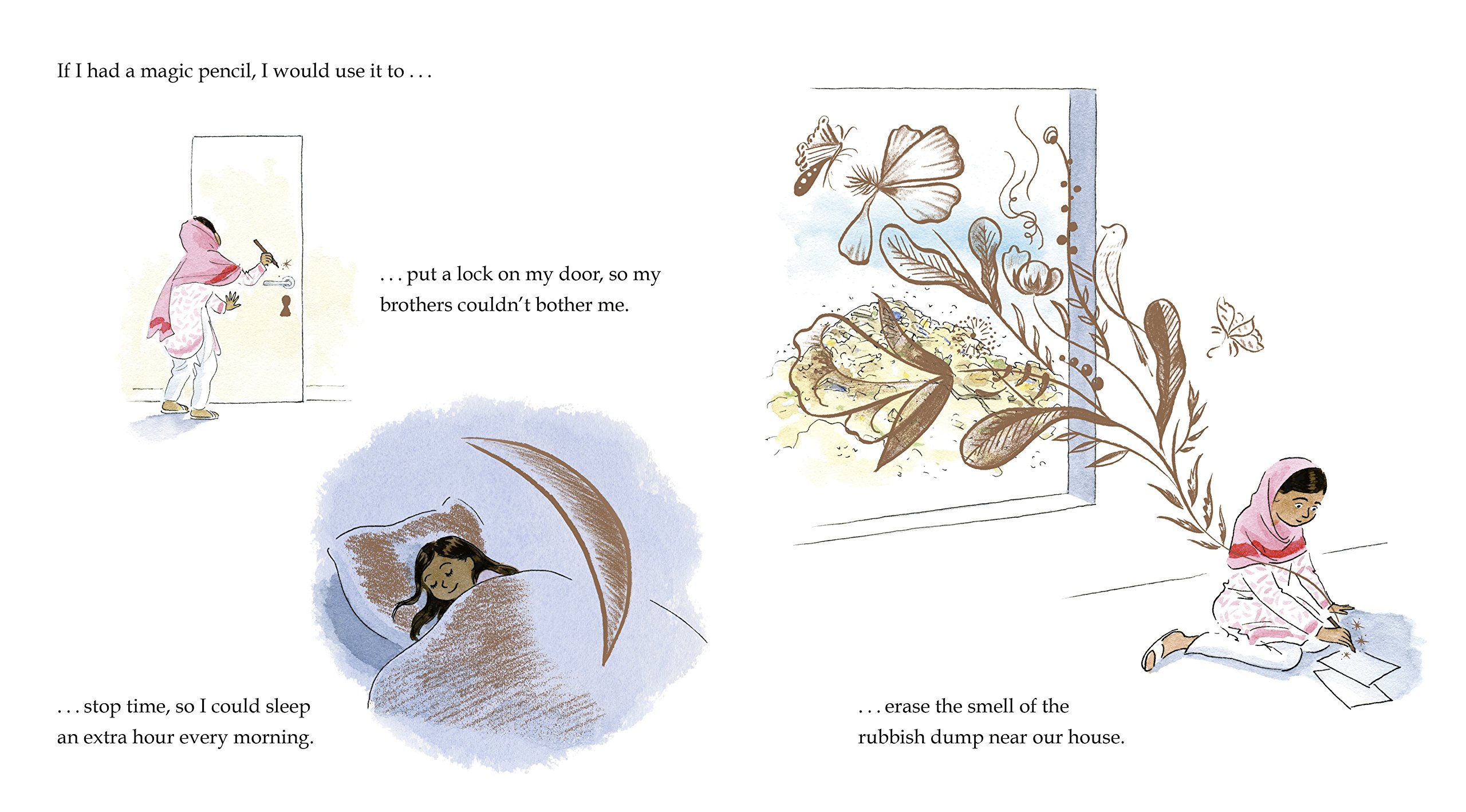
Summary:  Malala Yousafzai describes how she used to watch a TV show about a boy who had a magic pencil that could create whatever he drew.  She wished she could have one so she could draw a lock on her bedroom door, new dresses for her mother, and a soccer ball for her brothers.  As she grew older, her dreams grew too, and soon she wished she could use her magic pencil to erase the poverty she saw around her.  She worked hard at school, and when “powerful and dangerous men” took over her country, she started speaking out about the importance of letting girls attend school.  With white letters on a black page, Malala states, “My voice became so powerful that the dangerous men tried to silence me. But they failed.”  The accompanying illustration shows her looking out a hospital window.  The last few pages show her continuing her work today, writing, demonstrating, and speaking at the United Nations.  Back matter includes a letter from Malala, a page of biographical information, and three photos of her at different stages of her life.  48 pages; ages 5-8.

Pros:  A moving introduction to Malala Yousafzai’s courageous story, beautifully illustrated with ink and watercolor drawings.  Kids looking for more information can move on to the young reader’s edition of I Am Malala.

Cons:  You didn’t really think I was going to write something negative about a book by Malala on Thanksgiving Day, did you?

If you would like to buy this book on Amazon, click here.

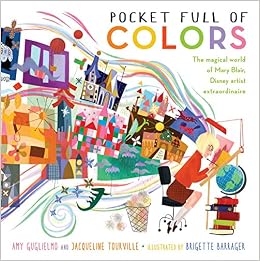
Pocket Full of Colors: The Magical World of Mary Blair, Disney Artist Extraordinaire by Amy Guglielmo and Jacqueline Tourville, illustrated by Brigitte Barrager

Published by Atheneum Books for Young Readers

Summary:  From the time she was a child, Mary Blair loved colors of all hues.  She used them at art school, and they led her to a job at Disney Studios, one of the first women to be hired by them.  Once there, though, a group of older men rejected her colorful drawings, preferring to stick with mostly black and white.  She did succeed in catching the attention of one man, Walt Disney himself, who invited her on a tour of South America to create art.  Upon her return, under the South American influence, her art grew even more eye-popping, and some of her ideas were finally accepted, including Cinderella’s pumpkin coach and Alice in Wonderland’s caterpillar.  But too many of her ideas were turned down, and Mary went off on her own, where she created children’s book illustrations and theater sets.  A few years later, Walt Disney approached her with a new plan, and Mary became the chief designer for his “It’s a Small World” ride.  At last, her colors could flow freely, and the world could finally see Mary’s world as she had always imagined it.  Includes an author’s note with biographical information.  48 pages; ages 4-8.

Pros:  A colorful biography of a little-known artist with a connection most kids will recognize and a “be yourself” message about creativity.

Cons:  Now we will all have “It’s a Small World” stuck in our heads for the rest of the day.

If you would like to purchase this book on Amazon, click here.

Hi, Jack! by Mac Barnett, illustrated by Greg Pizzoli

Published by Viking

Summary:  Jack is a mischievous monkey in this three-chapter beginning reader.  In the first chapter, he steals a woman’s purse and puts on some lipstick.  The second chapter starts out being about Rex the dog, but when Rex’s lips suddenly turn red, Jack is revealed to be the culprit.  The final story takes place at the woman’s house (she’s known only as The Lady).  Jack shows his hands to convince her that he doesn’t have any lipstick; meanwhile, he’s writing his name on her wall with a lipstick held by his tail.  There seems to be the beginning of a friendship when The Lady offers Jack a cookie; Jack reciprocates with a kiss…but his version (involving Rex) is a little different from what she is expecting.  The final pages show how to draw Jack, Rex, and The Lady.  80 pages; ages 4-8.

Pros:  Behold, the first book of 2018, from an advance reader copy I picked up at AALS.  The pairing of Mac Barnett and Greg Pizzoli is kind of genius, and I predict beginning readers are going to love this series.  The first two entries are scheduled for February, with two more to come in May.

Cons:  It’s a lot of pages for a beginner.

The Perfect Score by Rob Buyea

Published by Delacorte Books for Young Readers

Summary:  Gavin, Natalie, Trevor, Scott, and Randi are all looking forward to sixth grade with Mr. Mitchell, and are dismayed when they learn at the end of the summer that he has left, replaced with Mrs. Woods who is coming out of retirement to teach them.  Each kid is struggling with different issues, including an abusive brother (Trevor), an overly ambitious mom pushing her in gymnastics (Randi), a know-it-all attitude that’s resulted in no friends (Natalie), learning disabilities (Gavin), and immaturity and impulsivity (Scott).  They take turns telling the story of how each gradually comes to enjoy Mrs. Woods’ teaching style, only to see the best parts of sixth grade disappear to make way for standardized test preparation.  The test becomes high-stakes for each one of them for a different reason, and the stress about not doing well results in a plan to cheat.  When their perfect scores arouse suspicion, the truth comes out, but with it comes the truth about many of the other issues in the kids’ lives.  There’s a lot to resolve with both students and teachers, but the school year ends on a high note.  368 pages; grades 4-7.

Pros:  Fans of the author’s Mr. Terupt series will enjoy this new book told in a similar style, with five different narrators.  Many readers will find something to connect with in at least one of the main characters.

Cons:  In today’s Common Core world, a straight multiple choice standardized test seems unrealistic.

If you would like to buy this book through Amazon, click here.


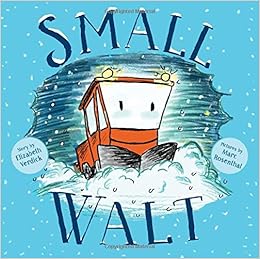
Small Walt by Elizabeth Verdick, pictures by Marc Rosenthal

Published by Simon and Schuster

Summary:  When a blizzard hits town, most of the snowplow drivers go for the big, tough plows.  But Gus agrees to drive Walt, the smallest one in the fleet, and Walt is determined not to let him down.  They plug along through town, and Walt keeps himself going with rhymes such as, “My name is Walt. I plow and I salt. I clear the snow so the cars can go!”  Finally, they reach a high hill with the biggest drifts Gus has ever seen.  “I don’t think we’re up to this,” he says, but Walt has different ideas.  With a bit of slipping and sliding, they make it to the top, then back down again, with mega snowplow Big Buck following close behind.  At dawn, they head back to the parking lot, and even Big Buck has grudging words of admiration for Walt.  As for Gus, he takes off his blue scarf and ties it around Walt’s rearview mirror, cementing their friendship for snowstorms yet to come.  40 pages; ages 4-8.

Pros:  A cross between Mike Mulligan and His Steam Shovel and The Little Engine That Could, this is a charming story of persistence and optimism with pleasantly retro illustrations.  A perfect read-aloud for the coming winter months.

Cons:  For the purpose of story hours and kids chanting along with a repeated refrain, Walt should have made up one rhyme and stuck with it.  Instead, he kept changing it.

If you would like to buy this book on Amazon, click here.

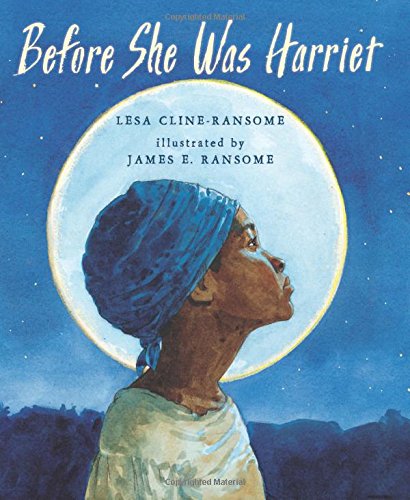
Before She Was Harriet by Lesa Cline-Ransome, illustrated by James E. Ransome

Published by Holiday House

Summary:  Harriet Tubman’s story is told in reverse, beginning when she is “an old woman/tired and worn/her legs stiff/her back achy”.  Before that, she was a suffragist, and before that, a Union spy.  The narrative continues back in time, showing Harriet as Moses, conducting slaves to freedom on the Underground Railroad, and finally, all the way back to a child named Araminta, “who dreamed/of living long enough/to one day/be old/stiff and achy/tired and worn and wrinkled/and free”.  32 pages; grades 1-4.

Pros: A brief, poetic look at Harriet Tubman’s life and many achievements, beautifully illustrated by Coretta Scott King medalist James Ransome.

Cons:  I was disappointed that there was no back matter giving more biographical information.

If you would like to buy this book on Amazon, click here.

The Friendship Code (Girls Who Code book 1) by Stacia Deutsch

Published by Penguin Workshop

Summary:  Lucy is excited to learn how to code in a new after-school club.  Her best friend, Anjali, is part of the theater club, and Lucy doesn’t have any coding friends.  When she gets an anonymous note written in code, she enlists some of the other girls from the club to try to help her solve the mystery.  With the help of her older brother Alex, Lucy and her three new friends create a game that eventually reveals the identity of the note writer.  By the time the mystery is solved, the four have formed a friendship and are ready to move along to book #2.  144 pages; grades 3-6.

Pros:  Two books about girls coding in the same week!  This one manages to sneak a few coding lessons into a book about friendship that coders and non-coders (and soon-to-be coders) will all enjoy.  Written by the creator of the Girls Who Code movement (www.girlswhocode.com) that is starting coding clubs for girls all over North America.

Cons:  Anjali seemed like an extraneous character.

If you would like to buy this book on Amazon, click here.

Click’d by Tamara Ireland Stone

Published by Disney Hyperion

Summary:  Allie has worked hard at CodeGirls summer camp, developing at app called Click’d that’s designed to help people make friends.  Her final presentation is so successful that she’s invited to enter the annual Games4Good competition, where  young programmers showcase their games designed to make the world a better place.  Allie’s plan is to keep Click’d under wraps until after the competition, but her friends’ enthusiasm is so flattering that she ends up releasing it early.  Before long, much to Allie’s delight, the game goes viral, but within a few days there’s a security flaw, and one of her friend’s private texts appears on other kids’ phones.  Allie knows she has to fix the problem before the competition, but the only person who can help her is Nathan, another super coder at her school, a fellow competitor at Games4Good, and her long-time nemesis.  It’s a roller-coaster week for Allie as she navigates the highs and lows of both the tech industry and seventh grade.  304 pages; grades 3-7.

Pros:  A fast-paced, funny story about two smart and talented coders whose skills don’t always extend to the social world of middle school.  Good messages about friendships are subtly woven into the light, breezy plot.

Cons:  Click’d didn’t really seem like it belonged in the Games4Good contest, going up against other games that addressed homelessness and the world’s water supply.