Saved by the Boats: the Heroic Sea Evacuation of September 11 by Julie Gassman, illustrated by Steve Moors

Published by Capstone Press 
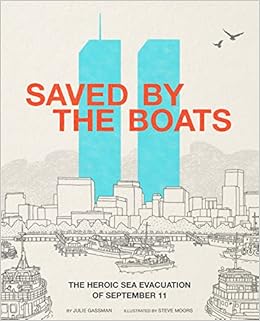
Summary:  On September 11, 2001, after the collapse of the World Trade Center, more than a million people were looking to get out of Manhattan.  New York City was under attack, and bridges, tunnels, and subways were closed.  The only way to escape was by water.  When lines for the ferries became miles long, the Coast Guard put out a call for any boat to come help with the evacuation.  “If it floated, and it could get there, it got there,” said an engineer who was part of the rescue effort.  Wondering if there would be more attacks, the ships and their crews knew they were easy targets, but they courageously sailed on.  Some put out sheets with their destinations in New Jersey painted on them.  They tried to help the shocked, distraught people who boarded their boats, and then they took them safely across the water.  In about nine hours, just under 500,000 people were helped, the largest sea evacuation in history.  Back matter includes an author’s note telling of her 9/11 experience being rescued by a boat, a brief glossary, and a few additional resources and source notes.  32 pages; grades 3-7.

Pros:  An interesting and inspiring slice of history, focusing on the courage of the ordinary people who answered the call of duty to help their fellow New Yorkers.  The illustrations are mostly sepia toned, with bright spots of color in the sky and water, symbolizing the brightness of the rescue effort on this tragic day.

Cons:  The glossary (“tragedy—a very sad event”) seemed superfluous for the intended age group.
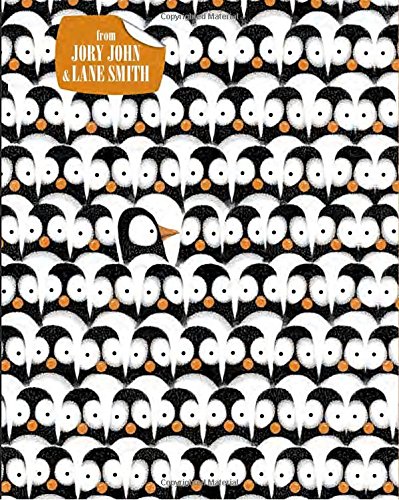
Penguin Problems by Jory John, illustrated by Lane Smith

Published by Random House 

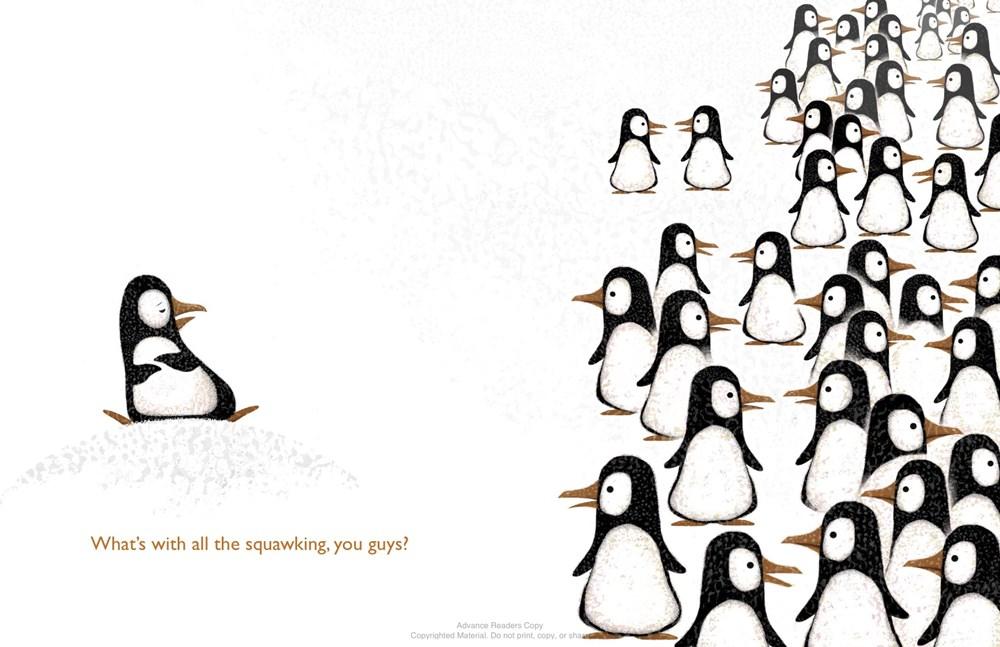
Summary:  The penguin narrator has a laundry list of problems:  he doesn’t like snow, he can’t fly, he’s not buoyant enough and sinks in the ocean.  He looks silly when he waddles, he wishes he could fly, and all the penguins look so much alike, he can’t fine his parents (“Mom?”  “I literally have no idea who you are.”).  Finally an old walrus taps him on the shoulder and gives him some advice.  Yes, life can be challenging, but it’s important to notice the beautiful ocean, the warm sun, and the love of the rest of the penguins all around him.  The young penguin gets the message…sort of.  32 pages; ages 3-8.

Pros:  A cute and funny story that makes a good point about appreciating life instead of complaining all the time.

Cons:  The penguin is still complaining on the last page.

In the Shadow of Liberty: the Hidden History of Slavery, Four Presidents, and Five Black Lives by Kenneth C. Davis

Published by Henry Holt and Company 

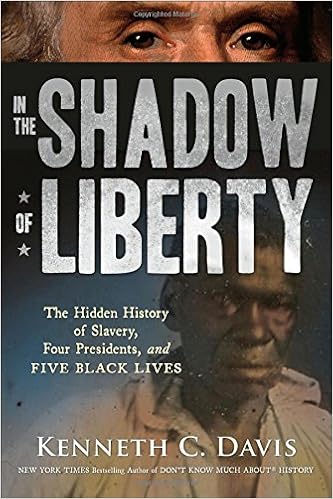
Summary:  Did you know that thirteen American presidents owned enslaved people or grew up in slaveholding households?  (The last one was Woodrow Wilson, born in Virginia in 1856.)  This book profiles four of them–George Washington, Thomas Jefferson, James Madison, and Andrew Jackson—and five of the African Americans who were enslaved by them.  These five were present at many pivotal moments of American history, including various Revolutionary War battles and the burning of the White House in 1812, yet they remained in the shadows due to their positions in life.  As the author points out in his afterword, they were more fortunate than most in that their names and stories have survived and they were all set free by the ends of their lives.  The stories of the four Presidents are equally fascinating, as their thinking about slavery evolved over the course of their lives.  Yet they all bought and sold slaves, punished them, housed them in primitive shacks, and never gave them their freedom.  The extensive research that went into this book is demonstrated in the nine pages of source notes and the four-page bibliography.  304 pages; grades 6 and up.

Pros:  An amazing historical work, heavily illustrated with photos and drawings, with a timeline of slavery at the end of each chapter.  This should be required reading for all high school history students.

Cons:  You’ll never look at the Founding Fathers in quite the same way after reading this.

Lincoln and Kennedy: A Pair to Compare by Gene Barretta

Published by Henry Holt


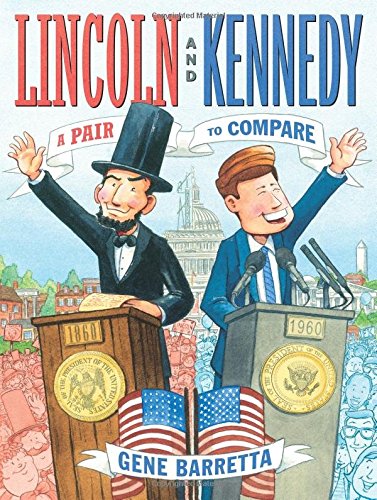
Summary:  They were born 108 years apart, one growing up in poverty and the other with great wealth and privilege.  Yet Abraham Lincoln and John F. Kennedy had a remarkable number of things in common.  Both were named for their grandfathers and had seven letters in their last names.  Both served in the House of Representatives, elected exactly 100 years apart (1846 and 1946), and both lost the race for Vice President before being elected President in 1860 and 1960.  The two men had somewhat tragic private lives, each losing a child before being elected President and another when he was in the White House.  Lincoln was determined to end slavery while Kennedy worked for civil rights legislation.  And, of course, both had their presidencies and their lives cut short by an assassin: each one sitting next to his wife who wasn’t injured; by a man who used three names and was killed before his trial; and succeeded by a President named Johnson.  Back matter includes presidential accomplishments, trivia, and quotes from each man, a glossary, and sources.  40 pages; grades 1-5.

Pros:  Biographical information is presented in a fascinating manner; this book could be the inspiration for students to research and compare two other presidents.

Cons:  This book only presents the tip of the iceberg for similarities between Lincoln and Kennedy.  Search the Internet if you really want to go crazy with this comparison.  http://surftofind.com/coincidence

When Friendship Followed Me Home by Paul Griffin

Published by Dial Books 

Summary:  Ben thinks he has finally found a real home with his former speech pathologist who adopted him a couple years ago.  He’s delighted when he rescues an intelligent little dog from outside the Coney Island library.  Then, just as life seems to be turning around, he comes home from school and finds Mom dead on the floor of her bedroom.  He’s forced to live with her sister, Aunt Jeanie, whose husband Leo struggles with a drinking problem.  Meanwhile, Ben has befriended the librarian’s daughter, Halley, who is undergoing chemotherapy.  As Halley and Ben grow closer, her home and family become a refuge for him.  Halley is a writer, and she and Ben create a magical science fiction story called “The Magic Box”, but Halley refuses to tell Ben what’s inside the box.  Bring out the tissues for the last 50 pages or so as Halley’s health and Ben’s home life deteriorate.  The final chapter brings a measure of hope for Ben.  And thank goodness, the dog does not die.  256 pages; grades 5-8. 

Pros:  Okay, I’m the first to admit I’m not a fan of the almost-too-good-to-be-true-young-person-in-a-life-threatening-situation genre (yes, Bridge to Terabithia and The Fault in Our Stars, I’m talking to you), but obviously there are many, many readers who love that very genre, and you should hand this book to them.  It’s beautifully written with interesting, believable characters, particularly Ben, and handles many difficult issues with sensitivity and grace. 

Cons:  There was too much of  the story Halley and Ben were writing; I found myself skipping over it and feeling like I didn’t miss much.

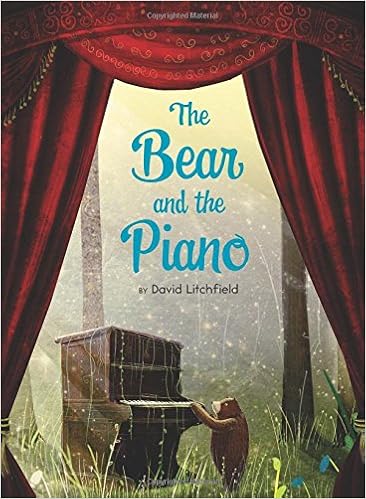
The Bear and the Piano by David Litchfield

Published by Clarion Books 

Summary:  When a bear finds an abandoned piano in the forest, he’s drawn to return to it day after day until he becomes a virtuoso.  He loves playing for all his animal friends.  One day a boy and a girl happen upon one of his concerts and convince him to go back with them to the big city.  The bear hates to leave his friends, but the idea of traveling and playing for large audiences is too tempting to pass up.  Off he goes to a new life of fame and fortune, performing in sold-out venues to adoring crowds.  But as time goes by, he misses his friends, and one day, he chucks it all and returns to the forest.  He’s worried that his friends are angry that he left them, but soon he discovers that they have been cheering on his successes from afar and have kept his piano safe for him.  The bear plays a concert for the most important audience of all.  40 pages; ages 4-8.

Pros:  A touching story about loving and supportive friends and getting back to your roots.  The illustrations were created “using a variety of traditional techniques, then assembling the different elements digitally to create large-scale, dramatic scenes” (from the back flap), and are gorgeous.

Cons:  How can a bear play the piano with no fingers or opposable thumb?

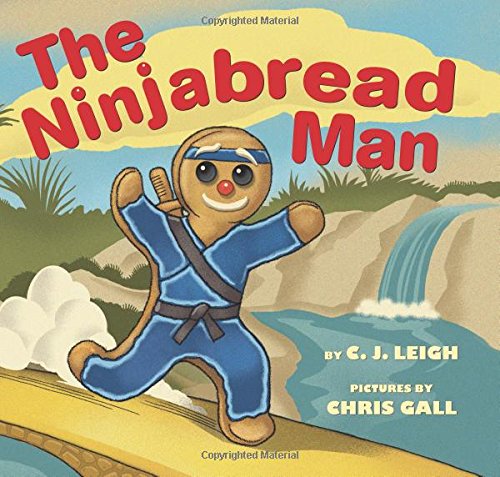
The Ninjabread Man by C. J. Leigh, pictures by Chris Gall

Published by Orchard Books


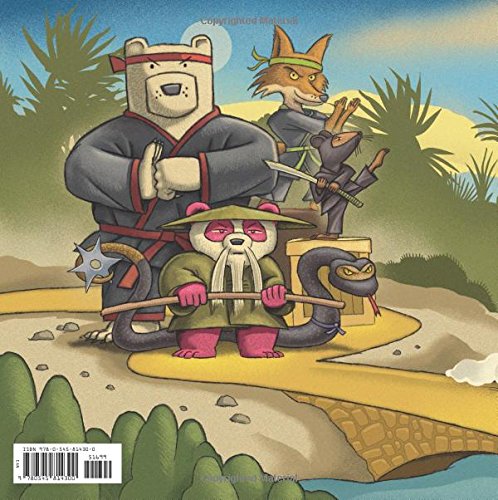
Summary:  As a reward to his hardworking ninja students, Sensei makes ninjabread, an age-old recipe that contains mysterious powers.  After making ninjabread swords and throwing stars, he makes a Ninjabread Man.  When Sensei checks to see how the cookies are baking, ka-pow!  The Ninjabread Man comes to life and runs off.  He taunts the other students, Bear, Snake, and Mouse, with different variations of the “You can’t catch me” rhyme.  Finally, he comes upon Fox, meditating by a waterfall.  Fox cleverly pretends he can’t hear the Ninjabread Man, luring him closer until the sly canine scarfs him up.  And in another dojo far away, another sensei begins the process of making ninjabread.  Includes recipe and brief glossary.  40 pages; ages 4-6.

Pros:  In this season of gingerbread men, kids will enjoy comparing the traditional tale with the ninja version.

Cons:  The ending was a bit of an anticlimax.

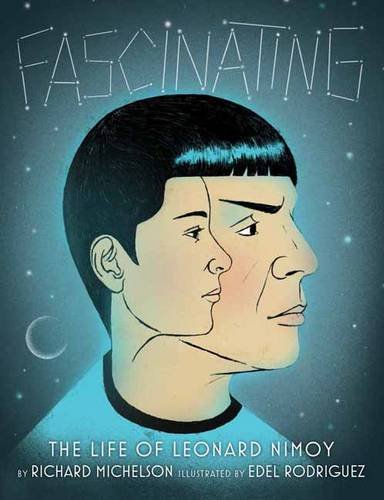
Fascinating: The Life of Leonard Nimoy by Richard Michelson, illustrated by Edel Rodriguez

Published by Alfred A. Knopf

Summary:  Leonard Nimoy grew up in a four-room apartment in Boston’s West End, the son of Russian immigrants.  He got his first taste of acting at a Jewish settlement house.  By the time he was 17, he knew he wanted to be an actor.  Heading to Hollywood where he drove a taxi (he once gave John F. Kennedy a lift), Leonard built a moderately successful career in movies and television.  His life changed in 1965 when he got a call from Gene Rodenberry, asking him to play the alien Spock in his new series Star Trek.  Initially concerned that the pointy ears and weird haircut might ruin his career, Leonard made the fortuitous decision to take the part, and the rest is science-fiction history.  A final note (“The Rest Is History”) gives more information about Nimoy, including his lesser-known careers as a photographer, writer, and musician.  An author’s note tells of Michelson’s close friendship with Leonard Nimoy.  40 pages; grades 1-5.

Pros:  An engagingly-written biography of a man who, in fact, lived long and prospered, rising from a poor immigrant childhood to success in many arenas.  The stories about Nimoy flow together well to tell his story, and the illustrations do a good job of portraying Leonard/Spock.  Readers will enjoy learning the origin of Spock’s famous four-finger salute.

Cons:  The pallette for the illustrations is kind of drab.

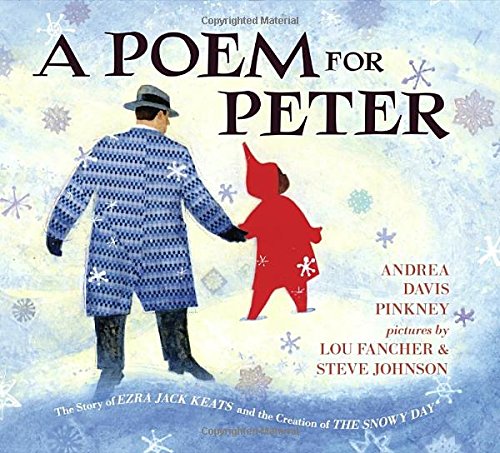
A Poem for Peter: The Story of Ezra Jack Keats and the Creation of The Snowy Day by Andrea Davis Pinkney, pictures by Lou Fancher & Steve Johnson

Published by Viking

Summary:  Andrea Davis Pinkney’s poetic homage weaves together biographical information about Keats with the story of the creation of his most famous book.  Born Jacob Ezra Katz, the son of Polish immigrants, the artist grew up in a poor Brooklyn neighborhood with a father who faced job discrimination and a mother whose secret dreams of becoming an artist never came to fruition.  Young Ezra loved art and won an art school scholarship, but when his father died of a heart attack the day before his high school graduation, his school days were over.  He was helped by the New Deal’s WPA, and went on to become a comic book artist before moving to children’s book illustration.  When he was asked to write and illustrate his own book, he thought of a little African-American boy whose picture in Life magazine had hung on Keats’s wall for many years.  This boy became Peter and the book was The Snowy Day.  Back matter includes “Ezra’s Legacy” with more information about the books that celebrated city life and the people from different cultures who lived there, and “Keats, the Collage Poet”, explaining how the verse narrative used for this book reflects Keats’ collage style of art.  60 pages; grades 2-5.

Pros:  A beautiful celebration of a life and a book, illuminated with illustrations inspired by Ezra Jack Keats’s art.

Cons:  I find the poetic biographies are a hard sell with the elementary crowd.


A Voyage in the Clouds: The (Mostly) True Story of the First International Flight by Balloon in 1785 by Matthew Olshan, illustrated by Sophie Blackall

Published by Farrar, Straus and Giroux 

Summary:  On the morning of January 7, 1785, Dr. John Jeffries and his dog Henry, and Monsieur Jean-Pierre Blanchard and his dog Henri, set off to be the first to travel from one country to another in a hot air balloon.  Jeffries was an Englishman financing the trip and Blanchard was an experienced pilot from France. Their dislike for each other showed up almost immediately when Blanchard wore a weighted vest to try to convince Jeffries that the balloon would be too heavy for both of them.  Jeffries discovered the trick, though, and insisted that they both make the voyage.  Partway through, the balloon began to sink, and the two men had to put aside their differences to make it to France.  They dumped everything they could out of the basket, including their clothes, but their descent wasn’t reversed until they both relieved themselves over the side.  Their safe arrival marked the beginning of a beautiful friendship.  An author’s note separates the facts from a few of the liberties taken in the story.  40 pages; grades K-4.

Pros:  A humorous piece of history, impeccably illustrated by last year’s Caldecott medalist Sophie Blackall.  Kids will get a big kick out of the picture of the two men clad in their old-fashioned drawers peeing over the side of the balloon basket.  The cartoon bubble dialog brings the events to hilarious life.

Cons:  Definitely a mix of fact and fiction, so be sure to read the author’s note.