Penguin Day: A Family Story by Nic Bishop

Published by Scholastic Press
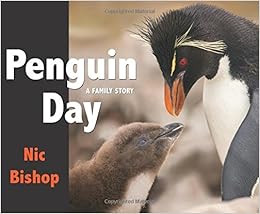
Summary:  When a baby rockhopper penguin is hungry, his mother goes in search of food while his father stays home to protect him.  The mother is part of a group of penguins that climbs cliffs and dives into the ocean, braving sea lion and orca predators, to hunt for fish and krill.  Meanwhile, when the baby penguin wanders off to explore, his father must protect him from a hungry skua (bird).  Finally, the family is reunited, and baby penguin gets his (apparently regurgitated) meal.  An author’s note gives more information on these Antarctic penguins.  32 pages; ages 4-8.

Pros:  Nic Bishop has another winning collection of nature photographs that will be popular with primary grades.  The story will draw them in, and the author’s note can be used to teach more about the penguins.

Cons:  The story was a bit more mundane than the photos.
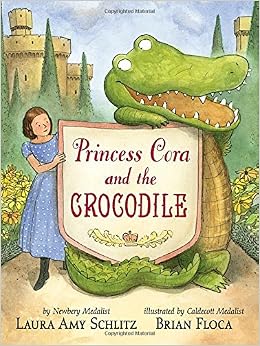
Princess Cora and the Crocodile by Laura Amy Schlitz, illustrated by Brian Floca

Published by Candlewick

Summary:  Princess Cora’s parents are determined to train her right, which to their way of thinking includes three baths a day, endless studying of dull books, and a lot of skipping rope in the basement.  Cora tries to do what they ask of her, but what she really wants to do is play.  Certain that a dog would help her cause, she writes a letter to her fairy godmother requesting a pet.  The next morning, a box arrives with a large crocodile inside.  Sympathetic to Cora’s cause, the crocodile offers to pose as her for the day, while the princess takes off for some outdoor play.  The predictable chaos ensues, and when Princess Cora returns, her nanny is stuck in the bathtub, her mother is locked in a tower, and her father has been tied up with the jump rope.  Cora sets things to rights, but that night she tells her parents how she really feels, and her life begins to change for the better.  80 pages; grades K-3.

Pros:  A perfect skewering of 21st century overachieving parents.  Some readers may be wishing for their own crocodile.  The illustrations are perfect.

Cons:  Will the message be lost on the intended audience?

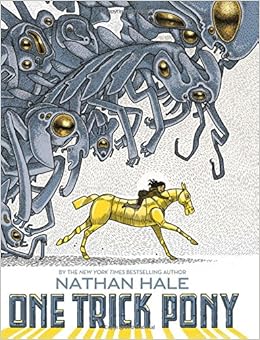
One Trick Pony by Nathan Hale

Published by Amulet Books

Summary:  Nathan Hale takes a break from his Hazardous Tales graphic novels (relax, he has a new one coming out in November) to create a futuristic science fiction story.  Much of Earth has been destroyed, and a small band of humans is trying to preserve what’s left of its culture and history.  They live in a caravan that has to constantly move to avoid the alien Pipers that travel in bubbles and devour any technology they can find.  At the beginning of the story, Strata, Auger, and Inby discover a cave filled with robots, including a robotic horse.  Activating the robots attracts the Pipers, and the three kids barely escape on the horse.  Their adventures have just begun as they struggle to return home, pursued by the aliens.  Meanwhile, the caravan has gotten wind of the new Piper activity.  There is a push to move on, but the parents of the three missing children don’t want to leave without them.  There are encounters with other groups of humans living in more primitive societies, and a final showdown when the aliens capture Strata and her horse.  The action comes to a quick finish, indicating that this is most likely a stand-alone story rather than the first of a series.  128 pages; grades 3-7.

Pros:  Hale’s fans won’t be disappointed with this exciting adventure told with his trademark illustrations.  There is enough action to keep a 13-year-old engaged, yet it is mild enough to be appropriate for an 8-year-old.

Cons:  The defeat of the aliens seemed way too easy, and the ending was a little too pat.

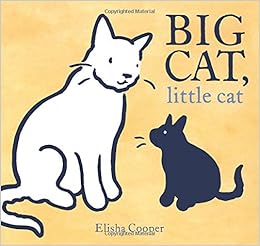
Big Cat, Little Cat by Elisha Cooper

Published by Roaring Brook Press

Summary:  A white cat lives alone for some time before being joined by a small black kitten.  The white cat shows the kitten when to eat, when to drink, where to go (in the litter box), how to be, and when to rest.  Big cat, little cat.  The kitten grows into a big cat, even bigger than the white one.  The two cats spend years together, working and playing, until one day, the white cat has to go.  And he doesn’t come back.  That’s hard for everyone, including the humans, until a white kitten joins the family, and the cycle begins again.  Big cat, little cat.  40 pages; ages 3-6.

Pros:  The cycle of life in the simplest terms, yet very moving.  Both the text and illustrations are minimalist black and white, but they work together to create a strong story and message.

Cons:  It’s a tearjerker!

Forever or a Long, Long Time by Caela Carter

Published by HarperCollins

Summary:  Flora and her brother Julian don’t believe they were born.  After years of foster care, some of it bordering on abusive, they have only dim memories of their past and have come up with many theories of how they came to be.  Each chapter begins with one of their theories.  For the last two years, they have been in their “forever” home, reassured by their parents that they will never have to move again, but it’s hard for them to really believe that.  Julian still sneaks food and hides it in his closet, and Flora frequently has trouble talking.  With the help of a therapist, their parents decide the best way for them to move on is to face their past, and so they go on a trip, starting with a visit to their most recent foster home, then working backward.  As they gradually uncover the people and places from their early childhood, they find reasons to be sad and angry, but also grateful; and they learn that only by facing the past can they can begin to heal and move into the future.  320 pages; grades 4-7.

Pros:  A powerful book that was hard to put down.  Flora narrates the story; readers see events unfold through her eyes and learn of the past through her incomplete memories.  The characters are memorable and realistically portrayed, and the story seems heartbreakingly real.

Cons:  I skipped reading most of the  kids’ chapter-opening theories about how they came to be.

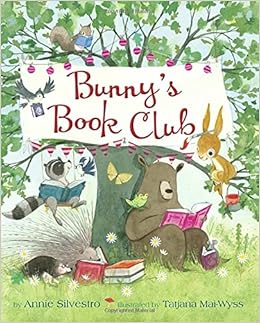
Bunny’s Book Club by Annie Silvestro, illustrated by Tatjana Mai-Wyss

Published by Doubleday Books for Young Readers

Summary:  Bunny loves summer story hours, but when fall comes, story time moves inside.  Bunny’s not sure animals are welcome in the library, so he decides to try to sneak in at night.  After some investigation, he discovers that the book drop provides a handy entryway into the library.  He helps himself to a big stack of books, which he takes back to his burrow.  When Porcupine drops by, he’s intrigued by all Bunny’s books, so Bunny lets him in on his secret.  Before long, it’s a secret no longer, and Bear, Mouse, Frog, and a host of others are using the book drop.  Everyone’s having such a good time one night, that they don’t hear the librarian turning the key in the door.  They’re caught red-handed, but luckily, the librarian’s solution is to give each one of them a library card and turn them loose among the bookcases.  The final two pages show Bunny’s Book Club, every animal cozily reading, surrounded by teacups and cupcakes.  40 pages; ages 3-7.

Pros:  An inviting introduction to the library and having your own library card.  The pictures are adorable.

Cons:  Bear’s trip through the book drop looks pretty uncomfortable


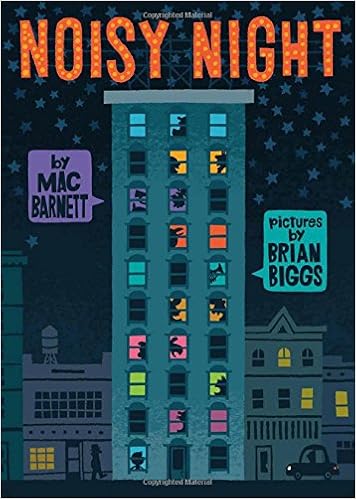
Noisy Night by Mac Barnett, pictures by Brian Biggs

Published by Roaring Brook Press

Summary:  “What is going La La La above my head?” wonders the little boy standing on his bed.  All the reader can see is a pair of legs and feet.  Turn the page, and you’re on the next floor up.  A man is singing opera.  Above his head is the sound “ma ma ma”, which turns out to be a cooing baby.  And so it goes, on up through a multi-story apartment building.  The last floor is inhabited by an old man hollering, “Go to bed!”  Peace descends as everyone settles down for a good night’s sleep.  32 pages; ages 3-7.

Pros:  Can you guess what’s on the next page?  Kids will have fun trying to figure out what’s making each noise.  The bright, comic illustrations with cartoon bubble dialogue are eye-catching.

Cons:  Are quotation marks going the way of the dinosaurs, with all dialogue now encapsulated in cartoon bubbles?

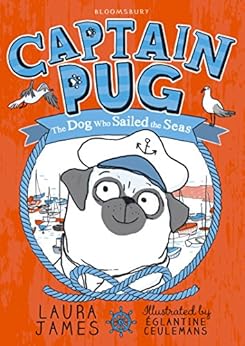
Captain Pug: The Dog Who Sailed the Seas by Laura James, illustrated by Eglantine Ceulemans

Published by Bloomsbury

Summary:  Lady Miranda and her pug Pug have been invited to a birthday party at the lake.  Despite his new captain’s uniform, Pug’s not crazy about the water, but he likes the fact that there’s lots of picnic food around.  He dives into a basket for a closer look, but accidentally gets stuck inside and carried off by the Picnic Lady onto a bus.  Thus begin Captain Pug’s adventures.  He serves as the coxswain on a crew boat, and gets rowed out to a cruise ship where he meets a real sea captain.  All the while, Lady Miranda is searching everywhere for her beloved pet.  An errant seagull finally leads her to Pug’s ship, where she makes quite a splash.  Girl and dog are reunited and head back home…until their next adventure.  128 pages; grades 1-3.

Pros:  Fans of Mercy Watson and Princess in Black will enjoy this funny early chapter book, with plenty of illustrations and not a lot of text on each page.

Cons:  I just can’t warm up to pugs.

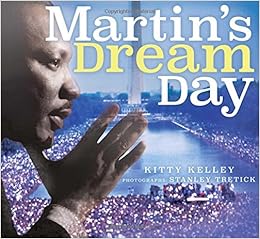
Martin’s Dream Day by Kitty Kelley, photographs by Stanley Tretick

Published by Atheneum Books for Young Readers


Summary:  Written to highlight photos by Look photographer and JFK favorite Stanley Tretick, this book focuses on Martin Luther King, Jr.’s “I Have a Dream” speech.  King is showed on the first page, nervous as he prepares to address 250,000 people at the Lincoln Memorial.  From there, the text and photos go back to explain King’s role in Civil Rights movement.  He is shown with John F. Kennedy, along with quotes from Kennedy urging Congress to pass his civil rights bill.  When Congress did nothing, King began to organize the March on Washington.  Photos are shown of individuals and crowds at the march, culminating with quotes from Martin Luther King’s speech.  On the last page, the reader learns of the passage of the Civil Rights Act of 1964 and the Voting Rights Act of 1965. Includes an author’s note and three websites with additional information.  40 pages; grades 1-5.

Pros:  A good introduction Martin Luther King, Jr.’s most important speech and the history behind it.  Seeing the author was Kitty Kelley–yes, that Kitty Kelley–I kept looking for gossipy passages about some King or Kennedy scandal, but don’t worry, you can safely read this to your first-grader.  The many photos bring an immediacy to the story and provide faces of real people instead of just the huge crowds.

Cons:  There could have been a lot more additional resources given.

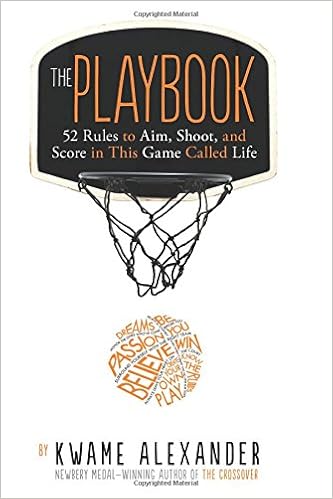
The Playbook: 52 Rules to Aim, Shoot, and Score in This Game Called Life by Kwame Alexander, photographs by Thai Neave

Published by HMH Books for Young Readers

Summary:  Kwame Alexander begins this book with his own athletic journey from basketball to football to tennis, where he finally found the sport that made him a high school champion.  After this introduction, the book is divided into four quarters, like a game, entitled Grit, Motivation, Focus, and Teamwork.  Each section begins with a profile of an athlete who personifies that trait, then there are 13 rules, each one accompanied by a drawing or photo of an athlete, and an inspirational quote.  Alexander refers to the rules as “poems”, but that feels like a bit of a stretch.  The quotes are mostly from athletes, but a few other celebrities like Oprah Winfrey and Michelle Obama are included. 176 pages; grades 5-8.

Pros:  Anyone looking for a little inspiration will find plenty of it in these pages.  Young athletes will particularly enjoy the sports stories and quotes.  The sharp black, orange, and gray graphics are similar to the covers of Alexander’s books “The Crossover” and “Booked”.

Cons:  This feels more like a graduation gift or self-help seminar than an actual reading experience.