Alpha, Bravo, Charlie: The Complete Book of Nautical Codes by Sara Gillingham

Published by Phaidon Press 

Summary: The four-page introduction explains signal flags, the phonetic alphabet, Morse code, and semaphore, as well as how all of these are used by ships’ crews to communicate.  Then come two-page spreads, one for each letter of the alphabet, that explain what each signal flag means, and give the phonetic, Morse, and semaphore versions of the letter as well.  In between these two pages is a signal flag for that letter on textured paper, cut into the appropriate shape for the flags that aren’t rectangular.  The alphabets are summarized on two pages at the end, followed by additional resources and a glossary of nautical words.  120 pages; grades 1-6.

Pros:  Kids will be drawn to this beautiful book by its design, but will stick with it to learn and use the cool codes.  There is plenty of interesting information in addition to the visuals.

Cons:  The $20 price tag, combined with the somewhat fragile flags may give librarians pause about purchasing this book.

The Rat Prince by Bridget Hodder

Published by Farrar Straus Giroux


Summary:  In this twist of the traditional Cinderella tale, Prince Char is the rat prince of all those rodents who live in Lancastyr Manor.  Tough times have arrived at the manor, in the person of the wicked stepmother, and Lady Rose has been reduced to little more than a house servant nicknamed Cinderella.  Prince Char is determined to defeat the evil Wilhemina, and when an ancient goddess is released from an heirloom Lancastyr ring, it looks like it may be possible.  Char is transformed into Charming, one of Rose’s footmen, and it doesn’t take long for him and Rose to fall in love, despite their knowledge that he will turn back into a rat at midnight.  Together, they travel to the great ball, where they must deal with both Wilhemina and the evil prince Geoffrey, who is seeking to make Rose his queen.  Told in the alternating voices of Char and Rose, the night progresses with plenty of twists and turns until the two of them are able to arrive at happily ever after.  272 pages; grades 4-7.

Pros:  In this unusual take on Cinderella, Hodder manages to pull off what would seem impossible to believe.  Both Char and Rose are strong, likeable characters, and there is plenty of action to keep the pages turning.

Cons:  The somewhat sticky-sweet romance may turn a few young stomachs.

Best in Snow by April Pulley Sayre

Published by Beach Lane Books 

Summary:  “A freeze. A breeze. A cloud. It snows.”  So begins this photo essay on snow, a follow-up to last year’s Raindrops Roll by Sayre.  Each page has a large photo or two of snowflakes in action, covering trees, animals, and the ground.  The sun comes out, the snow softens, and the ice begins to melt.  But before long, the snow begins again.  The final two pages give quite a bit of additional information on snow, along with a short list of books you can read to learn more.  40 pages; ages 3-8.

Pros:  A visually stunning science book which can be enjoyed by all ages.  Not only does it provide excellent information and beautiful photographs, but the writing would be a good mentor text on using strong verbs.

Cons:  Stopping after the thaw would have provided a happier ending.


Billions of Bricks: A Counting Book about Building by Kurt Cyrus

Published by Henry Holt and Company 

Summary:  A man, woman, and boy start building on the first page with bricks…two, four six.  People and bricks multiply with dizzying speed from there until the end of the book: molding and baking the clay to make bricks, mixing mortar, and building, building, building.  Schools, malls, government buildings: all are built with millions and billions of bricks.  Finally, at the end, “The work is nearly done, the cleanup has begun, let’s count the bricks we didn’t use, all together—one!”  32 pages, ages 4-8.
Pros:  Kids will love the catchy rhymes and the intricate illustrations showing many different people building immense structures with bricks.  While not a counting book in the traditional 1-2-3 sense, teachers can use it to introduce counting by two’s, five’s, and ten’s.

Cons:  Some child labor laws were undoubtedly violated in these pages.

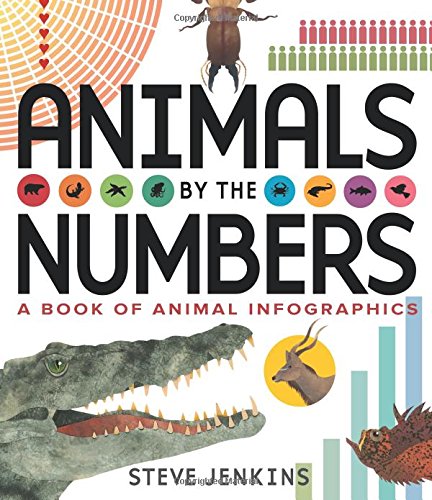
Animals by the Numbers: A Book of Animal Infographics by Steve Jenkins

Published by Houghton Mifflin Harcourt 

Summary:  Teaching kids how to read graphs and charts?  Want to wow kids (or adults) with amazing animal facts (the biomass of termites is twice that of humans; the pistol shrimp makes a sound that’s louder than a jet plane taking off)?  This book has you covered on all fronts.  Looking at many different aspects of animals, including life spans, speed, size, and deadliness, every page has a different infographic that brings the information to life.  The sobering last few pages graph the winners and losers of mass extinctions of the past, including one that is going on right now, and chart the numbers left of some of the most endangered species.  Additional books and websites are listed at the end.  48 pages; grades 2-6.

Pros:  You won’t hear much from any child you hand this book to; he or she will be way too absorbed studying the graphs and charts on every page.  That reader may emerge on occasion to share some fascinating fact with you (a koi fish can live 226 years!  There are 20 times more spider and scorpion species than mammals!).  I’ve already raved about Steve Jenkins’ cut-paper illustrations enough times to fill a pie chart, so I’ll spare you another round.

Cons:  It’s hard to believe those pesky squirrels in my backyard sleep twice as many hours as I do.

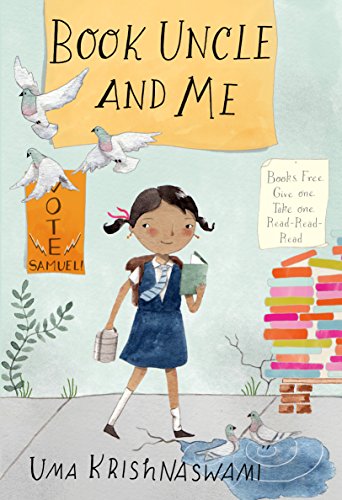
Book Uncle and Me by Uma Krishnaswami

 Published by Groundwood Books


Summary:  Yasmin has a goal to read a book a day, an achievement she has maintained for over 400 days.  Getting the books is easy, because elderly Book Uncle has set up his free lending library right outside her apartment building.  Lots of people in her building enjoy his generosity, so Yasmin is shocked and dismayed when she finds out that Book Uncle has been told he needs an expensive permit to continue operating.  There’s an election going on for a new mayor, and Yasmin decides to take Book Uncle’s plight to her favorite candidate.  She slowly builds her case, eventually getting help from her friends and family, to effect a happy ending for Book Uncle.  149 pages; grades 2-4.

Pros:  A sweet story originally published in India. Yasmin will inspire readers to find out how they can make a difference in their own communities.

Cons:  Kids may need some help with some of the Indian names and customs.

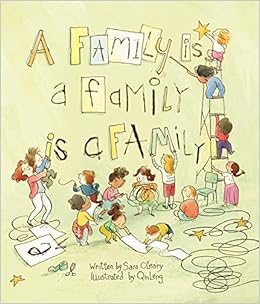
A Family is a Family is a Family by Sara O’Leary, illustrated by Qin Leng

Published by Groundwood Books 

A Family Is a Family Is a Family: Sara O'Leary, Leng, Qin: 9781554987948:  Amazon.com: Books

Summary:  When her teacher asks the class what makes their families special, the narrator isn’t sure how to answer.  She quietly listens to her classmates answer the question.  There are large families and small families, families with two moms and two dads, divorced parents and stepparents, families who all look alike and those who all look different.  Finally, the girl remembers a time with her family in the park.  Someone asked her foster mother to point out her real children.  Her mom answered, “Oh, I don’t have any imaginary children.  All my children are real.”  Conclusion:  A family is a family is a family.  32 pages; ages 4-8.

Pros:  Filled with family love and warm, funny illustrations, this book is perfect to share with children and invite them to think about what is special about their own families.

Cons:  It is no accident I am posting a book celebrating different kinds of love today.

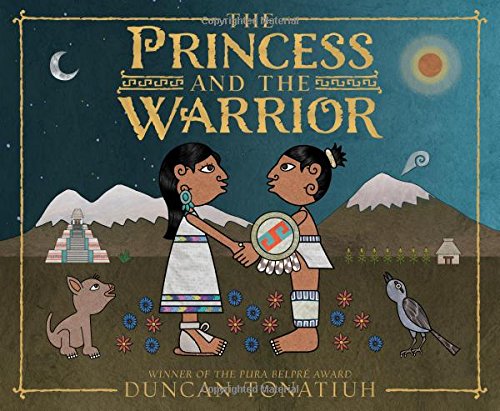
The Princess and the Warrior: A Tale of Two Volcanoes by Duncan Tonatiuh

Published by Abrams Books for Young Readers 

Summary:  Izta is a princess of the people, so when she falls in love, it isn’t with one of the wealthy suitors who travel from distant lands to court her.  The warrior Popoca can’t offer her riches, but he recognizes her kind heart and promises to always be faithful to her.  The king would prefer a more titled son-in-law, but he agrees to let the two marry if Popoca can defeat Jaguar Claw, a neighboring king who has caused trouble for years.  Popoca goes off to battle.  When Jaguar Claw realizes he is near defeat, he sends a messenger to tell Izta that her fiancé has been killed.  Grief-stricken, she drinks a potion that the messenger says will ease her sorrow.  Instead, it puts her into a deep sleep from which she never awakens.  When Popoca returns, he brings her outside to try to revive her, and there they stay, together, until they have turned into the two volcanoes, Iztaccihuatl and Popocatepetl.  An author’s note gives more history of this Aztec legend.  40 pages; grades 1-4.

Pros:  A captivating retelling of a Mexican legend that explains the existence of two volcanoes visible from Mexico City.  Award-winning author-illustrator Duncan Tonatiuh brings his distinctive style to the art done in the traditional Aztec style.

Cons:  Even with the glossary and pronunciation guide at the end, pronouncing the Aztec words is a challenge.

The Girl Who Drank the Moon by Kelly Barnhill

Published by Algonquin Young Readers 

Summary:  Each year, the youngest child in the Protectorate must be sacrificed to the witch to keep the people safe.  One year, the mother goes mad when her daughter is taken away.  Antain is just a boy when he witnesses this, but he never forgets it, nor can he forget what it was like to walk away, leaving the baby girl in the forest to die.  Little does he know that she is rescued by Xan, the witch who has rescued all the babies.  Usually Xan takes the children to another city to be adopted, but she accidentally feeds this one moonlight, filling her with magic, and decides to name her Luna and raise her herself.  And so the story goes, for almost 13 years, following Antain, Xan, Luna, a monster named Glerk, a tiny dragon named Fyrian, the madwoman, and the evil Sister Ignatia, until they all meet one fateful day in the forest.  The magic in Luna finally comes to fruition, and allows the power of love to overcome the power of evil.  386 pages; grades 4-7.

Pros:  Beautifully written and crafted, this is one of those books that weaves many different strands through the entire story until they all come together at the end.  Look for this as a Newbery consideration.

Cons:  While I admire and appreciate this book, the story never really grabbed me.  I had to assign myself nightly readings to get through it in a timely fashion.

Pablo Finds a Treasure by Andree Poulin, illustrated by Isabelle Malenfant

Published by Annick Press 

Summary:  Pablo and his sister Sofia spend their days hunting for treasure on Treasure Mountain, the local dump.  They’re joined by many other children who look for items that their parents can resell to buy a little food.  Sometimes they find old food, and eat it quickly before someone can steal it.  Their worst enemy is Filthy-Face, a man who bullies the children into handing over their treasures.  On this particular day, Pablo is having trouble finding anything; Sofia is doing better and scolds him for overlooking bits of plastic that can be recycled.  Just when he is ready to give up, Pablo finds a gold chain.  He and his sister excitedly make a list of all the things they’d like to buy with the chain until suddenly Filthy-Face looms in front of them.  He steals everything, and the two children have to run home empty-handed…until they arrive safely and Pablo reveals where he has hidden the gold chain.  32 pages; grades 1-4.

Pros:  An eye-opening look at poverty in an unnamed country.  The gray-toned illustrations match the sober subject.  This would make a good read-aloud to prompt further discussion or writing.

Cons:  It’s a pretty bleak story.