Pocket Change: Pitching in for a Better World by Michelle Mulder

Published by Orca Book Publishers
Summary:  What is money?  And why do some people have more of it than others?  This book starts with a history of money, which hasn’t been around all that long, and work, which has increased with the introduction of money.  People used to be self-sufficient, but with the Industrial Revolution, they started working to earn money and buy goods and services from others.  Advertising has created even more demand.  The author then moves on to grassroots movements that are helping to look at wealth in different ways and try to distribute it more equally.  Organizations like Kiva and the Grameen Bank provide microloans to give people an opportunity to work their way out of poverty, while groups such as Habitat for Humanity allow them to provide sweat equity instead of money.  Sidebars labeled “My Two Cents’ Worth” give brief personal stories from the author’s life to illustrate the concepts.  A glossary, index, and additional resources complete the book.  48 pages; grades 3-7.

Pros:  A can-do look at how kids can help others around the world.  The interesting history of economics will have readers looking at money, shopping, and advertising in new ways.  Lots of colorful photos on each page give this an appealing look.

Cons:  Not a topic most kids will be interested in without some adult guidance.
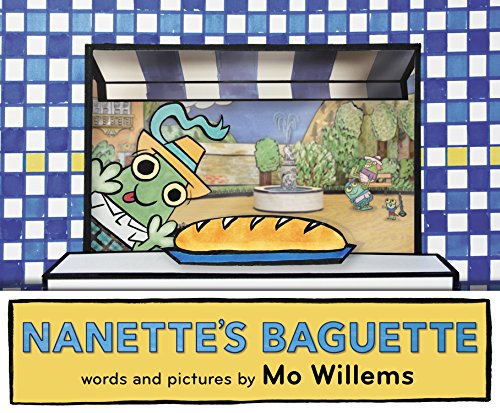


Nanette’s Baguette by Mo Willems

Published by Hyperion Books for Children 

Summary:  Nanette is a young frog who is in for a big day—she gets to go the bakery and buy the baguette.  She leaves the kitchenette and is out the door.  On her way, she sees Georgette, Suzette, and Bret, who is with his pet, Antoinette.  Soon she arrives at Baker Juliette’s, where she gets the best baguette yet.  But on the way home, the warmth and wonderful smell prove too much for Nanette, and she eats the entire baguette!  Plagued by guilt, she considers taking a jet to Tibet, but decides instead to return home and confess all.  Her mother is quite forgiving, and back they go to the bakery together to pick up another baguette.  So don’t fret.  Or sweat.  40 pages; ages 4-8.

Pros:  Mo Willems keeps his fingers firmly on the preschool pulse.  Goofiness informs all the illustrations and the multiple “—et” rhymes will keeps kids in stitches.

Cons:  The conspicuous absence of Chet from DeSmet.  Not to mention Janet.

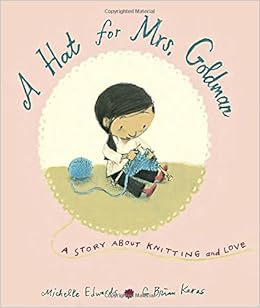
A Hat for Mrs. Goldman: a story about knitting and love by Michelle Edwards, illustrate by G. Brian Karas

Happy Thanksgiving!

Published by Schwartz & Wade Books 

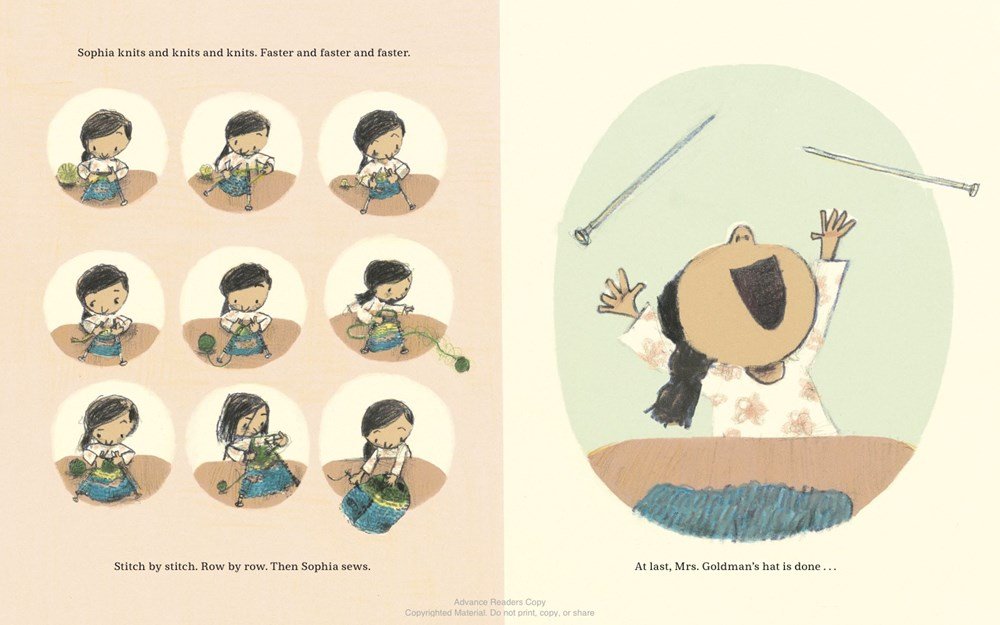
Summary:  When Sophia was a baby, her neighbor Mrs. Goldman knit her a hat.  Now that she’s older, she likes to make pom-poms to decorate Mrs. Goldman’s creations.  Her friend is always knitting for others, giving them warm hats, mittens, and sweaters.  She calls knitting her mitzvah, or good deed.  When Sophia goes walking with Mrs. Goldman and her dog Fifi, she notices that Mrs. Goldman doesn’t have a hat.  Snow accumulates on her hair, and her ears turn pink or red, depending on the temperature.  Wanting to rectify the situation, Sophia pulls out her knitting needles and tries to remember what Mrs. Goldman taught her about knitting.  She finally finishes a hat, but it’s full of holes.  Fortunately, Sophia thinks of all those pom-poms she’s made, and creates a whole bunch of them to cover up the holes.  She rushes next door to give  her gift to Mrs. Goldman, who declares it Sophie’s mitzvah and happily wears it every day on her walks with Fifi.  Includes instructions for knitting a simple hat and making a pom-pom.  40 pages; ages 4-8.

Pros:  A simple but heartwarming story.  Mrs. Goldman’s knitting is an expression of love for her, and she passes this on to Sophie.  G. Brian Karas learned how to knit to make his illustrations accurate, and he perfectly captures Sophie’s efforts with the knitting needles.

Cons:  My own knitting failures haven’t had this happy of an ending.

Giant Squid by Candace Fleming, illustrated by Eric Rohmann

Published by Roaring Brook Press 

Summary:  Millions of them may live in the oceans, growing to a length of 40 feet or more, yet very little is known of the giant squid.  Scientists first saw a living one in 2006.  Much of what is known about these creatures comes from studying their remains inside sperm whales, whose stomachs can contain thousands of the indigestible squid beaks.  The poetic text of this book tells what little is known of the giants, illustrated with dark undersea paintings that show glimpses of different parts of them.  The final two-page spread is a labeled drawing of the squid’s body.  After that, an author’s note, “The Mysterious Giant Squid” gives more scientific information, and there’s a substantial list of print and online resources.  40 pages; grades K-5.

Pros:  One of my favorite parts of this “job” is learning about topics like the giant squid.  It is amazing that so many of these giant creatures have remained elusive for so long.  The pictures really capture the feel of their deep undersea home, and the author’s note is fascinating.

Cons:  Using the last eight pages to illustrate how the squid’s ink helps protect it (including a few mostly black pages) seemed like a little too much.

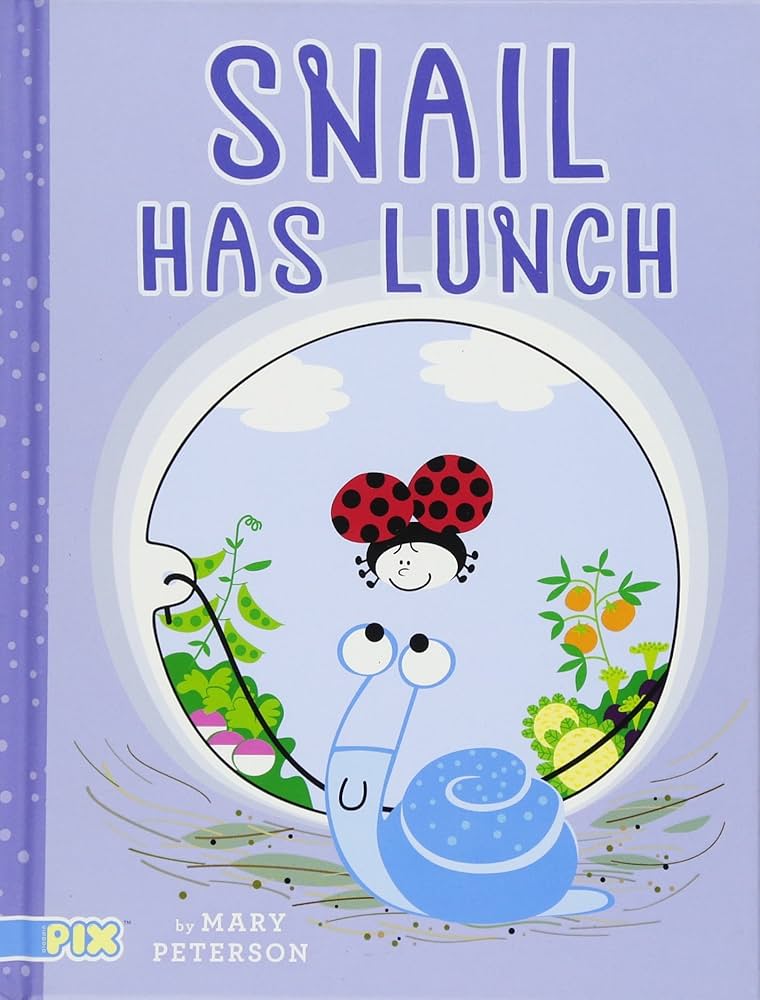
Snail Has Lunch by Mary Peterson

Published by PIX 

Snail Has Lunch (PIX): Peterson, Mary, Peterson, Mary: 9781481453028:  Amazon.com: Books

Summary:  Snail is happy living in his rusty bucket.  Filled with dirt and grass, it has everything he needs.  Every day his friend Ladybug stops by to tell Snail the news from the garden and to try to convince him to sample life outside the bucket.  But Snail is stubborn until one day, the pail is grabbed by a human, and Snail is unceremoniously dumped into the outside world.  Ladybug leads him to the garden, and there he learns what tasty treats he has been missing, and even makes a new friend or two.  At the end, Snail ends up back in the bucket (now filled with yummy strawberries), but with a lesson or two about the outside world under his belt (or shell).  64 pages; grades K-2.

Pros:  A delightful book for beginning readers, illustrated with cute and humorous animals (I loved the sequence of the gopher eating an eggplant).  Kids will enjoy the mix of regular text and cartoon bubbles.

Cons:  At 64 pages, this will require some stamina from emergent readers.

Cloud and Wallfish by Anne Nesbet

Published by Candlewick 

Summary:  Imagine Noah’s surprise when his parents pick him up from school one day, announcing that they’re leaving that night for a six-months stay in East Berlin where his mother will do research for her master’s thesis.  Not only that, but there are a lot of rules to follow, starting with the fact that Noah and his parents will have different names (Noah becomes Jonah), and Noah’s mom has made up a photo album called the Jonah Book, showing a fictional past for his life so far.  It’s 1989, and everywhere in East Berlin, people are watching and listening.  As Noah’s family settles in, he starts to suspect that his parents are doing more there than helping his mom get her thesis done.  He meets a girl named Claudia, pronounced Cloudia, and he nicknames her Cloud.  She calls him Wallfish after the German word for whale, a reference to his new name, Jonah.  Cloud has learned that her parents have been killed in a car accident while traveling in Hungary, but she is starting to suspect that this may not be true.  As 1989 draws to a close, events unfold very quickly throughout eastern Europe, and Noah, his parents, and Claudia are caught up in history as the Berlin Wall begins to crumble.  400 pages; grades 5-8.

Pros:  A fascinating story about an amazing time in German history.  The reader sees events unfolding through Noah’s eyes, supplemented with “Secret Files” that give more history and reveal a couple of secrets that help explain what Noah is experiencing.  A possible Newbery contender.

Cons:  Definitely a confusing plot; I was still unsure about Noah’s parents’ lives at the end of the story, as is Noah.  Also, the “Secret Files” seemed like an easy way out to explain the background of what was happening, rather than weaving it into the story.

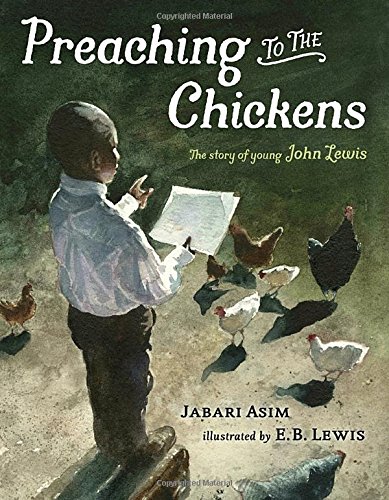
Preaching to the Chickens: The Story of Young John Lewis by Jabari Asim, illustrated by E. B. Lewis

Published by Nancy Paulsen Books

 Summary:  Growing up in Alabama, young John Lewis waned to be a preacher. His mama always said, “Work hard and trust in God.”  John loved going to church and found it easy to trust in God.  Working hard took a little more effort.  There was plenty of work to do on the farm where his family lived and grew cotton.  John was put in charge of the chickens on the farm.  After he had fed them and put fresh straw in their nests, he would pretend he was the preacher at church and that the chickens were his congregation.  He even baptized them with water from a syrup can.  When a man offered to trade with his family for one of John’s chickens, he convinced his family to trade other goods instead.  Many years later, John would go on to speak before huge crowds and stand up for those who couldn’t speak for themselves, as a leader of the Civil Rights movement.  An author’s note gives more information about John’s life as an adult.  32 pages; grades 1-5.

Pros:  An interesting slice-of-life look at a boy who rose from an impoverished childhood to do great things for others.  The paintings by award winner E. B. Lewis capture life on the farm.

Cons:  Although the author’s note lists some of Lewis’s accomplishments, there’s not really enough biographical information for a full report on his life.

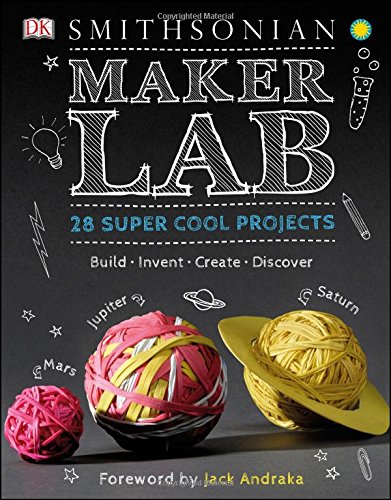
Smithsonian Maker Lab: 28 Super Cool Projects by Jack Challoner; foreword by Jack Andraka

Published by DK Children 

Summary:  28 projects introduce kids of all ages to the fun of science and technology.  The projects are divided into four sections: Food for Thought, Around the Home, Water World, and The Great Outdoors.  Each activity gets a four-page description that includes colorful photos to take young scientists through each step.  A “How It Works” sidebar explains the science behind each project; some also include “Real World Science” to connect with real life science or engineering.  Glossary and index are included.  160 pages; grades 3-7.

Pros:  While there are some tried-and-true projects (making slime, balloon rocket car), they are presented in a clear and interesting manner.  There are also some quirkily interesting ones, such as making a baked Alaska and creatng models of the planets from rubber bands.  Perfect for libraries starting a maker space or for kids who are interested in trying some science at home.

Cons:  No time to think of any…I’m off to my kitchen to turn a lemon into a battery.

Radiant Child: The Story of Young Artist Jean-Michel Basquiat by Javaka Steptoe

Published by Little, Brown, and Company 

Summary:  Jean-Michel Basquiat grew up in Brooklyn with a mother from Puerto Rico and a father from Haiti.  His childhood was filled with art, both his own works and what he saw around him.  His mother was artistic and regularly took him to art museums.  There were also difficult times for Jean-Michel.  He was in a serious car accident at the age of eight, and spent months recovering.  During that time, his mother brought him a copy of Gray’s Anatomy, which helped him learn to draw the human figure.  A few years later, his mother’s mental illness drove her to leave the family.  Jean-Michel left school and moved to New York City, where he continued to pursue his art in a number of unconventional mediums, including graffiti.  He lived his dream of being a famous artist until his tragic death in 1988 at the age of 27 from a heroin overdose. An author’s note gives more biographical information. 40 pages; grades 1-5. 

Pros:  The story of Basquiat’s life is told in brief, lyrical text, illustrated with beautiful collages inspired by the artist’s work.  The artwork is sure to receive some Caldecott consideration.

Cons:  There are some pretty adult topics covered in this book targeted for elementary students.  Also Basquiat’s work isn’t included anywhere in the book.

New York City Trails: Secrets, Stories, and Other Cool Stuff by Lonely Planet Kids and Moira Butterfield

Published by Lonely Planet 

Summary:  Marco and Amelia, the Lonely Planet Kids, have created nineteen kid-friendly trails around New York City, including Urban Jungle (where to find animals), Game On (sports and games), and Movie Magic (spots you might have seen in the movies).  Each trail gets four pages, with two attractions per page.  There’s a picture (photo, drawing, or a combination of the two), and a brief description of each site, filled with facts that will appeal to kids.  A very complete index rounds things out.  Enjoy other books in the series on London and Paris.  104 pages; grades 3-7.

Pros:  What a great way to get your offspring involved in planning a trip!  Every one of these trails would make an unforgettable weekend for children and parents alike.  The busy, colorful format is sure to appeal to young readers.

Cons:  It would have been nice to include some additional resources, especially websites.