Shadow Magic by Joshua Khan, illustrated by Ben Hibon

Published by Disney-Hyperion 

Summary:  Thorn is trying to find his missing father when he is captured and sold into slavery.  He’s rescued by Tyburn, an executioner from the kingdom of Gehenna, a country of darkness and gloom, rumored to be home to zombies and other questionable beings.  13-year-old Lily, a.k.a. Lilith Shadow, is the new queen of Genenna, having come to power when her parents and brother were murdered.  Tyburn has executed five of the bandits who killed the royal family, and is determined to track down the sixth one, whom he believes to be the mastermind and someone who wants to see Lily dead.  When Thorn becomes Tyburn’s squire, he meets Lily and gets drawn into the dangerous world around her.  Together, they experiment with some dark magic and race against time to try to unmask the evildoer whose ultimate goal is to take over Gehenna.  336 pages; grades 4-6.

Pros:  Fans of Harry Potter and Percy Jackson will enjoy this first entry in a new series featuring young teens learning to use their magical powers to defeat the evil around them.  With lots of adventures, plot twists, and short exciting chapters, this is sure to please fantasy readers.

Cons:  A friendly young character is murdered and there’s a slightly graphic description of Lily’s family’s killings.

Circle by Jeannie Baker

Published by Candlewick Press 

Summary:  Before the title page, a boy lies on his bed, wishing he could fly.  A couple pages later, he’s in wheelchair on the beach, watching a bird called a godwit flying with his flock.  They’re heading north, on the longest migration any animal in the world makes, traveling 7,000 miles from Australia to Alaska.  It’s a perilous journey, but the godwit finally makes it.  He builds a nest and finds a mate.  Together they have four babies, only one of which survives to make the return trip with his parents.  The flock flies for nine days and nights without stopping, arriving back at the beach where the story started, and where the boy has now abandoned a set of crutches to run along the beach.  An author’s note tells more about godwits and some of the threats to their survival.  48 pages; grades K-3.

Pros:  Beautiful collage illustrations capture the various environments inhabited by this remarkable bird.

Cons:  A hungry fox eats the other three chicks.

Good Night, Baddies by Deborah Underwood, illustrated by Juli Kangas

Published by Beach Lane Books


Summary:  The title page shows three pigs cowering in their house, while the wolf leans against a tree, yawning.  Next up is Jack, chased by a sweating, exhausted giant.  Clearly it’s time for the villains to get some rest.  They gather together for the night, surprisingly kind for one another, to eat dinner and get ready for bed.  Rumpelstiltskin could go for a bedtime story; the three billy goats’ troll needs a long bath.  Finally, it’s time to crawl under the covers.  A witch checks under the giant’s bed to reassure him that there are no princesses hiding there.  Then finally, “Underneath a starry sky/sing a baddie lullaby.  Day will bring more evil schemes/Good night, baddies…sour dreams!”  32 pages; ages 4-8.

Pros:  The rhyming text, illustrations, and entire idea behind this book are all very funny and cleverly executed.  Kids will enjoy identifying the classic fairy tale associated with each villain, and may be reassured to see that the “baddies” are really not so bad after all.

Cons:  What evil role does the cute little mouse (rat?) play?

The Blobfish Book by Jessica Olien

Published by Balzer + Bray 

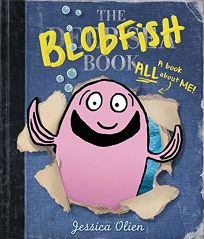
Summary:  Blobfish takes a book called The Deep Sea Book and turns it into The Blobfish Book.  The original is about the deepest part of the ocean, with photographs of some of the animals that live there.  Blobfish’s version has a pink cartoon of himself drawn onto the photographs, attempting to make it all about him.  Finally, the book gets to the page about blobfish, but the sentence “The blobfish was once voted the world’s ugliest animal” stops the narrator in his tracks.  Fortunately, the other sea creatures are paying attention, and they join forces to create a final page that celebrates Blobfish and cheers him up again.  Includes more facts about the deep sea and its creatures, plus a list of additional resources.   40 pages; ages 4-8.

Pros:  2016 is turning into The Year of the Blobfish…this is the second kids’ book featuring a blobfish in the last six months (see Pink is for Blobfish).  This one is a fun blend of fact and fiction, with some facts about the deepest parts of the ocean being snuck in around Blobfish’s slightly obnoxious, but always good-intentioned narration.

Cons:  The informational part is pretty slight.

Brave Like My Brother by Marc Tyler Nobleman

Published by Scholastic 

Summary:  Joe is off to England from Cleveland, Ohio, having been drafted to fight in World War II.  His younger brother Charlie slips a letter into his bag before he leaves, and this begins a correspondence between the two brothers that lasts from June 6, 1942 until August 2, 1944.  Only the first and last letters are from Charlie, although others are alluded to as Joe writes home about his war experiences.  Although Charlie’s always looked up to Joe, Joe doesn’t see himself as a hero, just an ordinary guy struggling to survive in extremely difficult conditions.  Training, dealing with a bully in his unit, capturing a spy, and a (sort of) failed mission are all detailed in his letters, which lead up to the climax of D-Day on June 6, 1944.  The final letter is Charlie’s, telling Joe how his courage helped Charlie deal with a bully at home.  An author’s note gives a little more background on Joe’s mission and the history recounted in soldiers’ letters home during World War II.  112 pages; grades 2-5.

Pros:  A good introduction to World War II for younger readers, with likeable characters, inspiring courage, and some adventure, but not too much gory detail.

Cons:  Joe’s mission, which seems to have taken a couple days, takes him almost five months to describe in his letters.

City Shapes by Diana Murray, illustrated by Bryan Collier

Published by Little, Brown Books for Young Readers 

Summary:  Rhyming text follows a little girl around the city, finding different shapes in what she sees.  Shapes include a square, rectangle, triangle, circle, oval, diamond, and star.  The watercolor and collage illustrations are colorful and busy, making it a fun challenge to find the items mentioned in the text.  An author’s note tells of her love for New York City that inspired this book, and the illustrator’s note explains how he created the pictures (and that the girl in the book is his four-year-old daughter).  40 pages; ages 4-8.

Pros:  Award-winning illustrator Bryan Collier has created a bright visual feast on every page of a book that would make an excellent introduction to shapes.  Kids will be inspired to find shapes in their everyday lives.

Cons:  Only seven shapes are introduced.


Awesome Minds: The Inventors of Lego Toys by Erin Hagar, art by Paige Garrison

Published by Duo Press 

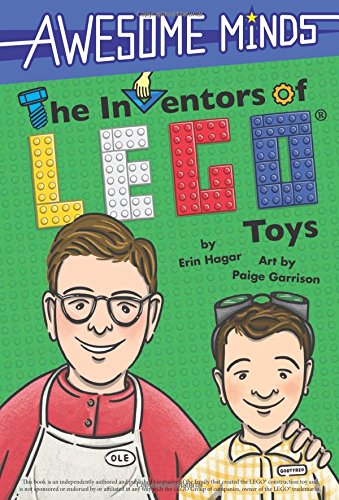
Summary:  When Ole Kirk Christiansen made the decision to change careers from carpenter to toymaker, he couldn’t have predicted the impact he would ultimately have on the world.  His family-owned business became the LEGO company.  After World War II, Ole Kirk decided to switch from wooden toys to plastic.  His son Godtfred took over the business, and ultimately made the fateful decision to focus on one toy—the sets of LEGO bricks the company had begun manufacturing in 1949.  Of course, this expanded to the LEGO empire we know today.  The story goes up to the present, with a couple pages devoted to the development of LEGOLAND and some of the amazing ideas that have come out of the LEGO company.  Includes a glossary, index, and book list of other books about inventors.  48 pages; grades 2-5.

Pros:  Filled with colorful illustrations and interesting sidebars on almost every page, this engagingly written biography/history will entertain and education LEGO fans everywhere.

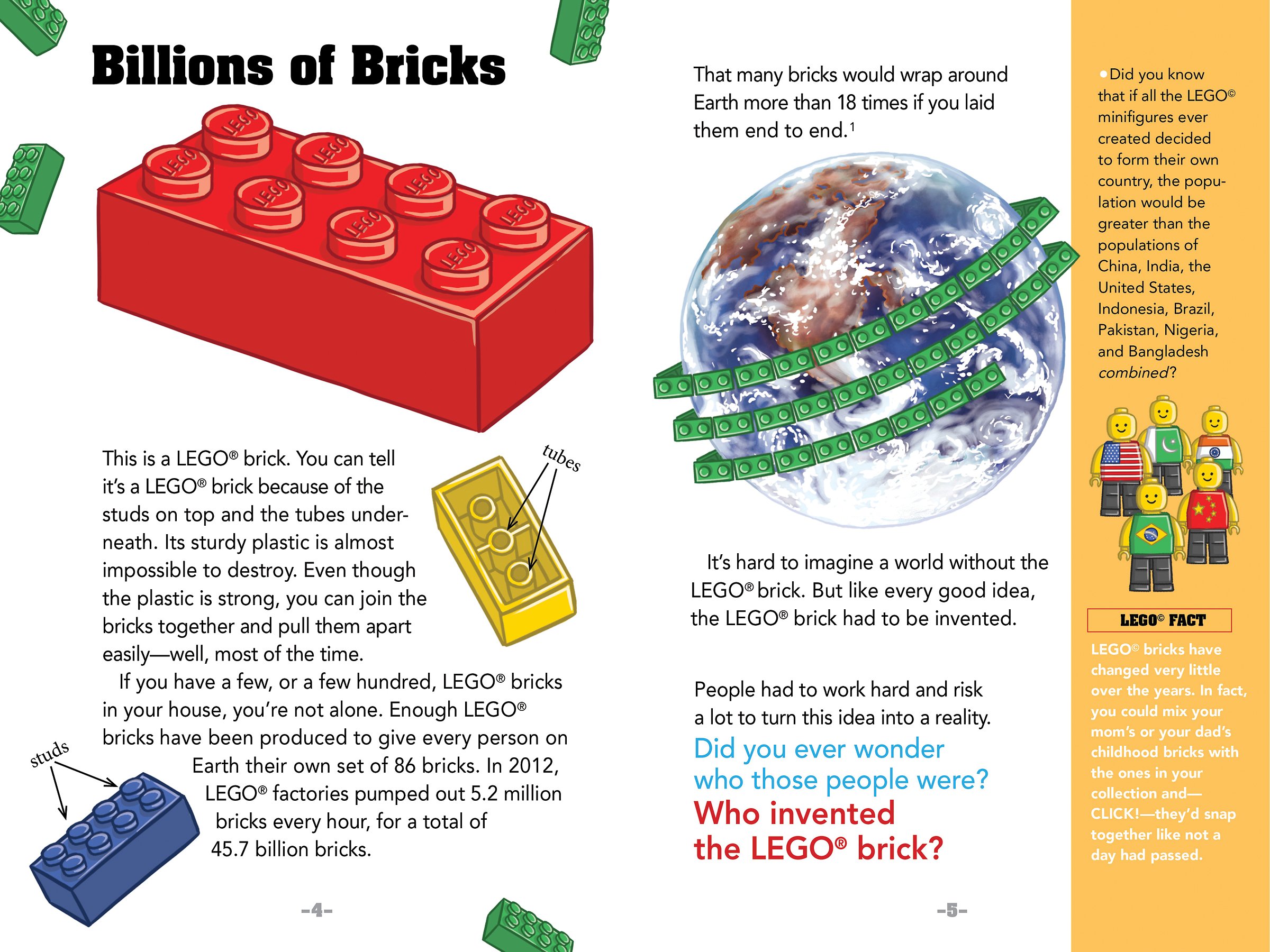
Cons:  Should we be afraid that if minifigs got together to form their own country, it would be greater than the population of the United States, China, India, Indonesia, Brazil, Pakistan, Nigeria, and Bangladesh combined?

Follow the Moon Home: A Tale of One Idea, Twenty Kids, and a Hundred Sea Turtles by Philippe Cousteau and Deborah Hopkinson, illustrated by Meilo So

Published by Chronicle Books

Summary:  Viv is new in town, and unsure how she feels about her new home.  On her first day of school, her new teacher encourages the class to look for a problem in their community that the kids can work to solve.  Walking on the beach, Viv learns that sea turtles nest there, and that the babies often get disoriented by beach house lights and can’t find their way to the ocean.  Her own difficulties finding her way in a new place makes Viv sympathetic for the turtles.  Soon her whole class is involved in researching the turtles’ plight and spreading the word to turn out lights and close curtains at night.  Their hard work pays off, and on a night patrol, Viv gets to see a line of loggerhead turtles heading for the sea.  Back matter includes a letter to young activists, a note to parents and teachers on how to help kids make a difference in their communities, and additional information about sea turtles.  48 pages; grades K-4.

Pros:  Environmental activist Cousteau (grandson of Jacques) and award-winning write Hopkinson join forces for an inspiring tale about young kids making a difference, backed up with information readers can use themselves.

Cons:  I was hoping this was based on a true story, but it seems to be fictional.

Slickety Quick: Poems About Sharks by Skila Brown, illustrated by Bob Kolar

Published by Candlewick


Summary: 14 different types of sharks get a poem, along with a brief factual description and two-page illustration. There are well-known sharks, such as the great white and the whale shark, and some lesser known species, like the cookie-cutter shark and wobbegong. Some of the poems are only a few lines (“Whale Shark: In water she dangles, and bubbles and jangles, and blinks her mouth right up at me. Her back spots they shimmer, her tail getting dimmer, the silkiest wave of the sea.”); others are a few stanzas. All are descriptive and playful with language. 32 pages; grades K-4.

Pros: The Venn diagram showing the intersection of poetry readers and shark fans must be pretty close to the null set. Slickety Quick does its part to remedy this situation, with fun poems and interesting shark lore to appeal to both groups.

Cons: Back matter with additional shark information would have been a nice addition.

Moo Bird by David Milgrim

Published by Scholastic 

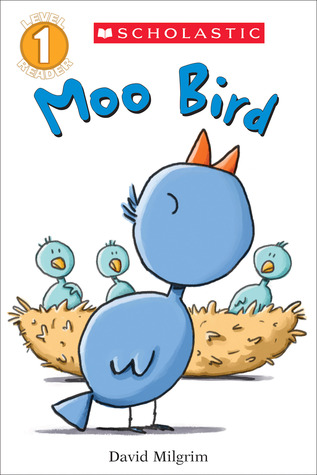
Summary: Four birds wake up in their nest; there are three “tweets”…and a “moo”! The moo bird is pushed out of the nest with the suggestion that he go find some cows. Off he goes, crossing paths with a pig, a horse, and a sheep, all of whom send him on his way. Even finding a cow proves disappointing, as she just thinks he’s confused. He starts to head back to the nest, wings drooping and black cloud over his head, when he finds another moo-er. It looks like the beginning of a beautiful friendship. 32 pages; ages 4-6.

Pros: With comic style illustrations and just a few words per page, this is a sure winner for those at the earliest stages of reading.

Cons: I am so busy painting my new house that Moo Bird is about the longest book I have time to read.