Five–no wait, six–more favorite picture books

I haven’t seen these on many Caldecott lists, but they were still among my favorites this year, for one reason or another.  I got the list down to six, but couldn’t eliminate any more.

Stick and Stone by Beth Ferry, illustrated by Tom Lichtenheld.  Published by HMH Books for Young Readers.

Book trailer: https://www.youtube.com/watch?v=OsgBILWhk18&feature=youtu.be

Everything about this book is simply perfect.  Cute characters (and really, they’re a stick and a stone, so well done, Tom Lichtenfeld), catchy rhymes, and a message of friendship–a perfect 10.

How the Sun Got to Coco’s House by Bob Graham.  Published by Candlewick.

This story travels around the world, then ends up in Coco’s house and yard.  Just right for showing young children a big, beautiful world, and how they are a part of it.

Red: A Crayon’s Story by Michael Hall.  Published by Greenwillow Books.

Book trailer: https://www.youtube.com/watch?v=rfKu59BvgGQ&feature=youtu.be

Don’t label.  Told in a way even the youngest kids will get.

The Red Bicycle: The Extraordinary Story of One Ordinary Bicycle by Jude Isabella, illustrated by Simone Shin.  Published by Kids Can Press.

Can one person make a difference?  Yes!  And talk about paying it forward, this bicycle just keeps on giving as it moves from one incarnation to the next.

How to Read a Story by Kate Messner, illustrated by Mark Siegel.  Published by Chronicle Books.

I found myself recommending this book to teachers all year–as an introduction to independent reading, as a mentor text for expository writing, and as an engaging story to illustrate the joys of stories.

Everybody Sleeps (But Not Fred) by Josh Schneider.  Published by  Clarion Books.

A bedtime story that will also make adult readers chuckle.
Five Favorite Caldecott Contenders

During this last week of 2015, I’m going to post lists of my favorite books in different categories.  This is the time of year when there’s a lot of buzz about what books will get Newbery and Caldecott honors. When I look at the lists of possibilities, these five are the ones I liked best, not only for the illustrations (which is the sole criteria for the Caldecott), but for the whole package.

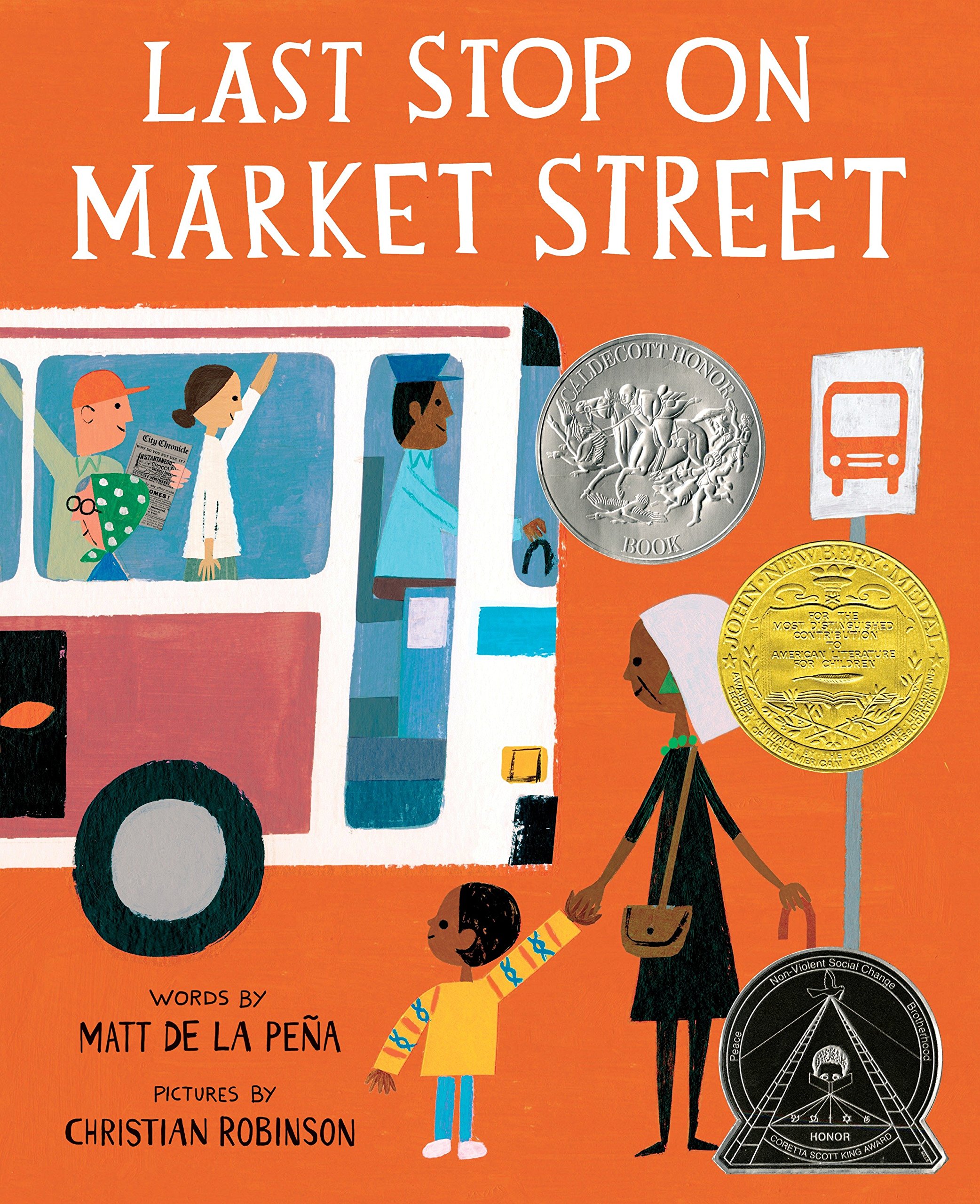
Last Stop on Market Street by Matt de la Pena, illustrated by Christian Robinson.  Published by G. P. Putnam’s Sons Books for Young Readers

Last Stop on Market Street: de la Peña, Matt, Robinson, Christian:  9780399257742: Amazon.com: Books

When I reviewed this in April, I liked it, and since then, it’s continued to grow on me.  The collage details of the city are evocative of Ezra Jack Keats.  The grandmother turned out to be one of my favorite characters of 2015.

Drum Dream Girl: How One Girl’s Courage Changed Music by Margarita Engle and Rafael Lopez.  Published by HMH Books for Young Readers.

Every page could be its own vibrant, colorful poster.  The book trailer is what really convinced me this is Caldecott worthy: https://www.youtube.com/watch?v=_lruQabrUco

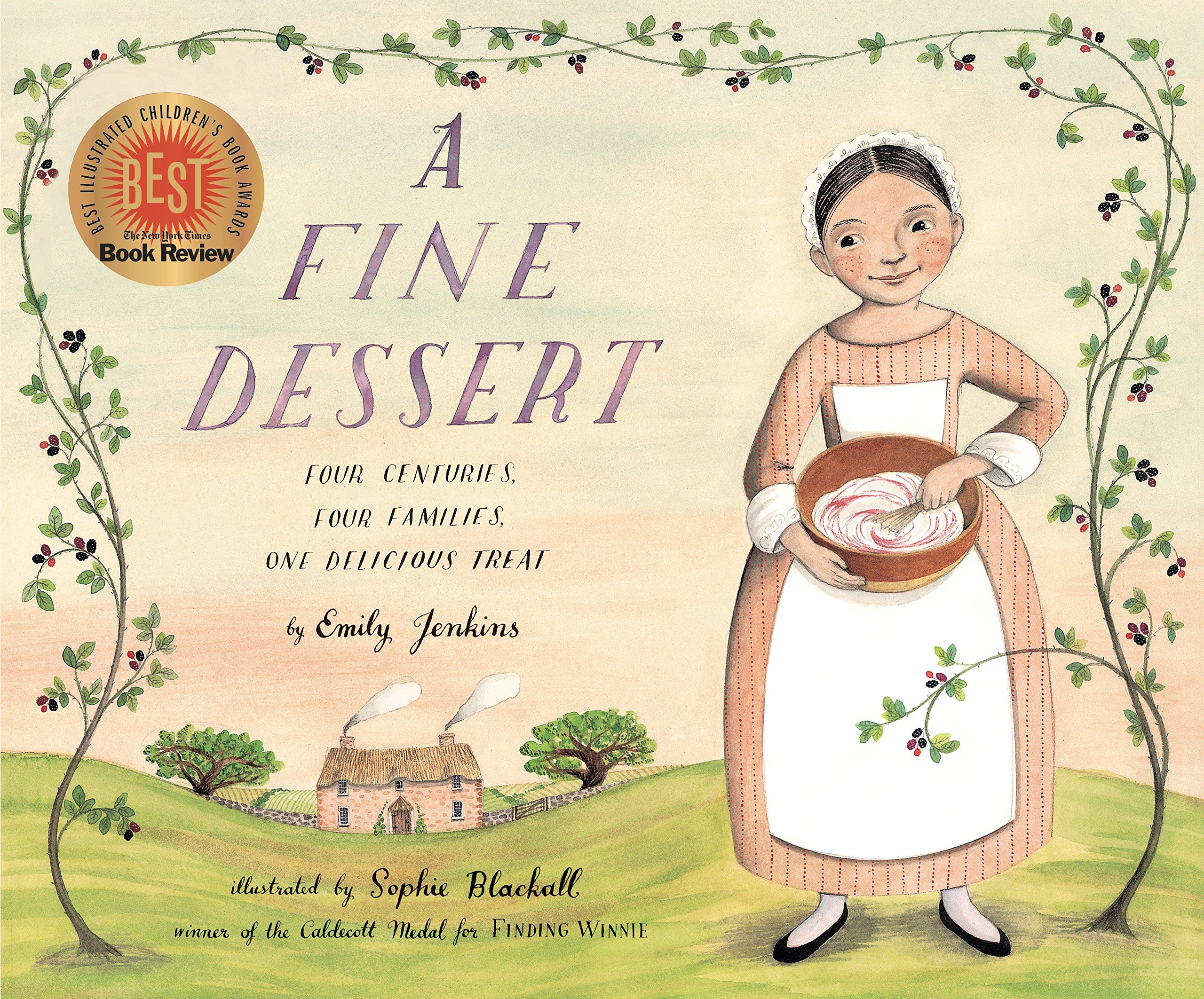
A Fine Dessert: Four Centuries, Four Families, One Delicious Treat by Emily Jenkins and Sophie Blackall.  Published by Schwartz and Wade.

A Fine Dessert: Four Centuries, Four Families, One Delicious Treat: Jenkins,  Emily, Blackall, Sophie: 9780375868320: Amazon.com: Books

I reviewed this back in February, and ever since, it’s been one of my favorites.  There’s been a lot of controversy over the depiction of slavery (Google “Fine Dessert Slavery” if you’re not familiar with this), but I stand by my original impression of this as a book that entertains and teaches on many levels.

Float by Daniel Miyares.  Published by Simon and Schuster

There have been some great wordless picture books this year.  And there have been some beautiful artistic depictions of water this year.  This one had both.

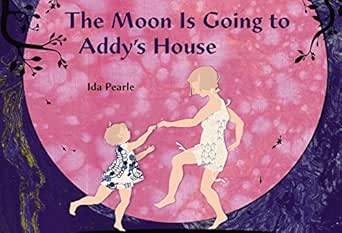
The Moon Is Going to Addy’s House by Ida Pearle.  Published by Dial Books.

The Moon is Going to Addy's House - Kindle edition by Pearle, Ida. Children  Kindle eBooks @ Amazon.com.

Okay, I admit I have a weakness for cut-paper illustrations.  These pictures amaze me.  Plus, the text and illustrations perfectly capture the feeling of a child’s world.

Jingle Bells: A Magical Cut-Paper Edition by James Lord Pierpont, illustrated by Niroot Puttapipat

Published by Candlewick


Summary:  The first verse of this famous song, written by James Lord Pierpont in 1857, is illustrated with beautiful silhouette drawings depicting a couple on their way to Christmas dinner.  Not surprisingly, their vehicle is a one-horse open sleigh, complete with green Christmas tree and red sack of gifts, which stand out as bright spots in the mostly black and white illustrations.  Alternating pages have delicate cut-paper illustrations, with a grand finale pop-up showing people gathered in around a Christmas tree in front of a snowy village.  12 pages; all ages.

Pros:  The beautiful artwork that will make this a holiday treasure to enjoy year after year.

Cons:  The conspicuous absence of Miss Fannie Bright.

Merry Christmas!

Miracle on 133rd Street by Sonia Manazo, illustrated by Marjorie Priceman

Published by Atheneum


Summary: It’s Christmas Eve, and Jose’s mami is feeling homesick for Puerto Rico. Not only that, but their oven is too small to cook the roast.  So Jose and his father box it up and set off for the local pizzeria to use the big oven there.  Along the way, they meet up with neighbors in and around their apartment who are experiencing a variety of holiday stresses.  A few hours later, they return, bringing the pizza shop owner for dinner and a fragrant cooked roast.  The delicious odors draw the neighbors to their apartment, and everyone forgets their troubles to enjoy a merry Christmas Eve dinner.  48 pages; ages 4-8.

Pros:  A feel-good Christmas story with a culturally diverse cast of characters.

Cons:  A pretty bah humbug collection of neighbors until dinner is served.

Pete Makes a Mistake by Emily Arnold McCully; Crow Makes a Friend by Margaret Peot; Pie for Chuck by Pat Schories

Published by Holiday House


Summary:  In Pete Makes a Mistake, Pete forgets to deliver one of his sister’s birthday party invitations, resulting in some misunderstandings and hurt feelings before all is put right.  Crow makes a friend from sticks, then snow in Crow Makes a Friend, but finally realizes a flesh and blood friend is the most lasting kind.  Chuck the woodchuck can see and smell the pie in Pie for Chuck, but can’t reach it until he gets some help from his friends.  24 pages each; ages 4-7.

Pros:  These new entries into Holiday House’s I Like to Read series are all colorful, appealing offerings for emergent readers.  Fountas and Pinnell types: the website says that all the books are levels A through G.  A bit larger than the typical easy reader, these have more of a picture book feel, yet are accessible to even the newest readers.

Cons: It’s hard to make a page-turning plot with fewer than 30 words.

Voice of Freedom: Fannie Lou Hamer: Spirit of the Civil Rights Movement by Carole Boston Weatherford, illustrated by Ekua Holmes

Published by Candlewick 

Summary:  Fannie Lou Hamer’s story is told in her own poetic voice, illustrated with collage renderings of events throughout her life.  Born in the Mississippi delta, the youngest of 20 children, Fannie Lou had to drop out of school after sixth grade to work in the cotton fields.  She married Perry Hamer and adopted two daughters after being tricked into having an operation to prevent her from being able to have children.  In 1962, she attended her first voter registration meeting, unaware that blacks even had the right to vote.  Within the year she was deeply involved in the Civil Rights Movement, losing her job and her home as a result.  Imprisoned and badly beaten, she refused to give up her work, eventually becoming a national spokesperson for the Student Nonviolent Coordinating Committee and addressing the 1964 Democratic National Convention about voter discrimination.  Fannie Lou also worked to improve conditions in Mississippi, organizing cotton pickers and starting a Head Start program.  She died in 1977.  An author’s note, timeline, and bibliography are included.  56 pages; grades 5-8.


Pros:  A powerful story about a poor, uneducated woman who was able to make a difference on a national level.  The poetic text perfectly captures Hamer’s voice, and is complemented by the large, colorful illustrations.


Cons:  There’s a lot of information here, and even older students may need some historical context to understand all of Hamer’s contributions.

Listen, Slowly by Thanhha Lai

Published by HarperCollins 

Summary:  12-year-old Mai thinks her summer is ruined when she learns that, instead of getting to hang out at the beach with her best friend and the boy she has a crush on, she has to travel to Vietnam with her grandmother and father.  Her grandmother has heard from a Vietnamese detective that he may have news of her husband, missing in action since the war.  Vietnam turns out to be hot and sticky, mosquito-infested, and overrun with dozens of relatives who never leave Mai alone.  At first, all she can think about is how to get back to California as fast as possible, but as the summer progresses, she learns more about her family and the country they once lived in.  A cousin with a buzz cut, a pet frog, and an attitude eventually turns into a friend.  Most of all, Mai sees the strength of her grandmother who raised seven children alone and left Vietnam during the fall of Saigon to make sure her children would be safe and successful, and the love between her grandparents that survived their long separation.  272 pages; grades 4-8.

Pros:  A funny coming-of-age novel, a tragic war story, and a love song to Vietnam all rolled into one.  Mai’s voice is perfect, as she slowly matures from a self-centered California girl to a (more or less) compassionate young woman.  I never thought I wanted to visit Vietnam until I read this book.

Cons:  The ending left me wanting more.


Sewing Stories: Harriet Powers’ Journey from Slave to Artist by Barbara Herkert, illustrated by Vanessa Brantley-Newton

Published by Alfred A. Knopf 

Summary:  Harriet Powers was born into slavery in Athens, Georgia.  She grew up on a cotton plantation, watching women spin, dye, and weave cloth.  She participated in quilting bees, where slave women were given a few hours to sew their own creations instead of having to follow directions of the mistress of the house.  At one of those bees, she met the man who would become her husband.  They married and had five children; when the children were still young, the family received word of the Emancipation Proclamation and were free.  Harriet and her husband worked hard and saved enough money to buy a small farm.  When the price of cotton dropped, Harriet was forced to sell two of her beautiful story quilts.  One of them was purchased by an art teacher who wrote down the stories pictured in the different quilt panels.  An author’s note explains that those two quilts still exist today, in the National Museum of American History in Washington, DC and the Museum of Fine Arts in Boston.  Other back matter includes a bibliography, photos of the two quilts with a list of the stories portrayed on each, and the only known photograph of Harriet in existence.  40 pages; grades K-3.

Pros:  The beautiful quilts are evidence that art can flourish in any environment.  The illustrations capture Harriet’s spirit as well as her works of art.

Cons:  I hesitate to enter into the controversy over the depiction of slavery in A Fine Dessert, but two of the criticisms I have seen—that the portrayal of a slave girl living with her mother is unrealistic, and that the slave girl shouldn’t be pictured with a smile—are present in this book as well.  So far, I’m not aware of similar criticisms for Sewing Stories.

Moletown by Torben Kuhlmann

Published by NorthSouth Books   

Summary: When a mole discovers a lush, green meadow, he decides to make his home there. He’s not alone for long.  Soon other moles join him, and the underground community grows.  As more and more moles make set up housekeeping, technology starts to move in as well, with machines helping the moles to move dirt, build infrastructure, and entertain themselves.  Eventually, the lush, green meadow has turned brown and barren, except for one small patch of green that still remains.  Is it too late to save it?  The endpapers show The Moletown Times headlining “Agreement on Green”, but it’s uncertain if that will save the moles’ world.  32 pages; ages 4-10.

Pros:  This nearly wordless picture book (there’s text only on the first and last pages) raises timely issues in a mole world that parallels humans’.  The illustrations are stunning, all done in shades of brown, picturing tons of details in Moletown.  Kids will have fun poring over the pictures, and the message is accessible enough to engender discussion with the youngest readers.

Cons:  Little brings me down faster than a global warming allegory.

Published by Candlewick 

Summary:  Seven animals are profiled—the land snail, hummingbird, garden spider, honeybee, potter wasp, beaver, and stickleback.  The emphasis is on what each animal builds to help it stay alive.  A web, a nest, a honeycomb; each example of animal architecture is marvelously illustrated with intricate pop-ups that show the animal with its creation.  The final page, “Neighbors” has one magnificent pop-up that includes all of the animals, and explains how humans and all these creatures are interdependent inhabitants of the “neighborwood”.  16 pages; all ages.

Pros:  The text is interesting and educational, but the incredible pop-ups are the real stars here.  Readers will gasp with delight as each page is turned to reveal an amazing animal habitat.

Cons:  Due to the price and the fragile nature of pop-ups, this may more suitable as a gift for a special child in your life than a purchase for the library shelves.