Hiawatha and the Peacemaker by Robbie Robertson, illustrated by David Shannon

Published by Abrams Books for Young Readers 

Hiawatha and the Peacemaker: Robertson, Robbie, Shannon, David:  9781419712203: Amazon.com: Books

Summary:  Rock and Roll Hall-of-Famer Robbie Robertson teams up with Caldecott honor winner David Shannon to tell the story of how the Six Nations Iroquois Confederacy was formed.  On page one, Hiawatha’s entire family has been killed, and his village burned to the ground.  In the midst of his despair, the Peacemaker approaches him, paddling a mysterious stone canoe, and invites Hiawatha to join him on a mission of peace.  The Peacemaker brings a message of forgiveness and peace to the Iroquois nations, but his voice is soft and he speaks with a stutter.  He needs Hiawatha’s powerful speaking abilities to convince the nations to stop their fighting.  Finally, everyone has joined together except the Mohawk, led by the evil Chief Tadodaho.  Tadodaho is the one responsible for the destruction of Hiawatha’s village.  Hiawatha must look deep within himself to find the forgiveness that is the only way to bring peace to the entire Iroquois nation.  Includes an historical note that tells the history behind this story and an author’s note that adds the personal tale of how Robertson came to write this book.  Grades 3-8.

Pros:  David Shannon’s beautiful paintings illustrate this fascinating blend of history, folklore, and mythology.  Take some time to appreciate the details of the story which has timely messages about peace and forgiveness.

Cons:  I found the story confusing until I read the historical note.  Some sources recommend this book for ages 4-8, but I don’t think audiences much younger than ten would fully appreciate it.

Bigfoot is Missing! by J. Patrick Lewis and Kenn Nesbitt, illustrated by Minalima

Published by Chronicle Books 

Summary:  Each two-page spread features a creature from the files of cryptozoology (creatures rumored to exist, but never scientifically documented).  The actual animal isn’t shown in full, just a part or hint of it, with a report of a sighting in the form of a poem.  For instance, Bigfoot’s entry includes a milk carton with this verse: “Missing/Last seen: walking in the forest/Height and weight: much more than you/Gender: unknown/Hair: all over/Shoe size (Rumored): 92”.  The first page tells about cryptozoology, and the endpapers include a list of all the creatures in the book with a brief description of each.  Grades 2-6.

Pros:  This is one clever book, and the topic is sure to be popular with young readers, who will want to spend some time studying the illustrations.  A fun and easy introduction to poetry by two former children’s poet laureates.

Cons:  If you get this book out of the library (which you should), the creatures’ descriptions on the endpapers will most likely be partially covered by a taped-down book jacket.

Spidermania: Friends on the Web by Alexandra Siy, photomicrographs by Dennis Kunkel

Published by Holiday House

Summary: The cover of this book will undoubtedly scare off some potential readers. And that’s kind of the point of this book…to debunk the myths that spiders are scary and dangerous.  Sure they have fangs and venom, but most of them are pretty harmless to humans and they do some darn interesting things, the most famous of which is spinning amazing webs from a material that is strong, tough, flexible, lightweight, hypoallergenic, and totally biodegradable.  Ten unusual spiders are profiled, all with amazing photomicrographs of various parts of the spiders that have been brilliantly colored to make them stand out.  Back matter includes information on how to identify spiders, additional resources, and a pretty extensive glossary and index.  Grades 3-6.

Pros:  There’s a lot of great information that might make an arachnophobia sufferer see spiders in a much more positive light.  The pictures are super cool; spider fans will enjoy seeing the amazing details of various arachnid body parts.

Cons:  I would have liked to learn more about the photography process used.  I was unfamiliar with the word “photomicrograph” and finally found a brief paragraph about this process under the copyright information.  It didn’t completely satisfy my curiosity, though, and made no mention of the brilliant colors used.

The Case of the Missing Carrot Cake by Robin Newman, illustrated by Deborah Zemke

Published by Worzalla Books 

Summary: Detective Wilcox and Captain Griswold call themselves the MFIs, Missing Food Investigators. As mice working on a farm with over 100 hungry animals, they have plenty to do.  In this story, they’re called by Miss Rabbit to investigate the disappearance of her carrot cake.  After interviewing a number of suspects (Fowler the Owl, Porcini the Pig, and Hot Dog the Dog), they get the brilliant idea to plant a new carrot cake in Miss Rabbit’s kitchen, then set up a camera to record what happens.  After a couple of hours, the cake disappears and the film reveals the surprising culprit.  Grades 1-3.

Pros:  At 37 pages, this would make a perfect book for kids just transitioning from easy readers to chapter books.  There’s plenty of humor in both the text and the illustrations, and the action moves along swiftly.  Includes a carrot cake recipe at the end.

Cons:  The recipe requires four bowls, which is three too many for my culinary abilities.

Wrap-Up Wednesday: Animal Books

Kids of all ages are endlessly fascinated by animals.  Animal books are often the first informational text children read.  Here are some of the best so far this year:

Trapped! A Whale’s Rescue by Robert Burleigh, illustrated by Wendell Minor. Published by Charlesbridge.

The exciting true story of a humpback whale rescue off the coast of California.  Beautifully illustrated.

The Most Amazing Creature in the Sea by Brenda Z. Guiberson, illustrated by Gennady Spirin.  Published by Henry Holt and Company.

Which ocean animal is the most amazing?  A variety of creatures make compelling arguments about why they deserve the honor.

Hippos Are Huge by Jonathan London, illustrated by Matthew Trueman.  Published by Candlewick.

Hippos ARE huge…and dangerous.  In fact, they’re the most dangerous animal in Africa.  This book is jam packed with fascinating information about them, with illustrations kids will love.

Emu by Claire Saxby, illustrated by Grahame Byrne.  Published by Candlewick.Another fascinating Australian animal book from the author/illustrator team that brought you last year’s Big Red Kangaroo.

My Leaf Book by Monica Wellington

Published by Dial Books for Young Readers 

Summary: It’s autumn, and the narrator fills up her leaf book with specimens she finds around her. She sees leaves that look like fans, stars, and hearts. Some are red, some orange, yellow, or violet. Pages alternate between bright trees with simple shapes on them and close-ups of more accurate renditions of the different types of leaves; these pages have a fact or two about trees and leaves. The last page gives directions for leaf prints and leaf rubbings. Ages 3-7.

Pros: A good introduction to different types of leaves. Young kids will be inspired to get outside and see if they can find leaves that match the ones in the illustrations.

Cons: Yet another tiny font, this time for the facts about leaves. And, editors, yellow print on an orange background?  No.

A Night Divided by Jennifer A. Nielsen

Published by Scholastic 

Summary: When Gerta is 8, her father and brother Dominic go to West Berlin to look for work, preparing to move there from the east. While they’re gone, the Berlin wall goes up overnight. Four years later, she spots the two of them on an observation platform on the western side of the wall. Her father seems to be pantomiming for her to dig. When he manages to smuggle her a picture of a building, Gerta is sure he means for her and her other brother Fritz to start there and tunnel an escape route through the wall. As they work on their tunnel, their neighbors and friends grow more and more suspicious, and before long, completing it has become a life-and-death proposition. Grades 5-8.

Pros: An eye-opening story of life behind the Iron Curtain during the early 1960’s, with danger lurking everywhere for Gerta and her family, resulting in an exciting story from start to finish.

Cons: The page-turning suspense was so intense that I almost booked a cardiologist appointment before I was done.

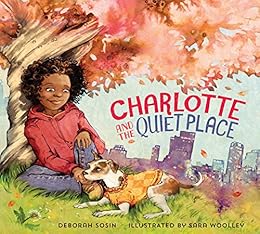
Charlotte and the Quiet Place by Deborah Sosin, illustrated by Sara Woolley

Published by Plum Blossom Books

Charlotte and the Quiet Place - Kindle edition by Sosin, Deborah, Woolley,  Sara. Children Kindle eBooks @ Amazon.com.

Summary: Charlotte lives in a noisy world. Her house is noisy, her street is noisy, even the library is noisy. Charlotte wishes she could find a quiet place. One day, she takes her dog for a walk in the park. He sees a squirrel and breaks free to chase it. Charlotte runs after him, and they end up in a quiet grove. When Charlotte sits down to catch her breath, she notices her breathing going in and out. Her thoughts slow down, and she finds herself, finally, in a quiet place. After that, whenever the world around her starts getting too noisy, Charlotte knows how to breathe deeply, slow her thoughts, and get back to the quiet place she found in the grove. Ages 3-8.

Pros: An excellent introduction to mindfulness and meditation for young kids.

Cons: An author’s note about the importance of mindfulness for children and some helpful tips for achieving it would have been useful.

.

Out of the Woods: a true story of an unforgettable event by Rebecca Bond

Published by Farrar Straus Giroux Books for Young Readers 

Summary: Antonio lives in the hotel his mother runs in 1914 Canada. He loves helping the different workers there and exploring the rooms on the second and third floors. One day, when Antonio is almost five, a man on the third floor spots smoke in the woods. Before long, the hotel is surrounded by fire, and all the inhabitants have to wade into the lake. As the fire closes in, wolves, moose, porcupine, bears, and other forest inhabitants join the humans in the lake. People and animals stand together until the fire passes by. The animals return to the forest, and the people go back to the hotel, which miraculously survived the blaze. An author’s note shows a picture of the real Antonio, the author’s grandfather, and tells how the story of the forest fire was passed down in her family. Grades 1-4.

Pros: A good mentor text for memoir writing. Kids will be fascinated by the forest fire and the gathering of all the animals. The beautiful illustrations look like old-time photographs.

Cons: The old-fashioned cover is not particularly eye-catching. Kids might have to be led to this book.

Fur, Fins, and Feathers: Abraham Dee Bartlett and the Invention of the Modern Zoo by Cassandre Maxwell

Published by Eerdmans Books for Young Readers 

Summary: When Abraham Dee Bartlett was growing up in the early 1800’s, there were no zoos. The closest thing was menageries where animals were kept in small cages for people to come and see. Abraham loved animals and read all that he could about them as a boy and a young man. His vast knowledge of wild animals eventually caught the attention of the London Zoological Society, and he was appointed superintendent of the new London Zoo. During his 38-year tenure there, he revolutionized the care of wild animals. He built larger enclosures for animals, learned how to feed them a healthy diet, and made labels so visitors could learn more about what they were seeing. By empathizing with the wild animals in his charge, he learned to keep them healthy and happy, and developed animal care methods that are used by zoos and veterinarians today. A timeline, author’s note, and brief bibliography are included. Grades 1-4.

Pros: Not only is this an interesting and inspiring story of a little-known man, but the cut paper collage illustrations are gorgeous. Readers will want to take their time with this book, enjoying both the text and the richly detailed pictures.

Cons: The final Doctor Dolittle-like illustration of Abraham surrounded by smiling animals is probably not entirely realistic.